The Mandalorian Episode 1 Review - 6 Ups And 1 Down
Bounty hunting is a complicated profession.

Even before Disney acquired Lucasfilm in 2012, Star Wars has been trying to swap the silver screen for the small screen for quite some time. Star Wars: Underworld was originally intended to be that series, and while it seemed as though a live action Star Wars series would be impossible to make given budgetary constraints, Disney have at long last finally delivered one that looks the real deal.
The company's ambitious new streaming service, Disney+, is looking to boast a wide selection of premium TV shows within the next few years, and right now, Star Wars and Marvel are its two biggest draws. Multiple shows based on both properties have been mooted, but the first to land alongside the service itself is The Mandalorian, a Jon Favreau-helmed Star Wars series set between the events of Return of the Jedi and The Force Awakens.
Pedro Pascal plays the title character, the eponymous 'Mando' whose name commands so much intrigue amongst the Star Wars faithful, and while Lucasfilm have managed to keep much of the plot a secret, the first episode has finally peeled back the curtain, and revealed something that could potentially be very special indeed.
Directed by Clone Wars and Rebels alum Dave Filoni, The Mandalorian's debut episode packs a wallop and serves as a strong statement of intent from Disney. It's not quite perfect, but if the first episode is anything to go by, it's going to be something Star Wars fans can't afford to miss.
SPOILERS AHEAD!
Downs...
1. It Can Get A Little Too Self-Referential At Times
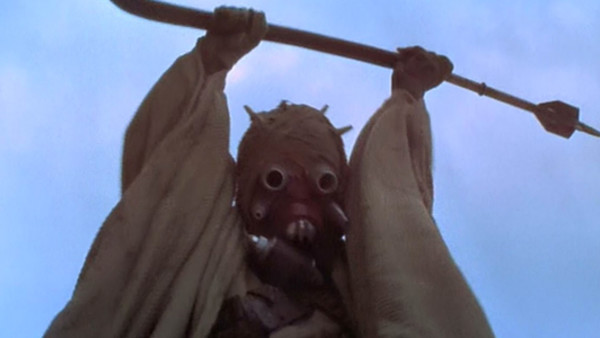
This is fairly par-for-the-course when it comes to Star Wars related works, but for all that The Mandalorian's episode delivers a fresh and exciting take on the series, it does occasionally stumble when it comes to paying its respects to Lucas' original works.
Now to be clear this isn't just a Mandalorian problem; countless Star Wars projects can't help themselves when it comes to referencing old bits of dialogue or rehashing shots from earlier works. "I have a bad feeling about this" is synonymous with the franchise for a reason, and while this isn't to say that Chapter One is over-stuffed with nods and winks to those earlier films, there is one shot late on in the episode that mimics the Tusken's attack on Luke in A New Hope that felt a little too on the nose.
That's it though, really. The first episode is pretty much faultless in almost every other regard, and while I personally don't care for those callbacks to the Original Trilogy, there's no doubt someone will enjoy those nods once they spot them.
Ups...
6. The Western Motif Works Perfectly

Star Wars has always been a western, in the sense that the original, 1977 classic took major inspiration from The Hidden Fortress, one of many samurai films by the legendary Akira Kurosawa that would come to form the basis of countless Old West tales helmed by American and Italian directors in the 1960s. Han Solo's as close to a space cowboy as you can get without putting an egregiously large hat on his already cowboy-ish costume, and there are plenty of other examples littered throughout the franchise that owe their existence to the western genre.
The Mandalorian, in a way, is paying Star Wars' debt to the genre - almost from the off. It's very Leone, and the intro where the titular Mando enters a remote canteen is even accompanied by a Morricone-esque accompaniment.
Pedro Pascal's protagonist is also typical of the genre. He's stoic, and while the Man With No Name comparisons are apt (Clint Eastwood's character from Leone's 'Dollars Trilogy'), he's not exactly emotionally distant. There's a vulnerability to the character and Pascal is able to sell those brief moments surprisingly well even when hidden behind a mask.
The western motif also translates into the action, and to a more lawless kind of Star Wars than we've seen before...
5. A Darker, More Visceral Kind Of Star Wars

By far the most exciting thing about The Mandalorian is its setting. The gap between Episodes VI and VII has been charted in books like the Aftermath Trilogy and in a select few media tie-ins, but nothing as visually detailed as what we've seen in this first episode. The end result is something fascinating, as we're treated to a version of the galaxy far, far away that feels pretty much uncharted; there's a new edge present, and while the political fallout of the Empire's dissolution never takes centre stage, it represents a lingering threat all the same.
In the vein of Rogue One, The Mandalorian works hard to restore a sense of grit and roughness to the franchise. There are no lightsabers, the Republic is distant and there is as of yet no discussion of the Force either. What we're left with instead are blaster marks, carbonite vaults, and a suitably perilous atmosphere that intimates danger even when things should feel relatively secure.
It makes for a fantastic change of pace compared to the films, and the freedom afforded by the new setting only ups the intrigue factor even further.
I'll get to how great the world building is later, but the important thing to bear in mind for now is that The Mandalorian is genuinely something new and compelling. We've never seen Star Wars done like it's being done here.
4. The Effects Really Hold Up

One of the biggest challenges that was said to prevent a live action Star Wars show from becoming a reality was the fact that any series would find itself over-budget and under-equipped. Disney have encountered no such issues with The Mandalorian (owing to the fact that, y'know, they're Disney), but it's still a pleasant surprise to see the scale of Star Wars translated almost effortlessly to the small screen.
There's a perfect blend between practical and computer-generated effects, and one thing that's also nice to see is that the show also has plenty of aliens involved too - most, if not all, rendered entirely through makeup and not CG. Given the Sequel Trilogy hasn't featured so many alien faces (at least not in any ancillary roles), it's actually pretty cool to see actors decked out in makeup and adding to Star Wars' roster of unique aliens.
Even the CG, which is only really used to showcase the Mando's ship (the Razor's Crest), Taika Waititi's IG unit, and the totally-not-horses-but-basically-they-are creatures the Mando uses to find their target in the episode's final act.
It's a major success, and illustrates the weight Disney are throwing behind their content going forward.
3. The World Building Is Handled Perfectly

The fact The Mandalorian is set between Return of the Jedi and The Force Awakens is a major plus, sheerly because it's an era Star Wars fans are yet to see in either live action or animation, but it's the way in which the first episode handles its world building that deserves extra praise.
There's a whole unspoken history with the Mandalorian, a name that courts major interest amongst longtime Star Wars fans for two principle reasons: one, because Boba Fett boasted one of the most compelling designs in the Original Trilogy; and two, because they've had a major part to play in the Expanded Universe both before and after Disney's acquisition of Lucasfilm.
The series thus finds itself having to juggle two very important responsibilities, in that it's the first piece of live action media to explore the gap between VI and VII, and also explore the history of Mandalore in a post-Original Trilogy setting. It satisfies all kinds of Star Wars fans in that respect, as those desperate to learn more about Mandalore will find themselves satisfied with the many nods to the planet's warrior culture, and those unfamiliar with the Mandalorians will get a concise education on one of Star Wars' most intriguing factions, as well as the state of the galaxy in the immediate years following the destruction of the Second Death Star.
The first episode handles both duties perfectly, never revealing too much and disclosing information organically rather than through contrived dumps of exposition.
2. The Team Up Between IG And The Mando

Taika Waititi was kind enough to grace Star Wars with a turn as assassin droid IG-11, an IG unit who resembles one seen in 1980s The Empire Strikes Back. His voice is instantly recognisable and, while it's a minor role, he leaves one heck of an impression by the time he departs in the episode's final minute.
Chapter One included plenty of action, but director Dave Filoni saved the best set-piece until last. As the Mando approaches the compound holding his target, it appears as though an IG unit from his bounty guild has beaten him to the punch. The element of surprise is lost and so the Mando resolves to bargain with the droid to ensure he still gets paid. The bartering process is hilariously dry, while the novelty of seeing an assassin droid in action won't be lost on the Star Wars faithful, who've been dying to see how an IG-unit would actually work for a pretty long time.
This is also where the action reaches his peak. Pascal's gunslinging prowess really comes into focus, as does Filoni's direction and Greig Fraser's cinematography.
It's a tremendous sequence, and one that only hammers home the western vibe further.
1. The Ending Reveal Is Perfect

It was immediately apparent from Werner Herzog's speech to the Mando that their target would be controversial. No puck was issued, and the only identifying markers were their age and their last known coordinates. Given the Client was also a part of what appears to be the Imperial Remnant, it was pretty clear that, whoever the Mando was tracking down, their conscious would be muddied all the same.
After dispatching the mercenaries guarding the target, the Mandalorian and IG track their tag to a crib. Inside is a baby Yoda, or rather, a baby belonging to Master Yoda's species - which Star Wars has never actually revealed! While IG is eager to kill the baby, the Mando opts instead to murder his partner and protect the child, in a decision that's sure to put him at odds with the Imperial Remnant and potentially even his own guild.
But this is more than just a great premise for the ensuing nine episodes - it threatens to disclose one of Star Wars' great mysteries, and that is the origin of Yoda's people. They're said to be 50 years old, which places their birth in 41 BBY, nine years before the events of The Phantom Menace.
That's one old baby. But what does it mean? Are they related to Yoda? Yaddle? Are they force sensitive? One would assume the latter most question is true, given the Empire's demand to study the target alive or dead. Either way, what a fascinating start to the first live action Star Wars show. Let's see what comes next this Friday!