Stargate: 10 Behind The Scenes Secrets You Never Knew About Children Of The Gods
Here are the things you never knew about Stargate SG-1's famous pilot episode.

Children Of The Gods introduced an entirely new audience to the Stargate program, Daniel Jackson, and a very different Jack O'Neill (that's with TWO Ls, remember that!). The original movie had been a success at the box office, but some of the characters were ill-defined. Its biggest strength was the fantastic world that it built in its short runtime.
Stargate SG-1 was given a green light for the first two seasons before the pilot even aired. That meant that these first episodes had a lot riding on them. If they failed to impress, there was going to be a disappointed fanbase - and a fairly annoyed production studio wondering if they'd made the right decision or not.
Thankfully, Children Of The Gods, despite some clunky dialogue here and there, was a smash. Stargate SG-1 would go on to run for ten seasons, with two spin-off series. There are technically four, if one counts Infinity and Origins, though oddly, not many people seem to do so.
But these episodes are where it all began, on television at least. It was remastered and recut much later, and we'll discuss why in this article. Here are the things you never knew you needed to know.
10. Dean Devlin And Roland Emmerich Were Not Fans Of The Idea

The original movie in 1994 was written by Dean Devlin and Roland Emmerich, and they very much wanted to create sequels for their own project. This got very awkward when MGM informed them that this was not a direction they were interested in pursuing.
For years, the pair of them harboured ill-will toward the series for this very reason. While Devlin spoke on the issue, he said that he appreciates it for what it is, though he doesn't see it as a continuation of his own idea. Rather, he sees it as another story altogether, one that just happens to feature some characters and ideas that he and Emmerich created.
Back in 1996, when Jonathan Glassner and Brad Wright were working on Children Of The Gods, they sought advice from the pair on how to work forward from the movie's story. Devlin and Emmerich flat out refused to meet with them, though they did state that it wasn't personal. It was simply their way of protesting the studio's decision.
9. The Studio Wanted A Different Type Of Actress For Samantha Carter

The initial pitch for the character who would become Samantha Carter was quite different from what the audience ended up seeing. First of all, although she was always a serving member of the military, she was to have been very disdainful of the service. Her true passion was in theoretical astrophysics, which did manage to remain part of the character, to a point.
She was written as 'pushy' and abrasive toward O'Neill and Jackson. The studio was also hesitant to hire Amanda Tapping. According to Jonathan Glassner, it was far more interested in hiring an actress based on her physical attributes. He said that they had their eyes on another actress, one who was closer to the typical beauty that would be seen in Hollywood films.
Tapping wowed Glassner and Wright when she came in to read for the part and put her own spin on Carter straight away. She saw the potential for humour in the part, adding this to her audition. It secured her the role. While some of her lines in Children Of The Gods are truly dreadful, such as the reproductive organs gag, she is immediately established as one of the major players.
8. Glassner And Wright Didn't Know The Other Was Interested In Stargate Before The Pilot

While Jonathan Glassner and Brad Wright had worked together previously on The Outer Limits, neither actually knew that the other was interested in a Stargate series. Glassner, for his part, was actually looking to move away from Vancouver and return to Los Angeles. MGM wanted him so badly that they were open to offering him whatever he wished.
Glassner told MGM he would only remain in Vancouver if he could have Stargate. They quickly said yes, with a slight caveat. He was paired with Wright, though the two quickly built a pitch that the studio loved.
They both had the same idea of a Stargate program that ran similarly to NASA, one with ongoing missions through the gate. Much of their script for Children Of The Gods was concerned with bringing back O'Neil and Jackson and introducing the idea that the Stargate was not simply an A to B device, but that it could send travelers all over the galaxy. They also wanted to introduce a female lead, and an alien character as well.
While Wright would go on to co-create Stargate Atlantis and Stargate Universe, this would be Glassner's only series in the Stargate franchise.
7. THAT Nude Scene
This is a scene that caused controversy at every step of the way, from its conception to execution, to reception. It's safe to say now that almost no one wanted to include it, least of all Vaitiare Bandera, who played Sha're, on whom this scene focussed. She had previously turned down movie roles, including a large part in Mutiny On The Bounty, which co-starred Mel Gibson, as she had no interest in doing nude scenes.
She had originally auditioned for the part in the 1994 movie, narrowly missing out. Here, she was officially cast. She agreed to a topless scene, though this was subsequently rewritten into a full-frontal nude scene at the studio's insistence. This, understandably, caused Bandera a lot of upset, as it was not what she had agreed to.
They agreed to shorten the scene, assuring her that it would be handled in 'good taste.' This assuaged her, though Brad Wright was never truly comfortable with it. While the possession scene is still present in the Final Cut, all of the nude scenes were trimmed from the later release, as they were deemed wholly unnecessary to the plot of the episode.
6. It Took 11 Years To Explain How Apophis Got Away From Stargate Command

This is one question that was finally answered with the updated Children Of The Gods - Final Cut. This had been a pet project of Brad Wright's for years, though he primarily had been interested in restoring Joel Goldsmith's unused score for the episodes. More on that later.
In 2008, MGM became more interested in revisiting the pilot and looking at the dailies themselves, which meant that Wright was able to re-edit the episode. This included trimming some scenes, including the full-frontal shots of Vaitiare Bandera, the possession of Major Kawalski, and then adding some others. This addressed a continuity error that the series itself created.
In the episode, the Dial Home Device is introduced on Abydos. This is what allowed users to control the Stargate and activate it. However, this was conspicuously missing from Stargate Command when Apophis arrived and, crucially, when he departed. In the final cut, the audience is shown Jaffa soldiers manually activating the gate. This simple change goes a long way to bringing this episode into line with the now-established continuity of the show.
5. Don S. Davis Hated The Version Of General Hammond In The Pilot

General Hammond was written to take over as the head of Stargate Command. He was initially conceived as an intimidating, powerful black man. In effect, he was a rewritten, fictionalized version of Colin Powell. At least, that's how Jonathan Glassner and Brad Wright envisaged him. With this template, Hammond would be a four-star general, a diplomat, and a politician.
When Richard Dean Anderson and Michael Greenburg joined the project as producers, they suggested Don S. Davis for the role. They had previously worked with him on MacGuyver. While he clearly didn't fit the mould that Glassner and Wright had laid out, he still won the role.
However, Davis himself was not a fan of how the character was written. In the pilot, he is a foil for O'Neill, appearing to be much more by-the-book, humourless and stereotypically rigid in his role. As quickly as he could, Davis, who himself was a Vietnam veteran, sought to change how Hammond was presented.
When comparing the character in Children Of The Gods to his later appearances, particularly his off-world adventure in Into The Fire, they are almost completely different. Davis took a thinly written part and made him one of the better representations of Military personnel in sci-fi.
4. The Production Team Ran Out Of Money So We Only Got Half Of A Kawoosh

If one watches Children Of The Gods before the original film, one will notice a drastic difference between the two Gates. This is not simply the design of the final lock for the seventh Chevron, which is open in the film while being identical to all of the others in the series. The actual Stargate vortex itself is missing an additional element in the series.
In the film, once the gate address is locked in and the wormhole opens, the 'kawoosh' that is seen extends out by several feet, before retracting into the event horizon - and continuing out the back, forming a whirling funnel. In the series, the sequence is almost the same, though the funnel is now missing from the wormhole.
The reason behind this is frustratingly simple - they ran out of money. The design of the gate opening was created by firing an air cannon into a pool of water, though recreating the funnel proved to be too costly at the time. Therefore, there is now only one appearance of this element in the franchise, that being the original film.
Added to this, the extra-long visual effects sequence from the film was abandoned, though it made another appearance in 'The Fifth Race', used as a handy way of showing that O'Neill was hopping galaxies. But that is another list altogether.
3. No One Liked The Score
The score that was cut and inserted into Children Of The Gods was effectively a straight copy and paste of David Arnold's fabulous score from the movie. There was a slight problem. This was a studio mandate, as they lacked the confidence in composer Joel Goldsmith to carry the pilot. Alex Wilkinson was hired to edit Arnold's score together with Goldsmith's, a feat for which he was nominated for a Golden Reel Award.
Despite Wilkinson's nomination, Goldsmith and Arnold both hated the result. The combined mix was released on CD in 1997, though both composers took their names off it. They both felt that it was a terrible mix of the two.
The music was one of Brad Wright's main reasons for revisiting Children Of The Gods in 2008. He initially sought mainly to fix what he saw as the studio's damage to the musical makeup of the episode. By that time though, Stargate had proven to be so popular that MGM was more than willing to allow, not only this but a complete overhaul of the episode itself.
What began as a crusade to fix the broken score became an almost entirely back-to-basics re-edit of the pilot.
2. Everyone Hated Chulak And The Feeling Was Mutual
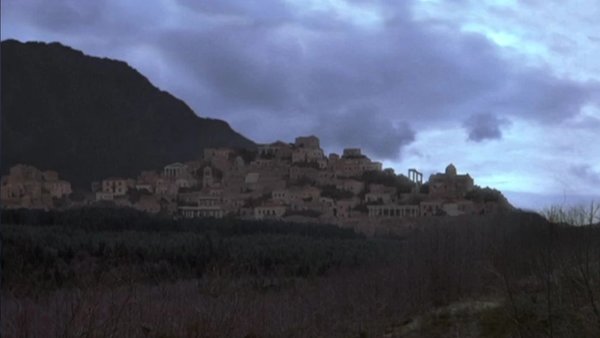
The first day of filming was spent in British Columbia so that the production could capture the external shots of Chulak, Teal'c's homeworld. It was a gruelling day, one that made the filmmakers wonder if the show was going to be cursed for the duration.
Filming on location in any production is always a bit of a gamble, as the team will have less control over the environment. This proved especially troublesome for Children Of The Gods, as, similar to the issues that beset Star Wars, the weather decided it simply didn't want the team to get their work done.
The wind and rain battered the set all day, leading to the film itself being scratched, making it largely unusable. In addition to this, the noise of the weather made much of the dialogue inaudible. At the end of the day, production had seemingly lost an entire shoot's worth of material. Next came the site of the prison from which SG-1 helps the locals escape. One scene called for a seamless escape scene, with people running through a gap in the wall and out into the wild.
The decision was made, as the set was so large, to erect a series of walls on location. The weather simply didn't want to comply, regularly blowing these walls down when anyone tried to film. In a truly old-school solution, extras and stagehands would stand, hand to wall, while the camera was rolling, just to make sure it didn't collapse.
1. Richard Dean Anderson Had No Interest In Playing Jack O'Neil

Richard Dean Anderson was actually brought on as a producer initially, though he was always eyed for taking on the lead role of Jack O'Neil from the movie. There was an issue with this. Anderson had no interest in playing the same part that Kurt Russell had originated.
In the movie, O'Neil is a grief-stricken man who has recently suffered the loss of his son. Tyler (later changed to Charlie in the series) accidentally shot himself. He was recalled to active duty to take point on the Stargate program, even before the military officially knew what the device did. Throughout the film, O'Neil gradually warms, largely thanks to Skara, played by Alexis Cruz.
Anderson was concerned that having to play such a dour character would end up being, simply put, absolutely no fun at all. However, he was told that the show had already been ordered for 44 episodes and that he would have plenty of opportunities to adapt the character as he saw fit. This would allow him to introduce humour to the role, something that had been lacking from the film.
In the first episode, it is clear early on that this O'Neill (now with TWO Ls) was both a warmer character while remaining just as competent. As time went on, with all respect to Kurt Russell, Richard Dean Anderson became Jack O'Neill, without question.