Star Trek: 25 Greatest Next Generation Episodes
11. Ship In A Bottle
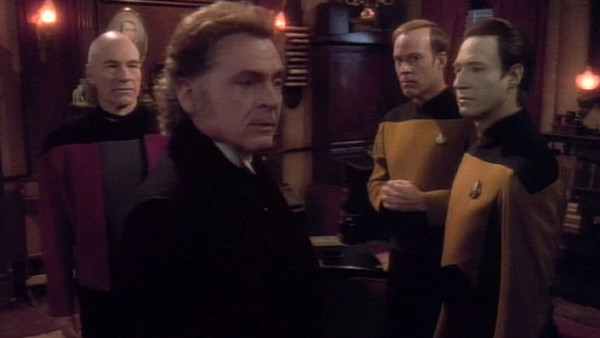
Here's all the backstory you really need to know for this classic: four years ago, Geordi got royally pissed off at Data for spoiling every Sherlock Holmes adventure on the holodeck and got the computer to create an original adventure with a worthy adversary capable of defeating Data (and not Sherlock Holmes? Grammar saves, Geordi).
The computer, in one of the most metaphysically skewed plotholes conceivable, makes its representation of Professor Moriarty a sentient being that is aware of the Enterprise's existence and will stop at nothing to be able to leave the holodeck. Four years later, the Moriarty program has been sitting in encrypted storage until Barclay, who wasn't assigned to the Enterprise until a year after all of this happened, accidentally activates it, which has apparently remained self aware in computer storage for all these years.
When Picard is summoned to speak to him about leaving the holodeck, Moriarty amazingly does just that. Of course, no hologram can leave the holodeck without immediately disintegrating so naturally Data deduces that they are in fact still on the holodeck, leading to a resolution that quite frankly has given most Trekkies a headache the last twenty years. Even the cast had to keep diagrams on set to understand what was going on in the plot that would even give Steven Moffat a run for his money.
10. Conspiracy

Granted, the first season, at least when compared to the later seasons, wasn't necessarily its prime, but this is definitely an underrated episode.
An early draft of the Borg storyline, the story involves an invasion of the Federation by parasitic bug like creatures. Breathing through a quill on the back of the host's neck, the parasites invade the bodies of high ranking Starfleet officers and weaken the Federation's defenses from within.
When the Enterprise returns to Starfleet Headquarters, Picard finds that three high ranking admirals are infected and have cornered him and Riker, leading to probably one of the goriest shootouts in syndicated television history including an officer's head being blown to bits by Picard and Riker.
With the Writers' Strike of 1988 ongoing (which delayed TNG season 2 for two months), this storyline was never properly wrapped up except in TNG novels and ended with a homing beacon being sent by the mother creature across the galaxy for a larger scale invasion.
9. I, Borg

In the third installment of the series featuring the Borg, the Enterprise intercepts a distress signal emanating from a nearby moon, where they discover a crashed Borg scout ship with one surviving Borg. The Borg, known as Third of Five, is taken aboard for medical treatment, causing much dismay and discomfort for the crew, especially for Picard, who is still fairly traumatized from his experience with the Borg the year before.
The Borg takes a liking to Geordi, who tries to teach him that it is better to think as an individual than as a collective, and even gives him a sense of identity by calling him Hugh instead of Third of Five. Meanwhile, the crew debates whether or not to return Hugh to the collective as well as whether or not to return him with a virus that could ultimately destroy the collective.
As easy as it would be to use Hugh to destroy the Borg collective, they decide the moral thing to do would be to send him home free of tampering. However, in their next encounter, the Enterprise crew will discover that by giving him individuality, they managed to do great damage the Borg without the virus at all.
8. Chain Of Command, Parts 1 & 2

In arguably the darkest hour in TNG's seven year run, even darker than The Best of Both Worlds, Picard is relieved as Captain of the Enterprise and placed on special assignment with Worf and Dr. Crusher to infiltrate Cardassian space and search for and destroy any metagenic weapons, essentially a prototype for a Cardassian bioweapon, on the planet Celtris III.
Meanwhile, the draconian new Captain Edward Jellico makes life difficult for everybody aboard the Enterprise, especially Riker and Geordi. He also fails miserably at negotiating with the Cardassians and sees war as inevitable anyway. When Picard is kidnapped on Celtris III, the metagenic weapon threat apparently a total hoax to lure him there, he is tortured for information regarding Federation strategy in the event of a Cardassian invasion.
Picard's torture scenes are particularly gut-wrenching and difficult to watch and include sensory deprivation, starvation, physical torture and stress positions among others. The sensory deprivation involved tricking Picard into thinking there were five bright lights instead of four, and the torture will continue unless Picard acknowledges that there are five lights.
Jellico, the Federation's negotiator during this crisis for some reason, disavows any knowledge of Captain Picard's mission, leading to veins popping out of Riker's head before he's relieved of duty, but the two of them must resolve their differences when Jellico asks Riker to take a shuttle and construct a minefield as a last ploy to get Picard out. When he is released, the last thing Picard does is defiantly yell to his Cardassian captors, "there are four lights!"
7. The Measure Of A Man

Paying homage to the famous U.S. Supreme Court case Dredd Scott v. Sandford, season 2's The Measure of a Man is considered by many Trekkies to be the first truly great episode of TNG.
Commander Bruce Maddox, an overzealous yet clumsy scientist who was the sole dissident in approving Data's entrance into Starfleet Academy, wishes to dismantle Data and study his inner workings in order to continue Dr. Noonien Soong's work as a cyberneticist to construct more units of Data for standard issue on Federation vessels.
Data, along with the Enterprise senior staff, believe that Maddox's scientific method is flawed and could very well be fatal to Data and he attempts to refuse the experiment; however, Starfleet has handed him over to Maddox for immediate testing. Picard immediately challenges the transfer order and a hearing is convened to determine Data's level of sentience: is he a person with equivalent rights to a human Starfleet officer or is he, as the judge puts it, a glorified toaster owned by Starfleet?
Short on staff, the JAG officer aboard the space station assigns Picard as Data's counsel and Riker as the prosecutor, a position where Riker must try and hand over his friend for the android equivalent of medical experimentation.
6. All Good Things, Parts 1 & 2

The series finale of Star Trek: The Next Generation is the perfect ending to this sci-fi classic. The entire overlapping plot of the previous seven years comes full circle so beautifully and the fact that it ended just like any other episode just shows that the adventure is far from over, as evidenced by the release of Star Trek: Generations mere months later.
Captain Picard finds himself shifting between three time periods against his will: the present, his first days as the captain of the Enterprise, and twenty five years in the future as a senile old man. In two of the three periods, a massive spatial anomaly is discovered in the Neutral Zone, a spatial anomaly that gets progressively larger in the past.
When Picard appears alone in the post atomic court, exactly where he stood seven years ago, it is instantly known that Q is behind his time shifting, and that this is another test in his trial for humanity that began seven years ago. The anomaly is larger in the past and doesn't exist in the future where Picard is dismissed as a demented old man, and one mistake could literally cause the destruction of humanity, and only Picard can stop it.
If that isn't a perfect goodbye to this series, I don't know what else would be.