10 Times Star Trek: Deep Space Nine Went Woke
If there was one Star Trek series that was a challenge to narrow down, it's this one
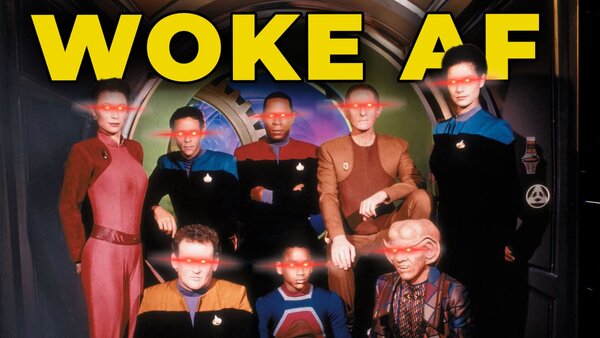
Star Trek: Deep Space Nine is often hailed as the most progressive Trek series, though with the advent of shows like Star Trek: Discovery, that title is up for debate. What is safe to say is that in 1993 there were few, if any, shows on television that sought to tackle the topics seen in DS9 from week to week.
In our previous entries in this series for Star Trek and The Next Generation, we discussed the origin of the term 'Woke'. To reiterate, according to Merriam-Webster, to be 'Woke' is to be:
aware of and actively attentive to important societal facts and issues (especially issues of racial and social justice)
DS9 was radical from the beginning in its casting of Avery Brooks as the new commander, who served as the first male actor of colour to play the lead role in a Star Trek series. Brooks was well known for his role on Spencer: For Hire and A Man Called Hawk, as well as having a long theatrical career. As an artist and performer, he was cited as 'private' and 'enigmatic' almost a decade before taking on the part - though his pride in his heritage was both on record and seeped in his performances.
With Brooks at the head of this show, Deep Space Nine would quickly establish itself in how it tackled social issues through the lens of the 24th century. There were missteps along the way, as with any Star Trek series, though this iteration of Trek has earned a legacy of being one of the most challenging and forward thinking of them all. Let's explore why.
10. Homelessness And Mental Health Class Divide

We have already penned an article breaking down the inspiration behind the Bell Riots, so it comes as no surprise that Past Tense, Parts 1 and 2, are examples of Deep Space Nine making direct statements on homelessness and the mental health crisis in the 1990s.
Two of the biggest inspirations behind the so-called Sanctuary Districts of 2024 were the Attica Prison Riot of 1971 and the Kent State Massacre in 1970. Increased restrictions on prisoners' rights primarily caused the Attica Riot, though the direct catalyst was the shooting of George Jackson, a prominent member of the Black Panthers. The Kent State Massacre saw the shooting of unarmed protestors, there to decry the ongoing US presence in the Vietnam War.
While those real-world events helped to shape the Districts themselves, the treatment of Sisko, Bashir, and Dax upon their arrival in the 21st Century was a deliberate and clear statement on race and class divide. As per our interview with writer Robert Hewitt-Wolfe, Sisko and Bashir, played by Avery Brooks and Alexander Siddig, who are both men of colour, were quickly deposited in the Districts, while Dax, played by the caucasian Terry Farrell, is found and cared for by a wealthy passerby.
Within the Districts, there are no prospects for those who are down on their luck to escape and rebuild their lives. There are literal and metaphorical walls erected to block them from view, resulting in the eventual Riots, fuelled by their need to tell their stories to the outside world.
Though the initial story pitch contained the idea of the Districts, neither Hewitt-Wolfe or showrunner Ira Steven-Behr knew that Mayor Richard Riordan's Administration was about to propose an open-air, fenced-in camp for homeless people in LA.
Past Tense contains allegories to those prior events, then-current events (however coincidentally) and also predicted the extreme wealth divide that would be so prevalent in the 21st Century. Though not exclusively depicted through a racial divide in the episodes, the class divide leaves no room for confusion.
9. Showcasing Disability
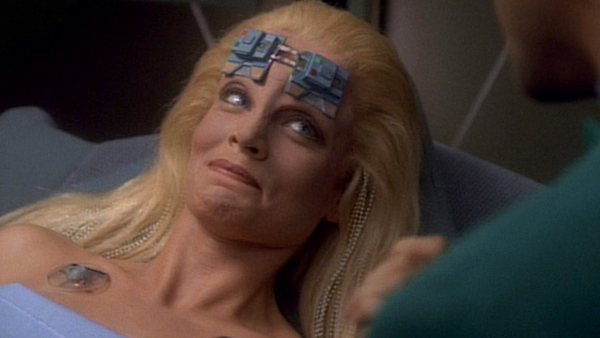
For story writer Evan Carlos Somers, Melora was a personal project. As a paraplegic wheelchair user, Somers used his own experiences in attempting to get around while creating the challenges that Melora faces with the Cardassian-designed space station.
According to the Star Trek: Deep Space Nine Companion, Rick Berman and Michael Piller had originally intended to include a character 'used to living in a low gravity environment,' who would have been forced to use a wheelchair in areas of 'normal' gravity. While budgets prevented a regular addition to the show, Somers brought this idea back for his episode.
Melora faces some of the challenges that Somers faced in reality. He had worked in several environments that had been rampless, though perhaps without the jutting struts of DS9's architecture. She was given a slimmed-down wheelchair, though she still struggles with the exoskeleton designed to equalise gravity around her.
Though representing disabilities on screen has a patchy history, Deep Space Nine both succeeded, but could have gone further. Somers later reflected on the episode, lamenting some of the writing changes that occurred after he turned in his draft. He felt that it devolved into stereotypes, with Melora becoming the problem, rather than her colleagues, when it came to acclimatising.
Though Melora was an attempt to showcase disability in the workplace, from an idea submitted by a writer with direct experience, the result was an episode that paints the character as combative, while focusing on Bashir's reactions, rather than any lessons learned.
8. Robin Hood: Prince Of Holographic Communicators
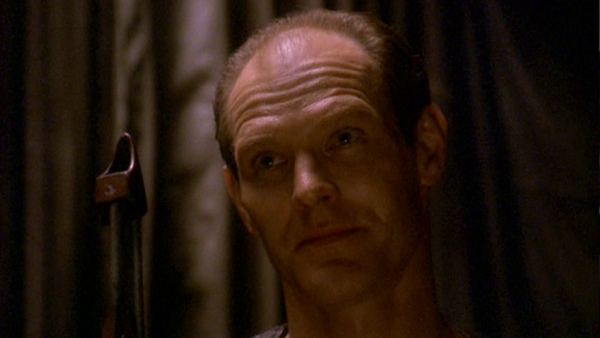
Though The Maquis deals directly with that group of freedom fighters, For The Uniform takes a different route. Here, Michael Eddington casts himself as Jean Val Jean (a name that Star Trek: Voyager would borrow for Chakotay's Maquis Raider), while casting Captain Sisko as Inspector Javert.
The stage musical of Lés Miserables debuted in the 80s', bringing Victor Hugo's 1862 novel to greater public awareness. In that story, Val Jean is sentenced to a life of labour for stealing a loaf of bread. In this episode, Eddington sees himself as the persecuted Val Jean.
This episode compelled the audience to view Sisko in a new light. He infamously bombs the atmosphere of Solosos III, rendering it uninhabitable for fifty years, to Eddington's horror. On the one hand, one could argue that Eddington, and by extension the Maquis, forced Sisko into taking direct action against them.
However, the episode opens with a scene borrowed from 1938's The Adventures of Robin Hood, starring Errol Flynn and Olivia de Havilland. The scene in question depicted Robin taking Maid Marion to see the starving people in the kingdom, exactly as Eddington does to Sisko in the DMZ.
The episode serves as another example of Deep Space Nine's attempts to blur the lines between right and wrong, and pushes the audience to investigate Starfleet's role in the proceedings. Ronald D. Moore felt that Sisko was evening the playing field between Starfleet and the Maquis, though he concedes that Sisko acts in a way that Picard wouldn't have. Does this then make Sisko a villain, as Eddington claims him to be?
This conflict: Need versus Right - in Deep Space Nine, the needle shifts away from what is easy. Though not as overt as his actions in In The Pale Moonlight, Sisko displays a Machiavellian method, and Eddington is captured.
7. He Was A Union Man

Workers of the world unite. You have nothing to lose but your chains.
Quoting Karl Marx and Friedrich Engels was no accident. Rom, creating a union of the bar staff in Bar Association, shatters all rules of Ferengi society, while simultaneously allowing the show to depict workplace disputes on television.
Armin Shimmerman and co-writer Robert Hewitt Wolfe both spoke about their passion for collective bargaining, with this episode depicting the fight for better working conditions, while, in the 1990s, that same fight was ongoing. Though Star Trek envisaged a future where humanity moved beyond material gain and wealth, the Ferengi were not so enlightened.
Shimmerman, who sat on the board of the Screen Actors' Guild, was very pleased with the episode. Though Bar Association is presented primarily as a comedy, the worker-management struggle was given serious treatment. Brunt, representing the Ferengi Commerce Authority, is, of course, appalled by Rom's endeavours, though it's Quark who finds himself on the wrong side of the Nausicaan strikebreakers.
While Rom ultimately steps down from the new Union, challenging the ultra-Capitalist system established by the Ferengi was really a statement on the greatest Capitalist system in which Star Trek is created. The Original Series and The Next Generation often discussed the absence of money and exploitative labour in short-hand references, while Deep Space Nine depicted the struggle to achieve both.
When one considers the Writers' Guild Of America strikes in 2023, with the prevalence of Star Trek actors contributing to their efforts, it isn't hard to look to Bar Association as a template on how to fight back.
6. Anti-Immigration Spotlight
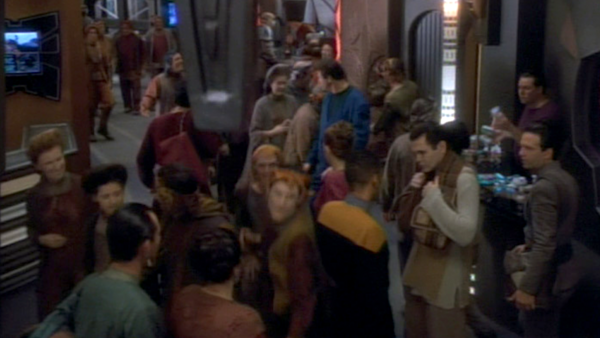
Sanctuary touches on some key Star Trek topics, with the universal translator being the earliest. When considering all of the differing alien languages in the universe, the translator is a wonderful tool, as long as one doesn't think too hard about how it works. This, according to Sanctuary's credited writer Frederick Rappaport, was one of the main ingredients to the episode's denouement. Understanding, or lack thereof, between the Skreeas and the Bajorans leads to the downbeat ending.
When Rappaport brought his script to Michael Piller, it was the latter who included the ending, whereas Rappaport had envisioned a more upbeat conclusion, one in which the Skreeas settled on Bajor. Michael Westmore designed a look for these aliens that resembled psoriasis, aimed to evoke a feeling of disgust in the viewer deliberately. Where one Skreea with this look may inspire sympathy, an entire race was meant to 'other' them. This, combined with the language barrier, was a deliberate attempt to not only divide the Skreeas from the Bajorans but to highlight their alien nature.
The episode, though deliberate in its message, took on a greater depth when barely a year later, Californian voters enacted Proposition 187. This proposition, introduced by Republican assemblyman Richard Lee Mountjoy, sought to deny public schooling, healthcare, and funding to undocumented immigrants. It was nicknamed the 'Save Our State' legislature.
Though the ballot was passed, it was immediately challenged in court and was found unconstitutional, though it took a further five years for the case to come to a close.
Though immigration was not a unique topic in 1994, Deep Space Nine sought to highlight the challenge faced by these aliens, while also pushing the regular characters into an unsympathetic light. Kira is the focus as Haneek coldly turns away from Bajor, though her journey to this point was understandable; one cannot help but see Kira as part of the greater problem.
5. It's Easy To Be A Saint In Paradise
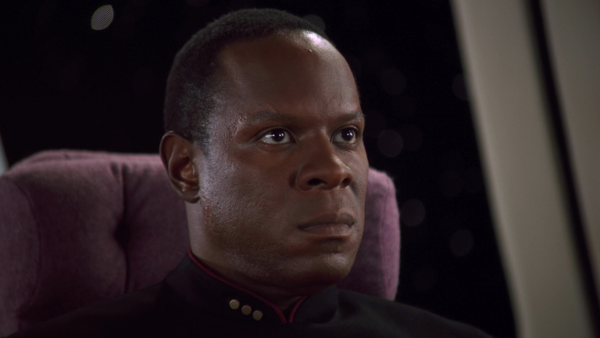
Though The Maquis Parts I and II were part of Star Trek: Voyager's conception (along with Journey's End and Preemptive Strike over on The Next Generation), they allowed Ira Steven Behr to challenge some of Star Trek's earliest ideals. Specifically, the idea that the Earth of the 23rd and 24th centuries was a paradise, or Eden. While that may have been the case, as Commander Sisko says to Major Kira:
It's easy to be a saint in Paradise.
Behr took inspiration from the playwright Harold Pinter, whose later works often depicted (depending on the source) the 'weasels under the cocktail cabinet' (this quote is often given as 'liquor cabinet' or, in Behr's words, the 'coffee table'). What this truly means is that even in polite society, there are those things that move underfoot, unseen, though certainly sensed and heard.
While this line would later lead to the introduction of Section 31, its connection to the Maquis formed the basis for Deep Space Nine's relationship with the group of freedom fighters. It also served to highlight the difference in setting between this show and its contemporaries. It was the Western in space, removed from the back-up afforded by Starfleet. DS9 had to deal with these people because they were the closest to them.
Depicting these human colonists, so far from the centre of the Federation and so removed, also gave rise to their sympathisers. Kassidy Yates was caught delivering aid to the Maquis in For The Cause, while other Starfleet officers were heard discussing their bravery. Several officers defected, not least of which was Michael Eddington.
While Sisko's quote may seem antithetical to Roddenberry's idealised future, it served as a mission statement for what Deep Space Nine would continue to deliver.
4. Rejoined
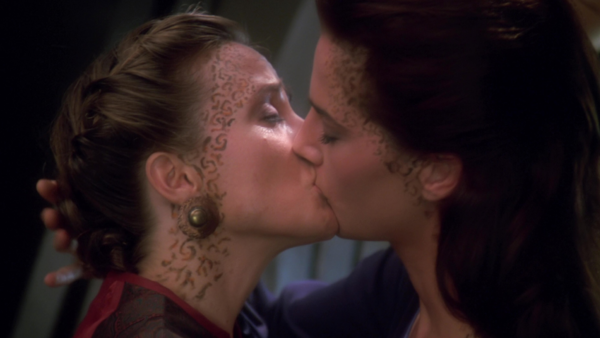
Rejoined has now reached levels of infamy in Star Trek, but in the mid-90s, it was a risky move for the franchise to make. Depicting a lesbian kiss on television, however, had become part of a trend, beginning with 1991's He's A Crowd, an episode of L.A. Law. This trend depicted characters, who were previously understood to be heterosexual, engaging in a same-sex kiss, specifically women in this context.
The episode was a collaboration between Ronald D. Moore and René Echevarria. The script was originally intended to feature a male ex-lover, but Khan was changed to female when the focus of the story changed. Where once the idea of preventing a Trill aristocracy barred the latest hosts of their symbionts from rekindling old flames, the simple gender switch made the story about homosexuality and homophobia. Once it was cleared by Ira Steven Behr, Rick Berman, and the studio executives, the episode was given to Avery Brooks to direct.
Brooks refused to allow the kiss to become a salacious piece of marketing. As per the Star Trek: Deep Space Nine Companion, he said:
People want to hype stuff like that, but I wasn't going to have it.
Susanna Thompson, who played Khan, recalled her comfort acting in the episode, thanks to her co-star Terry Farrell and Brooks' direction. On the season 4 DVD special feature, she said:
...[h]e also knew that this episode was going to be a little controversial because there was a same sex kiss. He was so good at keeping us safe and protected, but also giving us such a great space to be brave.
Unsurprisingly, the episode drew criticism from conservative elements. There was a split in the correspondence; however, the phone calls the studio received were mostly positive, while the letters they received were mostly negative.
Ultimately, the episode never comments on Jadzia and Lenara presenting as female. Rather, the story focuses on the taboo of former spouses rekindling romance. For his part, Brooks considered the episode a story about love.
It was an extraordinary story. I thought it was important that we tell this story honestly and truthfully about love, and so it's not about sex, or same gender or any of the above, even though, obviously, in our world, that's what people started to look at, but I mean it was so important for me to tell that story honestly and truthfully, especially for the people who have suffered, you know, in our world, needlessly, because of love.
3. Single Black Fatherhood
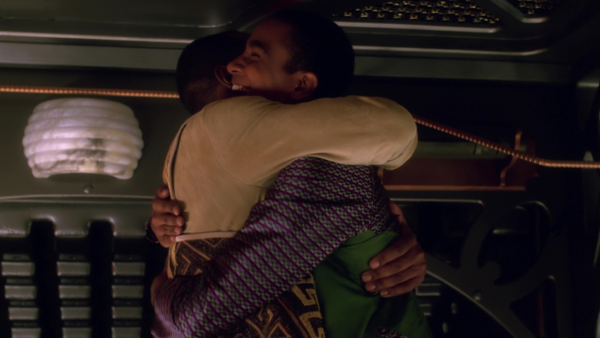
Star Trek: Deep Space Nine first aired in 1993, not long after the LA Riots, and four years after the end of Ronald Reagan's Presidency in the United States. While television offered strong black male characters at the time, notably with James Avery's Uncle Phil on The Fresh Prince of Bel-Air, the 'absent black father' trope had become entrenched in the zeitgeist.
Avery Brooks was more interested in portraying a strong, black father figure in Star Trek than anything else. Both he and Cirroc Lofton have spoken at length about their relationship, both on and off-screen. Ben Sisko is a widower, raising his son alone, now in Emissary assigned to a remote space station. In the tense encounter with Captain Picard, he tells the man he is considering resigning his commission.
In The Myth of the Missing Black Father, edited by Roberta L. Coles and Charles Green, one of the conclusions found in the book was that,
...ironically, most absent in the literature on black fatherhood have been those fathers who are most present: black, single full-time fathers.
The book argues that, despite the stereotype, single black fathers were, in the early 1990s, more prevalent than depicted. Angelica Jade Bastién, in her article Deep Space Nine Is TV’s Most Revolutionary Depiction of Black Fatherhood, points to Deep Space Nine as a critical example for these depictions, as other examples, like the aforementioned Fresh Prince Of Bel-Air, Good Times, and even The Cosby Show, were often taken less seriously due to being comedies.
In 1993, casting a black man as the lead of a Star Trek show was itself a statement. To make that lead character a single black father was a direct challenge to the narrative already so firmly entrenched in television. This was a show, despite its Sci-Fi setting and alien prosthetics, to be taken seriously. So too was Ben Sisko, father, widower, and leader.
2. Depicting Post Traumatic Stress Disorder In The 24th Century

The Siege Of AR-558 remains one of Star Trek's darkest hours. Though more recent shows have followed it into the mire, it was a stark, challenging episode to present in the late 90s'. Ira Steven Behr recalled facing pushback on the idea of the show:
A lot of people didn't want us to do the episode, and a lot of people were unhappy as it was being developed...War sucks. War is intolerable. War is painful, and good people die.
Writer David Weddle suggested making the episode an homage to the real-world stand at Guadalcanal during World War II. AR-558 was about depicting a fight that would cost these heroes dearly. Through Nog, the audience could feel the true impact of war.
It's Only A Paper Moon, serving as both a sequel to this episode and a stark depiction of PTSD, was Aron Eisenberg's finest hour as the young Ferengi officer. Quite apart from the physical challenge of extra days in makeup, Eisenberg also focused on ensuring Nog cried at the end of the episode (the script called for him to get emotional).
The therapy that Nog undergoes in this episode is a real-world process known as creative therapy. These types of therapies, according to creative arts counsellor Ani de la Prida:
...can work really well when people don’t consciously know what the problem is or what will help, as this approach also works at a subconscious level.
Nog, still reeling from the loss of his leg, throws himself into working with Vic Fontaine. Though the entire environment is simulated, Nog substitutes it for his own reality, focusing more on the holographic world than his own journey. In a meaningful moment, his cane is seen abandoned, despite Nog's earlier assertion that he needed it to walk.
Though he is forced to return to reality by the episode's close, Nog's journey opened the door for Star Trek to examine long-term effects of conflict. His closing statement, that he is not alright, but he will be, also serves as a reminder that the journey with mental health rarely moves in a straight line.
For Eisenberg, the highest praise that he received was the letters he received from veterans congratulating him on his performance.
That was the best compliment, because those guys have lived through the stuff that we were playing.
1. Far Beyond The Stars

When considering the topic of 'woke' in Star Trek, Far Beyond The Stars must immediately be discussed. For Deep Space Nine, and for the wider franchise, it reminded the audience that for the positive future that Trek offers, it was conceived and created in much darker times.
Benny Russell's struggles as a black man in the 1950s, portrayed with a tour-de-force delivery by Avery Brooks, who also directs the episode, are painful to watch, though unsurprising. Science Fiction may offer these writers a chance to depict a better tomorrow, though reality reminds them that they lived in a worse today.
Though Russell's censorship, dismissal, and eventual breakdown are the key focus points of the episode, Nana Visitor's K.C. Hunter also faces discrimination for being a woman with a typewriter. Michael Dorn's Willie Hawkins is a celebrated baseball player, though he is barred from living alongside his white teammates. Cirroc Lofton's Jimmy is shot dead by racist policemen during an attempted robbery, leading to the brutal beating of Benny.
Brooks considered Far Beyond The Stars his favourite episode of Trek that he worked on. He would even have preferred it to have been a two-parter, as per the Star Trek: Deep Space Nine Companion.
However, the main point that Brooks wished to make about the setting of the episode was this:
If we had changed the people's clothes, this story could be about right now. What's insidious about racism is that it is unconscious. Even among these very bright and enlightened characters - a group that includes a woman writer who has to use a man's name to get her work published, and who is married to a brown man with a British accent in 1953 - it's perfectly reasonable to coexist with someone like Pabst. It's in the culture; it's the way people think. So that was the approach we took. I never talked about racism. I just showed how these intelligent people think, and it all came out of them.