10 Star Trek Actors Who Suffered From Typecasting
A role in Star Trek can ensure a legacy, but sometimes at a price.

This is not to sound trite or sycophantic, but Star Trek has on the whole featured some rather remarkable actors. Talent has been in abundance amongst each and every cast since 1964's The Cage. If, then, careers stalled after the fact, in particular for those who found themselves on the bridge of the original Enterprise, the fault was in the indelible association with the Star Trek phenomenon and not in the star. What was a character became an essence, and for an actor, that rarely bodes well for playing other parts.
Typecasting and Star Trek has been described as both a 'curse' and a 'double-edged sword.' On the one hand, it comes with the kind of fame (and often fortune) that any actor would risk saying Macbeth a thousand times in a crowded theatre for; on the other, the show has had an unfortunate history of limiting its actors to science-fiction, if not just to Star Trek. For some, typecasting has been a temporary hurdle; for others, it has been a lifelong affliction. Actors have reportedly turned down recurring roles on Star Trek for fear of it.
The flip side is, of course, those actors who haven't suffered from typecasting at all, going on (or continuing) to play other iconic characters so diametrically opposed that it is equally hard for newer Trek fans not to see Galina 'Red' Reznikoz when Captain Janeway pops up on screen.
"There's a certain immortality in being associated with Star Trek," said Walter Koenig in Parade magazine in 1978. That is endlessly true. For some Trek actors, however, including Koenig himself to a degree, living forever has been all too vicarious an experience.
10. Nichelle Nichols

A gifted actress, a singer with a mesmerising voice, a dancer, and a campaigner whose work took her to NASA, Nichelle Nichols was truly a once-in-a-lifetime talent and extraordinary human being. Her example has been an inspiration to countless many across the generations. Her legacy is one for the ages.
After Star Trek: The Original Series had come to an end, Nichols just wanted to do what she did best, but like many of her Trek castmates in their respective roles, she suffered from the unfair impositions of having been Uhura. By 1970, Nichols was already feeling the sting of typecasting, having been "defined so narrowly as an actress" by Star Trek and forced into a "saleable stereotype" by producers, as she commented in newspaper The Calgary Herald. Ultimately, Nichols wanted to achieve success by being herself. "My creation comes in reaching out to audiences, swaying them, manipulating them, pleasing them. That's were [sic] I get my creative satisfaction," Nichols told the Herald.
Already on a singing tour of Canada at the time of the Herald article, Nichols was trying to make her mark after Star Trek. It is true, however, that in the years that followed, she was never afforded anywhere close to the range of roles on screen that her talent quite clearly deserved. Nichols did become, in essence, Uhura for the rest of her life and career — a fact she also embraced, returning the love she received from fans through her numerous convention appearances.
9. James Doohan

Sadly, given the man's flair for his craft, James Doohan is one of the most emblematic cases on this list. He became so intimately associated with the Enterprise engineer that he struggled to find other roles. In 1992, Doohan gave a presentation at NASA, and answered a question from the audience about a possible return to Star Trek as follows:
I'm really making a concentrated effort to do characters far away from doing one with an accent or certainly one with a Scottish accent. Because I have been typecast, and it is absolutely deadly. […] That happened to me, seriously, by 1971. […] For the next five years, I didn’t' work in the business at all, and that is deadly.
Evidently affected by the situation, it was, according to The Washington Post, advice from an unexpected source in 1973 that convinced Doohan to embrace the Star Trek association. As Doohan's dentist told him, "Jimmy, you're going to be Scotty long after you're dead. If I were you, I'd go with the flow."
From 1973-1974, Doohan lent his voice to Star Trek: The Animated Series, and then later appeared in seven of the Star Trek movies, plus a most memorable episode of Star Trek: The Next Generation. He was also a stalwart of the convention circuit and gave lectures at numerous universities (42 in 1977 alone, as he stated during his NASA presentation). He even lampooned himself as Scotty in National Lampoon's Loaded Weapon 1. Doohan might never have broken free of the Star Trek mould, but we are forever grateful for the one character he played so brilliantly, and for that time he went to the dentist!
8. DeForest Kelley

At this point, it might seem like we have something against the actors of The Original Series. The unfortunate reality is that the "curse" or "double-edged consequence" of being in Star Trek, as The New York Times phrased it in 1991, affected (certain) members of its very first cast the most.
DeForest Kelley's career is a tale of two halves. Having got his start as one of the leads in the 1947 film Fear in the Night, he went on to appear in several other films and TV shows before landing the legendary role of Doctor Leonard McCoy. After 1969, what the New York Times' piece further qualified as the "lifetime Starfleet commission" of typecasting befell Kelley, who didn't work much at all outside of Star Trek until his untimely death in 1999.
The other edge of that allegorical sword was the beginnings of fandom as we know it today in the late 1960s and into the 1970s. With that, Kelley also managed to make a living from appearances at Star Trek conventions. Moreover, for a man who had wanted to be a doctor in the real world, but whose family could not afford to send him to medical school, Kelley inspired many through his fictional physician to take up the profession, a fact he was rightly proud of. That's a fine way to be typecast, after all.
7. Michael Dorn

Four years into the run of Star Trek: The Next Generation, The Los Angeles Times ran a piece on the continuing success of the franchise. Even at that stage, the article touched on the question that concerns us here, pointing out that "the actors themselves may grow weary of their roles, especially if they perceive a danger of being as terminally typecast as their predecessors." However, Michael Dorn already had a different interpretation of the subject:
If what happened to the first cast is called being typecast then I want to be typecast. […] They are making their sixth movie. Name me someone else in television who has made six movies!
Dorn was cast in Star Trek quite a few more times, 283 times in total as Worf — episodes and movies combined — to be precise. He also appeared in the franchise as other characters, including one in Star Trek VI: The Undiscovered Country that would have the grandfather paradox wondering what to do with itself. It is little surprise, therefore, that Worf is the character with which the actor is most associated. In Ted 2, Dorn even played 'Rick,' a man cosplaying as Worf at Comic-Con to "f**k with the nerds." His deadpan humour in Star Trek: Picard was then one of the highlights of an outstanding third season.
Dorn has spoken further about pigeonholing in the industry. In a video for a kickstarter campaign in 2012, the actor opened up about being restricted not to the character of Worf or Star Trek, but as a 'science-fiction actor'. To that end, Dorn had written the script for, and was planning to direct and act in, his own movie Through the Fire — a romantic comedy. Other Trek actors were attached, but sadly the kickstarter was cancelled part way through.
6. John Billingsley

During his time as Doctor (Phil) Phlox, and if you'll allow us the crossing of the sci-fi streams, John Billingsley also played the geeky, Star Trek-loving Dr. Simon Coombs (PhD) in the Stargate SG-1 episode The Other Guys. That character went to Star Trek conventions as a Vulcan, not a Denobulan, and chided fellow scientist Dr. Jay Felger for not "worship[ping] at the altar of Roddenberry."
Forever self-aware of his career to the point of parody, Billingsley has always managed to play against type by playing towards it. Nevertheless, the Star Trek actor has suffered from a form of typecasting — one not related to being on a "genre show," but specific to Enterprise. As Billingsley told TrekMovie in 2020:
I felt like I was in dry dock for about a year after Star Trek ended. […] Much of it was because we were on UPN and a low-rated show, so in the eyes of the community, I just disappeared for a number of years. […] And if you are not on a show on a particular network, or not on a prestige drama or not doing film, they [certain casting directors] aren't really paying attention.
Billingsley has not been hemmed in by sci-fi post-Enterprise, but he's not abandoned it either. His credits since have included everything from Prison Break to The Orville to Shameless.
5. Jonathan Frakes

Now a prolific director, Jonathan Frakes hasn't had the time to be typecast. That so many Star Trek alum of the 'Berman era' have gone on to successful careers behind the camera — Roxann Dawson, LeVar Burton, and Robert Duncan McNeill, for example — owes in large part to the semi-to-unofficial 'Star Trek Directors' School' whereby cast members at the time could learn the new (directorial) job on the job.
That said, in a 2018 interview for StarTrek.com, Frakes reflected on some of the other factors that motivated him to direct:
I don't know if I knew subconsciously or consciously that there'd be this typecasting. As Leonard Nimoy famously said, 'It's better to be typecast than not to be cast at all.' But there was a certain thing that happened after the show that you can see evidence of from The Original Series, from our series, Voyager, DS9, Enterprise. […] I don't know what you'd call that in your world, but there certainly is… It was a double-edged sword.
In the same breath, and typecasting or no, Frakes was also extremely modest about his acting talent. We all know he has that in abundance, proven most positively by his reprisal of Riker in the third season of Star Trek: Picard. The Saturn Award nomination was most well-deserved!
4. Connor Trinneer

Like John Billingsley (and others), Connor Trinneer also crossed the Star franchises, this time to the Pegasus Galaxy for Stargate: Atlantis in which he played the decidedly more serious and recurring role of Michael ('Kenmore'), a Wraith-turned-human-turned-part-way-back-to-Wraith. He also played Professor Langford in Stargate: Origins.
In an interview with the Stargate news site GateWorld in 2007 about his then-ongoing role on Atlantis, the issue of typecasting was raised. Trinneer admitted that after Star Trek: Enterprise had come to an end, he feared that playing Trip "was going to pigeonhole [him] as a sci-fi actor."
Ultimately, Trinneer had a far more stoic reply to GateWorld's decidedly direct "So you're not being typecast at all?" replying,
I don't think that, and if I was, typecasting means you're getting work. If it's in one genre, so be it. […] I'm just hitting the pavement like the rest of them.
As demonstrated here, typecasting is also being asked the question. Our own interrogations and (mis)associations can be part of the problem. Moreover, Trinneer might have starred in other sci-fi shows since Enterprise, but he's equally shown his range in the likes of American Made and The Fablemans. He has fully embraced Trek and Trip too with The Shuttlepod Show.
3. Patrick Stewart
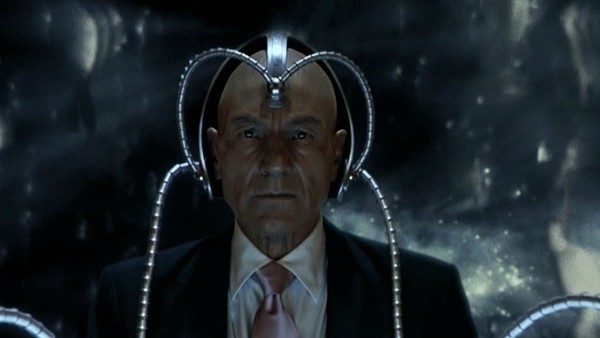
Sir Patrick Stewart has had, and continues to have, a highly successful, award-winning career spanning a variety of roles — from just about every character in Shakespeare to the Poop Emoji. However, like all of the captains in Star Trek, perhaps more so because he was only the second, Stewart is always and forever Jean-Luc Picard.
No doubt Stewart's second most iconic role was in yet another franchise behemoth. In a 2015 radio interview for KPCC's The Frame, Stewart admitted that he had been "reluctant" at first to take on the Marvel role because of the pitfalls of the "close identification" with one particular character that he had already begun to feel with J.L. Stewart went on to say:
Jean-Luc Picard was who I was. I did finally get into a room to meet with a director […] [who] was doing a movie I wanted to be in as a supporting role, and we had a good meeting. At the end he said, 'Look, you're a terrific actor, and I would love to have you in my movie, but why would I want Jean-Luc Picard in my picture?'
That incident left Stewart feeling understandably hurt, and he even left Hollywood shortly after. For the longest while, Sir Patrick wasn't intent on playing Picard ever again. As he said in his memoir Making It So, "I had very much enjoyed being Jean-Luc and kept him close to my heart. But. I was done with him." Thankfully, he was persuaded otherwise.
2. Brent Spiner

"I'm a success story of a class clown," as Brent Spiner described himself in Brent Spiner: Data and Beyond, Part One (Star Trek: The Next Generation Motion Picture Collection [Blu-Ray] special features). Spiner is well known for his delightfully wicked sense of humour that often tends towards the self-deprecating. Of course, his comedic acting talent is ever evident in Data, who was, in spite of himself, surely the funniest character on Star Trek: The Next Generation, even before the emotion chip.
Though not unfamiliar with typecasting, Spiner has arguably not suffered the most from it. The actor appears on this list because he has taken the matter and, like Data hooked up to the computer in Disaster, humorously turned it on its head. In an interview for The Washington Post, Spiner commented,
I, frankly, like to think I've been typecast as the reason when I don't get jobs, because the alternative is that I'm just lousy. But all that being said […], if I had to have one character I had to be typecast as, it would be this character [Data].
Spiner has not been afraid to be cast to type as the exaggerated version of himself, post-Data, on several occasions. In his own web-series Fresh Hell, Spiner played Spiner, the actor struggling to revive his career after the "incident," heckled by those shouting the android's name. "At least I'm not Brent Spiner" is the running gag of Fresh Hell, even for former castmate LeVar Burton, who also played a heightened version of himself in episode two of the show's second season. Both appeared as themselves on the Big Bang Theory, and in the short film self-send-up Brentwood. Who needs an Emmy anyway!
1. Leonard Nimoy

Well, he did basically write two books about it. As a title, I Am Not Spock caused a fair amount of backlash from press and fans alike who thought that Nimoy was trying to disassociate himself from the character. The nerve! Nimoy, who came to regret the title, then famously went on to 'rectify' things with his second memoir I Am Spock in 1995.
The fact is, he needn't really have written the second in the first place. I Am Not… already does the work of I Am… as Nimoy underscores it in …Not Spock: "The question is, without Spock, who am I? Do I, or would I, exist at all without him? And without me, who is he?" Of course, Nimoy wasn't actually Spock, but at that point, no one else was Spock either.
I Am Not… and not I Am… also contains within it the performative I play(ed), and most importantly here, They cast… but the distinction matters little. The indissociable link between actor and role had already been forged by the power of Star Trek and its fandom, gaining extraordinary momentum at the time of publication of I Am Not Spock in 1975. Privately, Nimoy was the character, even greeted as such. Professionally, 'Mr. Spock' was always on stage.
Nimoy did play other roles in TV, film, and theatre to great success, so it would be difficult to argue that his career truly suffered as a result of Star Trek. In the end, however, he could never escape the ontology of Spock. Like many of his Trek co-stars on this list, Nimoy experienced the ultimate form of typecasting — he got the role both in and for life.