The Best Movie Of Each Year From 1925-2025
51. 1975 - Jaws
Honourable Mentions: Barry Lyndon, Dog Day Afternoon, One Flew Over the Cuckoo's Nest
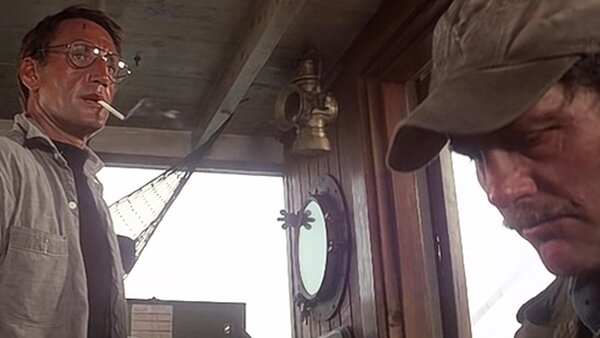
1975 was a landmark year for cinema, an attribute you could lay squarely at the feet of Jaws. Directed by a young Steven Spielberg, who to that point had directed two formidable feature films in Duel and The Sugarland Express (plus, not forgetting, an all-timer instalment of Columbo), Jaws tore up the box office rulebook and ushered in the age of the summer blockbuster - of gigantic, tentpole extravaganza that would make the movies more of an "event" than ever before.
Of course, Spielberg's adaptation of Peter Benchley's best-selling novel is a lot more than just an event picture. It's also a showcase for the filmmaker's resilience and deft touch for dynamic movement and innovation, not to mention his rhythmic approach to suspense and action. It's a film that's both of the seventies in its subtext and of another era in its premise and execution, at once a throwback and something uniquely ahead of its time.
The definitive blockbuster, yes, but also just a remarkable piece of cinema.
50. 1976 - Network
Honourable Mentions: All the President's Men, Rocky, Taxi Driver
1976 is another one of those years that confidently makes the case for the seventies being the greatest cinematic decade, with not just the aforementioned honourable mentions to contend with, but also the likes of John Carpenter's Assault on Precinct 13, Richard Donner's The Omen, and Brian De Palma's Carrie, among several other formidable examples.
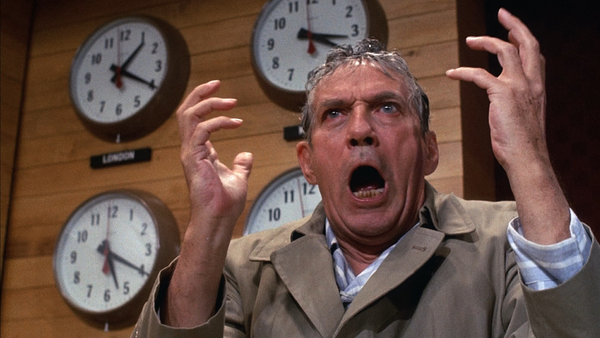
Of all the films of that year, though, one persists as a timelessly prescient and immaculately performed piece that goes beyond just capturing the zeitgeist, and that is Sidney Lumet's Network.
Written by Paddy Chayefsky and starring William Holden, Faye Dunaway, Peter Finch, and Robert Duvall, Network is as much a brilliant ensemble drama as it is a blistering satire of broadcast journalism and the corrosive effects of seventies rot. Chayefsky's dialogue is razor sharp, while the cast - comprised of old and new Hollywood players - renders that sense of generational shift and moral existentialism in stark clarity.
49. 1977 - Sorcerer
Honourable Mentions: Close Encounters of the Third Kind, Star Wars, Suspiria
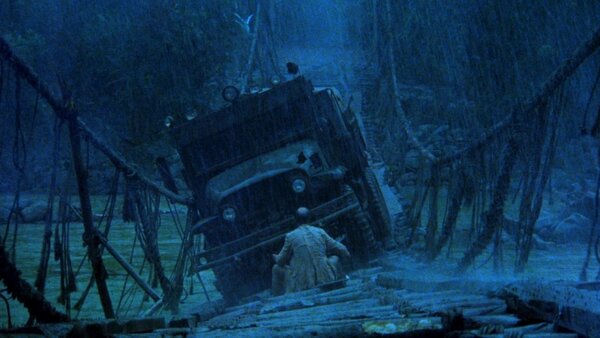
A remake of Henri-Georges Clouzot's 1953 classic The Wages of Fear, William Friedkin's Sorcerer has the unfortunate honour of being one of the greatest films ever made, but one that took years to find its audience. (We in the biz call that the "John Carpenter special".)
The reasons for Sorcerer's contemporary failure can be attributed to its vague (but great) title and being released in the tsunami generated by George Lucas' Star Wars, but that has little bearing on its reputation today, where it's rightly considered one of Friedkin's best - a frantic, stress-induced whirlwind of a picture whose energy reflects its own arduous production, anchored by the ineffable Roy Scheider, with whom Friedkin had previously collaborated on The French Connection.
The film itself revolves around a quartet of rogues who find themselves stranded in a Latin American purgatory, with the only route out being to transport boxes of leaking, combustible nitroglycerin through the jungle to collapse a burning oil derrick run by an unscrupulous petro company. It's man pitted against himself and the elements, and the results are dizzying.
48. 1978 - Halloween

Honourable Mentions: The Deer Hunter, The Driver, Invasion of the Body Snatchers
While perhaps not the greatest film in John "The Master of Horror" Carpenter's oeuvre - with The Thing, Prince of Darkness, and In the Mouth of Madness together arguably embodying the peak of his powers - Halloween still lives up to its reputation as a chilling horror classic, following in the footsteps of Psycho and The Texas Chain Saw Massacre in the canon of stories devoted to exploring a more inexplicable, earthly evil than anything explicitly paranormal.
Carpenter and collaborator Debra Hill do sprinkle a little of the supernatural into their recipe, in which the institutionalised Michael Myers escapes from confinement to stalk the sleepy Illinois town he grew up in, but it's more a seamless blend of reality and nightmare than straight fantasy. Myers - credited only as "The Shape", and played to ghostly perfection by Nick Castle - takes on the qualities of the Bogeyman, slipping in and out of darkness in a chalk-white mask, but exacts a distinctly human evil on his victims, hyped up to glorious effect by Donald Pleasence's Sam Loomis.
Throw in a bone-chilling score from Carpenter himself and a star-making turn from Jamie-Lee Curtis, and you're left with not just slasher royalty, but an immaculate piece of horror fiction that makes an antiquated concept like inherent evil feel hauntingly tangible.
47. 1979 - Alien

Honourable Mentions: All That Jazz, Apocalypse Now, The Jerk
What more fitting way to close out what historian Philip Jenkins called the "Decade of Nightmares" than with arguably the best filmic nightmare the seventies conjured? Ridley Scott's Alien is the pinnacle of existential terror - an inversion of the wonder and spectacle that had defined the decade's other iconic sci-fi films (Star Wars and Close Encounters of the Third Kind), which peered into the inky void of space and saw not the limitless possibilities of exploration, but instead a dwarfing maw of uncertainty and menace.
It's no surprise that Scott and screenwriter Dan O'Bannon's depiction of a rusting, decaying future dominated by vicious corporations resonated with a seventies audience, but while Alien's political allegory is compelling, its ability to conjure a profound sense of primordial dread - pioneered by the biomechanical stylings of H. R. Giger - is what has led it to endure for so long.
It's rare for a film to confront the viewer with something unseen - an image that is, in effect, totally alien - and yet that's what Scott's production accomplished. It's the perfect lifeform. (And the sequels aren't half-bad either.)
46. 1980 - The Empire Strikes Back

Honourable Mentions:The Blues Brothers,Raging Bull, The Shining
It is simply far too easy to forget that The Empire Strikes Back is a filmmaking masterpiece. Given all the decades of franchising, merchandising, spin-offs and of course Disney's fumbling attempts at renewing the series over the last decade, there's a tendency to place Star Wars within a different cinematic context - less so a series of films and more a product that has been leveraged to ludicrous success, fixed on a parallel track apart from its peers.
And given that 1980 also saw the release of The Shining and Raging Bull - two masterpieces from Stanley Kubrick and Martin Scorsese - that sense of imposter syndrome could feel even more pronounced. Even so, while the two aforementioned films are among the greatest of the 20th century, it shouldn't be controversial to say that Irvin Kirshner's Star Wars sequel can sit quite happily alongside them.
The original Star Wars was a brilliant, operatic spectacle brought together by technical wizardry and pioneering effects work, but Empire brought those gifts to bear in a more structured and accomplished fashion. Today, it remains a transformational viewing experience - a testament to the immersive qualities of the medium, but one whose iconicity has frequently belied its filmic merit.
45. 1981 - Thief
Honourable Mentions: Blow Out, Possession, Raiders of the Lost Ark
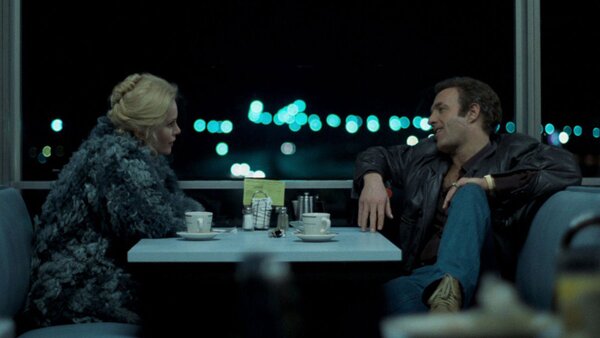
Few filmmakers have arrived on the scene so fully formed as Michael Mann did with Thief, a film which instantly distilled the director's enduring mix of urban spirituality and technical authenticity with a tidal wave of neon, Tangerine Dream, and a .45-wielding Jimmy Caan.
Thief is sensorially resplendent, but also boasts a compelling emotional and thematic throughline, of an angry, isolated professional yearning for an unattainable dream, and the exploitative forces working to capitalise on that one weakness. It's a film about the smiling face of capitalism and the ruthlessness that lies just behind it, as well as the twisted catharsis of self-destruction.
Caan's Frank burns everything down in his quest for revenge, which Mann executes in the mould of Donald Westlake and punctuates with a pulsating track performed by Craig Safan, as Frank unloads his pistol into a coalition of wrongdoers, before fading away like a shadow in the night.
An all-timer ending to an all-timer debut.
44. 1982 - Blade Runner

Honourable Mentions: First Blood, The King of Comedy, The Thing
In some ways, it feels like a bit of a cheat to call Blade Runner the best film of 1982. It wasn't until 1992 that a version resembling Ridley Scott's original vision was given a wide release, and it took a further 15 years after that for the "Final Cut" - an edit of the film presided over by Scott, and widely considered to be the definitive version of the film - to premiere on home video. The original theatrical print, which included toned-down violence, a studio-imposed happy ending and a miserable narration from Harrison Ford, was, for lack of a better phrase, not it.
Of course, retroactively, that Final Cut does ensure that Blade Runner is the best film of 1982, shading John Carpenter's masterpiece The Thing by a whisker thanks to an impeccable set of performances from Harrison Ford, Rutger Hauer and Sean Young; a magnetic composition from Vangelis; and a glorious fusion of science fiction and neo noir administered by Scott and an accomplished design team comprised of Syd Mead and Mark Stetson, among many others.
In short, Blade Runner typifies sci-fi at its very best - a story about the fantastical that cuts to the very core of our humanity.
43. 1983 - Videodrome

Honourable Mentions: Local Hero, Scarface, Trading Places
David Cronenberg is a whole horror brand - a maestro of the grotesque and salacious whose films have pushed genre boundaries with an undulating mix of seduction and repulsiveness. But they also comprise a whole lot more than grot and grunge, with 1986's The Fly more compelling for its human drama and sensitively drawn depiction of disease than it is solely for its incredible effects work.
The idea of a Cronenberg movie retains its constants, but there has been a clear evolution, with 1983's Videodrome arguably the moment the Canadian director as we know him today formally marked his arrival.
Psychosexual, dark, and thoroughly surreal, Videodrome is undoubtedly one of Cronenberg's very best and stands out today as the most fascinating film of 1983, and one of the very best of the decade.
42. 1984 - The Terminator

Honourable Mentions: Amadeus, Indiana Jones and the Temple of Doom, Paris, Texas
It's a hilarious irony that so many of the greatest films were at one time prophesied for failure. James Cameron's The Terminator - a tech-noir sci-fi horror tinged with nuclear anxieties - was one such effort, with anxieties at the time swirling around its perceived B-movie premise and the casting of Arnold Schwarzenegger, a figure who was not only pilloried for his Austrian accent and bodybuilding exploits by his contemporaries, but who also held huge reservations about the project himself.
Cameron was, back then, a novice filmmaker, with mostly VFX credits to his name and Piranha II: The Spawning his sole major release as a writer and director. There was precious little belief that The Terminator would turn out good, let alone be the star-making cultural reset it turned out to be, and yet it was all of that and more.
Sleek, mechanical, and immaculately arranged by Cameron and his VFX wizards, The Terminator remains a perfect Cold War parable but one with a prescience that has (sadly) extended far beyond its historical context. Not quite Cameron's peak, but a truly seminal piece of filmmaking that boasts a seismic impact.