The Best Movie Of Each Year From 1925-2025
41. 1985 - Witness
Honourable Mentions: After Hours, To Live and Die in L.A., Ran
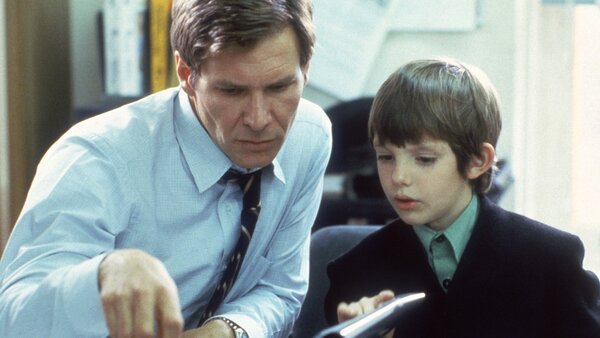
Witness might just be Harrison Ford's greatest film. Despite the accompanying Oscar nomination to back such a statement up, it's also likely to raise a few eyebrows, given Ford's career includes such illustrious acting highs as Raiders of the Lost Ark, Blade Runner, and The Fugitive - movies for which he received immense acclaim and box office success - but it shouldn't.
Peter Weir's 1985 neo noir - of a Philadelphia cop forced to go into hiding with the Amish after a young boy (Lukas Haas) witnesses a murder - is dark, subtle, and nakedly vulnerable, all qualities you could argue made Ford such a compelling leading figure following his emergence in the seventies.
The real genius of Witness isn't just that it tackles what at first seems like a left-field premise with complete sincerity, but that it plays totally and utterly to Ford's strengths as a performer. Australian filmmaker Weir enmeshes the film in the codes and rituals of two societies - the Amish on one hand, and the police on the other - while tapping into Ford's vulnerability and intense sex appeal. His character, John Book, strikes up a star-crossed romance with Kelly McGillis' Rachel Lapp - a recently widowed Amish mother of the previously mentioned child witness - with the pair sharing a pained kind of yearning as their relationship develops in the midst of an unravelling conspiracy.
The end result is something thoroughly unique - a neo-noir romance caught between two worlds, punctuated by sudden, unceremonious violence and cathartic eruptions of love and passion. It's Weir at the peak of his powers, complemented by a haunting Maurice Jarre score and the epic photography of John Seale, with Ford the fulcrum as the embattled detective.
40. 1986 - Platoon

Honourable Mentions: Aliens, Blue Velvet, Ferris Bueller's Day Off
When it comes to the cinema of the Vietnam War, there is a "before" and "after" Oliver Stone's Platoon.
As the narrative goes, before, there was propaganda like John Wayne's The Green Berets and exaggerated depictions like Apocalypse Now and The Deer Hunter; after, there was Hamburger Hill, Dead Presidents, and Casualties of War.
A generalisation, of course, given the overall direction of travel with the genre at the time and the fact that Hamburger Hill - another raw and committed depiction of the conflict - premiered mere months after Platoon, but that shouldn't disabuse anyone of the fact that Stone's film is a unique beast of its own, a trailblazing text from a Vietnam veteran that made tangible a generation's sense of betrayal and innocence lost, as well as the director's own wartime experiences.
Platoon's iconicity has led to repeated parody over the years, but that hasn't dulled its edge. The feud between Willem Dafoe and Tom Berenger's Sgt. Elias and Sgt. Barnes, the use of Samuel Barber's Adagio for Strings - Stone's film remains one of the eighties' most essential.
39. 1987 - Matewan
Honourable Mentions: Evil Dead II, Predator, The Princess Bride
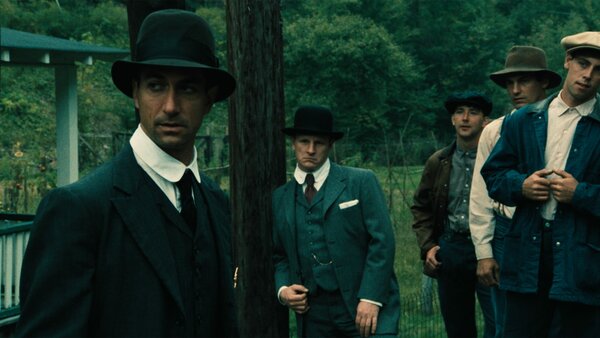
John Sayles' Matewan is essentially eighties kryptonite - a long, fiery parable about one of the darkest chapters in America's capitalist history and the moment the dying embers of the Old West rose to meet it.
Sayles has regularly returned to the theme of a corrupted American past with his films - most notably in Eight Men Out and Lone Star - but Matewan remains his crowning achievement. Set during the West Virginia coal wars, in which striking miners and local law enforcement came up against the power of the Baldwin-Felts Detective Agency and (eventually) the US Army, Sayles' film brought together the likes of Chris Cooper, James Earl Jones and David Straithairn for a teal-toned tragedy that confronted the foundational narratives on which a destructive new economic era was laid upon.
The historical allegory is uniquely gripping, but it's also the case that Matewan's value is propelled by its subject matter being so inherently fascinating. It's a story of gunfighters, organised labour, solidarity, and resistance set during a period conventionally characterised by excess, urbanity and post-war prosperity. In that sense, Sayles' film lays bare the inconvenient proximity of history and does so to anguished completion, delivering a finale without solace or mercy, but one that invigorates all the same.
38. 1988 - Die Hard

Honourable Mentions: Beetlejuice, Midnight Run, Who Framed Roger Rabbit
It's an unfortunate reality that the vast majority of the action films of the 1980s are characterised as excessive cheesefests, antiquated by the egos of their leads and the wanton destruction of their gunfights, because - as many genre proponents will confirm - there is both craft and nuance in them there hills.
If any filmmaker were to exemplify that sense of underestimation, it'd have to be John McTiernan, who proved himself a master of genre subversion during an eight-year period from the late eighties through to the mid-nineties. His 1987 classic, Predator - which is also in contention to be the greatest action film of all time - took contemporary genre icons like Arnold Schwarzenegger and Carl Weathers and placed them within the confines of a sci-fi slasher, while 1990's The Hunt for Red October - based on the Tom Clancy novel of the same name - spotlighted the bookish but determined CIA analyst Jack Ryan as he butts heads with all manner of stringent military archetypes. (He also co-developed 1993's ill-fated but supremely underrated genre tribute/parody Last Action Hero.)
But the action film most commonly regarded to have recalibrated the genre's trajectory is Die Hard, McTiernan's 1988 blockbuster famed for its wisecracking protagonist who gets his ass kicked as much as he delivers the ass-kicking.
Die Hard was famously laughed out of cinemas when its trailer first played, with audiences perplexed that the star of Moonlighting was now duking it out with machine-gun-wielding criminals in a high-rise office building, but that's merely a testament to the transgressive abilities of McTiernan as a filmmaker. He ushered in a whole new era of action cinema, took Bruce Willis from TV to the big screen, and delivered a then-unmatched level of genre spectacle - and it's arguably not even his best film.
(Just don't get bogged down in the Christmas movie debate, for all our sakes.)
37. 1989 - Do The Right Thing

Honourable Mentions: Glory, Indiana Jones and the Last Crusade, The Killer
Although he marked his full feature debut a few years prior with She's Gotta Have It, 1989 marked the major emergence of Spike Lee as a force in American cinema, with Lee bringing seminal comedy drama Do the Right Thing to cinemas and making the words "a Spike Lee joint" something everyone had to pay attention to going forward.
Lee's uncompromising approach to political subject matter - which is often times devastating, defiant, and empowering all at once - was fully formed with Do the Right Thing, which dwelled on racial conflict and tensions in a New York neighbourhood during a scorching summer and featured Lee in an iconic acting performance alongside Giancarlo Esposito, Danny Aiello and John Turturro, among many other considerable talents.
Alongside the masterpiece biopic Malcolm X, which released a few years later in 1992, Do the Right Thing remains Lee's most essential film - a searing deconstruction of America's racial politics, love, hate and community, built with a generational depth of feeling.
36. 1990 - Goodfellas

Honourable Mentions: The Hunt for Red October, Misery, Total Recall
Martin Scorsese had long established himself as one of the finest filmmakers of the 20th century by the time 1990 rolled around, having before that point directed the likes of Taxi Driver, The King of Comedy, and Raging Bull, so it could be seen as the mother of all flexes when he delivered what many consider to be his greatest work so far into his career - a feat he has a habit of repeating every few years.
Adapted from the book Wiseguy by Nicholas Pileggi, which told the story of real-life Mafia enforcer-turned-informant Henry Hill, Goodfellas was Scorsese's first true crime epic - a saga that shifted between the various incarnations of America's post-war self and the greed and violence that remained a mainstay throughout. Technically marvellous and immaculately drawn, Goodfellas boasted an ensemble of Godfather-level proportions, matching regular Scorsese collaborator Robert DeNiro with the likes of Paul Sorvino, Ray Liotta, and a never scarier Joe Pesci, as well as a tremendous Lorraine Bracco.
Not only is it an immaculately realised adaptation, but also the perfect post-script to the end of a decade - and an era.
35. 1991 - The Silence Of The Lambs

Honourable Mentions: Cape Fear, JFK, Terminator 2: Judgment Day
As far as movie villains go, few loom larger than the cannibal psychologist, Dr. Hannibal Lecter. A creation of author Thomas Harris, Hannibal the Cannibal made his literary debut in Red Dragon and his cinematic debut in Michael Mann's criminally underseen adaptation, Manhunter, where he was played by Brian Cox. Manhunter is fantastic - a far better film than the meek 2000s update, Red Dragon - but it has spent much of its existence in the shadow of another adaptation of Harris' works, and one that is, in no uncertain terms, a true masterpiece.
Jonathan Demme's The Silence of the Lambs swapped out the forensic detail and lyrical stylings of Mann's interpretation for something distinctly neo-gothic, bringing to the surface the feminist themes that bubbled underneath Harris' prose and weaving them through the dank basements and skin-garnished cellars that decorated the novel.
Silence is oppressively claustrophobic at times, emphasising not just the vulnerability of Jodie Foster's Clarice Starling but also her resilience. Extreme close-ups amplify Lecter's menace (played to theatrical perfection by Anthony Hopkins), but more pronounced in these moments is Clarice's strength - her vulnerability treated not as a foible, but as an asset that ultimately drives her and leads to the capture of Buffalo Bill.
As controversial as Demme's adaptation was and for all the tropes and imitators that it spawned, Silence still stands out in the buffet of serial killer fiction as a thoroughly sympathetic and human production. It's easy to see why its flamboyance has been deemed exploitative, but ultimately, this is still one of the most sensitively drawn examples in the genre, and a more than worthy Oscar knockout.
34. 1992 - Twin Peaks: Fire Walk With Me

Honourable Mentions: Hard Boiled, Malcolm X, Unforgiven
1992 is an exemplary movie year from an exemplary movie era, boasting a magnum opus from Clint Eastwood in Unforgiven, the pinnacle of Hong Kong action with John Woo's Hard Boiled, and an intoxicating dose of gothic horror from Francis Ford Coppola with his adaptation of Bram Stoker's Dracula. While those films were immediately canonised as modern classics, enjoying cult and awards success in equal measure, there was one masterpiece from the same year that wasn't so fortunate - one that came from one of our most celebrated but now sadly departed auteurs.
Twin Peaks: Fire Walk With Me is a crucible of a film - a prequel to a televised phenomenon where levity is light and pure, unvarnished horror engulfs completely and utterly. It was made in the aftermath of a creative ruction. Twin Peaks co-creators David Lynch and Mark Frost had seen their series plans upended thanks to the interference of ABC executive Bob Iger, which in turn led Lynch - whose vision also differed from that of Frost's - to end the show on an incredible yet gutting cliffhanger with its cancellation.
Fire Walk with Me entered into production soon after, with Lynch determined to explore the tragic character of Laura Palmer, who viewers had only come to know through the judgment and interpretation of Twin Peaks' residents and the intrepidly empathetic FBI agent Dale Cooper (Kyle MacLachlan). With his film, Lynch sought a cathartic and thematic post-script to the series' explorations of love and evil, and the end result - lacking in much of Coop or the quirkier components that endeared Twin Peaks in its initial airing run - was inevitably divisive.
Lynch's prequel is less a replication of the tonality of the show and more a long, pained scream - a fierce recontextualisation of the complex young woman who lived in death. Sheryl Lee's performance as Laura is a tempest of emotional torture and anguished release, with Lynch stoking the flames to newfound heights of terror and vulnerability before the credits roll.
33. 1993 - Schindler's List
Honourable Mentions: Carlito's Way, The Fugitive, Jurassic Park
1993 was a momentous year for Steven Spielberg. One of the defining filmmakers of the seventies and eighties, Spielberg had emerged from the blockbuster successes of Jaws and Raiders of the Lost Ark with a string of critical and commercial hits that consistently belied a deeply introspective core - one that drew upon the filmmaker's childhood and parental trauma, which came full circle with his semi-autobiographical film, The Fabelmans, in 2022.
The past has long been a propellant for Spielberg. It was his father's aviator history during World War II that took him to Empire of the Sun in 1987, and his Jewish faith that compelled him to tackle one of the most horrific moments in humanity's history, the Holocaust, with Schindler's List in 1993.
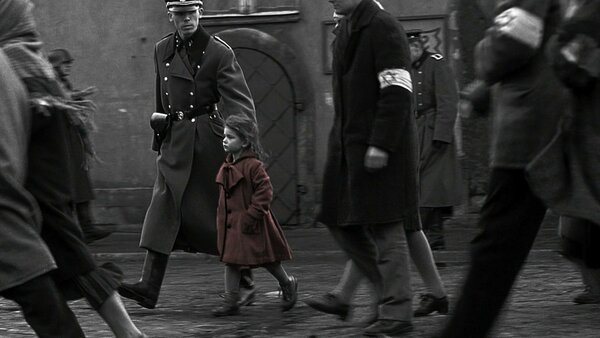
The weight of the story was both crushing and jarring for the director, who had also been conducting post-production on the comparatively trivial-seeming Jurassic Park while shooting on the Holocaust biopic was underway. But that weight, the two-and-fro of Spielberg's relationship with his Jewish faith and identity, yielded an appropriately profound and devastating cinematic portrayal, the decision to shoot in black and white emphasising the darkness of the historical moment whilst also seeming to further animate the brutal wartime photography that emerged from the Nazi concentration camps as the Allies advanced into Germany.
Schindler's List is landmark cinema, and possibly Spielberg's crowning achievement as a filmmaker.
32. 1994 - Pulp Fiction

Honourable Mentions: Chungking Express, The Lion King, The Shawshank Redemption
Forget all the stale discourse about "bro cinema" for a second or two, because Pulp Fiction is still every bit the masterpiece it was when it premiered in 1994.
The reputation of Quentin Tarantino's sophomore directorial effort has taken a bit of an online beating over the last decade, mostly due to its association with teenage bedroom decor and by proximity its place within the canon of conventionally male movie tastes (upon which sits The Shawshank Redemption at the peak).
But the discourse is the discourse, and it ultimately has no bearing on the technical and storytelling merits of Pulp Fiction as a piece of cinema - a film resplendent in its affection for genre filmmaking and packed to the gills with cutting dialogue, groovy tracks, and brilliant performances.
It is not, perhaps, Tarantino's greatest technical achievement, but it is sumptuous cinema and quite possibly the most iconic film of the early nineties indie renaissance.