Star Trek Picard: 7 Ups & 3 Downs From Episode 1 'Remembrance'
To boldly go... again.
Wow. When the credits rolled on Star Trek: Nemesis in 2003, few would have predicted that it would be 17 years before we'd see Captain Picard again. Indeed, once JJ Abrams unleashed the Kelvin Timeline on the world, it seemed that our best chances of seeing anything even resembling a Next Generation revival would involve some manner of ill-advised reboot in 30 years time.
Not the case though, as this week saw the launch of Star Trek Picard on CBS. Set some decades later but narratively picking up where the loosely-mentioned events of Star Trek 2009 left us, Patrick Stewart returns to the role that made him a household name in the last millennium, and is joined by faces both familiar and new. Retired from Starfleet, opting instead for the quiet life on Earth he so sternly shunned during his years of service, both he and the galaxy have changed a lot in the time we've been away.
But while other beloved franchises have found new life in recent years, this is a weird time for Star Trek. With Discovery dividing audiences and a rumoured 4th film never quite managing to get off the ground, Picard has an uphill task before it's even left spacedock. Could it deliver on an exciting premise? Well, let's find out.
Downs...
3. The Pacing
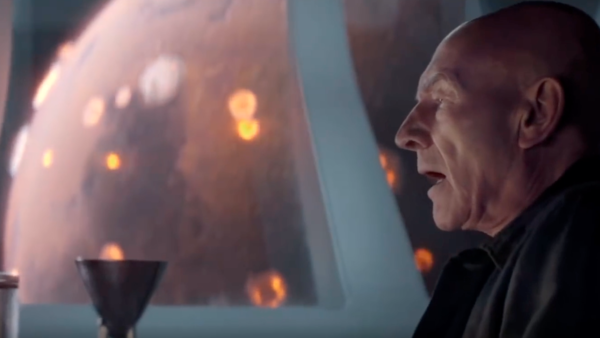
Ostensibly, Remembrance is less an opening episode of a series as much as it is a primer for the world the show wants to be set in. The real story looks like being an intergalactic heist of sorts where a rag-tag crew, led by a retired legend with a point to prove, battle shadowy political forces and their own demons. Remembrance, by contrast, was about an old man decided he needed to get out of the house more.
This in itself isn't a criticism (and obviously it was about a lot more than that) but given the decades-long gap the show needs us to get to grips with it absolutely rattled through the scene-setting. In the space of 45 minutes we've been shown precisely how the galaxy looks post-Supernova, how society looks post-Synths, how Picard looks post-Starfleet, and how Picard looks post-Picard. We've also said a frantic hello, and shocking goodbye to Dahj.
By rights, all of this would have been enough to inform a number of different episodes. Indeed a lot of the core themes - especially the Synth ban and attack on Mars - would have benefitted from a full episode to really let audiences get to with them. As it was, a number of major topics simply raced past like a starfield in Ten Forward's window.
2. To Boldy Go Where Everyone Has Gone Before
To some fans this categorically won't be a problem (and, yes, hello, I'm one of them) but the major criticism coming Picard's way after Remembrance is that a lot of its major tropes have been done many, many, many times before. Darren Franich from Entertainment Weekly summed it up succinctly...
Premonition dreams wedge in a dead-character cameo. New character Dahj gets the Jason Bourne intro: A regular person, so whoooaaaaa where’d the badass martial arts moves come from? Jean-Luc Picard returns with a mad-as-hell televised speech, such a tired way to launch a show that Aaron Sorkin already did it twice. The dynamic between Picard and Dahj suggests one Star saga playing catch-up: He’s the famous elderly hermit unretiring for one last job, and she’s Palpatine’s granddaughter, more or less.
While there is absolutely nothing wrong with treading old boards, sci-fi series are always expected to be ones that push us in new directions. It's too early to label this a major problem with the show as, after all, this episode was more about preparing us for the journey to come, but going forward fans will want to see something more original.
1. Imagine Not Being A Big Star Trek Fan...

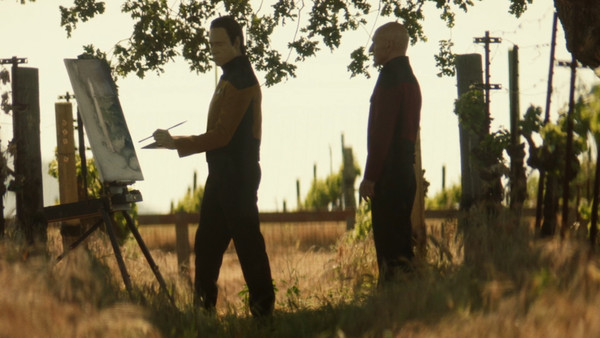
As you'll see over the rest of this article, there was so much - so much - for Star Trek fans to absolutely adore about this episode. It drops us back in to, arguably, pop culture's richest world of lore and doesn't waste time spelling out who or what anything is. With so much to cram in, it can't afford to tell us what a Starfleet is, why an android would bother painting, or why the hell you'd call a dog Number 1. We know all this.
But imagine if you didn't? Imagine if your interest in Star Trek extended as far as "casual". Imagine if you didn't watch Nemesis, or didn't pay attention to Spock's one scene of exposition in 2009? Imagine if you preferred Voyager, or hadn't given any of it a second thought in years?
A chunk of fans, and probably a good chunk of them as well, will be in one of these boats. Dropped back into this world without so much as a primer to hold your hand, so little of this episode will have made complete sense to you. Now, The Witcher has recently proved that you can get away with this provided your stories and characters are engrossing enough, but it remains to be seen how much of the audience will stick around to find out.
Ups...
7. That Opening
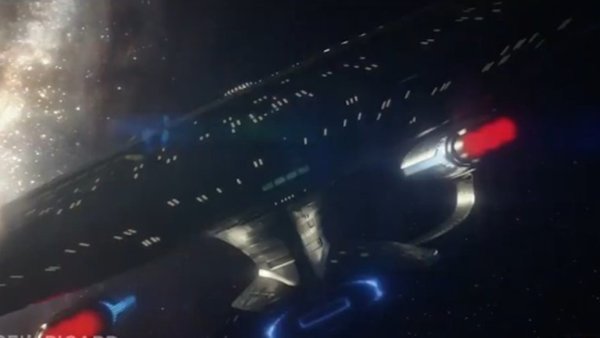
You only get one shot at a first impression, and Picard could not possibly have done a better job. Space, still the final frontier, some gorgeous VFX shots of a vivid nebula, the Enterprise-D rendered in pristine condition, and the track Bing Cosby's Blue Skies rolling away in the background. Not a single fan will have watched this opening minute and not made a gentle "awh" noise.
From there we're dropped back into Ten Forward, usually, the Next Generation's home of calm, reassuring exposition, to find Picard and Data indulging in a card game and some tea. A huge reward for big TNG fans, who'll remember that the series' final episode went off the air to the sight of Data dealing cards to his Captain.
After a back-and-forth that honestly feels like neither the show nor the characters have ever been away (let alone since 1994 and 2003 respectively), we're jolted into a terrifying nightmare of an exploding Mars before Picard wakes up in his home back on Earth. Visually and narratively gripping, there haven't been many better series openings in the last few years.
6. Strange New Worlds

Every long-running franchise that successfully navigated the turn of the millennium has done one thing consistently. They've gone dark.
Christopher Nolan took Batman out of tights and rubber nipples to produce the greatest comic book movie of all time and, in the wake of that, "dark and gritty" has become the norm. Christ, even the Transformers now use a muted colour palette and make grandiose philosophical points about the human cost of warfare.
Picard's entire premise centers on the 900 million displaced Romulans who fled the Supernova, as well as the Synth attack on Mars that killed over 92,000 people and ended Starfleet's interest in helping the refugees. Comparisons have already been made to both the 9/11 attacks and Hurricane Katrina in the United States.
While these might be a little bit on the nose, the show is definitely trying to paint a picture of a damaged, suspicious and deeply secretive universe; a long-way removed from the utopian ideals the Federation had previously presented us with. Pulling this tone switch off might be Picard's greatest challenge, but the early signs are promising.
5. The Abrams Influence
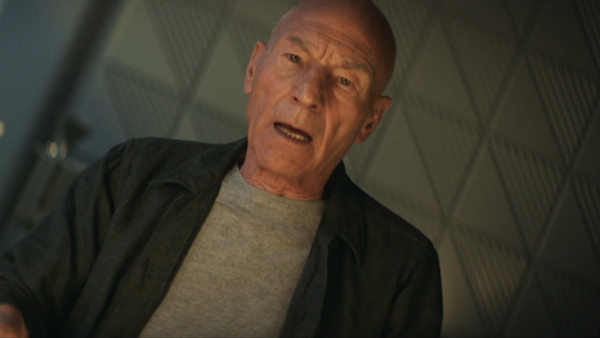
It'll not be universally popular, but in Picard you can categorically feel the hand of the modern Trek movies. It's not loaded with lens flare and, as yet, there's been not a single note from The Beastie Boys, but there's a few subtle nods here and there. Just enough, I'd argue, to make the show feel consistent with its own present, rather than at odds with its own past.
Given that the series was co-created by Alex Kurtzman, one of the men responsible for the 2009 Star Trek reboot this was, perhaps, inevitable. Our opening scene that sees the camera close in on Picard at an awkward angle as the frame shakes and explodes around him is Abrams Filmmaking 101, and a lot of the scene-setting that follows on earth feels like it's taken directly from Into Darkness.
While this style won't be to everyone's tastes, shooting Picard with the same style as a 90s TV show would have been a disaster once the novelty factor had worn off. Modern TV has a cinematic care to everything, while 20+ episode seasons used to be filmed more like soap operas than anything else. To see a classic Trek story, and the people who inhabit it, realised this way is long overdue.
4. The Nostalgia
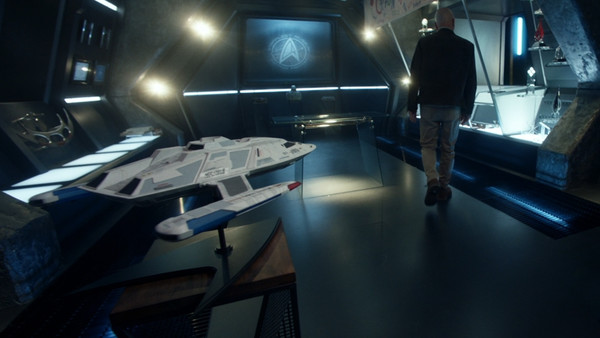
Arguably the hardest job Remembrance had was how to find the right balance of nostalgia. Too much and it was just going to feel like trivial fan service that should have been restricted to a one-off special web episode, too little and it just wasn't going to feel like a natural continuation of the world we left behind in The Next Generation.
Opening with the Enterprise-D in a dream sequence was a smart opening and using Data in short and important bursts fell just on the right side of cynical. But the real masterstroke on the episode was leaving everything else to a living vault of Picard's service; metaphorically (and literally) locking away all of the nostalgia in an almost museum-tour of a scene. One that's already been paused, screengrabbed, and shared ecstatically online.
More subtle references to the Daystrom Institute, Utopia Planitia, problematic replicators, and, of course, Earl Grey tea will have rewarded long-term fans. Every location and nod feels perfectly judged as the show attempts to push forward into something new, and hopefully what's introduced here will become important Trek lore on its own terms for years to come.
3. Treasure Hunting
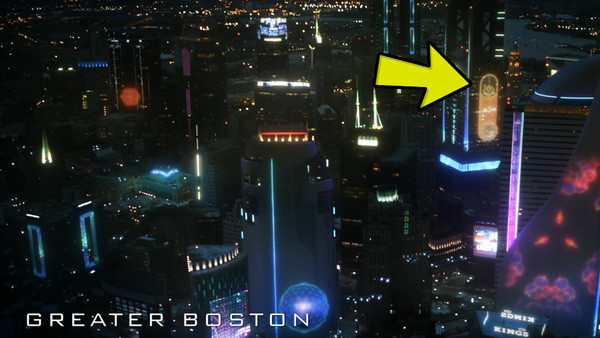
Directly linked to the nostalgia point I've just made but rewarding a very, very different sort of fan service, Picard appears to have nailed the viewer's modern thirst for easter eggs. One of the few elements of Discovery that everyone seemed to agree on was brilliant was how much fun it seemed to have with this stuff. Nods and winks to upcoming events, sly little jokes about Trek tropes and, ironically, even a bottle of wine for Chateau Picard.
Between sweeping shots of earth and the aforementioned treasure trove at Starfleet HQ, Remembrance is littered from start to finish with amazing little finds. Shakespeare, the Ferengi, Spock, there's all sorts tucked away in there and, lukcy for you, we're already done an entire article on it...
Star Trek Picard: Every Easter Egg & Hidden Reference From 'Remembrance'
2. Maddox

Star Trek: The Next Generation is a treasure trove of dangling threads. Smartly choosing not to wrap anything up as it went off the air, it provided sufficient narrative tangents for the creation of both Deep Space Nine and Voyager, with more still left over for three feature films. Even heading into Picard, nearly two decades after it went off the air, there were still storylines from the show that were just begging to be picked up.
Enter (or at least enter a mention of...) Commander Bruce Maddox. Featuring in only a solitary episode of TNG he was one of the Federation's most prominent researchers in robotics and, in 1989's Measure of a Man, takes Picard into a courtroom to argue that Data has no human rights. The show gifts us some of its best-ever writing, and his case is thrown out.
Remembrance tells us though, that he's been busy. Recruiting Doctor Agnes Jurati, he develops his theory of fractal neuronic cloning; which Picard suspects has been used to create Dahj and Soji, two twin, flesh and blood androids from a single positronic neuron of Data's brain. He disappeared after the Synthetic attack on Mars, hasn't been seen since, and looks like playing a major role in the show. A masterstroke.
1. Patrick Stewart

It goes without saying that The Next Generation would have been nothing without Patrick Stewart, but nonetheless it still felt like a huge gamble to base an entire new Star Trek series on a solitary character. The shows, all of them, have excelled because of how wonderfully they play off the different relationships of several major players. Geordi's relationship with Data, Data's relationship with Picard, Picard's relationship with Worf, Worf's relationship with Troi, Troi's relationship with Riker, on and on it goes.
About 15 minutes into Remembrance, Picard sits down for an interview with a particularly pushy reporter. The scene serves to rush us through the events that led to Picard's resignation from Starfleet, but it also shows us that no other actor, no other character, could have made this show possible. Patrick Stewart, even at 79, has not lost a single flame of the fire that he brought to this role.
Wherever the show goes, and wherever the story takes us, he'll keep people tuning in week on week regardless. It's a viewing privilege to have him back in the role.