Star Trek: Everything We NOW Know About The Lost Era
Is Star Trek's greatest yet forgotten era just a little less lost these days?
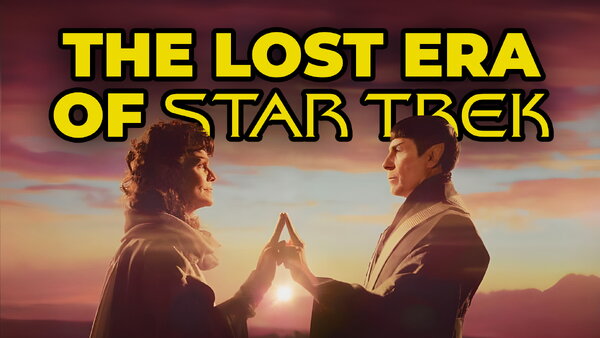
As with any great mystery, Star Trek's so-called 'Lost Era' has offered researchers a wealth of possibilities for decades. Spanning the years between the launch of the Enterprise-B and Captain Picard taking command of the Enterprise-D, so roughly 2293 - 2364, the Lost Era saw two Enterprises, interstellar conflicts, occupations, and raptors' wings.
It was a time when the galaxy was still largely uncharted, years before Voyager arrived in the Delta Quadrant, or the discovery of the Bajoran Wormhole. Empires were shadowy, ships were undermanned, and secret agencies operated outside of tracked territories.
In 2025, two new canon entries to the franchise offered more context for this period. Star Trek: Section 31 was set in the early 2320s, featured a future Enterprise captain, and saw a crossover with another universe. Star Trek: Khan, set thirty years earlier, depicted Starfleet at an earlier stage of exploration, though one still focused on discovery and truth.
These new entries to canon also add to our previous exploration of the Lost Era.
Where these examples expand the canon is also where the canon must become malleable. There are dozens more examples of what was happening during that period, many of which have now been canonised on screen. It is not enough to simply open a history book and trace events through time. Canonisation must now come with context, and that context with explanation.
As a writer and sometimes historian, this really is one of the fun parts of the job!
10. Looking Forward To Look Back - The Truth Of Ceti Alpha V
If we consider the revelations from Star Trek: Khan as a prelude to the Lost Era, understanding the events that transpired during the Augments' exile on Ceti Alpha V provides more context for the subsequent events.
We have long known that Khan and his remaining followers commandeered the USS Reliant in 2285, with the ensuing battles resulting in the death of Spock. Until 2025, Khan was a single-minded villain, ushering in a new era for Starfleet.
By the time the Excelsior heads to Ceti Alpha V, months after James Kirk 'died' in 2293, the records surrounding Khan's exile had been sealed. This was, we discovered, part of the standard process of classifying any deceased captain's logs. Dr Rosalind Lear, though her motivations were self-serving, was instrumental in clearing Kirk's name of any wrongdoing in regards to the exile.
In short, the decades-long debate as to how the Enterprise didn't know Ceti Alpha VI was unstable is settled. There were instabilities, but nothing to suggest an explosion so soon after Khan's arrival.
While these discoveries do nothing to exonerate the Augments who murdered the team on Regula 1, marooned the crew of the Reliant, and caused the deaths of so many aboard the Enterprise, they do help to explain what drove them to madness. This mission, coming so soon after the events of Star Trek: Generations opening act, is crucial to understanding the foundations of the Lost Era.
9. Why Did Tuvok Leave The Service?

Tuvok, it was established in Star Trek: Voyager, left Starfleet for several decades, early in his career. Until the revelations in Star Trek: Khan, the only reason the audience had been given was Tuvok's discomfort around humans in general.
Flashback depicts one of his earliest missions aboard the USS Excelsior, roughly two months out from Starfleet Academy. Despite trying to make a good impression on Captain Sulu with tea, he was not opposed to voicing his opposition to his commander's violation of orders. He had also previously vocally opposed the Federation's peace talks with the Klingon Empire.
Khan depicts Tuvok in the months following the launch of the Enterprise-B. He was still serving aboard the Excelsior and was assigned to surveil Dr Rosalind Lear. This raises an ethical dilemma for the young Vulcan. Lear's discovery of the Augments' conditions post-exile, as well as the revelation that she herself is the daughter of Khan Noonien Singh, broadens Tuvok's understanding of humanity. Despite Captain Sulu's resentment toward Khan and the Augments, Tuvok vows to fight for their rights in his career going forward.
With this context, it can now be surmised that the reason for his departure from Starfleet was, at least in part, due to the conflict he must surely have encountered in his search for equal rights for Augments. Though this affects only a single Vulcan, it also presents the late-23rd and early-24th Centuries as still being unkind times for Augments to live through.
8. A Nexus Of Possibility
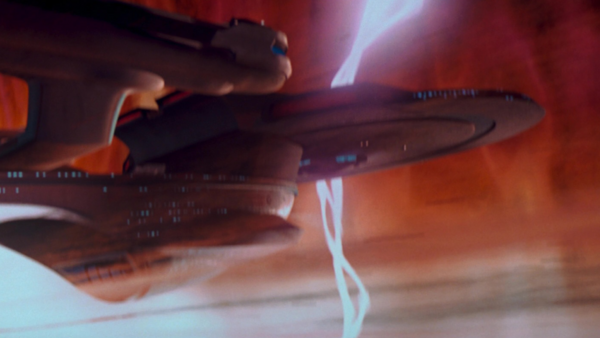
In 2332, the Nexus energy ribbon returned to our part of the galaxy. Though time has no meaning within the phenomenon, one could also say James Kirk came along with it. This takes on a deeper significance when one considers the Lost Era novels The Art Of The Impossible and Well Of Souls.
James T. Kirk captained two Enterprises and was, of course, present for the maiden voyage of a third. 2332 is the year in which another Enterprise - this time the C, under the command of Rachel Garrett - was launched.
We now know that the Nexus is connected to the name Enterprise, having been present at the launch of two and the destruction of a third. The Enterprise-D's demise over Veridian III was followed by the ribbon swooping in to carry Soran and Picard away, moments before a massive shockwave obliterated the survivors. Don't worry, they got better—Timey wimey.
Had the Nexus simply returned any other year than 2332, it would be just another space curiosity with a very mixed reputation, travelling through space on its path to eternity. The specificity of that year connects the Enterprise lineage to the passing of a commander, the survival of another, and the entrenchment of another in the annals of history.
7. Some Nights On The Baraam

By the early 2320s, Starfleet had begun to grow into the further reaches of the Alpha Quadrant, though the borders of Federation space were still edging on the wild west of the unknown. Enter Section 31, now roughly two hundred years ago, and still operating from the shadows.
A large space station resembling a Christmas tree ornament named the Barram sat just beyond the edge of Federation space, controlled by one Phillipa Georgiou. She, formerly of the Terran Empire, operated a largely lawless facility, which was ideal for illicit trades and deals. This quickly drew attention from Alok Sahar, a Section 31 operative who was looking good for his age.
The station was surrounded by several vessels that resembled one that would come in contact with the Enterprise-D in 2368, some fifty years later. Dubbed 'the Smuggler's ship,' it was heavily armed, though it could easily fall foul of a well-placed phaser blast. Star Trek: Section 31, set in 2324, depicts a fleet of these vessels, which now suggests they may be part of their own Federation of smuggling. To be fair to the one that explodes after Worf fires on it, it may have been fifty years behind the times.
Behind the times could also describe both Georgiou and her former flame and friend, San, who have both time-hopped as well as universe-hopped. There must be some decent geriatric care on that station because Georgiou looks well for her 120s, as she was born in 2202. This portion of the Lost Era is still largely mysterious, at least in this section of the galaxy. While Georgiou was trading jibes with future Enterprise captain Rachel Garrett, the eyes of the galaxy were looking elsewhere.
6. Not The Last Chameloid

The jury is still out on this one. Are the Chameloids an offshoot of the Founders? Are Marta and Quasi two of the one hundred infants sent out into space to explore? Are they adopted siblings of Odo and Laas? Or are they another mysterious race, of which we know very little?
Marta was introduced in Star Trek VI: The Undiscovered Country, where she displayed her shape-changing abilities during the escape from Rura Penthe. Though her journey was brought to an unceremonious end on the frozen surface of the penal asteroid, she was not the last of her kind.
Quasi, a golden-eyed and awkward being, forms part of Alok Sahar's covert Section 31 team aboard the Baraam. He is in complete control of his shape-changing abilities, though he is still mastering social interactions. One could argue - fair enough when the other person doesn't know who or what you really are. It's always best to put your best goo forward, so to speak.
Quasi survives San's attack, while also helping Garret seemingly kill Fuzz, the 'Irish' nanoken interloper. Nothing is known of his exploits beyond his final 'your momma' joke, though he may have been one of several shape-changing people in the galaxy. Over on Daled IV and Klavdia III, there is yet another race that can seemingly change shape at will. Demonstrated by Salia in 2365, their natural form is a gaseous state in a roughly humanoid shape, suggesting they are different from Chameloids.
However, in 2375, Odo became a cloud to give Colonel Kira Nerys a special hug, so who really knows at this point?
5. Shakespearean Augmentation
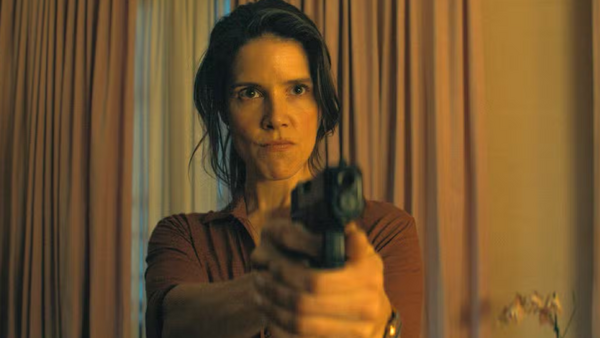
So, Khan Noonian-Singh has a surviving daughter...
Dr Rosalind Lear, clearly named for her father's admiration of the Bard, is revealed as Khan's child in Star Trek: Khan. Though in reality, there was very little shock in this bit of news, the implications could have far-reaching consequences for the quadrant at that time.
The Excelsior journeyed to Ceti Alpha V in the months following Kirk's apparent death aboard the Enterprise-B. Lear was then in her twenties. The twist, for the audience, was less that she was Khan's daughter, and more that she was fully aware of this. The closing moments of Khan reveal that she is very much alive and active, with Ensign Tuvok pledging to fight for the rights of Augments.
As Voyager historians will know, Tuvok then left the service for several decades (thanks a bunch, Tuvok), leaving Lear without an ally in Starfleet. Though she had dedicated her career to the pursuit of historical truth, she is also one of the last remnants of that age of eugenics in Earth's history. While Alok Sahar was at least a contemporary of Khan's, he is locked away as part of Section 31. He may seek Lear out once her parentage is revealed, though as of writing, that remains unknown.
Khan Noonian-Singh, he of at least several nieces (one of whom served in Starfleet in the 2250s and 60s), may be dead and gone, but his progeny lived on. Is Lear doomed to repeat her father's curse? Is the galaxy, now without Tuvok's support from within, ready to ostracise yet another augmented individual? We know that by the 2370s, genetically engineered people were still barred from serving in Starfleet. What life did, or possibly does, Dr Rosalind Lear face during the Lost Era?
4. The Adventures Of The USS Leondegrance
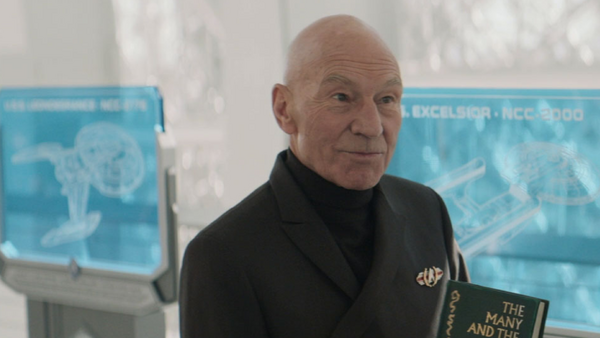
The USS Leondegrance entered service in the later years of the 23rd Century, remaining operational until the 2330s. From 2301 to 2305, Captain Nyota Uhura took the ship on an exploratory mission of the Lesser Magellanic Cloud. On that mission, the ship made first contact with over one hundred new species.
What exactly the Lesser Magellanic Cloud is or constitutes lacks clarity. The Leondegrance's commemorative plaque names it so, though it could be a reference to the Small Magellanic Cloud that sits outside the borders of the Milky Way Galaxy. Though that may cause havoc with the starship, as demonstrated in Where No Man Has Gone Before, Uhura herself travelled outside the Galactic Barrier in By Any Other Name. In short, we shouldn't make any assumptions.
In 2317, the ship was retired from active exploration and became a training ship, aboard which many new Starfleet officers and cadets broke the light-speed barrier for the first time. One such individual was Jean-Luc Picard, who received his entry certificate for the Faster-Than-Light-Club here. This was later seen in his vault in Remembrance.
The Autobiography of Benjamin Sisko further states that Captain Sisko's maternal grandparents served aboard the ship, further connecting the various generations of Starfleet officers during this Lost Era of history.
Captain Uhura remained in charge of the ship until her retirement in 2333. There were plans for a Short Trek to depict an elderly Uhura mentoring a young Jean-Luc Picard, but sadly, this never came to be.
3. 2309

2309 was a great year for the Siskos, with Joseph Sisko being born in this year. Klingon Blood Wine produced a vintage that, according to Martok and Kor in the 2370s, had never been surpassed. For all things good, some things are evil. For the Bajorans, it was a very, very bad year.
2309 was the year in which the Cardassians first arrived on Bajor, promising to help them grow their resources, while secretly planning to strip the world of everything it needed to survive. For nearly six decades, the Union plundered the homeworld, forced its inhabitants into poverty and starvation, and used slave labour to prosper. By the 2360s, the Bajorans (or Bajora) were an almost entirely nomadic race, though the resistance kept the slame alive.
Full control over the planet began in 2319, though the previous decade saw the Cardassians firmly establish themselves as the future rulers. Several different sources place the actual years of Occupation at different times, including as late as 2328, though it roughly takes up the first half of the 24th Century.
Before the loss of the ship, the Enterprise-B was assigned to patrol the Cardassian border and to help fleeing Bajorans. Much like several contemporary examples today, Starfleet opted not to get involved, leaving the overpowered world to fend for itself, though it did occasionally provide aid where possible.
2. Spock and Saavik Are Married
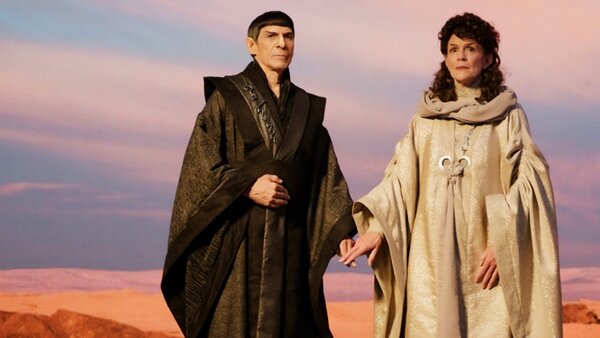
By 2329, 'Sarek's son' was married in a ceremony that was attended by Jean-Luc Picard. As Sybok, Sarek's currently only known other son, died in the 23rd century, that suggests it was none other than Spock himself who was married. Thanks to sources like 765874: Unification and the novel Vulcan's Heart by Josepha Sherman and Susan Shwartz, we know that he was bonded to Saavik.
While both sources could be considered apocryphal, seeing Saavik with their son, Sorak, in OTOY's short film, released in 2024, seemingly confirms that Spock did not die childless, that Saavik survived into the 24th Century, and that there was, at least, a partial family reunion.
Saavik's career after her tenure on the Enterprise and Grissom is also given more depth in Star Trek: Picard. She captained the original USS Titan, with the Titan-A carrying a shuttlecraft named in her honour. While saying that, this shuttle is destroyed quickly after the ship arrives in the Rytan system. Perhaps it is best to concentrate on the positive elements of what we've discovered - such as her continuing to thrive through the 24th Century.
Much of Saavik, Spock, and Sorak's lives through the Lost Era is unknown. While Vulcan romance and family life may look a little different from what humans are used to seeing, it is still cathartic to imagine that they had, in a way, their own happy ending.
1. What Hope Is There For The History Of The Future Now?

TrekCulture has never shied away from espousing its interest in the Lost Era. There is a wealth of opportunity to explore Starfleet's growth from the wild west of Kirk and Sulu's days to the relative stability of Picard's. The quadrants take a beating in the latter half of the 24th Century, whereas the early half was about establishing peace.
What of the Tomed Incident? What of the Detrappa Nebula skirmish?
With the franchise's focus on the future and Starfleet Academy's 32nd Century setting, the chances of exploring these lost years seem increasingly remote as the years pass. We may never get a Star Trek: Legacy, though, what of a Star Trek: The Lost Years series?
Perhaps unlikely, and this may be an idea relegated to expanded media, but if Beta Canon has taught us anything, it's that every ship in the fleet has its own story to tell. There are two Enterprises whose exploits are largely unknown.
The chances of exploring the history of the Lost Era on screen are fleeting, but we shall never say never. No one expected a Khan mini-series to bring Tim Russ and George Takei back to Star Trek, and then it happened. Starfleet Academy teases us all with their Wall of Heroes. Many of those stories still need to be told.
And we will be ready and waiting for them once they are.