Star Trek: 5 Literary Precursor Captains To James T. Kirk
 Why do I love Captain James T. Kirk so much? His leadership skills? Is it his tactical genius or his love of history? It could be the self-developed double hammer-fist, judo-flipping, flying drop-kick style of martial arts? What about his way with the ladies? Granted, that last one would be pretty much worth all of them put together, but that would make me a pretty shallow person and end anybody's interest in reading this article all together. So let's not explore that option too much. But there are a number of other heroic qualities about Kirk that make him a compelling character. For one thing, there's his loyalty. Kirk is always the first member of a landing party. Granted, that's more of a story device than a tactical decision. But what makes a great story is an unbeatable hero, rushing into a fray to confront the enemy. Kirk will sacrifice himself for crew and friends in a heartbeat and there are a number of occasions when he has placed himself on the altar to sacrifice himself for the sake of his command. Look at Star Trek II: Wrath of Khan, for example. In order to protect the mauled Enterprise from Khan's surprise attack, Kirk willingly offers to beam himself over to the Reliant. There are some friends or family who wouldn't offer that level of commitment, but in a matter of mere seconds, Kirk instantly puts his life on the line without hesitation. The other quality Kirk has going for him is the force of sheer bravado that permeates his tactical abilities. Kirk has faced a dreadnought-sized battleship in the TOS episode "The Corbomite Manoeuvre" with nothing but a simple bluff. Sure enough, the enemy backs down from his faked distress call to Starfleet that indicates he will detonate a massive explosive to prevent the Enterprise from falling into enemy hands. Or what about "The Enterprise Incident", when faced with overwhelming odds of three-to-one, he fakes his death, disguises himself as a Romulan and steals the Romulan Empire's most strategic piece of technology and manages to escape with his ship intact. Sheer balls ... of Romulan plasma energy weapons aside, Kirk makes tactical guesses that are innately decided to the moment, taking into account all of the resources he has at his disposal. Hey, remember that this is a guy who does NOT accept the concept of a "no-win scenario". Kirk just sees options that the rest of us wouldn't. What about his charm? For a leader, it's essential to be able to persuade people to your point of view. He's the consummate "cowboy-diplomat" we saw in "Journey to Babel", placating violent Tellarites and even convincing Vulcans with his passion (his passion! Come on!), Kirk knows the right thing to say to enlist the support he needs. Shatner soliloquys aside, one cannot help but be moved by the impassioned speech to Commander Kang in "Day of the Dove", when he needs the Klingon to stop fighting and drive the alien intruder from the Enterprise. He manages to stop a Klingon from fighting and convinces him to have a good laugh at the same time. But where does all this come from? The influences can be seen in previous works of literature. Trust me they're there if you know what to look for. There are five characters that immediately come to my mind. If you've heard of them, maybe you can see the similarities. If you haven't heard of them get thee hence to a library, post-haste!
5. Captain Horatio Hornblower
 Take Captain Horatio Hornblower from C.S. Forester's "Hornblower" series. Hornblower begins his career as a midshipman but it's his stints as captain and leader that provide inspiration for Captain Kirk's character in Star Trek. In Forester's "Ship of the Line", the self-conscious captain is completely aware of the fact that he needs to enlist hands for HMS Sutherland. Instead of looking down on the handcuffed, gaol-supplied convicts who would have resented taking punishment as service at sea, he wins them over by immediately ordering their handcuffs released and addressing them as honourable men with a glorious career at sea before them. Of course, he is desperate for crew and in early 19th century England, pressed crew was the best that a captain could hope for when short of men. Still, he approaches the simple act of greeting new crew members as a leadership opportunity and succeeds wildly in a total Kirk manner. It's a ballet of tactical manoeuvres to read Forester's account of Hornblower defending the merchant ships in his convoy against two French privateers. Even with its inexperienced crew, The HMS Sutherland weaves in and out of the convoy, dodging the big, bulky freighters and manages to position itself to deliver volley after volley of the ship's 74 cannons at the enemy French vessels. Throughout the battle, Hornblower notes his crew's deficiencies but wears an iron mask of mental concentration as he makes multiple calculations in his head: trajectory of the opposing ships, their speed and the direction of the wind in addition to the other factors at play. The immediate battle zone is a chaotic mess of freighters, ships-of-the-line and privateers yet Hornblower is able to stand on the bridge of his ship and calmly survey the whole situation and deftly pilot the ship to victory, driving the French attackers away, defending the convoy. Does he take joy from this? No he is merely relieved at crippling one enemy and driving off the other. In fact, his rage at the crew's excitement of winning the encounter is because of the errors he calmly noted during the action. It's very much like Kirk's own reaction to being surprised by Khan's sneak attack in Star Trek II: The Wrath of Khan. To the exclamation: "you did it, Sir!" He rounds on the speaker and shouts: "I did nothing! Simply got caught with my britches down!" Though Kirk saves the Enterprise from sure destruction, he is simply relieved by driving Khan away. Both captains display their respective tactical genius, but neither takes any pleasure from it.
4. Captain Jack Aubrey
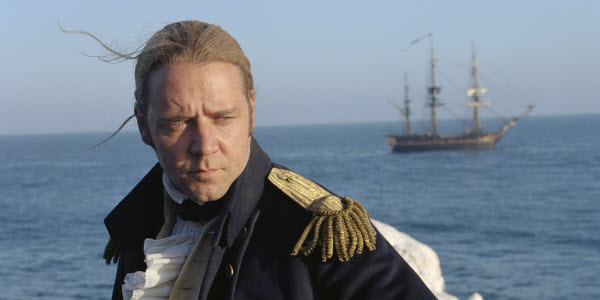 Patrick O'Brian's Lucky Jack Aubrey is another one of those dynamic captains who loves his ship as he does his own life. He served on the HMS Surprise when he was only a boy midshipman and rose through the ranks to be its captain. The crew know this and revere him for it, pointing out his initials carved into the bowsprit to younger members of the crew in Master and Commander. When Aubrey gives a command, he knows how much the ship can take, as it's remarked that there's as much of the captain's blood in the ship as there is in his body. Though Kirk never served on board the Enterprise as a boy, he is as bound to her as Aubrey. It's a relationship that comes out in the episode "The Naked Time", when instead of a beautiful young yeoman to love and hold, he remarks about the cold, relationship between him and his ship: "This vessel, I give, she takes. She won't permit me my life. I've got to live hers." Kirk knows the breaking point of the Enterprise as well as Aubrey knows the Surprise's. When Aubrey takes his ship around the Cape in pursuit of the French Privateer Acheron, he strains the ship's mast, nearly breaking it. Eventually, he is forced to break off the pursuit, recognizing that his ship can't take the strain. In "Balance of Terror", Kirk accelerates the Enterprise past its safety point to escape the Romulan warbird's plasma torpedo. He too, realizes that his ship won't be able to escape the weapon but luckily, he discovers that the warhead's energy level dissipates with distance. Luck is another trait that Kirk shares with "Lucky" Jack Aubrey.
3. Captain Buck Rogers
 Buck Rogers was originally a short story-pulp fiction hero in the 1920's created by Phillip Francis Nowlan. He is more recently remembered in the 1980's TV show created by Battlestar Galactica's Glen Larson, starring Gil Gerard and Erin Gray. Just as an aside, I ran into Erin Grey in Toronto a couple of years ago, and she is still an amazing person to meet. Sorry fanboy moment had to share. There was a comic in between, written in the late 1920's about a veteran of the Great War (aka World War One) who was looking for radioactive gas in mines. He falls into a cave that is filled with gas that suspends him in time for over 500 years. When he awakes, he discovers that the United States he knew is now splintered into rival factions called "orgs" after a great, global conflict with the invading Mongol Reds. Buck emerges from the mineshaft to rescue Wilma Deering from raiders. With Buck's combat experience in the Great War and his membership in the American Legion, he was, in a strange, anachronistic way, deemed a worthy addition to the Philadelphia "Org" and allowed to join them in their struggles to defence of modern America. Buck Rogers became an American iconic science fiction character who epitomized the attributes of adventure, heroism and a firm attachment to applying lessons learned from history to whatever situation he is in. Kirk is a character who follows in the same historical tradition as Rogers. Watching Star Trek, we discover that Kirk admires famous historical figures like Lincoln ("The Savage Curtain"); he can even relate to his eventual nemesis, Khan Noonian Singh from the Eugenics Wars ("Space Seed") and is able to navigate through 20th century military bases ("Tomorrow is Yesterday") with ease. Star Trek has a lot of historical themes. Kirk, as an ardent history lover, is a perfect character to present the lessons from history. Like Buck Rogers, he looks backwards in time for the solutions he needs in the present. Kirk easily assimilates himself into historical scenarios. In "A Piece of the Action", Kirk falls into the role of an early 20th century Chicago mobster with ease. He adopts the accent, the mannerisms and the attitude like he was born to it. We see him adopt the role of a Nazi officer in "Patterns of Force" and even provide detailed information about the Earps and the Clantons in "Spectre of the Gun". He communicates concepts of control and authority as if he were a member of the Chicago mob in order to bring the planet Iotia under Federation influence, completely disregarding issues relating to the Prime Directive. It may be the wrong thing to do but it is for the right reason. This is the mind of a historian: someone who can bring the lessons of the past to bear and edit and change them to fit the contextual needs of the current situation. ... Or a really good method actor. Buck Rogers constantly refers to strategies and tricks used in World War One. He employs trench techniques or mechanized warfare to assist the American Orgs of the 25th century in reclaiming their lost nation. He also makes racial and cultural observations about the Mongol Reds that had basis in his day, but somehow seem to be as accurate in his new century. The more people change, the more they stay the same? Not only does Buck teach the lessons if the past, he IS a lesson from the past.
2. Captain Peter Blood
 Captain Blood, by Rafael Sabatini was a novel written in 1922. Thirteen years later, Errol Flynn brought the character of Captain Peter Blood to life on the big screen. Blood, originally a doctor in James II's England, was arrested and convicted of treason. His punishment was transportation as a slave to the colony of Port Royal. Eventually, he escapes, claims a ship and lives a life of piracy, repudiating any former allegiance he had to England. However, with the deposition of James and the ascension of William of Orange, Blood is offered a commission in the Royal Navy and, after successfully defending Port Royal, becomes its governor. Blood is the wildly successful hero who faces near-insurmountable obstacles and overcomes them all with style, panache and audacity. He even wins the hand of the previous governor's daughter in process. He even gets the girl Kirk would be proud to be the literary descendant of this guy. In Star Trek III: The Search for Spock, when Kirk and McCoy look up in the sky of the Genesis planet and see the flaming wreckage of the Enterprise fall from orbit, Kirk asks his friend:" My God, Bones ... what have I done?" McCoy answers: "What you always do turn death into a fighting chance to live." Only swashbuckling characters like Blood and Kirk can do this. Kirk bluffs, lies, outwits, and manages to change a severely disadvantaged position into one where he eventually emerges victorious. Blood lies, cheats, steals and eventually comes out on top too. They are both awesome story characters that are able to reach from an extreme low to a pinnacle height of success and turn death and defeat into fighting chances for life and victory. God, I love the bravado of swashbucklers.
1. Captain Nemo
 The obvious technology and ranks aside, Kirk and Nemo share other similarities. First, Nemo is a genius. Not only in his design of an underwater vessel far before its time, but in his creative tactical innovativeness. Nemo developed the tactic of ramming various Imperialistic military vessels of the 1870's with a specially designed dorsal blade located on the spine of his ship, the Nautilus. He was also credited with exceptional piloting skills. Kirk is an exceptional helmsman as he is able to deftly manoeuvre the battered hulk The USS Constellation in "The Doomsday Machine" around the sun-eater that threatens the Enterprise. Later, Kirk arms it with an explosive and rams the automated weapon with the Constellation. In terms of Kirk's tactical genius hey, the guy can out-think a Vulcan at chess. Nemo also is devoted to his crew. He mourns the death of his crewmembers who were killed by the giant squid in the Bahamas. He also rewards them generously with treasure and gold bullion from the Spanish wrecks found at the bottom of the sea. Kirk has also demonstrated on numerous times how devoted he is to his crew. In "The Tholian Web", Kirk willingly allows Scotty to beam the boarding party from the USS Defiant first, before he himself is beamed aboard the Enterprise. That ends up with Kirk trapped inter-dimensionally, and how Spock and McCoy have to rescue him later, reciprocating their loyalty. Nemo is popularly known to be Latin for "No-one", but it is also Greek for "I give what is due", as in the concept of Nemesis. Cool, huh? I mean, if you really want to include J.J. Abrams' version of Kirk, well, the Nemesis reference is just too obvious to be missed. In the Abrams re-boot, Nero kills Kirk's dad and later, Kirk kills Nero. If that isn't an obvious case of simply giving what's due, then I don't know what is. So, there are clearly literary precedents for Kirk's character, but Kirk is more than just an amalgamation of these figures' main attributes. Kirk is all of these figures for a new century. When Gene Roddenberry envisioned this character, he saw him as a way of taking what was valuable from the past and creating a hero for the future with it. He is the best of heroes and a way for us to imagine what the future can be with just such a hero in it. ... Not to mention how to do a flying drop kick and landing on your opponent with a scissors leg-lock. The man was a gifted martial artist.