Star Trek: 10 Ways The Klingons Have Developed Since The 1960s
The Klingons have developed far beyond their villainous role.

Even the most casual viewer of the Star Trek T.V. or film series can easily recognize the Klingons. Whether it's some of the better known characters like Michael Dorn's Worf, or Robert O'Reilly's bulging-eyed portrayal of Gowron, they are not only the most iconic aliens in Star Trek, but science-fiction as a whole.
Since their debut in 1967, the Klingons have become a fan favorite. They frequently appear at cosplay events, fans pore over Klingon lore with religious fervor, and both fans and scholars study the intricacies of their constructed language. Fans have even translated literary classics such as Hamlet into Klingon.
Like other aspects of the long-running franchise, the Klingons have undergone many changes throughout the years. The species that began as villainous stand-ins for the Soviets are now depicted as honorable, romantic warriors. With that in mind, here are ten developments that have shaped the Klingons as we know them.
10. As Created By Gene L. Coon They Weren't Honorable And Actually Kinda Racist

The Klingons were created by screenwriter and Star Trek show runner Gene L. Coon for the episode Errand of Mercy. According to story editor D.C. Fontana, they soon became the series' recurring villains instead of the Romulans since creating the Klingons' swarthy appearance was cheaper than creating multiple pointy ears.
Created during the Cold War, the Klingons were originally stand-ins for the Soviet Union and Communist China. According to Science Fiction by Adam Charles Roberts, although occasionally shown as honorable, they were usually presented as brutish, murderous, and scheming.
Coon's script for Errand of Mercy described the Klingons as 'oriental-looking' and 'hard-faced'. According to an interview in Cinefantastique, John Colicos, who played Kor , and makeup artist Fred Phillips developed a look for the Klingons featuring dark skin, shaggy hair, beards, and Fu Manchu mustaches. This design leaned heavily on racist Asian stereotypes and would hardly pass muster today.
Fortunately, the greater budget of Star Trek: The Motion Picture meant that the Klingons could be redesigned. Klingons with the now familiar ridged foreheads made their debut in 1979's Star Trek: The Motion Picture.
9. Klingon Honor Originated In A Script For An Unrealized Star Trek Spin-Off

As central as honor has become in modern depictions of Klingons, it wasn't originally part of their character. Klingon honor actually originated in Kitumba, a script for the unrealized Star Trek spin-off, Star Trek: Phase II.
Written by John Meredyth Lucas, Kitumba featured a Klingon Empire modeled on Feudal Japan with its emphasis on honor and bushido, or 'way of the warrior'. This version of the Klingon Empire would have been led by a head of state called the Kitumba, who would have been worshiped as a god-like, ceremonial figure much like the Emperor in Feudal Japan whilst real political power would have been held by the shogun-like Warlord.
The episode would have also revealed that 'Klingon' was not the name of their species but rather the name of the samurai-like warrior caste. The rest of the species would have been part of one of the two other castes. 'Technos' would have been the technicians and scientists whilst the 'subjects' would have been the ordinary citizens of the Empire.
8. "You Haven't Experienced Shakespeare, Until You've Read Him In The Original Klingon."

William Shakespeare was an English actor, poet, and playwright known for his three narrative poems, 154 sonnets, and 39 plays. He was arguably the greatest writer in the English language. Or was he?
In Star Trek VI: The Undiscovered Country, Klingon Chancellor Gorkon asserted that Shakespeare was a Klingon. Throughout the movie, Klingon characters quoted Shakespeare with relish. General Chang, played with melodramatic zeal by the late Christopher Plummer, delivered the most Shakespearean lines, including quotes from Romeo and Juliet, Henry IV, Richard III, Henry V, Julius Caesar, and The Merchant of Venice.
On the audio commentary for Star Trek VI: The Undiscovered Country Special Collectors Edition, director Nicholas Meyer said that the inspiration for Gorkon's assertion about Shakespeare came from Nazi Germany's similar attempt to claim Shakespeare.
Linguist Mark Okrand, who had helped develop Klingon, had a hard time translating the iconic line "to be or not to be" because Klingon lacks the verb 'to be'. Okrand's first attempt translated to "live or not live" but Plummer didn't like that, and well, you don't make Christopher Plummer recite bad Shakespeare. Okrand eventually hit on, "taH pagh, taHbe " which roughly translates to "to continue, or not continue [existence]".
7. The Klingon High Council -- Old Boys' Club

In the Star Trek: The Next Generation episode Reunion, would-be chancellor Gowron offers K'Ehleyr a seat on the Klingon High Council, if she'll urge Picard to speed up the ja'chuq, the lengthy ritual in which candidates for chancellor prove their worthiness by reciting their accomplishments during the Rite of Succession.
However, in Star Trek: The Next Generation's Redemption and Star Trek: Deep Space Nine's The House of Quark, it's stated that women may not serve on the Council. This is contradicted by the fact that two women, L'Rell in Star Trek: Discovery and Azetbur in Star Trek VI, have served as Chancellor.
In a 1997 AOL chat, Ronald D. Moore said he made the change to serve the plot of The House of Quark and to make the Klingons seem different from other Star Trek factions. He explained that they were a patriarchal society and while some aspects had changed, the High Council was still the province of men. However, he emphasized that no male Klingon would ever question the idea of fighting alongside women.
6. Michael Dorn Partly Inspired The Bat'Leth - Which Was Designed On Post-It Notes

The bat'leth, or 'sword of honor', sliced its way into Star Trek canon in the Star Trek: The Next Generation episode, Reunion, when Worf used his to kill Duras as revenge for Duras's murder of K'Ehler. According to Klingon mythology, Kahless forged the first bat'leth from a lock of his own hair dipped in lava.
According to Star Trek: Communicator issue 114, Star Trek writer Ronald D. Moore was inspired by comments from Michael Dorn that he wanted Worf's fighting style rooted in the martial arts. This aligned with Moore who compared the Klingons to samurai. Moore shared his idea with Dan Curry, a member of both the special and visual effects teams and a martial arts expert.
As Curry recalled in Star Trek: The Next Generation - The Continuing Mission, the designs created in the effects department were overly familiar, so Curry began sketching out his own ideas on Post-It Notes. He was inspired by Nepal's iconic kukri and Chinese swords. He sketched something close to the final design on the back of a phone message.
Once Curry was satisfied, he showed executive producer Rick Berman a rough model. Although it was just foam-core, Berman approved it.
5. Klingon Warriors Killed The Gods...

Every culture has a creation myth. As described in the Star Trek: Deep Space Nine episode, You Are Cordially Invited, in the Klingon creation myth, anonymous gods created the heart of Kortar, the Klingon Adam, from fire and steel. When they sensed his loneliness, they made him a mate with an even more powerful heart.
In the spirit of thanksgiving, the first two Klingons showed their appreciation to the gods by kneeling in prayer and offering sacrifices. Naw! They killed the gods because, as Worf so succinctly put it, "they were more trouble than they were worth". They then burned the heavens to ashes.
For his part in the deicide, Kortar was condemned to an eternity ferrying the dishonored dead to the gates of Gre'thor on the Barge of the Dead. According to deleted lines from the Star Trek: Voyager episode, Barge of the Dead, Kortar's mate, Shelka, was condemned to spend eternity wandering the land of the living never to see Kortar again.
But if Kortar and Shelka killed the gods, who administered these punishments?
4. Excuse Me, Sir, Do You Have Time To Talk About Our Lord And Savior, Kahless The Unforgettable?

Klingon warriors may have killed the gods, but that doesn't mean they didn't worship anything. The major figure of worship was the First Emperor of the Klingon Empire, Kahless the Unforgettable.
Kahless was introduced in the Star Trek: The Original Series episode The Savage Curtain written by Gene Roddenberry and Arthur Heinemann. The episode featured simulations of Kahless, Abraham Lincoln, and other historical figures in a drama staged by the non-humanoid Excalbians as part of their exploration of the human concept of good and evil. This version of Kahless was depicted as a savage tyrant.
The writers for Star Trek: The Next Generation developed a more benign version of Kahless. As related by Worf and other Klingons, Kahless was a ninth century warrior who slew the tyrant Molor and united the Klingons in the first Klingon Empire. He was idealized as the "greatest warrior of them all", the creator of the laws of honor, the forger of the first bat'leth, and a fount of wisdom. At the end of his life, Kahless told his followers that he would return someday and then departed for Sto-vo-kor.
3. Where Will You Spend Eternity? In Sto-Vo-Kor?

The first two Klingons may have killed the gods, but, as first mentioned in Star Trek: The Next Generation, Klingons still had an afterlife.
Overseen by Kahless, Sto-vo-kor, the Klingon afterlife for the honorable dead, was a paradise, if your idea of paradise was fighting all day and feasting all night. Ninth century Norsemen would have enjoyed it just as much as the Klingons as it was similar to the Viking concept of Valhalla.
There were many paths a warrior could take to Sto-vo-kor. These included dying in battle, performing a heroic deed, and being ritually killed by a fellow Klingon. In cases where a Klingon died in a dishonorable fashion, the deceased's loved ones could perform a great deed in the deceased's name. This act was meant to show that the departed had lived a life that could inspire feats of courage.
Before the Klingon afterlife was mentioned on television, it was discussed in novels published by Pocket Books. The Honorable Dead would serve in the Black Fleet, their rank determined by their achievements in life. The Black Fleet and Sto-vo-kor were both mentioned in Star Trek: Discovery as part of the same belief system.
2. Or Gre'Thor?
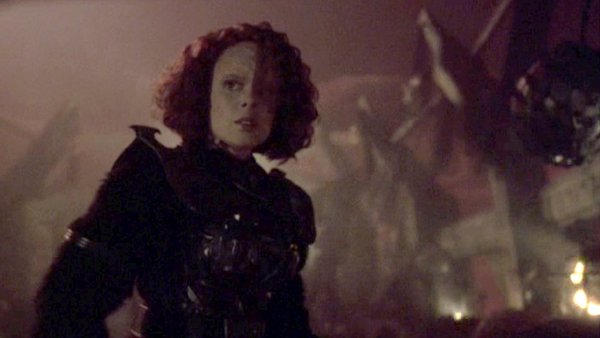
As depicted in the Star Trek: Voyager episode Barge of the Dead, Gre'Thor was the afterlife for Klingons who died without honor.
It was the exact opposite of Sto-vo-kor. Instead of being greeted by the spirit of Kahless the Unforgettable, the dishonored dead were met by Fek'lhr, the gnarly-headed bestial Klingon thing first seen in the Star Trek: The Next Generation episode, The Devil's Due. Rather than eternal feasting and combat, Fek'lhr meted out eternal torments, much like the Devil in some versions of Christian Hell.
However, the torments of the dishonored dead began long before they even arrived at Gre'Thor's gates. After they died, the dishonored dead were ferried down the River of Blood on the Barge of the Dead. The barge was captained by Kortar, the first Klingon.
While on the barge, the dead were tempted by siren-like serpents, the Kos'Karri. These serpents called to the dead in the voices of loved ones before dragging them into the water to spend eternity. For example, in Barge of the Dead, B'Elanna Torres heard the voices of her Voyager crew mates.
1. Klingonese, PetaQ! Do You Speak It?

First mentioned in the Original Series episode, The Trouble with Tribbles, the Klingon language wasn't spoken on screen until Star Trek: The Motion Picture. It was originally conceived by dialectician Hartmut Scharfe, James Doohan, and producer Jon Povill.
According to both Return to Tomorrow - The Filming of Star Trek: The Motion Picture and Star Trek Monthly issue 80, Doohan became involved with creating Klingon when he learned that Gene Roddenberry didn't like what Scharfe had created. According to Povill, Scharfe created exactly what they needed when he developed the Vulcan language but his Klingon didn't sound alien enough. Doohan and Povill combined Scharfe's concept with their own nonsense syllables. Doohan taught the resulting gibberish to Mark Lenard and the other Klingon actors.
According to the books From Elvish to Klingon: Exploring Invented Languages edited by Michael Adams and In the Land of Invented Languages by Arika Okrent, when Leonard Nimoy directed Star Trek III: The Search for Spock, linguist Marc Okrand fleshed-out the language with a grammar and expanded vocabulary.
Orkand's work led to the Klingon Dictionary and other references. Fans have used these reference to create Klingon translations of literary works including Gilgamesh, Hamlet, and The Wonderful Wizard of Oz.