Netflix's Maniac: What Does The Ending Really Mean?
We're off to a good start.

Maniac has been on Netflix for a few days now, with Cary Joji Fukunaga and Patrick Somerville teaming up to deliver a drug-fuelled trip through the minds of Emma Stone's Annie and Jonah Hill's Owen.
Led by its pair of A-list stars, and assisted by the likes of Justin Theroux, Sally Field, and Sonoya Mizuno, Maniac offers up a meditation on mental health and illness, and whether or not there's a quick fix solution in the form of therapy or medication, alongside the connections we make with each other.
At the same time, though, it dives into its own fantasy worlds, offering a riff on Raising Arizona involving the theft of a lemur, and another episode that spins on fantasy series like Game of Thrones and Lord of the Rings.
Other inspirations range from 2001: A Space Odyssey to Eternal Sunshine of the Spotless Mind, and across ten episodes and five hours the ambitious effort plays around with multiple tones and genres, leading us to its big finale where it ties some things up while leaving plenty of questions behind. But what happens at the series' end, and what does it all really mean?
7. What Happens With The Drug Trial

Although the drug trial takes place across the bulk of Maniac's run and is what gives it its narrative thrust, that storyline actually wraps up in the ninth episode.
It begins with Annie and Owen both remembering who they really are, but at the same time GRTA is seemingly malfunctioning, ramping up the heat both in the real world and in the created ones (where it manifests as heat rays from invading aliens). She can only be shut down from the inside though, so Annie and Owen split up to tackle the problem.
Annie finds GRTA, where - in a great spin on the technology is evil trope - it turns out Maniac's HAL900 stand-in is actually depressed and heartbroken, rather than bad. GRTA, after opening up, allows Annie to see her sister one last time, with the pair having an emotional farewell. Owen, meanwhile, has to solve a Rubik's Cube in order to shut the computer system down, allowing Drs Mantleray and Fukita to reclaim control, although it does mean Owen has to say goodbye to the imaginary version of his brother. The experiment is successfully shut down, and everyone is brought back to reality.
6. What Happens Afterwards

Unfortunately for the participants in the trial, despite going through the three stages they aren't suddenly fixed. Owen and Annie's problems haven't disappeared as they hoped, and they part ways.
Owen stands witness at his brother's trial and, in a surprising turn, stops lying and states to the court that his brother his guilty of sexual assault. It's a brave move, but one not without repercussions, as his family have him put in a mental institution.
Annie, meanwhile, goes home and reconnects with her father - played by Hank Azaria - before learning of Owen being committed, and thus she decides to visit him and attempt to break him out. As for the doctors, they've had to completely sacrifice all of their work, but it's led to Dr Mantleray dealing with his mother issues, and he and Dr Fujita are able to reconnect on a romantic level.
5. Options A, B, And C
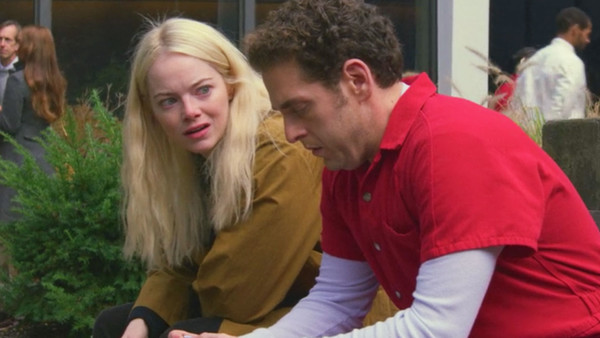
While at the facility, Owen talks about not wanting to see Annie again, because the two options are either A) she never really existed, or B) she did exist, but he'll mess it up.
It's an insight into Owen's frame-of-mind, but it's also one that gives pause for a second. Given everything else we've seen go on inside his head throughout the show, is it possible that this too isn't real? The show, and especially Fukunaga's direction, enjoys blurring the lines betwixt the two, and there's the chance what we're seeing here is a continuation of that.
If it is, though, the show doesn't give too much credence to it. Instead, it plumps for Option C, where Annie arrives and convinces Owen to run away with him to Salt Lake City. It's another sign of reality starting to mirror the drug trial, with C here reflecting the C pill in the trial, with the pair confronting their problems. This time, though, they're actually able to work through them properly.
4. Pills And Therapy Aren't Bad, But Aren't Magic Fixes Either

In parts, Maniac could quite easily come off as an outright dismissal of medication and/or therapy as a means of treating mental illness, but the show has enough in it to realise that's not what Somerville and Fukunaga are saying. As we see earlier in the series, the therapy and pills taken by Owen DO help him, but what's important to note is that, despite what Dr Mantleray thinks, there is not a magic fix.
As Owen and Annie come to realise after their three-day trial, 'fixing' yourself isn't as easy as taking three pills. They might offer a solution - a very necessary one in cases - that helps the problem, but it won't eliminate the root cause of them. The confrontation pill worked in that it made them face their issues, but it is then still upon the person to tackle them.
3. Acceptance And Human Connection

Where the pills were really important wasn't in providing a 'cure', but helping push Annie and Owen towards acceptance. The former is diagnosed with borderline personality disorder, the latter with schizophrenia, but by the end of the trial they're able to accept those parts of themselves and begin to really work through the issues.
For Owen, that starts with no longer lying for his brother or cowing to the pressure of his family, and for Annie it means letting go of her sister and moving through her grief. They aren't suddenly free of their problems, but they've been offered a chance to be, and are taking it.
That then leads to the other core message of Maniac, which is that above pills and therapy, what's important is human connection. This is one of the most elusive things for Annie and Owen in their real world, who have been separated - in different ways - from their families and feel cut adrift, but keep on finding their way to one another in the trial.
And importantly Maniac doesn't simply make this ending a love story, but purely a friendship - it's two people who are learning to know each other, to trust and care for each other, but we see when Annie's Owen stand-in proposes it's clearly not what she wants, she instead just desires an authentic connection with another person, and that's what he needs too. It's also why, in the end, Annie's father has to come outside of the box he's living in, and why Dr Mantleray and Dr Fujita are sticking together. All of them have their own issues, but it's going to be a lot easier with someone else there.
Do they actually know each other? Not yet, but like Annie says, they're off to a good start.
2. Fantasy Becomes Reality

And so the series ends with Annie busting Owen out of the mental institution, escaping the chasing guards who have figured out what's going on, and hit the open road in a truck that may not be able to take them all the way to Salt Lake City, but it's a start.
It's here we have the biggest, most obvious and important case of fantasy bleeding over into reality. Back in the sixth episode of the series, Owen reveals the fantasy world he would've used the missing Don Quixote chapter to escape to, telling Annie:
"I had a plan we were going to go somewhere. We were in a car, driving really fast, someone was chasing us, I don’t know who. It felt like an escape, and I was just laughing and I had this huge smile on my face, it hurt it was so big. We were just two people watching out for each other.”
It's quite fitting that this is the one fantasy to become a reality: it's the one where Owen doesn't need to be the hero or the Chosen One that others often present him as, but instead finds the genuine human relationship he's never before had. For Annie, it's finding a way to finish that trip to Salt Lake. For both, it's learning to move forward through their pain.
1. There (Probably) Won't Be A Season 2

Maniac loosely ties up its story, with Annie and Owen headed to Salt Lake City, Mantleray and Fujita off to Newfoundland - even passing each other on the road - and the drug trials over, but it's open-ended enough that there could quite easily be a Season 2.
It's rather common for so-called 'limited' series to have another run ordered due to success, after all, and since we don't know the next chapter of Owen and Annie's story, there's scope for more episodes, even if there isn't a necessity for it.
Thankfully, despite Season 1's quality, neither Cary Fukunaga nor Patrick Somerville have expressed much interest in doing a second season. Somerville, when asked by THR about the possibility, said: "No. This was always planned as a limited series, and I think that's another reason why we had the freedom to have a more hopeful ending."
Speaking to Thrillist, however, he did add: "The world has a lot to it. I think the world is really interesting. I think more things could live there, but I haven't really gone down that road."
Of course, if there's enough demand then these things can and do happen - hence why Big Little Lies is getting another season, for example - but Maniac's ending works so much better if it allows you to imagine what might come next, without actually showing it. It ends on a surprising, and surprisingly optimistic, note, and with a strong message. It doesn't need anything else.
What did you think of Maniac and its ending? Share your thoughts down in the comments.