Doctor Who: The Well Review - 8 Ups & 2 Downs
Well, well, well. Looks like Doctor Who Season 2 has got its mojo back!

In Aliens, James Cameron swaps the claustrophobic tension of Ridley Scott's original for a full-scale war movie set on a colony world. Steven Moffat's Blink sequel, The Time of Angels/Flesh and Stone, did something similar by pairing our hero with a group of space marines to battle an army of Weeping Angels.
Both of these sequels lost their way in the upscale, losing the tension and atmosphere of the originals in pursuit of bigger thrills. By conceiving a similar type of sequel to Midnight, Russell T Davies and co-writer Sharma Angel-Walfall manage to retain the unnerving atmosphere of the original while expanding our knowledge of the central monster.
And yet, the old adage that sequels are never as good still applies here.
For all the new elements that The Well introduces, some don't quite work, while many of our supporting characters don't leave their mark in the same way as Midnight's fellow passengers. But more than any of that, The Well ends in a very similar way to Midnight – a heroic sacrifice that leaves the monster exactly where we found it.
So, after the mixed bag that was Lux, how does Doctor Who Season 2 fare this week? Let's find out.
10. UP - The Doctor and Bel's Space Skydive

Instead of Britney Spears' Toxic, the Doctor and Belinda should have been listening to David Bowie's Space Oddity. Because when it's time for them to leave their capsule, they very quickly have to put their helmet on and jump out of the platoon's tin can of a spaceship.
Let's not get hung up on how the TARDIS had two of the exact spacesuits the Doctor and Bel needed to blend into their mission because it enabled one of The Well's best gags. We're used to the Doctor and their companions bumbling into an adventure, but rarely is it as chaotic and high-octane as this.
Walking right out of the TARDIS into an outer space base jump is a pretty dynamic way to go into the title sequence, and sets up The Well as a thrilling sci-fi blockbuster.
It's also an interesting way to set up the episode's climax, which sends Shaya diving into the well to save the Doctor and Belinda. And if Bel thought jumping out of a spaceship was a heartstopping moment, she ain't seen nothing yet...
9. UP - Exploring The Well
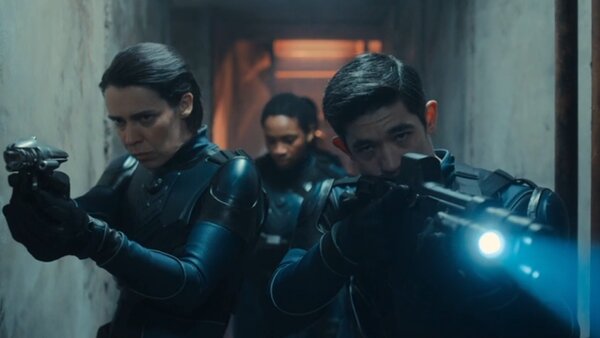
Mark Gatiss once spoke of how the increased pace of modern Doctor Who means that the Classic era episode one cliffhanger is now the pre-titles sequence. He's definitely on to something, as the Doctor and companion rarely get as much time to explore a location before being thrown head first into adventure.
Initially that feels like the case here, with the Doctor and Belinda emerging from the TARDIS before being tossed out of a spaceship. However, we still get to see them exploring the mining facility, finding dead bodies and smashed mirrors – clues to the eventual solution.
After the whizz bang colour and spectacle of The Robot Revolution and Lux, it was a refreshing change of pace to see the Doctor and Belinda properly spend time getting to know their fellow characters and attempt to solve a mystery.
What did it all mean? What climbed out of the Well? The Beast? Why were all the mirrors broken? Weeping Angels? THE MARA?! It was utterly captivating to watch the Doctor, Bel and the team explore this creepy abandoned facility. It's a welcome reminder that Doctor Who is often at its best when it takes things slowly.
8. UP - Rose Ayling-Ellis
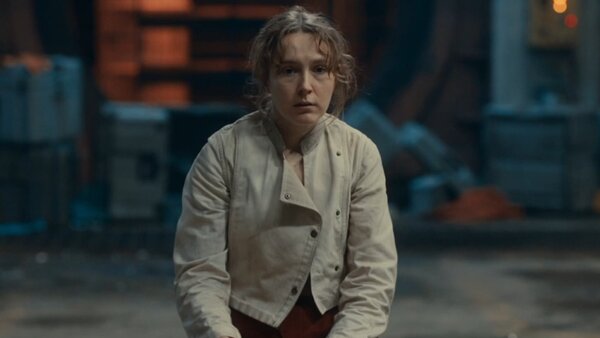
Hands down, Rose Ayling-Ellis gives us the best guest performance of the season so far. She brings such vulnerability to the role of Aliss – the moment where she pleads for the Doctor not to turn his back on her was astonishing. The dual meaning of it – being left isolated because she can't read the Doctor's lips (or his handy subtitling device) while also fearful of being left behind.
The Well's use of different forms of communication – sign language, subtitling, and lip reading – was a wonderful touch. When the Doctor first encountered the Midnight monster, it was learning to communicate by mimicking the voices around it. In The Well, this is turned on its head, with Aliss' deafness being her very means of survival.
Aliss isn't driven mad like her colleagues because she can't hear the Midnight monster whispering in her ear. Without a corporeal form, it can't communicate with Aliss, and so she sits and waits for rescue, more terrified about never seeing her daughter again than she is about the monster on her back.
You want Aliss to survive, because Ayling-Ellis' performance taps into this isolation, tugging at your heartstrings.
7. UP - "What Did You See?"
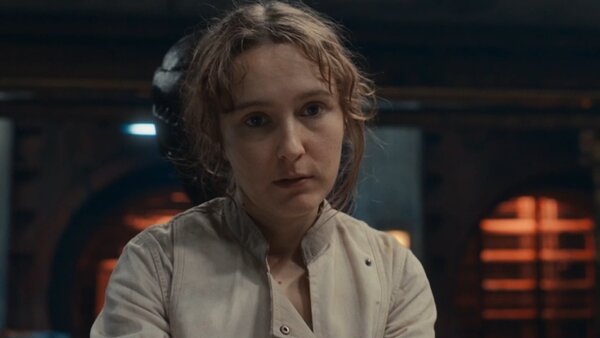
Once it became apparent that The Well was a sequel to Midnight, there was a worry that we might actually see the monster. After all, Aliens gave us heaps of xenomorphs, Flesh and Stone gave us talking Angels. How would The Well update the Midnight Monster? Would it show us what it looked like?
Thankfully not. Instead, there were just glimpses of shadow behind Aliss' shoulder. These glimpses were just another way that the Midnight Monster created paranoia and tension for its victims. Clearly RTD and Sharma Angel-Walfall understand that less is more, and the creature in our imaginations – and those of the characters – is far more terrifying than anything conjured up by VFX.
There was another risky moment when the Doctor and Bel spun around to look at the monster while running away, but again, all we get are shadowy shapes that create fear and wonder.
The Doctor's decision to stare directly into the eyes of the monster was an incredible character moment. Of course the Doctor would risk his life and that of his companions to see something he'd never seen before. That's how the First Doctor ended up meeting the Daleks after all!
6. UP - "Funny Kind of Nurse"
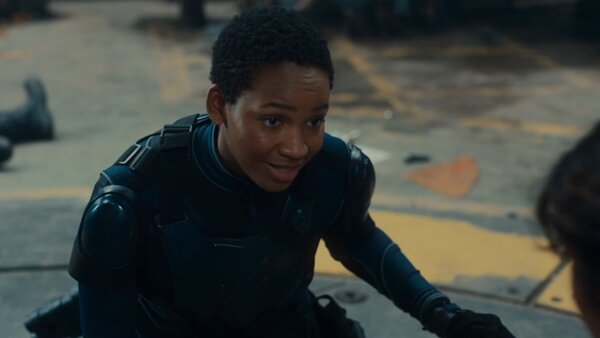
When Belinda and Mo first meet, there's a suspicion that this kindly soldier may one of those characters – like Gwyneth in The Unquiet Dead or Raffalo in The End of the World – who won't make it to the end credits. Pleasingly, that isn't the case, although Mo doesn't make it to the end of The Well entirely unscathed.
There's a great dynamic between Bel and Mo before all hell breaks loose, though. Mo's wry chiding of Belinda for being "a funny kind of nurse" for whom all the medical tech is completely alien is a idea. The Robot Revolution established that Belinda's training as a nurse can be utilised during her adventures with the Doctor. However, in contrast to this, The Well shows that medical science has moved on considerably in the hundreds of thousands of years since she graduated, but she's still happy to get stuck in and work it out for herself.
This, despite the fact that some of the tech in the "basic" box is as alien to Belinda as painkillers were to Katarina in The Daleks' Masterplan! It seems like Rory Williams won't be the only nurse who starts "acquiring" new items for their first aid kit.
5. UP - "Planet Earth? Never Heard Of It"

The Doctor and Belinda could have saved a lot of time if they'd hung around long enough to see the Eiffel Tower float past at the end of The Robot Revolution. Two weeks later and they finally discover that something has gone very badly wrong with the planet Earth.
The Well does a terrific job of being both a sequel to an acclaimed Doctor Who story while furthering the central story of why Belinda can't get home. The Doctor and Bel's realisations that Earth no longer exists are beautifully constructed. For the Doctor, the Time Lord, the penny drops when it turns out that Earth is no longer part of the joint foundation with Lombardo, meaning that future history has been dramatically changed.
For Belinda, the nurse, it comes from idle chat while putting together medical supplies. Mo's never heard of the Earth superstition about unlucky number 13. These teases for the finale never feel clunky, and instead feel organically dropped in as part of wider conversations between the characters. It doesn't jar in the way that, for example, Mrs Flood dressed as an outer space general talking about Vindicators does.
4. UP - You Die At Midnight
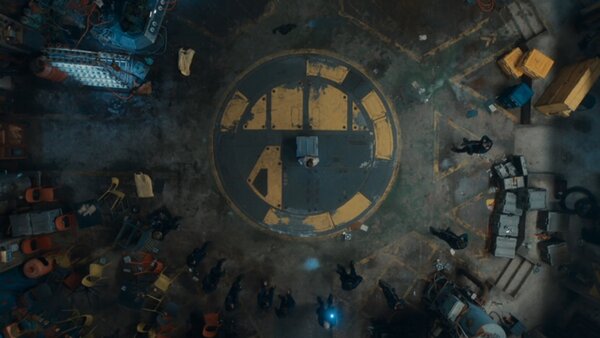
"If it was a clock face you die at midnight" is from the same school as Susan Triad Technology = Sue Tech = SUTEKH! It's utterly ludicrous, but also very fun in the moment. Forget the fact that most of the characters in The Well get killed somewhere between half past and twenty to, the aerial shot of Aliss inside the circle is a really striking visual.
If the script hadn't literally called it out to us, we'd have made the connection ourselves and thought it was a brilliant bit of production design and staging. But RTD loves a big daft reveal, so here we are!
If we're being nitpicky, the Midnight monster standing behind Aliss inside the circle is all very "something on your back", which is from a completely different RTD script from Series 4. Still, its defensive capabilities are a definite improvement from the last time we encountered the creature.
After all, the Midnight Monster has had 400,000 years to evolve since the Hostess grabbed it and tossed it out of an airlock, so of course it would develop the ability to break the bones of anyone or anything that gets behind it.
3. DOWN - Red Code
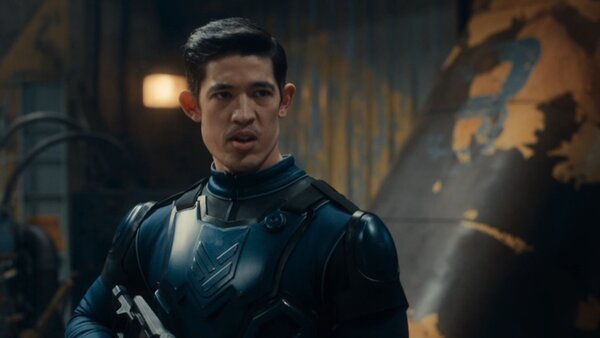
Anyone who's seen him play Roddy Ho in Slow Horses will know that Christopher Chung excels at playing arrogant arseholes who mask deep insecurities. Cassio is a similar character, more of a hands-on type of guy than Roddy but just as insufferable to be around. When he finally tires of Shaya's handling of the mission, he pulls a "Red Code", effectively a mutiny that lasts all of a few minutes before he gets everyone killed.
As a moment of drama it feels clunky and functional, rather than an organic development which takes the story in a new direction. RTD and Walfall need to show the power of the Midnight monster at this stage in the episode, so toss in a quick mutiny that gets everyone brutally murdered. Job done.
Cassio's death in and of itself is a great moment, reflecting the atmosphere of paranoia and self-interest that the monster creates, but the wanton destruction of everyone else confirms what we suspected all along – that the majority of these 13 space marines are cannon fodder.
And worst of all? The apologetic "He tried his best" at the end. He got a bunch of people killed by being a total tool!
2. UP - Mercury Falling
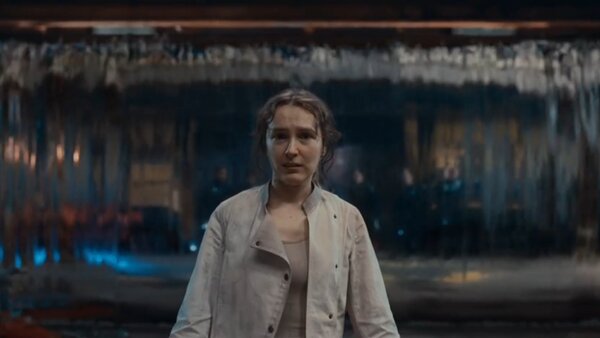
The Well has a heap of corpses with broken bones, snapped necks, and gunshot wounds. The planet itself is a blasted heath, and once the Midnight monster emerges from behind Aliss, everyone descends into fear and paranoia. The Well is bleak, and while bleakness in Doctor Who has given us classics like Genesis of the Daleks and Caves of Androzani, it should really be used sparingly. After all, Doctor Who is a show that has hope and optimism at the very heart of it.
For the most part, The Well balances the light with the shade to great effect – the stunning starscape contrasted with the blasted surface of the planet, for example. Other times, it can be a bit grating – yes that means you TARDIS wardrobe!
The best and most punch-the-air moment of light in the episode is the Doctor's daring rescue of Aliss. It's perhaps one of Ncuti Gatwa's most Doctorish moments yet, and demonstrates how he can hold a conversation with a monster while simultaneously working out an exit strategy. Using the mercury to reflect the Midnight monster is inspired (bit Weeping Angels but we'll allow it) and is realised impeccably.
1. DOWN - Shaya Goes Down The Well
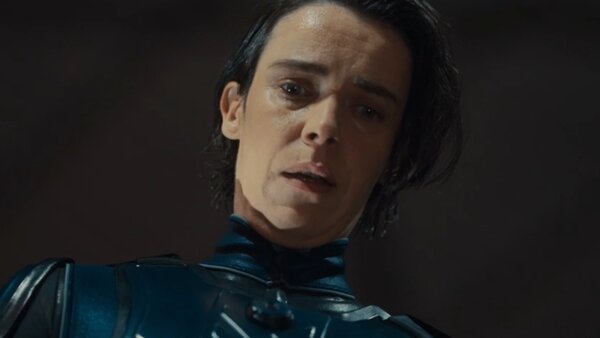
Having seen the Doctor pull off an incredible rescue a few moments earlier, The Well runs dry, placing the Doctor, Bel, Mo and Shaya in a hopeless situation for which the only solution is... Shaya shooting Belinda in the heart before throwing herself down a big hole.
Two weeks running now and we've had a supporting character give their life to save the Doctor and Belinda, but Shaya's sacrifice doesn't have any build-up. At least in Lux, Reginald Pye had a tragic backstory that informed his sacrifice. The only solution being self-sacrifice smacks of a writer who doesn't believe that better things aren't possible.
This hopelessness reflected in Shaya's Cybermanesque mantra “hope is irrelevant” and the episode confirms this with a final twist that heavily suggests Mo was the Midnight monster's host all along. It introduces a chilling new level of manipulation from the creature, and proves that Shaya's sacrifice was completely pointless.
RTD's very first season of Doctor Who in 2005 relied heavily on characters sacrificing themselves for an easy climax so the episode can clock in at around 45 minutes.
20 years later, and it seems he's still very happy to return to that particular well.