5 Iconic TV Moments Only Made Possible Through Slashed Budgets
 Most creative projects hit budget constraints from time to time. Whether your budget allows for little more than tinfoil saucers and rubber-suited aliens or sparkling planets filled with floating islands and 8-foot cat people, money will always be an issue. This is even truer of television, where funding has to be spread evenly across a vast range of projects that also have tighter time constraints. Inevitably, sacrifices have to be made - no matter how beloved they may be. More often than not, these creative sacrifices amount to little more than directorial anecdotes on DVD commentaries, but now and again the more opportunistic producer will find a way to make the most of such frugality, bringing in concepts and visual styles that are just as effective but at a fraction of the cost. Here are five great examples of when TV turned budget constraints into iconic moments...
5. Star Trek - The Transporter
 'Beam me up Scotty,' is a phrase so synonymous with the Star Trek franchise that most people don't even realise it was never said on screen. Of course, the phantom quotation is supposed to have been delivered by Captain Kirk to Montgomery Scott as an order to start the ship's transporter, which would have teleported the away team to a nearby planet. But the point is, 'Beam me up Scotty' is up there with 'Elementary, my dear Watson' and 'Luke, I am your father' in terms of how unanimously ingrained in popular culture it has become over the years (and no, neither of those were ever said either), and it's all because of that transporter. However, that iconic means of teleportation, along with the sparkly, shimmering sound that accompanies it, would never have been had the bigwigs over at CBS Television been a bit more liberal with their money. Simply put, the transporter was an addition to the series by way of necessity; the characters needed to go from the Starship Enterprise to whichever planet needed them that week, and the show just didn't have the money to realise the coming into orbit and landing of a spaceship that series creator Gene Roddenberry wished for. Their solution was a device boasting the very simplicity that gives it its iconic status now (less is more, especially when there is less money) - a teleportation device that instantly beams our heroes to the planet's surface, with little more required of the production team than a fade out and a nifty sound effect. It's hard to imagine the Starship Enterprise without its famous transporter now, and indeed the device has been the subject of entire episodes from time to time. Its late-in-the-day inclusion seems like a no-brainer for a science fiction series short on cash, but it's a cultural icon nonetheless.
4. Doctor Who - The TARDIS
 An iconic spaceship from an enduring science fiction series created in the sixties? Am I repeating myself already? Well, the story behind Doctor Who's famous time machine once again comes down to that oh-so-persistent nag - budget concerns. The image of the TARDIS - that piercing blue police box, standing out in some bygone land in all its anachronistic glory, is about as iconic as it gets. For most (fans and casual viewers alike) it's the immediate image that springs to mind when remotely thinking about the show, and is often used as the logo for various Who-related promotional material (so instantly recognisable is the TARDIS that it was even embedded in the recent series' title logo). Well, that police box could have disappeared for good way back in 1963, if the BBC had more money to throw at set design back then. The well-known premise of the Doctor's ship is that it is equipped with a "chameleon circuit" a feature that allows its shell to appear as an object befitting whatever time or place it lands in. The running joke in the show is that the chameleon circuit is broken and the TARDIS must remain looking like a police box from the sixties, but that wasn't the plan back in the day. Producers Sydney Newman and Verity Lambert originally planned for the TARDIS to take on a different shape each week in other words actually doing its job. It's purely because they didn't have the budget to build a new prop for every episode that the stuck appearance of the police box was written in. And thus a British icon was accidentally born.
3. The Young Ones - Musical Guest Stars
 The Young Ones is a cult sitcom classic from the 1980s that you may remember as being rather anarchic, off the wall and, although its political leanings have rendered it somewhat dated now, extremely unprecedented for a sitcom of its day. Paving the way for the likes of abstract successors The Mighty Boosh, the show regularly deviated from the sitcom format to feature such things as monologues from talking rats, axe-wielding landlords foaming at the mouth for overdue rent and, most memorably, musical performances from popular bands of the day. These sequences were the icing on the very youth-focused cake that was The Young Ones, the comedy that put budding sitcom writer and future sell-out Ben Elton firmly on the map ahead of his involvement with the Blackadder series (more on that soon). Using his zany student characters to send-up youth culture and shout down Thatcherism, Elton fully captivated the young target audience by featuring the likes of Madness and Motorhead in the mid-point musical sequences. What an idea. But get this: TV sitcom didn't have a great deal of money thrown at it in the thrifty 1980s, especially politically-charged sitcoms by little-known upstarts. Learning that variety shows got far more funding than sitcoms, Elton merely included the musical guest performances so he could legitimately pass off The Young Ones as a variety show and receive the extra budget such a show would receive, thus rendering him able to spend it on the likes of rat monologues and axe-wielding landlords. Well done Ben.
2. Blackadder Goes Forth - Goodbyeee
 Is there a sitcom with a more perfect ending than Blackadder? (this is not an invitation for debate, it's a yes/no question and if you say 'yes' you're wrong) Knowing full-well that their series four setting of World War One was not one to be tackled with the flippancy of earlier series, writers Richard Curtis and Ben Elton chose to bring the show over its six episode run, to a sombre, moving and deadly serious denouement, reiterating the horror and massive waste of human life that the First World War was. Comic hi-jinks were had at Blackadder's fruitless attempts to find a way out of 'going over the top,' but there was always a lingering undercurrent of tragedy, unprecedented for a Blackadder series, that dogged the central characters right until that heart-wrenching final scene. The sequence itself is one of the most beautiful ever broadcast Blackadder, Baldrick, George and Darling leap over the lip of the trench and -in agonising slow motion- tear through no-man's land toward the enemy as bombs and machinegun fire explode and cackle around them. Before their fate is shown, the scene fades to one of the barren, empty ground on which they previously stood, before moving gently to a present-day poppy field, all the while a haunting piano rendition of the series' theme tune plays funereally over it. But it wasn't always to be this way. The original cut of the push scene is available to see and it was quite terrible, bereft of all the poetic ambiguity that made the final version so impactful. In the original, there is no slow-motion and our heroes are seen grotesquely collapsing to the ground as they are rather unconvincingly killed by gunfire. Baldrick actor Tony Robinson has said how his heart sank when he stepped onto the atrocious no-man's land set, and the series creators were equally horrified when looking back at the finished scene, feeling they'd completely ruined the whole series with such a naff, tacky ending. The solution? Fade out before the actual death shot, slow the whole thing down to obscure the cheapness of the set and add that beautiful piano. Hey presto, you have yourselves one of the most perfect television endings in history.
1. The Simpsons - The Entire Look Of The Show
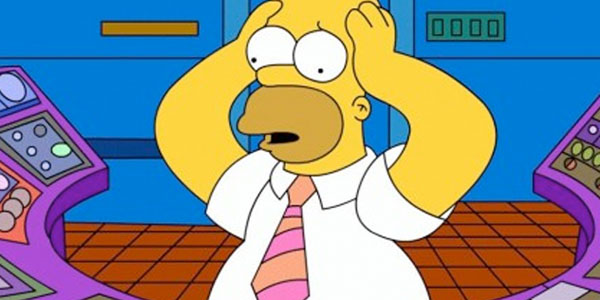
 Who (perhaps apart from Marge) would change a thing about Homer Simpson? Instantly recognisable and endlessly quotable, the man and his family have captured the hearts and funnybones of audiences of all ages through nearly thirty years of classic television and one iffy movie. Well someone would have had it differently Matt Groening. That's right. The legendary creator of the most celebrated cartoon series in history didn't actually want his characters to look like they do. He simply sketched some crude characters, gave them names and handed them over to the animation department with the assumption that the talented folks there would refine and tidy up his drawings, making something of a little more quality out of them. What follows was brilliantly satirised in the season 8 episode 'Itchy and Scratchy and Poochie' they didn't change a thing. To save time and money, the animators simply traced over Groening's original sketches and thus the Simpsons retained the simplicity of design that eventually rocketed them to cultural phenomenon status, despite Groening's hopes otherwise. And that's not all - if you've ever fleetingly wondered why the Simpsons are yellow skinned, that was an idea of Gyorgyi Peluce (try saying that out loud), the show's colourist, theorising that getting sitcom-hardened audiences interested in a prime time cartoon series would be a tall order. He thought that making them yellow would help catch the attentions of channel surfers, who may stop on the Fox Network to wonder what had gone wrong with their televisions. He was probably right.