10 Resurrected TV Shows That Should’ve Stayed Dead
Some TV networks and producers don't seem to know when they're beating dead horses...
10. Iron Chef
9. The Tonight Show With Jay Leno
8. Ren And Stimpy
 In the early '90s, Nickelodeon unveiled a Sunday morning programming block called Nicktoons built around Doug, Rugrats, and The Ren and Stimpy Show. They were three very different shows: Doug was sort of designed for tweens, with characters and plots being more typical of a show about young teenagers: Crushes and dating, obsessing over your favorite band, etc. Clever with a nice moral center, it was probably the most beloved of the three shows out of the gate. Rugrats was the show designed for all ages, with babies and toddlers as the central characters and clever writing that could literally entertain anyone. It became the longest-running and most popular of the three by far. Ren and Stimpy was the weird one. It was the biggest hit in the short term, but it was too offbeat and risque to sustain its popularity, especially once creator John Kricfalusi (usually known as John K.) got combative with Nickelodeon, stopped turning in episodes on time, and was eventually fired from his own show. https://www.youtube.com/watch?v=_wW6rENTfaU Being a Ren and Stimpy fan was a unique experience in that you had no idea when new episodes were going to come along. Long before South Park, it was a show that was clearly too adult for its time slot and audience, but kids got away with watching it because it was a cartoon. It completely fell apart with all of the behind the scenes turmoil, though. The original run on Nickelodeon and sister network MTV ended in 1996. In 2003, to coincide with the launch of Spike TV, Viacom (parent company of Nickelodeon and MTV) brought the show back with John K. at the helm. Dubbed Ren and Stimpy "Adult Party Cartoon," the announcement was met with much rejoicing until more details came out, including teaser clips. It was revealed that the show would be built around it being explicitly stated that Ren and Stimpy were a gay couple, something sort of implied in the original series. http://www.dailymotion.com/video/x7vj5v_gross-ren-and-stimpy-moment_fun As soon as the first episode aired, it was perfectly clear that John K. no longer had it. The new show consisted entirely of cheap gay jokes and gross-out humor without any of the cleverness of the original show. Spike pulled it after less than two months.
7. ECW
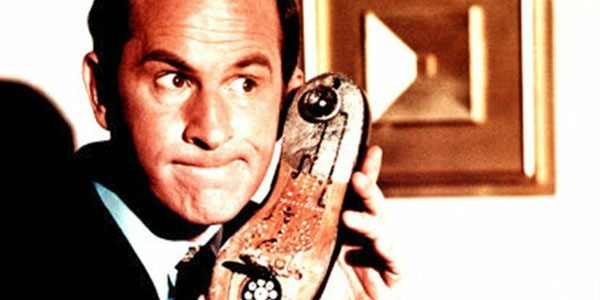
6. Get Smart
5. Saved By The Bell
 Saved By The Bell was never a good show by any sane definition of the word. It was a low budget wacky sitcom about high school that was written by old men for children several years away from high school. It also had the worst continuity of any show on TV: A number of new girlfriends were introduced for the lead, Mark-Paul Gosselar's Zack Morris, only to disappear after one episode with no explanation, including a homeless girl who MOVED INTO ZACK'S HOUSE WITH HER FATHER and the one off appearance of a younger sister of Mario Lopez's character, A.C. Slater. But it had its charm. Gosselar was legitimately talented, the plots were odd enough to be amusing, and once it entered syndication, it was seemingly on all the time. Kids' shows need to be easy to rewatch, and Saved By The Bell was incredibly watchable. Unlike most high school shows, the actors playing the students were age appropriate. When they turned 18, it was time to send them to college, and everyone graduated in the finale. The show then forked into two continuations/spin-offs. http://www.youtube.com/watch?v=1Fnm7yd52bY Saved By The Bell: The College Years was a prime time sitcom featuring most of the students from the original cast. It quickly became apparent that the writing staff was not up to the task of putting together a prime time sitcom. Figuring out just how far the show went in terms of the characters' sexuality was a huge problem. It was farther than the Saturday morning show went, but it looked ridiculous in prime time, where Kelly having an affair with her professor was basically lots of kissing. The show lasted a season and eventually married off Zack and Kelly in a TV movie. http://www.youtube.com/watch?v=E1jaAMkXvxQ Saved By The Bell: The New Class was exactly what you'd expect, new students at the original show's Bayside High, eventually with Dustin Diamond returning as Screech to work with principal Mr. Belding in the office. It started terribly with the cast consisting of expies of the original show's characters and had incredibly high cast turnover. Oh, and it became an edutainment show. Sort of. See, The New Class started right before the U.S. Government mandate that each broadcast network must air a certain amount of educational programming. Early on, the networks were really lazy about it: Fox would air the cartoon Bobby's World with open captions because theoretically it helped kids learn to read, while The New Class had a heavy heaping of Important Life Lessons added to a show that was already at least sort of pointed in that direction. It wasn't a good mix. Improbably, The New Class actually ran a few years longer than the original Saved By The Bell, but it left none of the legacy of the parent show.
4. Scrubs
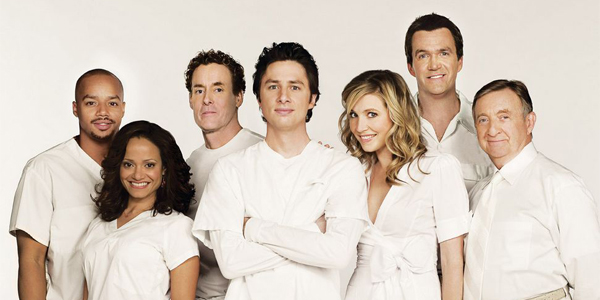 Premiering in 2001, Scrubs doesn't get enough credit for launching the wave of single-camera, no laugh track sitcoms that have taken over television over the last decade or so. Creator Bill Lawrence assembled an incredibly talented cast of young actors for a very funny show about young doctors. He took what was a stale concept for dramas (hospital shows) and made a very fresh comedy out of it. While it had an iffy few seasons in the middle, it recovered in its last couple seasons, being as funny as ever and rejuvenated by a move from NBC to ABC. Lawrence got the time to craft a proper finale and the show got a great, emotional farewell. Or did it? http://www.youtube.com/watch?v=GzWQBcJ3Nz8 Lawrence wanted to do a spin-off, Scrubs: Med School. Some existing characters would stick around for a new show built around them teaching a number of new doctors in a medical school setting instead of the hospital. That was all well and good until ABC demanded that the show be branded as the ninth season of Scrubs, though it was still titled "Scrubs: Med School" in the graphics during the opening credits. I think you can guess what happened next: The show was cancelled after a season of the new format. Would it have done better if it was explicitly pushed as a new show? Maybe, maybe not. But the way it was handled was a bad idea.
3. The Killing
 It's impossible to explain this one without some degree of spoilers, so if you haven't seen the series yet and you're planning on watching it, you may want to skip to the final entry. The Killing was, uh, born during the period where AMC's popularity was exploding thanks to Mad Men, Breaking Bad, and The Walking Dead. It was supposed to be their next prestige drama, a police procedural where the first season covered a single case (a la ABC's Murder One), the, well, killing of Rosie Larsen. All of the promotional material for season one was centered around one question: "WHO KILLED ROSIE LARSEN?" With too many red herrings, odd dialogue, and a terrible understanding of the Internet, it was an OK show with some potential carried by strong performances by the key actors. Which lost a gigantic percentage of its audience when season one ended without telling us who killed Rosie Larsen. The internet threw a collective fit and there was speculation about if it was a stunt to guarantee a second season. If it was, it worked, and thankfully, the show revealed the killer's identity before being mercifully cancelled at the end of season two. Until someone decided to renew it for no apparent reason. https://www.youtube.com/watch?v=VoqjTS9hbB8 Season three was the best so far, even with more bad red herrings, and while they badly telegraphed the identity of the murderer, it ended in an interesting place emotionally for the main characters that served well as a series finale. Which was all well and good, because AMC cancelled it. For real this time. Then Netflix picked it up, with the idea that they were providing original content that increased the value of the previous seasons since it would now be a cohesive story. This meant that the emotionally interesting ending was no longer an ending, and the show did a terrible job trying to get the characters out of it, ending with a terrible deus ex machina. The mystery itself was the bleakest yet, especially without the restrictions of basic cable, though from a straight "Who did it?" standpoint, it made the most sense of the show's three cases by far, with the red herrings all making complete sense. So that was actually kind of OK. If there was any goodwill, though, the ending flushed it all down the drain. The show flashed forward five years to make the two leads a couple even though they had never shown any romantic chemistry whatsoever and the show was ending so there was no shipper fanbase to appeal to. Because...why? Nobody knows.
2. Jericho
1. 7th Heaven
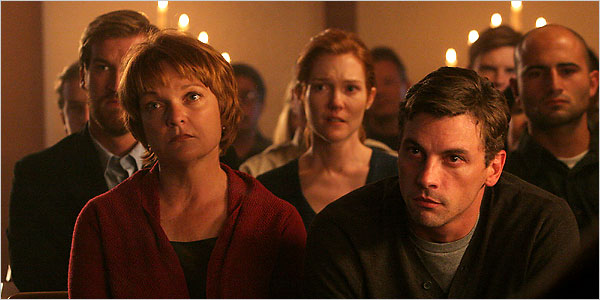
 Let me tell you the story of two TV shows, 7th Heaven and Everwood. Both were conceived and promoted as "family dramas," shows that tweens and teens could watch with their parents while learning important life lessons. 7th Heaven was the lead-in to Everwood on The WB Television Network, one of the smaller broadcast networks, which had found a niche in "teen" dramas. Monday was their night for "family" shows. When you hear their premises, both sound terrible: 7th Heaven was about a the large family of the pastor of a Christian church, the denomination of which is never mentioned. They all learn important life lessons and...that's about it. Everwood was about a brilliant, rich, and famous neurosurgeon who freaks out and moves with his kids to a small Colorado town to run a free clinic when he breaks down after his wife's death. Everyone involved learns important life lessons. On paper, they actually sound pretty similar. In practice, 7th Heaven was one of the worst shows in the history of television while Everwood was actually pretty great and is incredibly underrated. https://www.youtube.com/watch?v=fV9iDKes4c0 In the first episode of 7th Heaven, the family held a celebratory party for one of the daughters getting her first period while the older daughter tried to learn how to kiss by asking her older brother to make out with her. Later on, some people would say the show was not so bad at the beginning, but clearly, they were wrong. The show featured a number of talented actors who clearly loathed the show and were slumming it by reciting the show's notoriously terrible dialogue. Jessica Biel even posed topless for men's magazine Gear when she was 17 years old in a desperate attempt to get out of her contract. Everwood was, while occasionally sappy, a well-crafted drama with a number of great performances and refused to shy away from controversial issues. It had the heart that its lead-in was missing. All of the key younger actors have become pretty successful, currently as regulars on successful shows, with one, Emily Van Camp, being the clear lead on her show, ABC's Revenge. It had a passionate fanbase and was probably the best show on the WB at the ends of its life. See, The WB was merging with its key rival, UPN, to form The CW for the 2006-2007 television season. The bulk of the programming was going to come from The WB, but Veronica Mars, America's Next Top Model, and WWE SmackDown were being retained from UPN. This meant that a few WB shows would have to go. 7th Heaven was set to end in Spring 2006, so one of the spots was already freed up, presumably making room for Everwood, which was on the bubble. Then things got weird. https://www.youtube.com/watch?v=SRSHZH3fnDc The 7th Heaven finale did one of the best ratings in WB history. This was no surprise: It was the series finale of the network's longest-running show. What was strange was that creator Brenda Hampton paid to keep the show's sets up after production had been completed. Remember: The show was not cancelled. It had been planned to end at this point. Nobody knows for sure if she was working on some sort of crazy evil genius plot or what, but if she was, it succeeded: Emboldened by the rating for the finale, The CW renewed the show for one more season. As a result, Everwood was cancelled. Having shot two endings since they were on the bubble, they used the more definitive one, and that was it for the show after four seasons in spite of a famously loud fan outcry. The actual last season of 7th Heaven saw the budget slashed and the addition of a bunch of new characters. The show was worse than ever, and then it was gone. Forever. But why did it have to take down Everwood with it?