10 Mind-Blowing Doctor Who Theories
 Shows like Doctor Who set our imaginations free, and the outer reaches of time and space aren't far enough. We write fan fiction, we ship pairings and we come up with crazy, outlandish ideas and constructs that the writers must have thought of first, surely. Of course, the answers are usually as simple enough as someone gaining god-like powers, or the Doctor pressing a reset button, but this doesn't stop us speculating. There are countless incredible theories about the show scattered across the internet like geeky confetti. Here are ten of the wackiest ideas that Whovians have had. Which ones would you make canon?
10. The Weeping Angels Are In Fact Time Lords
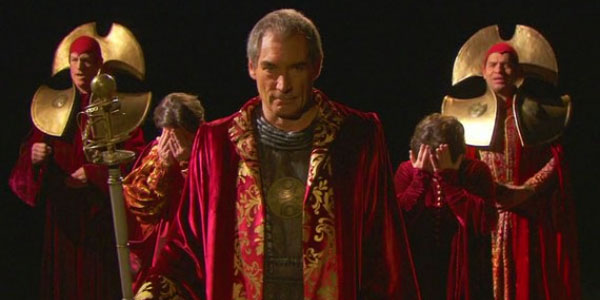 Perhaps something that a lot of viewers have missed, the Weeping Angels are referenced in 'The End of Time', when Rassilon declares that two Time Lords will "stand as monument to their shame, like the Weeping Angels of old". One of them, the mysterious lady speculated to be the Doctor's mother, covers her eyes with her hands like an Angel, perhaps in shame, or perhaps in fear of not being able to watch the lovely David Tennant regenerate. But does the connection go deeper than that? She does have a habit of disappearing when you're not looking, after all. We know that the Weeping Angels are as old as the universe itself, "or very nearly"; in that "very nearly" period, did they evolve from Time Lords? They live off time energy, after all, and no one knows their home planet. As with many Moffat creations, there isn't much crossover into Russell T Davies territory. It was Davies that planted the seed in 'The End of Time', and Moffat's not mentioned it once. Unless he's planning some big reveal soon, it remains unlikely, but given that the Angels are fleshed out more and more with every appearance, don't be surprised if we learn something incredible about them in their last story.
9. The Doctor's Daughter Is The Same Jenny Married To Madame Vastra
 Ever since Jenny, the Doctor's daughter (well, Peter Davison's daughter and David Tennant's wife) survived that bullet wound, fans have wondered whether she'd return in a spin-off, or as a new companion (perhaps even Clara). After all, it was Moffat that wanted her to survive. But what if she regenerated into Jenny, Vastra's wife? Both Jennys are trained in combat, hungry for adventure, and well, called Jenny: is that a coincidence? There wasn't a lot about her "regeneration" that made sense, and she's not a true Time Lord, so would the Doctor be able to sense another one of his kind? Also, it would explain why Jenny was so disgusted at the Doctor kissing her in 'The Crimson Horror', besides the fact she's a married lesbian of course. According to Moffat, it really is just coincidence. He claims he'd forgotten about poor Jenny. So no future for that spin-off then?
8. River Song Is Represented Through Music In Series 7
 We only saw River twice in Series 7. Which is a surprise, given how she was around every corner in Series 6, brandishing guns and revealing secrets. But when the Doctor claimed "You are always here to me, and I always listen" in Series 7 closer, 'The Name of the Doctor', was he talking metaphorically, or has Song being following him recently? Song of the musical kind seems to have replaced Song of the spoiler kind though; it's been four times more prevalent in Series 7, from Carmen being played by Oswin, to The Specials' Ghost Town playing in 'The Rings of Akhaten'. We've heard Sting, Rudimental, Slade and even Fantasia in F minor. Surely though Moffat wouldn't go to all that trouble just to signify something about River? Any other character and you'd be inclined to think not, but we all know how much the Moff loves Melody Pond. Where were they going on their last date? The Singing Towers. Where did Song die? The (silent) Library. And who was it that tried to bring an end to River's relationship with the Doctor? The Silence. Genius.
7. Angie Is Queen Nefertiti
 Remember those annoying kids that tagged along in 'Nightmare in Silver'? Angie, the girl who seemed utterly unexcited to be on another planet, decided that one day she would be "Queen of the Universe". Yeah, as if any king could put up with her attitude problems. Ancient Egypt isn't quite the universe, but what if she grew up to become the Queen Nefertiti that appeared in 'Dinosaurs on a Spaceship'? Moffat's known for introducing characters that have childhood encounters with the Doctor - Clara, Amelia, River - and it seems like there's more to tell about the Doctor and Nefertiti. How did he save her? How are they friends? Of course, it's somewhat tenuous to relate every character that's ever been in the show, but it's certainly something that could be referenced in a nod, like Jack being the Face of Boe. If Moffat ever wants to bring such ungrateful children back into the show, that is.
6. The Lux Corporation, Sweetville And Sardicktown Are All Connected
 It's not unusual for a writer to have a master plan years in advance. Just look at 'The Name of the Doctor'. But subtler than those prophesies, the Lux Corporation, Mrs Gillyflower and Elliot Sardick all have a lot in common. Well firstly, all three stories featured a character called Abigail: this isn't the same Abigail obviously, but it enforces the idea of preserving people. Sardicks Senior and Junior both preserved people in ice, Mrs Gillyflower preserved people against the "coming apocalypse", and The Luxes preserved Charlotte in the Library. And all three could, or wanted, to control the atmosphere. Why Steven Moffat would want to connect three seemingly unrelated enemies is beyond comprehension, but then so are a lot of his ideas before he ties the strings up. It is worth noting however that he had planned to write 'The Crimson Horror', but gave the task to Mark Gatiss due to time constraints; will Moffat explain what's going on here, or is this purely coincidental?
5. Captain Jack Was Beheaded By Headless Monks
 One of the more straightforward theories that Doctor Who fans have come up with, Jack Harkness is rumoured to have been decapitated by the Headless Monks. It makes sense: Dorium was a 51st Century ma who knew Time Agents and dealt vortex manipulators, and Jack was a Time Agent from the 51st Century. Somewhere along the line, Jack became a head, and the Headless Monks are known for making that sort of thing so. The link between the Face of Boe and Jack was always blurry, but Moffat was the writer who introduced Jack, so why couldn't he be the one to behead him? What connects the idea further is the confirmation from John Barrowman that Jack was meant to be in 'A Good Man Goes to War', but couldn't get time off from filming Arrow. Maybe it's just as well: Jack would have probably made River jealous if he'd flirted with Eleven...
4. The Doctor Shares Complicated Ideas With Us
 There's a moment in 'School Reunion' where a bespectacled David Tennant says, "So... physics. Physics, physics, physics... I hope you're getting this down." And it's funny, because there was nothing to write down. But what if there was? What if the Doctor was sharing deep secrets about the 11th dimension and the time vortex, in his natural Gallifreyan tongue, but it only translated into "physics" when heard in our puny Earth language? It's the same principle with "Timey-wimey" and "Spacey-wacey", catchphrases that have embedded themselves at the heart of Who: we all know the TARDIS translates, but if there's no word in the English language for it, perhaps it defaults to gibberish. Whilst this is probably untrue, it's a wonderful thought. Nearly as wonderful as watching 'Blink' in French, and hearing a dubbed actor trying to pronounce "Wibbly-wobbly, timey-wimey". Yes, the TARDIS even translates French.
3. Rory Died The Year He Became A Nurse
 There are no mistakes in Doctor Who. Everything's deliberate. Right? If you believe that, you might just want to question what's gone on with Rory's timeline. Not happy with killing him an amazing nine times (Rory really is a cat), it appears that the Moff planned his life more scrupulously than Amy's, even. The first time the Doctor sees Rory, he takes a note of his badge, which claims he's been a nurse since 1990. Okay, we're never told exactly when 'The Eleventh Hour' is set, but assuming he's 30 by 'The Angels Take Manhattan' in 1938, he lives for fifty-two years in New York with Amy. This would make him 82 when he dies in 1990; is younger Rory the one that treats older Rory when he dies? There are discontinuities that throw the theory: Rory is clearly not old enough to have become a nurse in the 90s, if you judge the phones and laptops in 'The Eleventh Hour'. We don't know he was exactly 30 in 'The Angels Take Manhattan' either; all we have is talk of Amy getting wrinkles. But if it is true, it's spectacular foreshadowing from Moffat and team, and maybe Moffat's the alien, not Matt Smith...
2. The Doctor's Name Is His Timeline
 Only the Doctor and River know the name of the Doctor. And Clara, but she forgot it. (As an aside, only River could've written that Time War book: she's the only one who'd write his name down in English, and plus, she's an archaeologist. It's her job to write about it.) Let's just clarify the language of the Time Lords though: Gallifreyan is an ancient tongue undecipherable to the TARDIS: she leaves it as it is, and we get that lovely, curly writing that resembles the inside of a fob watch. You must have noticed that though, right? Circular Gallifreyan is designed to look like the workings of a watch. The Time Lords literally write in time, as well as walk in it. There's a rumour that the Doctor has every companion's name written in the latest TARDIS interior, and there's even a program for fans to download and write their own names in Gallifreyan. Facing facts though, no one knows what any of it means. We only know that the Doctor doesn't like to tell anyone his name. What if the Doctor's ashamed of his name because it reveals everything he's ever done? Sure, his name is dangerous, but only because it opens his tomb: it's probably not a dangerous word. No one will ever reveal the Doctor's name obviously, but it all points to time: he is a Time Lord, after all.
1. The Master And The Doctor Are The Same Person
 Back in the olden days, The Master was a plotter. A devious man with an evil plan, cold and calculating, like the Doctor himself can be sometimes. And when Russell T Davies resurrected the second most famous Time Lord of them all, he became a madman (the Master that is, not Davies). Plagued by drums in his head and a psychotic need to control the universe, he was again parallel to the Doctor's post-Time War pain. What if they're both the same man though? The theory - the wildest Doctor Who theory on the internet - says that the Doctor could one day regenerate into a new form and assume the Master's identity. What we'd have been watching all these years is not two Time Lords, but one Time Lord at different points in his own timeline. That's enough to send any Gallifreyan mad, surely, and it just so happens that the Master is unhinged. So much of it wouldn't make sense, but if Moffat ever gets sick of the show, it's certainly a way to end it with a bang...