10 Made-For-Television Movies That Are Actually Worth Your Time

TV movies are, by default, pretty awful. Here's 10 that won't make you regret being born.

One of the most tragic things to have occurred in the realms of television nowadays comes with the loss of the TV movie. I know what you're probably thinking: "Are you nuts?! TV movies are horrible!" Generally speaking, that's true. When you pop a made-for-TV flick into your DVD player, there's a 99.9% chance that you've booked in for an evening of boredom: horrible acting, stagey camerawork, a plodding script, and fake-looking special effects. No wonder modern TV stations prefer to stick with sitcoms and reality shows. However, there is a .1% of TV flicks that defy all logic. Such movies don't quite measure up to the caliber of a feature film, of course: I mean, how good can your movie really end up being with such a small budget and all those TV executives breathing down your neck? If you're looking to burn an hour and a half, however, you could do a lot worse than checking out some of the better candidates. Here, we'll point out 10 made-for-TV gems that are absolutely worth your time. If we've left out any of your favorites, don't forget to tell us about them below...

10. The Wave (1981)

A solid story can make or break a movie. It doesn't matter how beautiful the film looks, how well it's acted, or how great the director is - if the story is flawed, the movie will fail. The opposite is also true; if a movie has a good story, we're willing to forgive sloppy filmmaking and acting. The latter is the case with The Wave. You might have seen this movie in school. I know I did; it's one of two "school movies" that I actually remember liking. The movie tells the true story of a classroom experiment gone wrong. Said experiment comes about when Ben Ross (Bruce Davison) tries to teach his high-school history class about the Nazi movement by forming a classroom Nazi party, which he calls The Wave.The Wave immediately becomes the most popular club in the school. Mr. Ross does nothing about it until other teachers start complaining. Ross decides to end The Wave through a melodramatic assembly that reveals The Wave's true leader. The acting is shoddy, you can see the ending coming from a mile away, and the film looks like it was directed by one of Mr. Ross's students, but the story is disturbing enough to make the film stay with you.

9. Night Gallery (1969)

The TV movie probably wouldn't have been around as long as it was if it wasn't for one simple reason: TV networks used the format to present pilot films. Many of the best TV movies were pilots for TV series. One example of this is the excellent 1969 film Night Gallery, written by none other than Mr. Rod Serling (of Twilight Zone fame). Mr. Serling uses his famous narrating skills to tell us three chilling (well... as chilling as horror TV in the 1970s could be) stories. He's helped by three not-so-good but still haunting paintings. The first story tells the story of a playboy (Roddy McDowall) who murders his rich uncle, only to have said uncle come back from the grave for revenge. The second story revolves around a blind lady (Joan Crawford) who undergoes an eye transplant to be able to see for a few hours. Unfortunately, she receives her sight at a most inopportune time. The third story tells the story of a Nazi war criminal (Richard Kiley) who uses astral projection to escape his pursuers. Sadly for Mr. Kiley, he chooses the wrong time for his final escape. The flick is flawed; the preachiness that marred Serling's later writing rears its ugly head a couple of times. Serling's talent wasn't entirely gone, however; the stories are still entertaining. It's the acting and directing, however, that really help the film gain its glory. The second film, "Eyes," is the best segment by far; that's due to a director named Steven Spielberg. The segment was Spielberg's first professional job; it's funny to see Spielberg reveal an artsy side that he hasn't used since.

8. Murder By The Book (1971)

Columbo is an oddity among TV series: every episode is a TV movie. This put the show at an advantage; the writers and directors had more time to unfold Lt. Columbo (Peter Falk)'s cases than other TV writers & directors. As a result, the Columbo series was a perfect training ground for beginning directors and writers, including Steven Bochco (who later created Hill Street Blues and NYPD Blue) and Steven Spielberg. Bochco & Spielberg teamed up for Murder By The Book. Murder By The Book's story is the best in Columbo's file. A novelist (Jack Cassidy) kills his writing partner (Martin Milner) when his partner says that he wants to break up the group. The murderer stupidly follows a plot that he wrote down and left in his partner's office. Lt. Columbo doesn't get to search the office for most of the movie, but that's okay. In the meantime, we get to see Falk & Cassidy verbally spar several times, and we get to see Cassidy commit another murder (sort of; the murder occurs off camera, but it's implied). Most of the Columbo TV movies are typical TV movies; it's fun to see Peter Falk embody the Columbo character (which he does perfectly), but the plots and filmmaking are sub-par. Murder By The Book is a rare exception. Bochco's teleplay shows his strength at developing characters and suspense, which would become Bochco's trademarks. And, of course, Spielberg's talent shines through. There are some awkward scenes, but you can tell that the awkwardness was due to studio interference and not because of Spielberg.

7. The Beach Boys: An American Family (2000)

It's not hard to see why The Beach Boys were seen as TV-movie material. Look at the band's story: a group of teenagers record a chart-topping demo in a garage and become world-famous. The success is marred, however, when the band's boy genius (Brian Wilson) turns to drug abuse. The group struggles to stay credible while trying to save their leader. During the course of their career, they encounter overbearing psychiatrists, bad parents, band in-fighting, serial killers, and fickle fans and critics. The Boys' story has all the elements for great drama. The best film version of the Boys' story is the 2000 TV flick The Beach Boys: An American Family. The film doesn't cover the full story of the band; it ends after Brian Wilson's first drug recovery. The movie does, however, do a good job of depicting what it does cover. The best parts of the film are the portions that show Brian creating Pet Sounds (arguably the greatest pop album of all time) and the months when Charles Manson descended on Dennis Wilson (the band's drummer)'s house. It's fascinating to see Brian as the mad genius during the Pet Sounds sequences. The Manson scenes are made great by one of the most accurate portrayals of Charles Manson that there's ever been (by Erik Passoja). It's scary how well Passoja depicts Manson; it's like watching the real Manson. I remember seeing this movie as a kid and being underwhelmed by it. Then again, an eleven-year-old kid isn't going to be the best critic. Upon revisiting the flick, I found it to be much better than I remembered. If you're a music buff, you can't afford to miss this film.

6. Tribes (1970)

Let's get the negative stigmas out there right away: it's a movie about boot camp, made at the height of the anti-Vietnam era, written by old men trying to be hip. With that kind of record, you'd expect it to be nothing but bad. You know what, though? It's not bad at all. The movie revolves around Marine Corps D.I. Drake (Darren McGavin) and one of his new recruits, Pvt. Adrian (Jan Michael-Vincent). Adrian is the archetypal hippie, complete with long hair, a pacifist attitude, and a heavy interest in meditation. Drake initially looks down his nose at Adrian. Adrian quickly becomes a model recruit, however, because his meditation helps him focus. Drake acts like he hates Adrian, but he secretly comes to respect Adrian. Unfortunately, Drake's fellow drill instructor, DePayster (Earl Holliman), has made it his mission to make Adrian's life miserable. Drake and DePayster butt heads throughout the film. Tribes isn't perfect. Jan Michael-Vincent seems to be sleepwalking through his performance, as does Earl Holliman. What really saves the film is Darren McGavin's brilliant acting. Of course, McGavin was given a great role by the writers (who managed to create a drill instructor who actually feels like a real human being). McGavin does a fantastic job making the character come to life, though. He manages to make us actually care about a drill instructor, which is a mean feat.

5. Helter Skelter (1976)

I didn't mean to have Charles Manson become a recurring theme in this article (he appeared in the Beach Boys TV movie), but you can't write a list like this and not include Helter Skelter. After all, the film defined the nightmares of a whole generation of TV-watchers. The movie is based on Vincent Bugliosi's book about the Manson murders. The movie begins as the police investigate the murders at Roman Polanski's Los Angeles house (the victims included Sharon Tate, Polanski's wife, and his unborn child). The movie eventually boils down to a showdown between two men, Mr. Bugliosi (George DiCenzo) and Manson himself (Steve Railsback), as they duke it out in the courtroom. The movie isn't anything special from a stylistic standpoint; you can tell the movie was made on a small budget. Most of the acting is pretty lame, too. The movie does, however, have two performances that elevate the movie to legendary status. George DiCenzo delivers the first of these performances; he does a great job playing a stoic, driven attorney. Railsback blows DiCenzo out of the water, though, with his performance as Manson. Railsback radiates so much power and force that you're almost scared to look at him.

4. It (1990)

Okay, so technically, It wasn't a TV movie, but a miniseries. However, the series' running time only adds up to about three hours, so I'm hoping you'll cut me some slack here. After all, It is, to my generation, what Helter Skelter was for our parents' generation. The movie isn't totally faithful to Stephen King's novel. I mean, come on, the book's over a thousand pages long. The screenwriters did a good job, however, of getting to the spine of the story and sticking with it. Said spine tells the story of five childhood friends to duel a demon that looks like a clown (Tim Curry), who they already "killed" in the late 1950s. The clown/demon, Pennywise by name, has the power to shape-shift into whatever you fear most. Pennywise rarely uses this power, but he does manage to add the fear of clowns to the mindset of those of us who have seen the series. The movie is a little slow as it gets the grown-up kids back to Derry, Maine, to fight the monster, but it gets better as our five heroes arrive. The special effects are fake-looking, and Pennywise puts up a pretty half-hearted fight against those who are trying to kill him. The movie still wields an eerie power, however, probably because of the brilliance of King's source work.

3. Brian's Song (1971)

Whoever said that it was wrong for men to cry was... well, wrong. If guys weren't supposed to cry, we wouldn't have been given movies like Brian's Song. It might be a cliche to include this movie on this list, since Brian's Song is included on every list of the best TV movies of all time. But just because it's a cliche doesn't mean it's not true. Brian's Song tells the true story of the friendship between Gale Sayers (Billy Dee Williams) and Brian Piccolo (James Caan). The two are drafted by the Chicago Bears during the same year, and they both become heroes of the Bears' defensive line. After a few years, Piccolo's performance declines. The coach sends Brian home to find out what's wrong; "what's wrong" turns out to be terminal cancer. Football takes a back seat for the rest of the movie, as we watch Sayers, Brian, and Brian's wife come to terms with Brian's eminent death. There are schmaltzy scenes in Brian's Song (especially the "game ball" speech; it'll rot your teeth with its sappiness), but such scenes are few enough that they don't hurt the movie. You don't have to be a football fan to enjoy the movie, either; the games are shown in montages that last maybe two seconds. All you really need to enjoy this film is a heart. If you don't cry during the final scenes, there's something wrong with you.

2. The Night Stalker (1972)

This is another of those movies that has to be included on every list of great TV movies. After all, Stephen King once called it one of the scariest TV movies ever produced. The movie isn't scary by today's standards, but it still stands up as a great mystery. The film also contains some of the greatest acting in the history of television, courtesy of Darren McGavin. The movie revolves around Carl Kolchak (Darren McGavin), a reporter in the classic "hard-boiled detective" tradition. Kolchak's trailing a murderer that turns out to be a vampire. Kolchak eventually uncovers the story, and the vampire (Barry Atwater, turning in the only bad performance in the film) isn't happy about it. Kolchak fights the vampire, but he gets more trouble from the police department, who want to keep the story under wraps, than the monster. The Night Stalker couldn't help but be good; that becomes obvious when you watch the opening credits. The teleplay was written by Richard Matheson (of I Am Legend fame), who does an amazing job adapting Jeff Rice's source novel. The roles are filled with amazing character actors, who almost all do a good job (especially McGavin, who nails the tough-guy reporter archetype perfectly). The result is a wonderful mystery with supernatural tones. It even has a nice subplot about police corruption to give some added flavor.

1. Duel (1971)

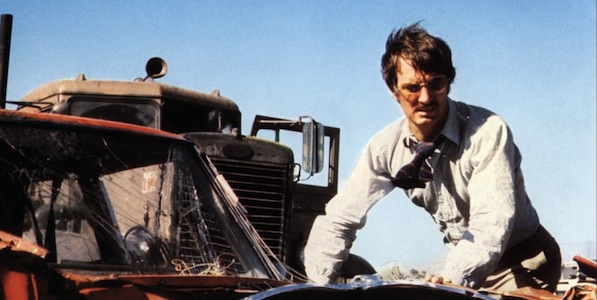
Here it is: the mother of all TV movies. This is the flick people always talk about when they discuss how great TV movies can be. The movie deserves all the praise it gets; it's one of the most suspenseful and exciting TV flicks ever made. In fact, it might not be an exaggeration to say that it's one of the most suspenseful movies of Steven Spielberg's career. It's not quite as scary and exciting as Jaws, but it's up there. Duel has a simple plot: like the title says, the movie contains a duel between two people. Instead of guns or swords, however, the duelists use their cars. David Mann (Dennis Weaver) is a timid businessman who's struggling to retain his manhood after an embarrassing incident with his wife. Everything about Mann cries "wimp!": his whiny voice, his doormat attitude, and even Mann's car, a gutless Plymouth Valiant. Mann gets a chance to reclaim his manhood when he's terrorised by a mysterious semi driver (Carey Loftin). Mann's car is useless against the tanker. Ultimately, Mann turns to the only strength he has - his wits - to defeat the driver. Duel is the first time that Spielberg's talents shine through in full force. The film is beautifully shot; Jack A. Marta, the cinematographer, did a fantastic job photographing the deserts Mann & the truck driver drive through. The movie moves at a lightning-fast pace, courtesy of Richard Matheson's teleplay. There's never a boring moment; there's either car-on-car action on the road or quietly suspenseful scenes. The result of all this fine work is a a TV movie that's as perfect as a TV movie ever gets. Well, there you have it: 10 TV movies that deserve your attention. What others have we missed? Let us know in the comments section below.

Contributor
Contributor

Alan Howell is a native of Southern California. He loves movies of any and all kinds, Hollywood, indie, and everywhere in between. He loves pizza, sitcoms, rock and pop music, surfing, baseball, reading, and girls (not necessarily in that order).