10 Darkest Star Trek Moments That You've Never Seen
These are the times that try our souls, but Star Trek has yet to truly depict them
When can one say that something is so dark, so damaging, and so affecting - yet it has never truly been seen or shown? These are those events in Star Trek's history, spanning almost sixty years in our universe, and hundreds in theirs.
Some of the true power of impact comes from what we don't see - what do our brains concoct when left to their own devices? In that graveyard surrounding Wolf 359, did we not see hundreds of Borg, lying in wait, ready to destroy all life?
With the respect each of these events is given in Trek, one does wonder when, inevitably, they will make it to our screens. Some have been shown in part, like Wolf 359 above, while some remain in the wilds of dialogue, spoken of in hushed voices and hesitant revelation.
We now also have something else to contend with: temporal shift. Captain Pike referred to events in the 21st Century that varied with the way they had been described before - so where does this leave the avid Trek historian, memorial enthusiast, and continuity officers? Let's dive in.
10. The Burn

Though the actual explosion was depicted in an unintentionally hilarious manner on Star Trek: Discovery (seriously, a sky full of ships just exploded, cut to next scene!), the true impacts of The Burn were only explored in discussion, rather than in depiction.
The Burn, when one accepts the cause, could be a fascinating way to explore what truly makes the Federation what it is. The tangible and immediate effect was the end of warp drive as we knew it, for fear of dilithium igniting and destroying the ship. What does this mean for a vast interstellar alliance?
We do know that the Federation began to fracture, but what of other dilithium-equipped powers? Would there be an inevitable power grab? As this led to a destabilisation in the Alpha and Beta Quadrants, would shorter-distance neighbours suddenly find themselves alone in a vast nothingness?
Star Trek has always relied on warp drive to transport the audience from one planet to the next, but what happens when that fundamental part of the franchise's makeup is lost? What is Star Trek without some star trekkin'?
And what of the lonely outposts, surrounded by space on all sides, condemned to make their own way? The Federation may have begun to re-form quickly thanks to the arrival of Discovery and her spore drive, but after a century shattered like glass, surely there are some truly dark stories to tell.
9. The Breen Assault On Earth

The latter days of the Dominion War grew dark as both sides began to scramble for whatever victory they could find. Section 31 had already put their genocidal plan into action, poisoning the Founders, and pushing them into the arms of whichever allies could best help them win.
Enter the Breen.
Though often discussed, the Breen had rarely been seen before. With one of their number being killed in a Dominion Internment Camp, one could assume that they would have no love for the Gamma Quadrant invaders. However, they allied, shocking the Quadrant, but spelling an even worse fate for Starfleet.
The celebrations aboard Deep Space Nine as Worf and Ezri returned from capture were cut short by the announcement that the Breen had attacked Starfleet HQ on Earth. Though most of their forces were destroyed, they managed to inflict heavy damage on San Francisco, and even more morale damage.
The Changing Face Of Evil, much like The Best Of Both Worlds, elected to show the aftermath of the assault - which itself was a stark image. This would only get worse mere days later as the Breen aided the Dominion in retaking the Chin'toka System.
8. Wolf 359
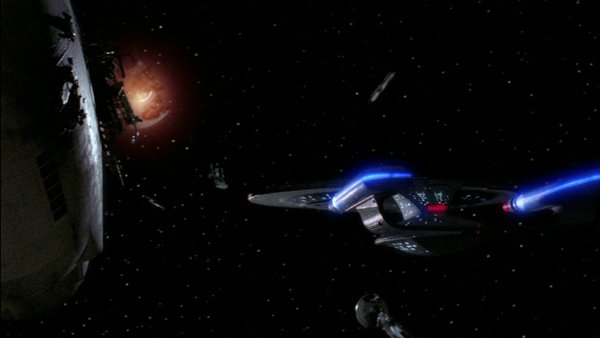
Perhaps the most famous battle in Star Trek's history is conspicuous in how little it has been seen on screen. In The Best Of Both Worlds, the audience is given a grim view of decimated ships, floating through space, devoid of life. The true horrors of the battle would be revealed later, but that scene has burned itself into our memories for decades.
The opening scenes of Emissary offer us a little more of the chaos that befell ships like the Saratoga, the Melbourne, and the Chekov. The Starfleet vessels are hopelessly outgunned, despite the preparation offered in the time since Q, Who?
No Win Scenario switched its focus from depicting the battle to offering a stark portrayal of PTSD, this time in the form of Liam Shaw. It is clear that despite thirty years passing, it is as fresh to him as to the man who was once forced to lead the assault.
It is perhaps unlikely that Star Trek will ever show the battle in full, yet there are numerous projects online that seek to fill that void. The Wolf 359 Project has created an oral history of the battle, which is available to read here. Meanwhile, JTFX has created a stunning visual reproduction of the battle which can be found here.
7. The Tarsus Colony Massacre

The Tarsus IV incident links two Star Trek series together, as well as offering some nice inspiration for a certain Purple Mad God in recent cinema.
James T. Kirk and Hoshi Sato were both residents of Tarsus IV when the then-governer, Kodos, responded to an ecological disaster in the starkest way imaginable. As the colony was running dangerously low on food, he ordered the deaths of half of the colonists. Kirk was spared, while Sato and her family weren't.
This Federation colony should have had everything, as most aligned worlds did. 23rd-Century technology may have been a little less refined than what would follow, but surely food requisitions shouldn't have been that hard to come by. So, what drove Kodos to make this decision? What failings had to occur that would result in the deaths of so many? Though Archer would have already passed away, how would T'Pol, Hoshi's former shipmate have taken the news?
There are still so many unanswered questions in the wake of the massacre, and the death of Kodos, posing as Anton Karidian, twenty years later meant many of those questions died with him.
6. The Tomed Incident

The Tomed Incident refers to the actions taken to end hostilities between the Federation and the Romulan Star Empire, specifically in the years following the Khitomer Peace Talks depicted in Star Trek VI: The Undiscovered Country.
An Ivarax-class Romulan Warbird crashed into a Federation outpost on the planet Tomed. When the ship's power core, a forced quantum singularity, broke down, the resulting explosion killed thousands of Federation citizens. The fallout from this attack caused the Klingons to side with Starfleet against the Romulans. Outmatched, they agreed to the Treaty of Algeron.
There is one small issue with the above - it was all a fabrication by Starfleet Intelligence. The outposts and ship (USS Agamemnon) that were reported destroyed were all empty, with the bodies assigned to the incident coming from people who had previously died. These deaths had been covered up in the run-up to the incident.
It is a fascinating piece of Starfleet's history that led to decades of galactic peace, though by the use of some of the shadiest tactics this side of a tailor's shop.
Captain John Harriman of the Enterprise-B was a main player in this story, operating from the hangover of being in command of the mission that saw the death of James T. Kirk. With Succession now at an end, if Alan Ruck was game to return, this would make a fabulous Long Trek.
5. The Crotonan Guard

Captain Rudy Ransom already had quite the reputation for original thinking by the time the USS Voyager encountered the Equinox in the Delta Quadrant. While much of this expertise would be put to use in his attempts to escape Janeway's wrath, he was sadly outmatched in his first week in the frontier.
After being dragged across the galaxy by the Caretaker, the Equinox found itself in the Crotonan Guard's territory. Despite warnings from the locals, he gave the order to proceed.
Much of what we know about the Equinox has been told to us by the surviving crew that Voyager encounters. However, when Ransom gave that order, they were still a mostly functioning ship with a mostly intact crew (we are allowing for some deaths from the Caretaker's actions). In that first week, Ransom tells Janeway, that the Crotonan Guard killed half of his crew. From that time on, they were limping through the Quadrant.
The event is detailed almost off-hand by Random. He had almost five years to come to terms with that horror, so one could be forgiven for blasting through the report - but there is little doubt that at the moment, this would have been a truly horrific event to endure.
4. The Massacre At Khitomer
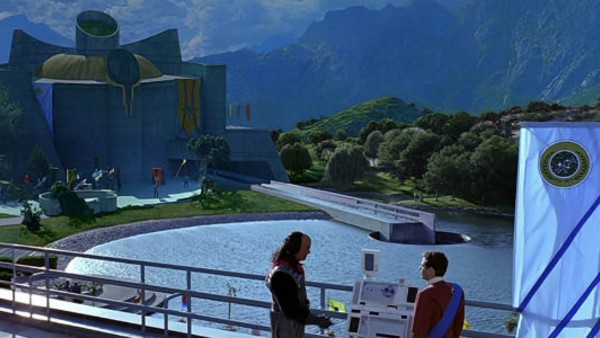
The massacre at Camp Khitomer is one of the more tragic events that has never been depicted on screen. The only time, in fact, that Khitomer has been seen has been as part of the Federation-Klingon Peace Talks in Star Trek VI: The Undiscovered Country. At that point, it seemed like the beginning of a brighter chapter of galactic history.
However, we know that the Tomed Incident followed these talks, though that did help to quell hostilities between the Federation and the Romulans. The same cannot be said of the Romulans and the Klingons, leading to this tragic event.
It was discussed in much detail when Duras was running for Chancellor of the High Council, leading to Worf's discommendation and family shame. It was all a ruse to cover up the crimes of the Duras family, which would find their own spiritual sequel in both Duras and his sisters', actions as years went on.
Yet there is another reason why it is a tragedy not to have witnessed any of the massacre. We know so little about any of Worf's Klingon family, bar his brother Kurn. He had a grandfather defend Kirk and McCoy, but the greatest name to a face we've never seen is Mogh, Worf's father, and the unfortunate scapegoat - blamed for betraying the Klingon Empire.
For an event so monumentally important in Star Trek's history, it is baffling to have yet to see any of it.
3. The Dominion Retaliation Against The Cardassian People
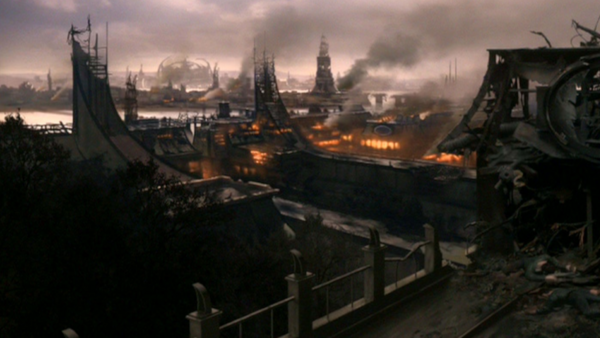
What You Leave Behind features an unfortunate amount of re-used footage from earlier episodes, though remains one of the strongest series finales of any Trek series. While it is a busy episode, the retaliation, by the Dominion, against the Cardassian people is almost brushed over.
The Cardassian Union allied itself with the Dominion, inviting them to the Alpha Quadrant, all in the pursuit of regaining its former strength. This led to war, though as Weyoun so eloquently put it - they had become quite the disappointment.
The Dominion never accounted for the sheer resistance that the Alpha Quadrant powers would put, but what's more, they certainly didn't expect it on their doorstep. The Cardassians, proud as they were, couldn't abide by the continuing disrespect offered to them by the Founders, the Vorta, and the Jem'hadar. The alliance with the Breen only solidified the resentment that had long been bubbling.
What began as various acts of sabotage against the Dominion became a full-scale uprising with the destruction of Lakarian City. The Cardassian fleet turned against the Dominion in battle, but the Cardassian people were left vulnerable. Though discussed in an almost off-hand manner, the retribution that the Dominion sought was terrible. As Bashir's stunned voice recounts - almost 800 million dead.
Buildings are destroyed, bodies litter the streets, and the casualty reports were still coming in after the Female Changeling's surrender. This is one of the most horrific off-screen events in Trek history, even if we did see a tiny fraction of it as Martok takes his drink.
2. World War 3
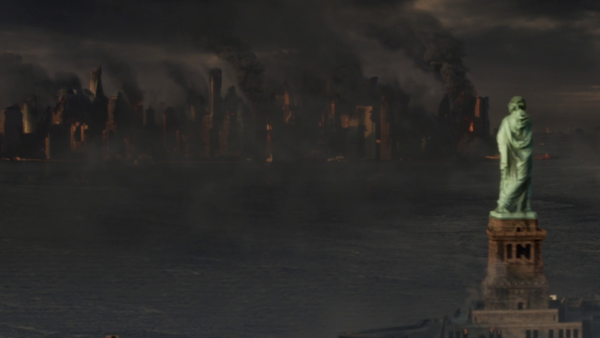
From the franchise's earliest days, Gene Roddenberry wrote that World War 3 would take place in the 21st Century and that it would be devastating. There are numerous references to it through The Original Series, and The Next Generation, with Star Trek: First Contact probably showing the best example of the aftermath.
As the years have passed, and real time has come a lot closer to the supposed years of World War 3, there have been clever alterations to Star Trek's history to tidy things up. First, the Eugenics Wars of the 90s - famous for seeing the exile of Khan Noonian Singh - have shifted in time. They now slide into the Second American Civil War, and eventually into World War 3 itself.
The Romulan Agent, known only as Sera, confirms to La'an and Kirk that the efforts of temporal agents have seen a shift in timelines - resulting, for example, in Khan's birth being pushed back by almost fifty years.
It remains to be seen if April 4th, 2063 will remain the date of First Contact going forward, but one thing has never changed: despite the brighter future Star Trek promises we will get to, a third world war is coming.
1. The Setlik III Massacre

The Massacre on Setlik III was disturbing enough to haunt the hearts of its survivors for decades to come. Though we would see Miles O'Brien deal with the fallout in both The Wounded and Tribunal, we do know that it was horrific enough to inspire a starship captain to abandon the Prime Directive.
The first Cardassian wars were skirmishes when one considers them against the Dominion War of the 2370s, yet theirs was a Union that was highly skilled at visiting death and destruction when needed. Setlik III was, by all accounts, one of the smaller engagements of the wars, yet Benjamin Maxwell was unable to put it behind him.
Even O'Brien struggled with it, years later. As he sat across from a Cardassian soldier who was trying to make small-talk, it was all O'Brien could do not to show the man his hatred. Still, as O'Brien says - it wasn't the Cardassian soldier he hated, it was what he became in spite of that soldier and others like him.
Setlik III would again be mentioned when O'Brien was arrested on false charges, but for all of the damage that it has done to the Irishman's life, it has never once been officially depicted.