Quentin Tarantino: Definitive Guide To Homages, Influences And References
Inglourious Basterds
27. The Title
The title of the movie, Inglourious Basterds, is a play on the title of an exploitation movie from the 70s, the correctly spelt Inglorious Bastards. That movie, which Tarantino's original plot seemed to borrow from more heavily, focused on a group of disgraced soldiers on their way to an execution camp who manage to escape and go on a Nazi-killing rampage. Though Tarantino's own WW2 movie took its own shape, he kept the title, though marked the title with a purely Tarantino-esque spelling touch - one that the director insists explain would make it redundant.
26. Once Upon A Time...
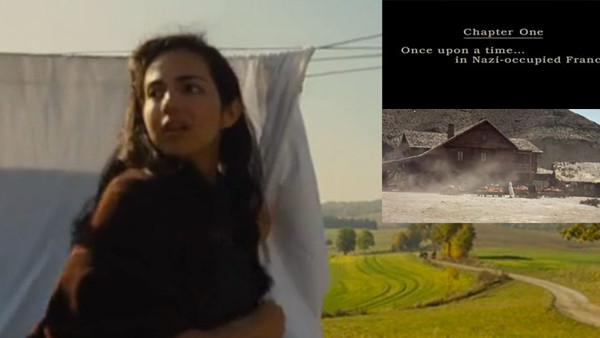
Chapter One of Inglourious Basterds is titled "Once Upon A Time in Nazi Occupied France"... what was once the sub-heading for the movie. For Tarantino's own fantasy WWII movie, this is a clear homage to Sergio Leone and his fantasy Western Once Upon A Time In The West and Fantasy gangster Once Upon A Time in America.
The whole first scene is shot in a Leone style with exaggerated, over-bearing Ennio Morricone music and extreme close-ups before the backdrop of huge landscapes. In both, the first sign of danger from an arriving harbinger of doom is with a woman outside, before the male, followed by a massacre.
25. The Citizen Kane Window Reference
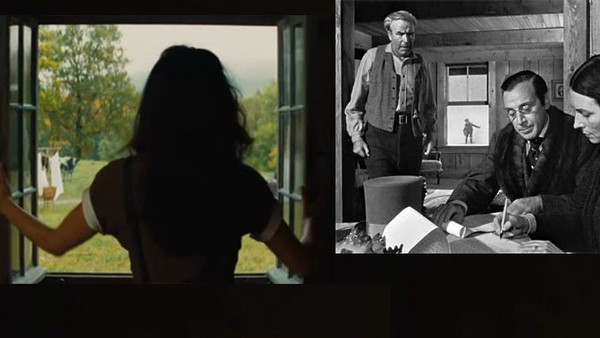
The moment where a member of the LaPadite family closes the window before Hans Landa's interrogation references a similar moment in Citizen Kane. Both moments reflect the shutting out members from a family unit; in Kane the parents of Charles giving him up to a foster parent and in Basterds, LaPadite giving up the location of the jews he has been hiding under the floorboards.
Inglourious Basterds
24. The Uneasy Hospitality Scene
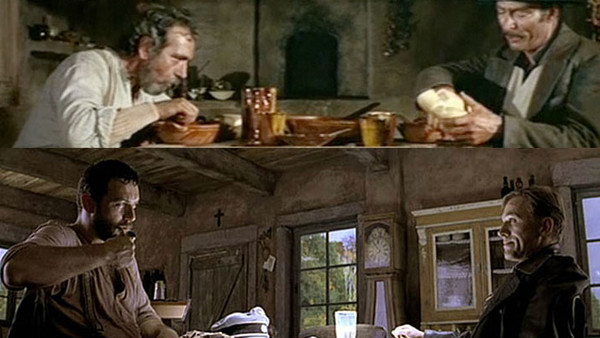
The first scene in the film - in which Colonel Hans Landa visits the French farmer and attempts to extract information from him - is highly reminiscent of the second scene in Sergio Leone's The Good, The Bad And The Ugly. In that iconic western, Angel Eyes "The Bad" Sentenza (Lee Van Cleef) is first visible in the distance, and is observed by somebody performing a menial task, whilst melancholic Ennio Morricone music plays over the top, all of which occurs in Inglourious Basterds.
Like Landa, Angel Eyes invites himself into somebody's home and interrogates them (in the case of The Good, The Bad And The Ugly, it's a former soldier) on the location of a missing man (Landa is looking for hidden Jews). The former soldier even looks physically similar to the French farmer. The composition of the entire scene, complete with shrill musical cues accompanying the burst of violence that ends the sequence, makes these two scenes unbearably comparable. Perfect, given that Tarantino envisioned the movie as a "western with WW2 iconography", and The Good, the Bad And The Ugly is his favourite film.
Tarantino seems to have a particular fondness for this scene, as it's similarly mirrored in Pulp Fiction, though not quite to the same extent. Hans Landa seems to have been somewhat based on the character of Angel Eyes Sentenza. Both are renound for their expertise in finding people, and support a similar "opportunistic" mantra. "When I start off to find somebody I find 'em. That's why they pay me," Angel Eyes says before shooting down his first victim.
23. Landa's Sherlock Pipe

Landa is first and foremost a brilliant detective. He smokes a pipe, presumably a nod to Sherlock Holmes, pop culture's most famous detective.
22. The Searchers
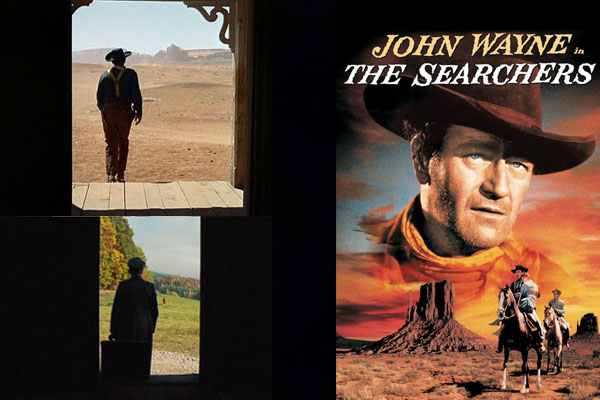
Despite outspokenly not being a fan of John Ford, Tarantino does take the time to homage an iconic image from his most famous film, The Searchers. When Shosanna is running for her life away from the Nazi's, Tarantino frames "The Jew Hunter" Hans Landa in the doorway looking beyond in the same way, and shot in the same angle, as Ford did John Wayne.
Inglourious Basterds
21. Aldo Raine
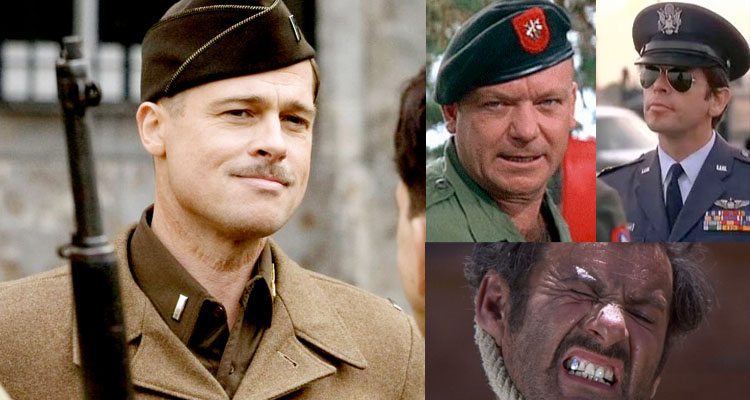
Brad Pitt's character, Aldo Raine, is a reference to one of Tarantino's favourite actors, Aldo Ray, who was known for his appearances in both Hollywood studio films and cheap exploitation fare. Raine's surname is likely a reference to Major Charles Rane, a character from Tarantino's favourite flicks, Rolling Thunder. If we are furthering the previous point that Hans Landa is the "Bad", Shosanna "The Good", then Aldo Raine could well be "The Ugly" of the film.
Perhaps this is where Tarantino got the idea for the character to have a rope burn scar under his neck, which goes though the film without explanation... a homage to Tuco who ends The Good, The Bad & The Ugly with a rope burn from hanging.
20. The German Sergeant York
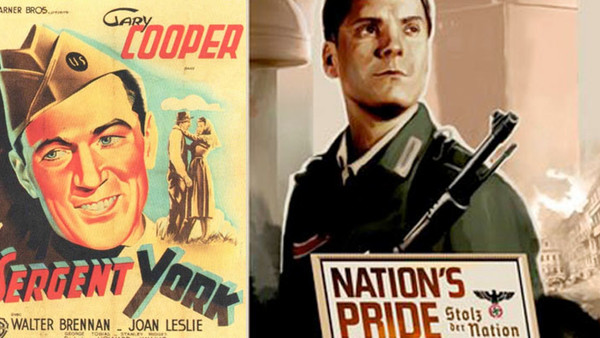
Various characters refer to "Sergeant York," a real-life WW1 veteran who became a movie star when he returned home having been the most decorated soldier of that war. He famously played himself in Sergeant York, a movie based on his own exploits. Frederick Zoller is often compared to Sergeant York as his German equivalent in the film.
19. The On A Mission Nods

Inglorious Basterds is also Tarantino's tribute to the war movie sub-genre "men on a mission" movies. These movies would often involve a group of tough guys sent on a mission bordering the suicidal, and would usually be supremely violent. Notable examples include The Guns of the Navarone, Where Eagles Dare, The Dirty Dozen, Battle Squadron and Five For Hell.
Inglourious Basterds
18. Madame Mimieux
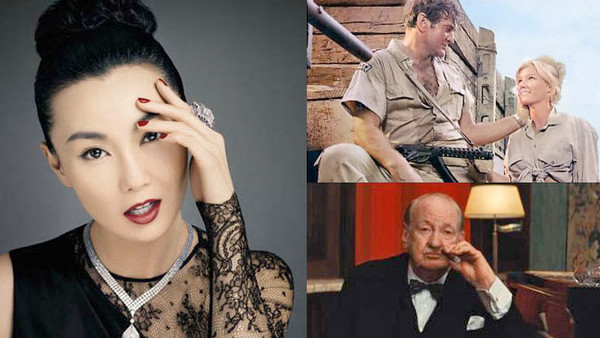
Cut well before the film's premiere at the 2009 Cannes Film Festival, Maggie Cheung's character of Madame Mimieux, the original cinema owner who took Shosanna in after she fled from capture by Hans Landa, was likely named after actress Yvette Mimieux. Directed by Jack Cardiff in 1968, Yvette Mimieux appeared in The Mercenaries (aka Dark of the Sun), a "bunch of a guys on a mission" war movie that starred Rod Taylor in the leading role. Now an elder statesman, Rod Taylor makes a memorable cameo as Winston Churchill in Inglourious Basterds.
17. Hugo Stiglitz
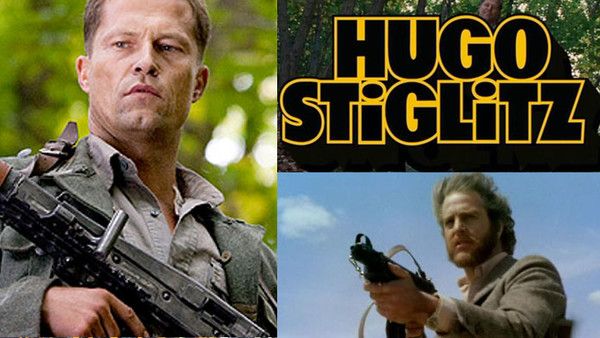
The name of the character Hugo Stiglitz, played by Til Schweiger, was inspired by a Mexican-German actor of the same name. Stiglitz was a notable actor in a variety of exploitation movies, including Nightmare City and Survive.
16. The Donowitz Clan
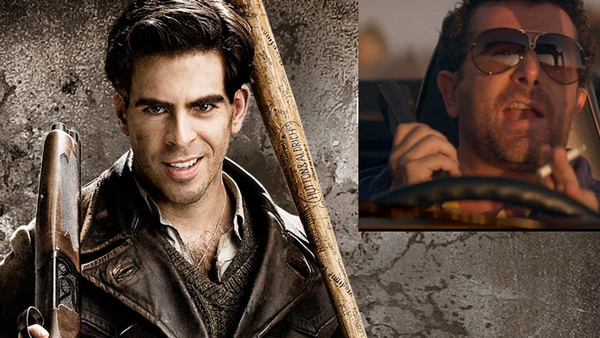
Eli Roth's basterd Sgt. Donny "The Bear" Jew Donowitz is supposed to be the father of Lee Donowitz, the Hollywood movie producer portrayed by Saul Rubinek in True Romance.
Inglourious Basterds
15. Le Corbeau

French director Henri-Georges Clouzots 1943 movie Le Corbeau (translated as The Raven) can be seen early on as the marquee movie at Soshanna's cinema. This can only be possible in Tarantino's universe as the film was actually banned from occupied France by the Nazis as it revolves around a group of friends who turn against each other over gossip, misinformation and paranoia in a small French village, an obvious allegory for what was happening in the country.
14. The Other Movie Posters
Other movie posters glimpsed throughout Inglourious Basterds include: Les Vampires (1915), Avalanche (1930) and Dominio (1943).
13. Feneche

Mike Myers' high intelligence British officer Ed Fenech is named after Euro-exploitation actress Edwige Fenech who starred in a number of Italian sex comedies and giallo films between the 60s and 80s. Likely a big fan of hers when growing up and exploring world cinema, Tarantino actually offered Fenech a role in the Tarantino produced and Eli Roth directed Hostel: Part II.
In the one scene Myers' appears in Inglourious Basterds, Tarantino purposefully parody/homages the atypical British general and exposition character in World War II movies. "We have all our rotten eggs in one basket" he says about the plot to pry all high-ranking Nazis to a French cinema that the Allies plan to blow up, likely a line taken from The Great Escape where a senior Nazi office explains why they couped up the most troublesome Allied prisoners together; "We have in effect put all our rotten eggs in one basket."
Inglourious Basterds
12. Zulu Dawn
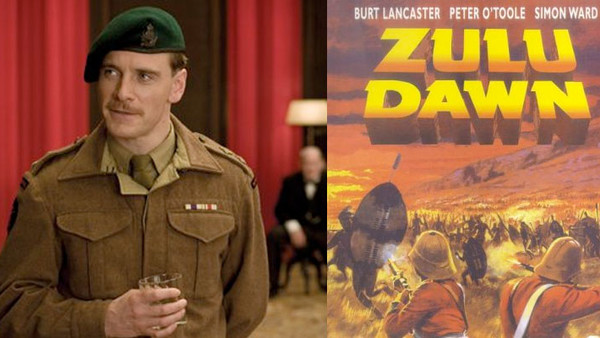
Michael Fassbender's Lt. Archie Hichox is probably named after Zulu Dawn film director Douglas Hickox. A track from the movie titled "Zulus" appears in Tarantino's movie. The character of Archie Hicox looks to have been partly based on famous English writer Graham Greene who, aside from being a movie critic and novelist, was a British Intelligence Agent. Unlike Hicox, however, Greene survived his espionage exploits and lived to the ripe old age of 86.
11. Pola Negri
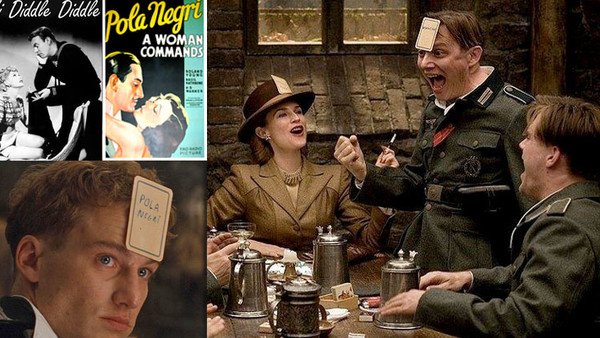
During the La Louisiane scene, the characters playfully start spitting out water in a surprised fashion. This is likely a homage to Hi Diddle Diddle, a screwball comedy from 1943 that is often cited as one of Tarantino's favourite films of that era. Pola Negri, the actress who co-stars in that movie, also appears in the naming game they play. Nazi officer Captain Willhelm Wicki who has the Pola Negri card on his head, was likely named in homage to German film director Bernhard Wicki, who directed the Best Foreign Oscar winning anti-war film Die Brücke (1959).
10. Shosanna's Window
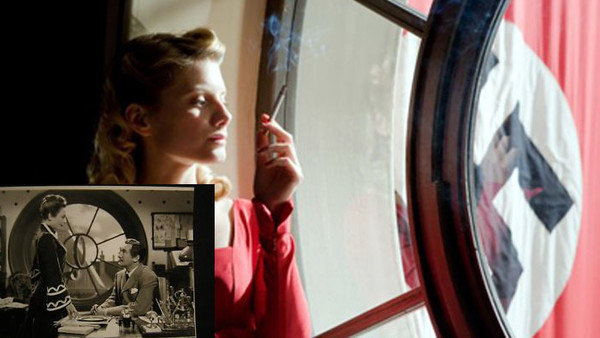
Shosanna's circular window design from her living space that looks directly over her cinema lobby is taken from Private Affairs of Bel Ami, Albert Lewin's 1947 movie starring George Sanders.
Inglourious Basterds
9. Action In Arabia
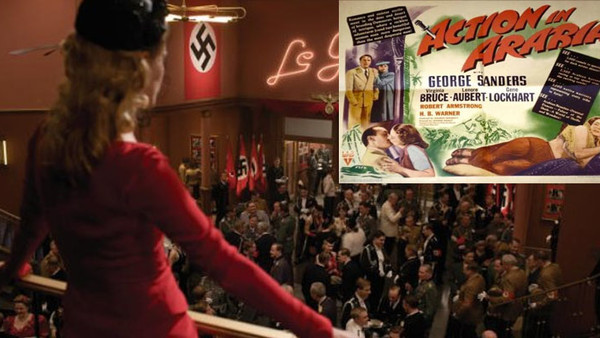
The lobby in Shosanna's cinema is designed on the one from Leonide Moguy's 1944 World War II movie Action in Arabia, starring George Sanders. Particularly the two staircases, the ceiling fans and the timing of the descents from Landa and Sanders coming down the stairs match in rhythm.
8. Cat People
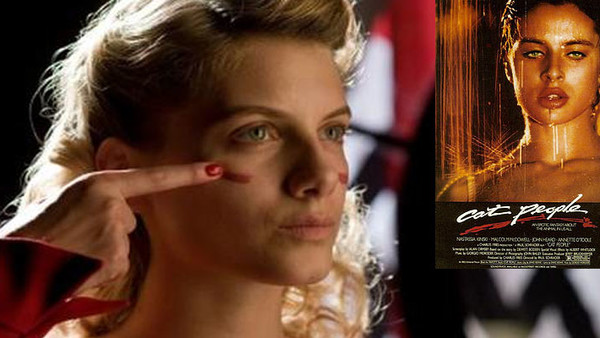
Tarantino's use of David Bowie's "Cat People" when Shosanna is putting on her war face paint ready for action is a reference to both Jacques Tournier's original German Expressionist movie of the same name, but also Paul Schrader's erotic horror remake. At one time Tarantino wanted the star of that movie, Natassa Kassinski to star as the German film star/British war spy Bridget Von Hammersmark, but talks broke down and the role ended up with Diane Kruger.
7. Marghetti

During the scene where the Basterds attempt to gain access to the cinema, Eli Roth's Donny Donowtiz takes guise of Antonio Margheriti, the name of a very prolific 70s exploitation director.
Inglourious Basterds
6. Cinderella
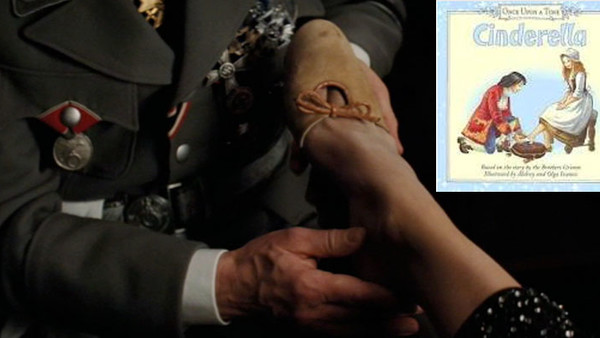
The "if the shoe fits" scene between Hans Landa and Bridget Von Hammersmark before the start of the movie is a clear recreation of the culmination of the Cinderella fairytale. Landa slips on the glass slipper which fits Von Hammersmark, revealing her identity as the traitor/British spy from the La Lousiana basement. Though unlike Cinderella, Von Hammersmark's prince had far more deadly intentions: he throttles the life out of her.
5. Shoshanna's Big Face

Shosanna's "Revenge of the Giant Face" could be referencing several memorable movie moments. Certainly with the fire underneath the face combined with the cackling laughter and the figure pulling the strings behind the curtain, the classic fantasy film The Wizard of Oz seems most fitting. However it could also/additionally be referencing 1984 and we shouldn't forget that both Adolf Hitler and Joseph Goebbels were known fans of Metropolis.
4. The Scarface Final Stand
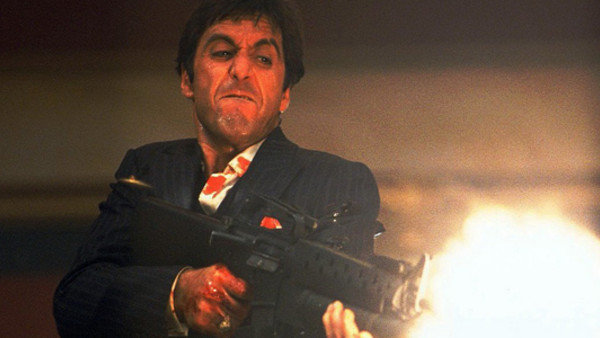
The scene where Omar Doom and Eli Roth kill Hitler mirrors the scene in which Tony Montana takes his final stand on the balcony of his home in Scarface (1983). Scarface was directed by Brian De Palma, one of the Tarantino's all-time favourite filmmakers.
Inglourious Basterds
3. Hangmen Also Die
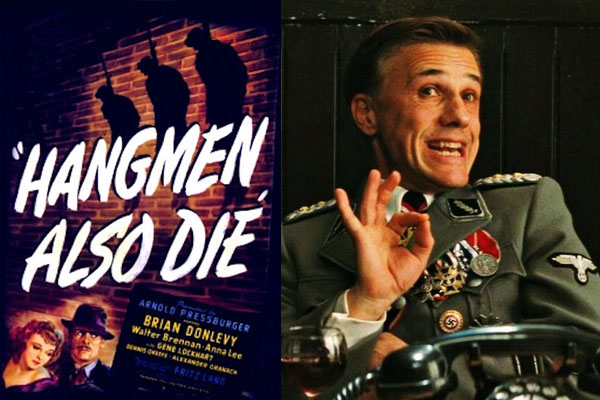
During the opening sequence with the French dairy farmer, Landa discusses Reinhard Heydrich, dictator of Czechoslovakia (who was known by his nickname as "The Hangman"). Landa mentions that Heydrich hated his nicknames, whereas Landa adores his own ("The Jew Hunter"). Interestingly, Fritz Lang made a film once called Hangmen Also Die! about the assassination of Heydrich.
The plot of that film mirrors the plot of Inglourious Basterds to some close degrees: it is done by British commandos behind enemy lines who use a machine-gun and a bomb. Hangmen Also Die also plays out like a "revenge fantasy." It's possible that Landa's line is Tarantino's way of acknowledging the film's influence on his own story.
Tarantino has also talked opening about his Fritz Lang and this film's influence: "When I was writing the script for Inglourious Basterds, I ended up looking at a different type of war film than Id ever watched before. These were the propaganda movies made in the 40s, mostly directed by foreign directors living in Hollywood because the Nazis had occupied their home countries, like Fritz Lang with Hangmen Also Die.
What's really interesting is that WWII was going on, the Nazis were an actual threat, not a theoretical threat, not just movie bad guys. Those directors, in most cases, had personal experience with the Nazis, and obviously they had to be worried about their loved ones back home. And yet those films are entertaining, theyre thrilling adventure stories, and oftentimes theyre quite funny, theres a lot of humor in them. And this goes against all the ponderous, anti-war, violin-music diatribes that weve seen in war movies since the 80s."
2. Danielle Darrieux
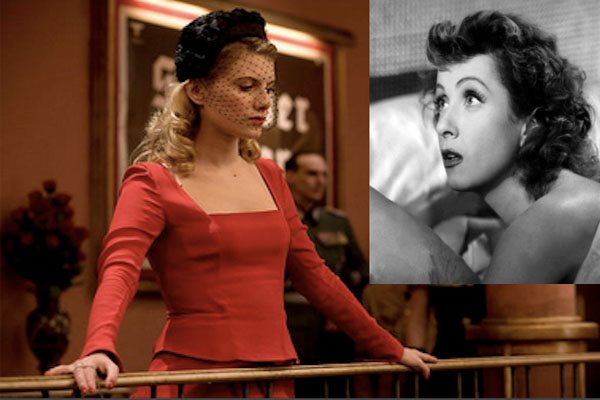
Upon seeing Shosanna all dressed up in her red dress before Nazi night begins, Marcel exclaims, "Ooh la la, Danielle Darrieux!" Danielle Darrieux was a famous French actress who appeared in more than 110 films. Her eight-decade film career is considered one of the longest in the history of cinema. She is still alive today and is currently 95-years-old.
1. The White Hell Of Pitz Palu
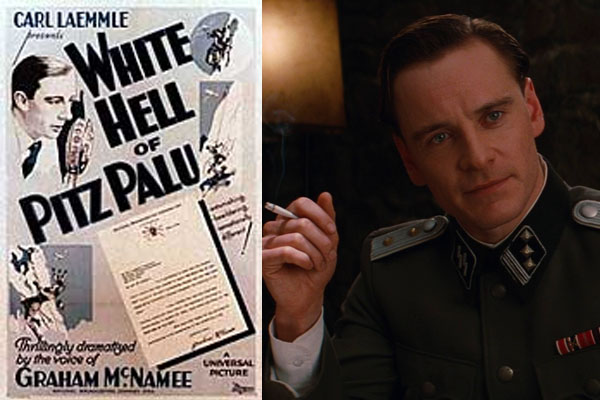
One of the films playing at Shosanna's theatre is the Pabst film The White Hell of Pitz Palu. Later Hicox, pretending to be German, says that he was born near Pitz Palu (hence his strange accent) and makes up a lie about his brother appearing in the film's ski torch sequence. The film was also later referenced in The Hateful Eight, when Tim Roth's character references the weather being a "white hell out there".
Django Unchained
20. The Title
Django Unchained gets its main inspiration (and its title) from a 1966 western directed by Sergio Corbucci, which starred Franco Nero. The Django character spawned over 30 unofficial sequels using the character's name to capitalize on the role, with each actor and director building to the legend of a character in the same way that Hattori Hanzo was mentioned and played by different actors in a multitude of samurai movies. Django is particularly well-known in Europe. Christoph Waltz revealed during a press interview for the movie, that growing up in Austria, children would call one another "Django" as a synonym for "cool."
19. The Violent Parallel

At the time of its release, the film was renowned as being one of the most violent westerns ever made and was refused a certificate in Britain until 1933. This is likely the reason Django has emerged as Tarantino's most violent film to date - and has drawn just about as much controversy.