Captain America - Every National Hero In Marvel Comics Explained
Did you really think the USA was the only country to create super soldiers?

Marvel Comics is an American company, so it's no surprise that the United States was the first country to be find itself reflected in a superhero motif.
Captain America was created by Joe Simon and Jack Kirby in 1941, as a rallying cry for the US to enter the Second World War, but Captain America isn't the only hero with patriotic sensibilities. Over the years, a number of heroes with pride in their home turf have popped up, ready to represent their nation and protect it from potential threats.
Now, with the MCU's Steve Rogers' retirement at the conclusion of Avengers: Endgame, there's room to explore other heroes who so boldly emblazoned their home country's flag on their chests. Black Widow will bring us Red Guardian, and a certain USA gent is set to debut in the Disney+ series Falcon and the Winter Soldier. Just last month, Marvel also announced new team The Union, a group of four heroes each representing a different country within the United Kingdom.
It's a pretty good time to be a Marvel national hero, so it might be useful to brush up on the smorgasbord we have to pick from in time for Marvel's upcoming efforts.
10. Major Mapleleaf

Louis Sadler Sr. first took up the mantle of Major Mapleleaf during World War 2 after being empowered by an undisclosed process. He fought with the Allied superhero group the Invaders, but he is perhaps best known for his role in fellow Canadian hero Northstar’s “coming out.”
When Sadler Sr.’s eldest son passed away from AIDS-related illnesses, he was incensed by the homophobic public reaction to the HIV/AIDS epidemic. Mapleleaf embarked on a rampage shortly after, only to be stopped by Northstar, who came out as gay in the same storyline.
The second Major Mapleleaf was the former’s second-born, Louis Sadler Jr. This incarnation didn’t really have any powers to speak of, but his horse Thunder was apparently gifted with flight and invulnerability - probably a nice nod to his time as part of the Canadian Mounties. Louis Jr was certainly not his father's favourite; he became the victim of frequent abuse at the hands of his father, who couldn't get over his wife's death in childbirth.
Despite a psychologically scarring upbringing, Sadler Jr. still went on to be a valued member of the Canadian team Alpha Flight. He was first enlisted as part of its new line-up, sent to rescue the original team. The new recruits worked well as a team, and stayed together to serve as Canada's premier super-powered task force.
9. American Eagle

Jason Strongbow, known by his alias of American Eagle, represents the Navajo nation. Strongbow gained his abilities via a tiff with Ulysses Klaue, who was mining and destroying a mountain sacred to the Navajo. The resulting exposure to uranium and a sonic blast from the baddie bestowed him with superhuman strength and agility, and amplified his senses.
His initial appearances were insensitive to say the least, but the character received an update in 2007 with a leather jacket and novelty eagle-shaped biker helmet - a vast improvement over the original design.
Considering the state of Native American representation in popular culture, it is a tragedy that the character has since been chronically neglected.
8. Black Panther

The crowned monarch of the fictional African state Wakanda also carries the title of Black Panther, and serves as the country's protecter.
Of the many figures to take on the mantle of Black Panther, T'Challa is the most prominent iteration of the character. Like his predecessors, T'Challa gained superhuman powers from a special herb native to this territory which bestows them with suitably cat-like reflexes, and enhanced stamina and strength.
As chieftain of his tribe, any Black Panther also undergoes rigorous training in preparation for the role, making him a formidable opponent even before donning the mantle. Wakanda’s immense supply of the extremely rare element vibranium gives Black Panther a near-indestructible combat suit and advanced weaponry.
But, even in such a high status position, T’Challa’s life hasn’t been without difficulties. He’s had his authority challenged by usurpers to the throne, like Eric Killmonger, who was ultimately unsuccessful in his attempt. He’s even had trouble in paradise: the Avengers’ conflict with the X-Men turned him against his wife Ororo Munroe a.k.a Storm. Later, illness would force T'Challa to pass on his title to his ever capable sister Shuri, but he's once again assumed the title and is currently leading Wakanda into space. Not too shabby at all.
7. Captain Britain (& The Corps)

The multiverse established in Marvel Comics provides an infinite number of realities to the franchise. The main one is dubbed Universe-616 – and so Marvel can pursue multiple possible plotlines. There are also an infinite number of all your favourite Marvel characters, and no one exemplifies the possibilities better than Captain Britain.
Earth-616’s Brian Braddock is effectively the “main” Captain Britain, as the son of one Sir James Braddock, an Otherworld guardian sent to Earth to father a great superhero. Another Otherworld being Merlyn (yes, as in King Arthur and his Round Table), his daughter Roma bestowed Brian Braddock with his Captain Britain gifts via the Amulet of Right, which transformed Braddock into a super-powered hero.
He would soon discover he was just one of an infinite number of “Captain Britains” spanning the multiverse; many realities have a version of Captain Britain. A far from exhaustive list includes Captain UK, Albion, Captain Airstrip (so Orwell gets a look in), Cap’n Brit, and most unusually, a Hauptmann Englande who hails from a reality where the Nazis won World War 2.
Together, they formed Captain Britain Corps under the leadership of Merlyn and Roma, and work to keep the multiverse safe.
Even within his own reality, Brian wasn't the only Captain Britain. His mutant twin sister Elizabeth "Betsy" Braddock has currently assumed the mantle while leading the latest incarnation of Excalibur, further enshrining the link between the Corps and Mavel's X-Men.
6. Captain America(s)

At the beginning of America’s involvement in World War Two, Steve Rogers was a kid from Brooklyn. He wanted to enlist in the US Army, but was rejected on medical grounds. A second chance came in a procedure called Project Rebirth – a US scientific experiment to create super-soldiers. It worked, but when the super soldier serum's creator Dr Abraham Erskine was assassinated, it died with him, leaving Steve Rogers the only living reminder of his work. Thus, patriotic mascot Captain America was born.
But Second World War patriotism didn't translate into Post-War America, and so the character needed amendments. The 1950s incarnation took on Communism amid the ongoing political tensions of the Cold War (although this was later retconned so that it wasn't actually Rogers); the Watergate Scandal disillusioned Cap from the US Government; and the Superhuman Registration Act turned him against the government entirely, kicking off Marvel's Civil War.
Steve Rogers isn't the only person to have taken up the shield however. On one of the many occasions Rogers resigns from the role, John Walker (then known as Super-Patriot) was assigned the part. He was unable to live up to the enormity of Rogers' reputation, and quit. Walker remained patriotic, dubbing himself US Agent.
The aforementioned 1950s Captain America was not actually Rogers - he was too busy being frozen in ice after crashing into the Arctic near the end of the Second World War. Three men filled the void left by Rogers' disappearance: William Naslund (also the similarly patriotic hero Spirit of '76, who'd end up being killed in an effort to protect JFK), Jeffrey Mace (formerly known as Patriot), and William Burnside (who eventually went a bit mad and returned as a white supremacist leader named Grand Director).
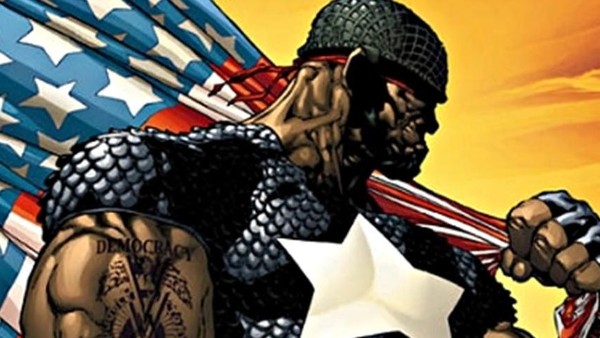
These heroes all lacked one thing: the serum that had empowered Rogers. The US Government attempted to replicate Erskine's experiment using 300 African-Americans volunteers, only one of whom saw moderate success. Isaiah Bradley did his part, liberating Nazi concentration camps wearing a stolen Captain America costume, but this was not looked upon kindly by the US army, who imprisoned and further experimented upon him, completely destroying his mind. His grandson Elijah would, however, go on to become another hero - this time called Patriot - in the Young Avengers.
Rogers' assassination at the end of Civil War once again left the shield open to a newcomer. This time, Rogers had the foresight to name a successor. Long time friend James Buchanan "Bucky" Barnes, his partner during World War 2 and himself frozen for a few decades, replaced Rogers. Unlike the always-unconscious Steve, Bucky had to deal with Hydra's brainwashing which turned him into a secret assassin called the Winter Soldier. His appointment as the new Captain America was the subject of some controversy, but he strove to make amends for his shady past nevertheless.
Rogers would eventually return due to a very convoluted plot regarding time travel and existentialism, but not for long. After losing the serum (long story), longtime friend and ally Sam Wilson (Falcon) assumed the mantle of Captain America, only recently surrendering it back to Steve once he regained his powers.
5. Guardian

It seems like every country took one look at Captain America and decided it was their turn to have a national hero, and Canada was no different. James MacDonald Hudson, a doctorate level engineer, created a power suit for the Am-Can Corporation that gave him superhuman abilities.
As soon as he found out that it was going to be used by the American military, however, he nicked the suit for himself. It’s a good thing the Canadian government decided to pardon him and enlist him for their own purposes rather than charge him for his crimes, or else that would have been a hefty prison sentence.
Hudson went on to call himself Guardian, and gave his suit a very Canadian paint job. As leader of Alpha Flight, he really embodied the Canadian spirit to become their national hero. Alpha Flight itself featured the best of Canada’s superheroes (except Wolverine - he wanted nothing to do with it).
4. Iron Cross

“Iron Cross” is a bit of a dodgy name, considering it's a German military decoration used sporadically 1871 and 1945, which became a symbol for a particular ideology popularised in the 1930s by angry men with dodgy moustaches.
Iron Cross’ first appearance in 1979 goes pretty much as you would expect – Helmet Gruler dons experimental supercharged armour created by German scientist and old school friend Professor Franz Schneider, and becomes the Axis Powers’ answer to Steve Rogers.
Iron Cross was technically a national hero, even if he was on the side of the Nazis. He at least managed a redemption arc of sorts when Gruber became part of an organisation tasked with hunting down war heroes. He died fighting for the right side, which was of some comfort to his daughter Clare.
An Inhuman, Clare Gruler took on her father’s mantle to become a real hero for her home country. She even took her father’s attachment to his suit a step further too, molecularly bonding herself to it as a result of her Inhuman genetic make-up.
Helmet may have done his best to atone for his previous misdemeanours, but it’s his daughter who continues to do the heavy-lifting clearing the family name.
3. Miss America

In 1943, Madeline Joyce gained her powers as a result of tampering with a mysterious device during an electrical storm. She was actively seeking to get zapped in the hopes of manifesting superhuman abilities: one Professor Lawson had already gotten his in the same way. Unfortunately, Lawson believed Joyce had died by the process, which led to his guilt-ridden suicide. He wouldn't know that Madeline would wake up graced with flight and super-strength.
Madeline Joyce adopted the patriotic title and costume of Miss America, and fought alongside other nationally themed heroes in Liberty Legion and the Invaders. She married one of the heroes she fought alongside, Robert Frank a.k.a. the Whizzer, and had a radioactively charged mutant child Nuklo. Her second pregnancy would end with too many complications, resulting in the death of her child and herself.
The name would go unused until 2011, when America Chavez entered the scene. Chavez, unlike her predecessor, did not hail from any Marvel continuity: she came from the Utopia Parallel, which exists outside of the multiverse. When she escaped that reality and chose to settle within the multiverse, she adopted Miss America as her title to start superhero duties.
In addition to the original Miss America abilities of flight and immense strength, Chavez has super speed and the ability to punch holes in realities and travel between them. As a younger hero, she spent time with the Teen Brigade and the Young Avengers. She soon got an upgrade (since she is pretty powerful, after all), and can now be found doing her bit with the West Coast Avengers.
Excitingly, even though she isn't technically from Earth, America Chavez made the history books as the first LGBTQ+ Latinx superhero with her own ongoing series. Good on her.
2. Red Guardian
The Cold War brought about Captain America's Russian counterpart Red Guardian. Alexei Shostakov, a Russian pilot and KGB agent, first appeared in 1967. The programme which created Red Guardian required that he fake his own death to ensure anonymity, even from his wife Natalia Romanov.
He received combat training and gadgets, including a magnetic throwing disc which attached to his belt for easy access. Add to that his red costume and hammer and sickle emblems, and the parallels with Captain America are anything but subtle. Unfortunately, his wife Natalia would switch allegiances from the Soviet Union: their eventual reunion and revelation of his true identity came only moments before his death protecting Black Widow and Captain America.
In Marvel's internal chronology, Shostakov was preceded by Aleksey Lebedev in the 1940s. This incarnation came into conflict with William Naslund’s Captain America shortly after WW II. Unlike his later counterparts, Lebedev’s Red Guardian was more critical of his home country – he was ultimately executed during the Soviet purges of the 1950s.
Other individuals to take the name of Red Guardian include Dr Tania Belinsky, more commonly known as Starlight, Josef Petkus who saw through the dissolution of the Soviet Union, the short-lived Krassno Granitsky, Life Model Decoy and former Crimson Dynamo Anton, and finally the current Red Guardian Nicolai Krylenko. Just as Captain America adapted to changing political climates, so too did Red Guardian evolve to fit whatever situation their home country found itself in.
1. Union Jack

Lord James Falsworth was the first Union Jack. He was a British soldier during the First World War who fought in the Freedom's Five. He returned to his post during World War 2 and joined the Invaders, but when his vampire brother Baron Blood attacked him and crushed his legs, he was effectively put out of service.
His son Brian would succeed him, while his daughter Jacqueline became the hero Spitfire. Together, they joined the Allied team the Invaders to carry on the work their father had started. Despite his service throughout WWII, Brain doesn't live much longer after it ended, and was unceremoniously killed in a car crash in the early 1950s.
Spitfire's son Kenneth, however, did not fancy continuing the family business. It was left to common, working class boy Joseph Chapman to pick up the Union Jack name following a visit to the Falsworth estate. Chapman remained friends with the Falsworths, serving as their protector against vampiric relatives with a vendetta. He also became close to Captain America, and they often worked together to prevent neo-Nazi uprisings in the UK.
Union Jack will soon appear as the leader of new British team The Union. While other countries will always be outnumbered by the sheer volume of American heroes and teams, these national heroes show what Marvel have to gain by taking a more international approach to their stories.
Watch Next
Avengers Quiz: How Well Do You Know Captain America?
