9 Marvel Heroes Embarrassingly Similar To DC Characters

Is imitation the sincerest form of flattery?
According to the Book of Ecclesiastes there's nothing new under the sun. This was never more true than in the case of superheroes. In every entertainment medium, after a new series or concept becomes popular, the competition always responds with a similar version. But in comics, jumping on the artistic bandwagon has been going on since the publication of the very first costumed hero, Superman. The two giants of the industry, Marvel and DC, take their cues from each other, copying the competition - and even copying their own successes. Sometimes, their comic book clones are uncomfortably, even embarrassingly, too close to the originals - right down to the names and circumstances. Is imitation the sincerest form of flattery? Or are the writers just guilty of "creative cribbing"? You be the judge.

9. Green Arrow (Oliver Queen) & Hawkeye (Clint Barton)
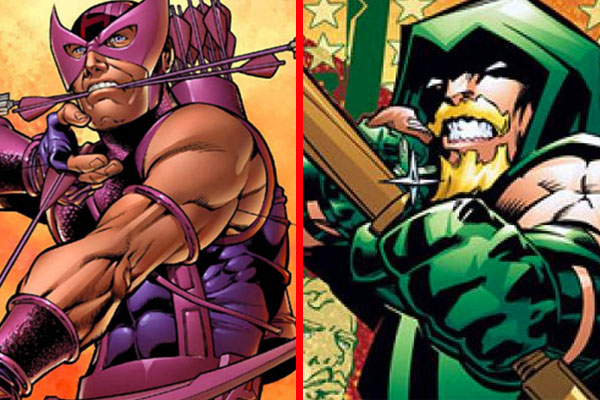
No one seems to care much that the lead character of the CW's hit series Arrow has exactly the same shtick as a major supporting member of the Marvel movie franchise The Avengers. Both of these tough guys run about the city armed with nothing more than a compound bow. And both carry a variety of trick arrows in their quivers. But which came first? George Papp created the Green Arrow, for DC Comics, in 1941 - well over 2 decades before Hawkeye made his first appearance in Marvel's The Invincible Iron Man. Stan Lee isn't exactly guilty of copying the Emerald Archer, though, because Lee's character, Clint Barton, starts out as a super-villain. But Hawkeye goes straight after only 3 capers, and he's then allowed to join the Avengers. Why are Barton's teammates so forgiving? Because a certain naughty Russian femme fatale called the Black Widow had the poor, love-sick and misguided archer wrapped around her manipulative little finger - and what super-guy hasn't been there before? Also, since creative cribbing is in discussion here, it's probably best to point out that to begin with, DC's Green Arrow was essentially conceived as a mashup of Batman and Robin Hood, literature's first costumed hero.

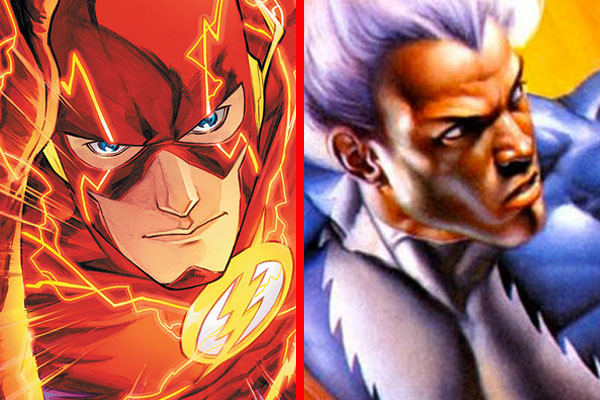
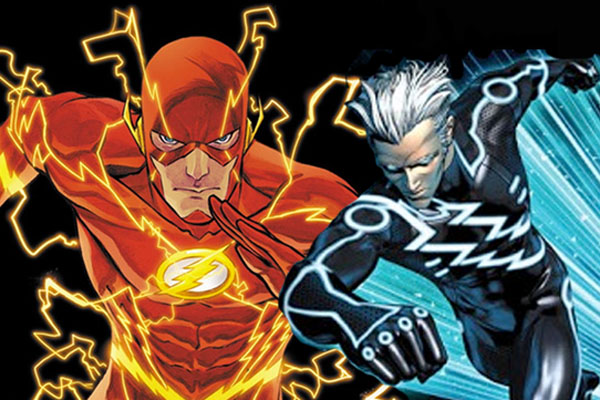
8. The Flash & Quicksilver

We got our first fleeting glimpse of Marvel's Quicksilver in last year's X-Men: Days of Future Past, while more recently, Pietro streaked across the silver screen in Avengers: The Age of Ultron. But in between these two movies, DC rushed its own high-velocity hero into fans' homes via the CW's immediately popular Flash series. So which character came first in the comics? The Flash is the original Scarlet Speedster, bursting on the scene in 1956, in DC's Showcase Comics, and ushering in the comic book superhero renaissance known as the Silver Age. Quicksilver sped into pop culture in 1964, in X-Men #4, then quickly joined the Avengers (in issue #16, 1965). But the winner in the originality race is actually Jay Garrick, the Golden-Age Flash (1940), who beat everyone, including DC's other running feature Johnny Quick. Jay wore a winged, saucer-shaped helmet like - *cough* - Mercury, Greek and Roman Mythology's super-fast Messenger of the Gods.

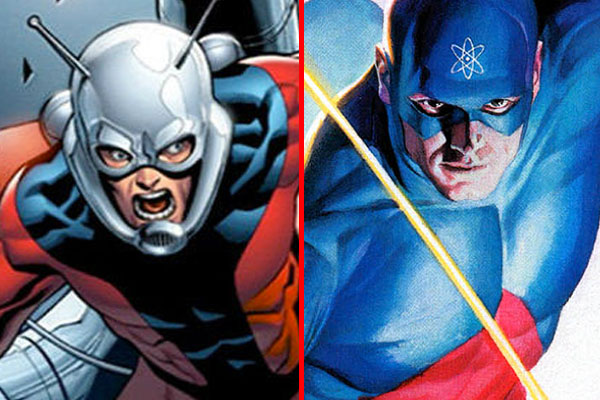
7. The Atom & Ant-Man

Marvel's Ant-Man is about to make his big-screen debut this Summer, but DC tried to minimize the impact of the Marvel Comics hero by introducing its own Tiny Titan months earlier, as a supporting character on the CW's Arrow series. DC's character sort of falls through the cracks, however, because we won't get to see Ray Palmer shrink until the November 2015 debut of the CW's spinoff show Legends Of Tomorrow. In the meantime, Scott Lang will prove to the world that - when it comes to heroes - size really DOESN'T matter. But which character was the first to get small? DC's the Atom debuted in Showcase #34, in 1961, while Ant-Man crawled on the scene a scant four months later, in Tales to Astonish #27. Small world, huh? Stan Lee didn't bestow the character's name, or transform him into a recurring costumed hero until issue #35 (Sept. 1962). DC still gets no bragging rights on this one; this may prove only a small honor, but credit for the first diminutive superhero goes to Quality Comics, which published creator Will (The Spirit) Eisner's Dollman way back in 1939.

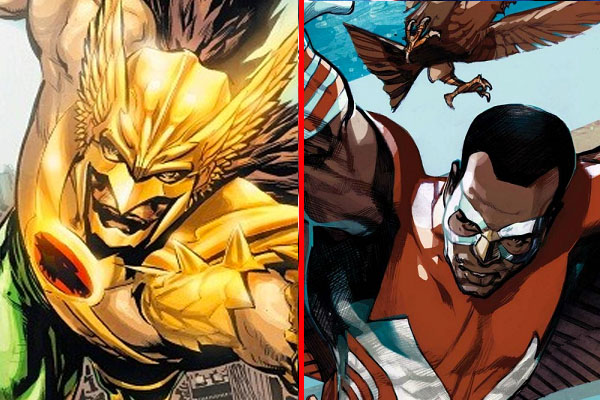
6. Hawkman & The Falcon

Over the past seventy years, the mythos of DC's Hawkman has undergone several revisions. The original character debuted in 1940, before a Silver Age reboot appeared in 1961 (in The Brave and the Bold #34), and DC still continues to tweak elements of his story. For instance, sometimes he's married, other times not. (By the way, his sometimes wife, Hawkgirl, will be soaring to TV when she becomes a regular character in the CW's Legends of Tomorrow.) One thing's been constant throughout, though: Hawkman's got wings and he flies... like an eagle. Oh yeah, he also receives frequent intel from his fine feathered friends, the birds. The Falcon, meanwhile last seen in Captain America 2: The Winter Soldier, as... uh... Steve Roger's "wingman," first appeared in 1969 (Captain America #117). Stan Lee and artist Gene Colan wanted to create a unique streetwise African-American hero - who's got wings and flies like ... a falcon. Oh yeah, he also receives frequent intel from his fine feathered friends. Who knows, maybe originality is for the birds...?

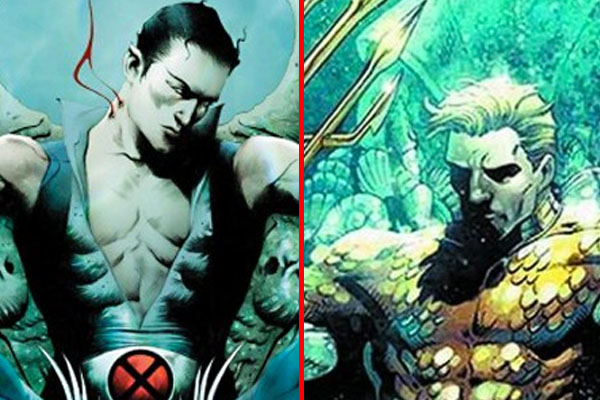
5. Aquaman & The Submariner

Marvel takes first place in this swim meet. Prince Namor of Atlantis, aka the Submariner, was created by Bill Everett, and made his first splash in Marvel Comics #1 (Oct. 1939). In addition to swimming like a fish, Namor has superhuman strength and agility - and he can fly, just to complicate matters. Originally, he also could communicate with his finny friends. And now for some trivia: Bill Everett wanted to give the Submariner a name that spoke of nobility and the creator found that name by spelling Roman backwards. Following in Namor's wake is DC's Aquaman, the King of Atlantis, who appeared two years later, in More Fun Comics #73. In addition to swimming like a fish, Aquaman has superhuman strength and agility - and he can ... jump! Like ... really long distances. Seriously. And, like Namor, Aquaman can communicate with his finny friends. DC's watery character is one of the few superheroes to be continuously published throughout the Golden Age of comics and into the Silver Age of the late fifties and sixties. Marvel's Submariner has an even greater distinction: he was the first comic book antihero.

4. Mr. Fantastic & The Elongated Man

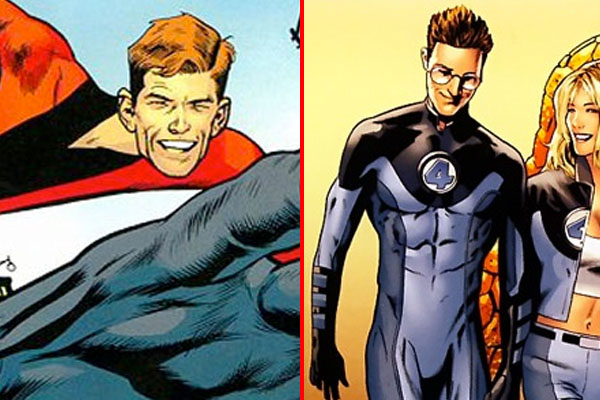
DC once again trumped Marvel on this one: it doesn't take a stretch of the imagination to realize Reed Richards, the leader of the Fantastic Four, is simply a reshaping of DC's the Elongated Man. Both heroes are malleable mainstays of the Silver Age, but Reed (Mr. Fantastic) didn't begin extending his influence over The Fantastic Four and comics history until November 1961. Ralph Dibny, the Elongated Man, debuted in the Flash #112, May 1960. Stan Lee created Reed Richards; Carmine Infantino created Ralph Dibny - two legendary comic book creators who were good friends and also staunch competitors. Incidentally, both are also guilty of grabbing inspiration from Jack Cole's Plastic Man, published by Quality Comics in 1941. None of this creative cribbing should get anyone too bent out of shape. There are bigger issues here: first, how did DC ever manage to get the handle of Ralph Dibny's alter ego past the Comics Code of Authority? At least Stan Lee was more subtle; like everyone else, Reed's wife simply called her hubby Mister Fantastic!

3. Wade Wilson & Slade Wilson

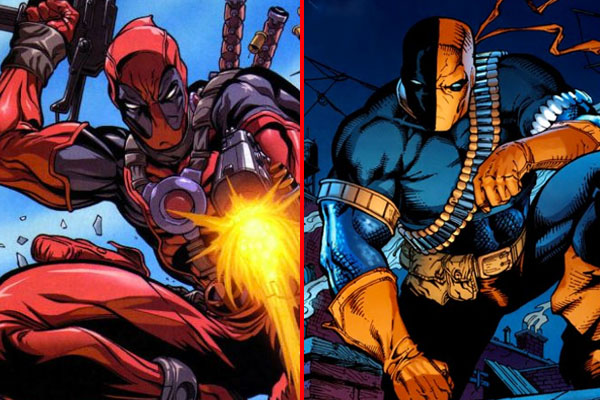
Both these characters debuted as super-villains. Wade Wilson, aka Deadpool, is a powerful, mentally unstable mercenary who eventually becomes a hero. Slade Wilson, aka Deathstroke, is a powerful, arguably mentally unstable mercenary who eventually becomes an anti-hero. Both are bad news, but Slade Wilson started his rampage of death and destruction in 1980, in DC's New Teen Titans. Wade Wilson didn't get to start his killing spree until 1991, in Marvel's New Mutants #98. Exactly how does anyone get away with such blatant copying? Well, first of all, as similar as the two characters appear, there are major differences in creative style and approach. Deadpool has a wicked sense of humor, for instance, and he frequently breaks the fourth wall to address his readers. And by the way, a new Deadpool movie starring Ryan Reynolds is currently in production. Secondly, Deadpool's creators, Fabian Nicieza and Rob Liefeld, openly admit drawing their inspiration from DC's Deathstroke. Which is why the name of their character is only a slight variation of Slade Wilson's. You see, these guys were paying homage to Deathstroke, which is a nice way of saying, "Yeah, we cribbed on this one - and we don't mind telling you so!"

2. Man-Thing & Swamp Thing

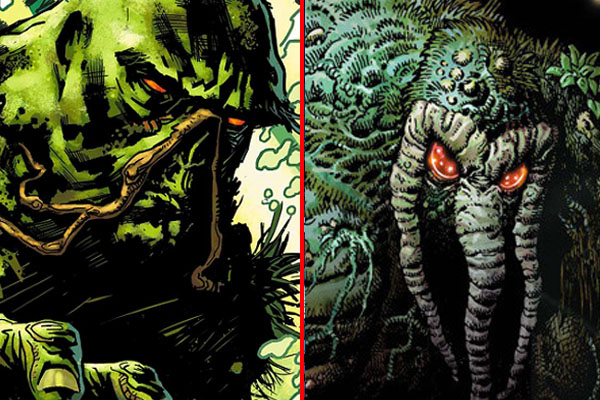
This one seems obvious, but the creators of each character insist they were just doing their own thing. DC and Marvel, within two months of one another, each concocted a feared and misunderstood creature; half man, half monster; spawned in the swamp. But this one goes to Marvel - by a nose: Man-Thing premiered in May 1971, in Savage Tales #1; Swamp Thing debuted in House of Secrets #92, in July 1971. Both characters were scientists working on a drug for the government; both suffer a mishap and end up being fused with swamp muck. There was one big difference, though: Marvel called their creation Man-Thing, while DC called theirs Swamp Thing. Hey, you can never be too subtle. Stan Lee, who'd recently been promoted to publisher at Marvel, called his pal Carmine Infantino, who'd recently been promoted to publisher at DC (not sure who was copying who with these career moves) and threatened to sue him. Carmine laughed and reminded Stan that the origins of both their muck monsters were rooted in a character called the Heap, published in 1942 by Hillman Periodicals. Legend has it that after their phone call, these two highly competitive comic book pioneers met for lunch.

1. Doom Patrol & The X-Men

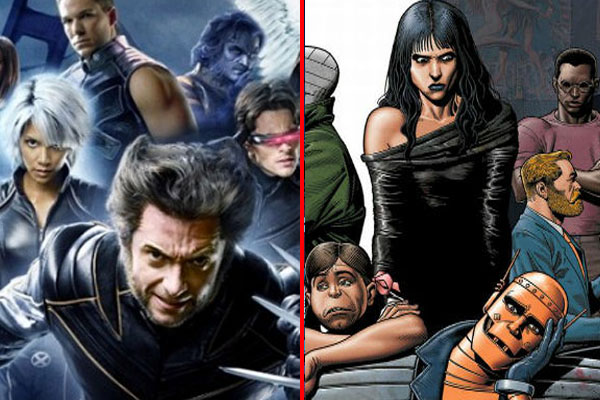
Both books feature a merry band of social misfits, who become reluctant heroes after being brought together by a wise guy in a wheelchair. So what if Professor X is bald and the Chief's bearded? Both their teams grouse at being labeled FREAKS while saving the world from some really weird menaces. Doom Patrol, created by Arnold Drake for DC Comics, premiered in My Greatest Adventure #80, in 1963. A mere 3 months later, Stan Lee and Jack Kirby released the X-Men. Coincidence? Quite possibly, because the time in between the two creations is far too brief for Lee and Kirby to concoct a similar concept, and then get it scripted, illustrated, and published. Some comics historians, however, have pointed out that the creators, artists, and publishers of both books often lunched together. And it's likely the idea for Doom Patrol had been openly discussed early enough for the Marvel Brain Trust to devise a competing title. What's really interesting, Doom Patrol creator Arnold Drake eventually ended up in Stan Lee's Bullpen, writing - what else? - X-Men. Either way, Marvel's hands are clean on this one. Because even if Stan Lee's X-Men was inspired by Drake's Doom Patrol, it's a safe bet that Doom Patrol in turn had been inspired by Lee's Fantastic Four, the very first team of oddball heroes. So, all's fair in love, war and comic book publishing. And in the end, are we concerned about a little creative cribbing? Nah. Whether they're old or new, big or small, bearded or bald, and whether they're named for bugs, birds, or bats, we can't get enough of these super-powered people. With this much supply and demand ... some duplication is bound to happen.

Contributor
Contributor

Tom English is an environmental chemist who loves reading comics, watching movies, and writing stories both weird and wonderful. His fiction has appeared in several print anthologies, including CHALLENGER UNBOUND (KnightWatch Press, 2015), GASLIGHT ARCANUM: Uncanny Tales of Sherlock Holmes (Edge SF and Fantasy) and DEAD SOULS (Morrigan Books). Tom also edited the mammoth BOUND FOR EVIL: Curious Tales of Books Gone Bad, which was a 2008 Shirley Jackson Award finalist for best anthology. Among his non-fiction books is DIET FOR DREAMERS, a collection of inspirational stories featuring everything from Stan Lee to Sherlock Holmes to Slinky Toys. Tom resides with his wife, Wilma, surrounded by books and beasts, deep in the woods of New Kent, Virginia.