10 Things DC Fans Need To Know About Plastic Man
Not just here for comic relief.
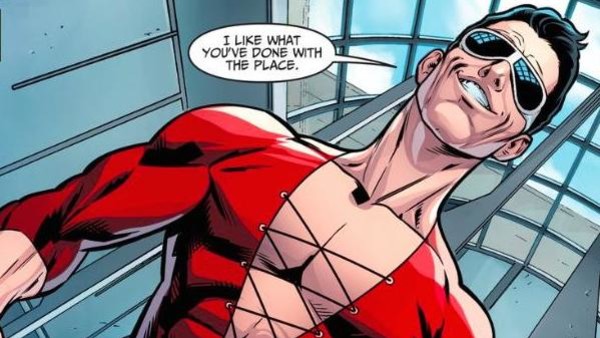
Although he debuted as early as 1941, Plastic Man is a relatively unknown character to modern audiences who are more likely to know about Reed Richards long before the name “Eel O’Brian” enters into discussion.
Despite this tendency, however, the character has a fascinating presence in comic books over the years as an unlikely hero with criminal beginnings, to a hilariously witty presence in a Justice League that occasionally takes itself far too seriously.
Even still, though, the character tends to be seen only in terms of his comedic appeal - which doesn’t offer much potential for possible character depth. Nevertheless, it would be a missed opportunity to not consider the potential he has as a character overall.
In the few instances where he was indeed given a chance to shine, Plastic Man demonstrates a character design that knows how to balance lightheartedness with qualities that are less so. Revealing, in turn, that not all comic book characters have to be solely defined by a sense of honor or tragedy...
10. He Was The First 'Stretchy' Hero

As the creation of characters like Mister Fantastic and Elongated Man implies, heroes with elastic powers are clearly a favorite of comic book writers and artists alike, which also begs the question of “which one of them came first?”
Elongated Man was created in 1960, and Mister Fantastic would soon follow not but one year later with the creation of the Fantastic Four in 1961. Neither of them are nearly as old as Plastic Man, though, who was created in 1941 by Jack Cole.
Back then, Cole had been working for the aptly named publication “Quality Comics” - where the owner, Everett Arnold, had asked him to create a new character that resembled the hero the Spirit, for the planned “Police Comics” line.
Obviously, this didn’t happen but in hindsight, it was probably for the best since Plastic Man would later become a hit among readers and even star in his own self-titled series - thus, becoming a major earner for “Quality Comics.”
9. Plastic Man’s Beginning
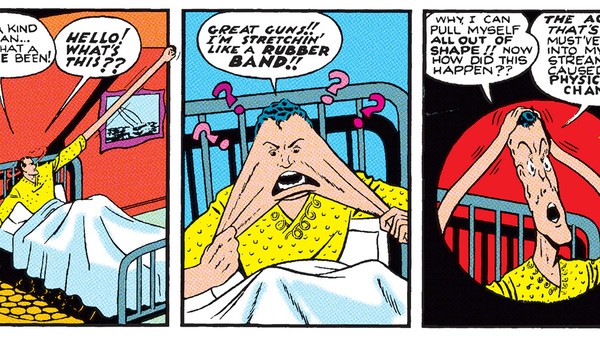
Eel O’Brian wasn’t always the hero in red and black spandex that people know and love today. In fact, it was primarily due to his criminal background as a gangster that led him to become Plastic Man in the first place.
It all started when O’Brian’s crew one day broke into a chemical factory to pull off a heist. They’re caught red-handed by a security guard, though, and are forced to quickly escape.
O’Brian himself is shot during this encounter, which inevitably lands him in a vat of chemicals. Afterward, O’Brian would discover the drastic effects that this exposure has had on his body, which has now been altered to allow him to stretch it to incredible lengths.
Although there would be some bumps along the road towards justice (namely using his powers to commit even more heists) O’Brian would eventually come to devote himself to heroic pursuits. Even going so far as to one day become a member of the Justice League.
8. Plastic Man’s Incredible Durability
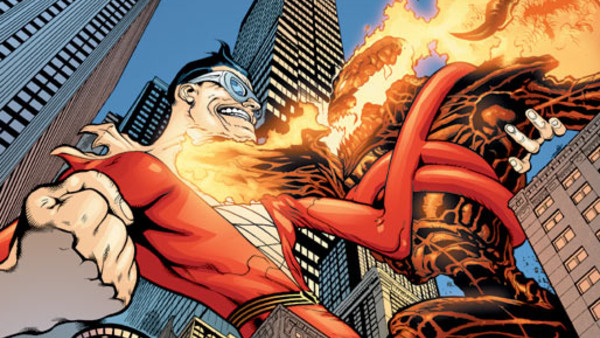
Many of Plastic Man’s close calls have proven him to be almost completely indestructible. Having even gone so far as to go one-on-one with other characters that are similarly invulnerable, such as the Martian Manhunter.
One of the most noteworthy examples, though, has to be his time spent in the JLA series “The Obsidian Age.” In the series, Plastic Man journeys back in time with the Justice League to investigate the disappearance of Aquaman.
This inevitably leads them to an Atlantis that has not yet sunk to the bottom of the ocean, where they come into conflict with powerful magical beings that are supposedly the protectors of this ancient city. Plastic Man is at one point frozen by these protectors, and it’s this which leads to his body being shattered to pieces that then float down into the sea.
Plastic Man would thus remain at the bottom of the ocean for over three thousand years until the JLA eventually comes to rescue him. Unsurprisingly, Plastic Man decides to go on a well-deserved hiatus from the League’s many chaotic adventures.
7. Plastic Man’s Other Abilities
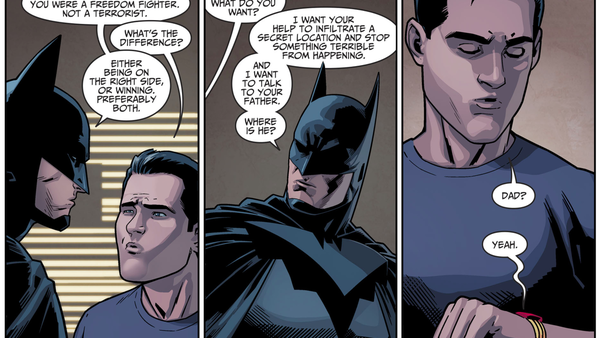
On first impressions, it might seem like all that Plastic Man has going for himself is the ability to stretch his body at great lengths. This is not at all the case, however, as Plastic Man has much more going for him than just extreme elasticity.
Other than stretching his body, Plastic Man can, for example, hide in plain sight using his manipulative physicality to blend in as well as impersonate other people - the latter, of which, has seen him impersonating guards and even villains like the Joker. Needless to say, Plastic Man can be pretty cunning when he wants to be.
His powers have also allowed him certain advantages- like being invulnerable to telepathy or mind-control, due to the malleability of his brain. So, really, elasticity is only part of the equation when it comes to Plastic Man’s powers.
6. He Was A Part Of DC's Fantastic Four

In 2018, a series titled “The Terrifics” saw Mister Terrific, Metamorpho, Phantom Girl, and, of course, Plastic Man, teaming up in the aftermath of the Dark Knights Metal series. The plot begins when Mister Terrific arrives to Stagg Enterprises and finds Simon Stagg interfering with a portal to the Dark Multiverse (using Metamorpho’s powers to do so).
Terrific, Metamorpho, and a dormant Plastic Man are then sent into the Dark Multiverse, as a result of this interference. Here, they encounter the Legion of Superheroes member Phantom Girl, who has also been left stranded within the Dark Multiverse.
Given their mutual circumstances, the four of them decide to assist one another in vacating the Dark Multiverse and returning to Earth. Although they do indeed return to Earth, all four of them are left affected by a huge side-effect of leaving the Dark Multiverse - they must stay within a certain range of each other to avoid certain death.
As a result, their team-up becomes more than just a temporary condition, as all four of these heroes must collaborate with one another to find a solution to this devastating problem. Kind of like a mandatory Fantastic Four situation, as it were.
5. Injustice's Plastic Man
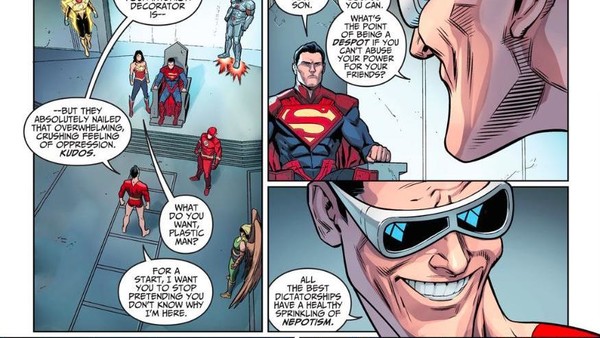
The introduction of Plastic Man to the Injustice: Gods Among Us prequel series saw the character as a legitimate threat to the Superman regime (despite his generally relaxed demeanor).
Mostly this concern was due to Plastic Man’s ability to easily impersonate others, as well as his overall talent to go undetected by Superman and his allies. Batman himself is even fooled by Plastic Man’s disguises when he goes looking for him during the Injustice 2 comic book series.
Even still, Plastic Man doesn’t really have much of an incentive to rebel against Superman… at least not until his son, Luke, is imprisoned by Superman for insurgent activities. Motivated to do right by his son, Plastic Man manages to not only incapacitate the Flash to obtain information disguised as him but later infiltrate Superman’s underwater prison fortress.
There, he’s able to return imprisoned Green Lanterns their power rings, who proceed to cause complete and utter chaos as a distraction for him, so that he can rescue Luke. In the end, the prison is rendered entirely uninhabitable, after Plastic Man frees all the prisoners via a teleportation vortex.
A true example, really, of the lesson “you should never judge a book by its cover.”
4. Plastic Man In Animation
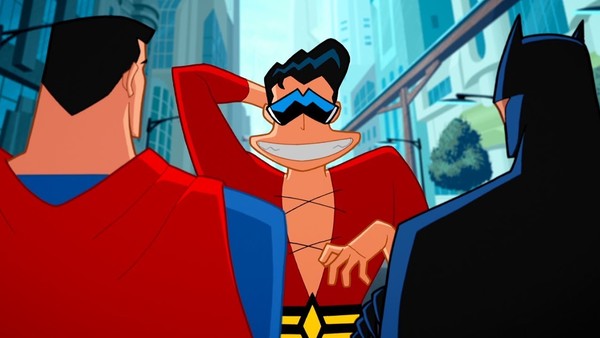
Given that his stretchy capabilities are ripe for cartoon material, it’s hardly a surprise to discover that Plastic Man has had a regular presence within animation.
Back in 1979, Plastic Man actually had his own Saturday morning cartoon called “The Plastic Man Comedy/Adventure Show,” which was similar in design to that of other seventies cartoons like Super Friends (1977).
In the years to come, however, Plastic Man would be seen mostly in non-speaking cameo appearances in shows like Young Justice (2011), and films like the animated adaptation of Darwyn Cooke's The New Frontier (2008).
Plastic Man later began to pick up traction again, though, with a recurring speaking role in both “Batman: The Brave and the Bold” (2008), and “Justice League Action” (2016). He also had a self-titled solo series with DC Nation animated shorts, in 2012.
3. Plastic Man In Justice League
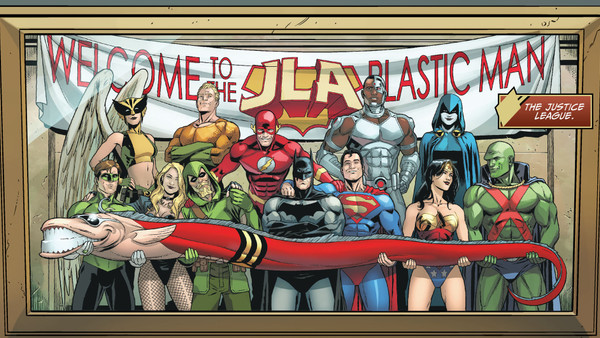
As strange as it might be that there were two elastic based heroes in the Justice League, it was nevertheless the case when Plastic Man joined the Justice League during the 1998-2004 run of the JLA series.
Batman originally recruited O’Brian for the purpose of having him infiltrate the Injustice League and pose as the Joker himself. Later on, as an official member of the Justice League, Plastic Man becomes a regular participant in major battles against villains like the Amazo android, Prometheus, and Dr. Polaris.
Thus, demonstrating ultimately just how much of an asset Plastic Man can be to the League’s success against formidable foes, and even brainwashed allies.
2. Plastic Man’s Son
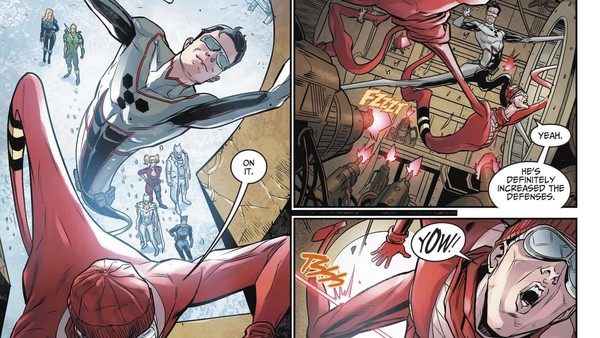
Another perhaps surprising element of Plastic Man’s backstory is that he is actually a father. His son, Luke O’Brian, is himself an elastic based hero that goes by the alter ego of “Offspring,” where he appears at first as a member of the Teen Titans.
Prior to all of this, though, the relationship between father and son starts off horribly, with Eel running away from his responsibilities as a father. Nevertheless, Eel eventually does reveal his regret in abandoning Luke and even tries to reconnect with his now much older son.
One of the most heartwarming versions of this development in DC lore comes from the “Injustice 2” comic, where Plastic Man and Luke trade quips back and forth, as they fight alongside one another during the series.
1. Plastic Man Taken Seriously

One of the few instances where Plastic Man is portrayed in a psychological sense comes from the “Divided We Fall” storyline of the JLA series. In it, several heroes baring a secret identity and a superhero alias have said identities separated from one another to become two individual entities.
Eel O’Brian himself is separated from his Plastic Man alter ego, and it's this which creates two different portrayals of his personality. One as a superficial version of Plastic Man as an ineffectual dolt and the other being a former thief struggling to resist falling back into a life of crime.
With the latter of the two, Eel often questions whether he is actually any different from the man that he was in the past, or if his superhero status as Plastic Man is nothing but a joke.
Overall, this was a refreshing take on the usual presentation of a wisecracking jokester, that allowed for Plastic Man to deal with internal qualities, such as introspection. A feat that’s rarely, if ever done, for this character’s arch.
DC Quiz: How Well Do You REALLY Know The Justice League?
