10 Bronze Age Comics That Changed DC & Marvel Forever
Demons, drug addiction, diversity and death, comics were never the same again.

Compared to the Golden Age, which gave us the DC trinity of Superman, Batman and Wonder Woman, or the Silver Age, in which Marvel brought us Spider-Man, the Incredible Hulk and Fantastic Four, the Bronze Age of comics doesn't seem so immediately iconic or impactful.
But it would be a mistake to forget the ways in which this era - which ran from around 1970 to the mid-80s - changed comics in a fashion which is still felt today.
By the early 70s the architects of the bright, zany and wildly imaginative Silver Age comics were stepping aside.
Marvel's Stan Lee stopped writing regular monthly comics in 1972 to become the company's publisher and increasingly a symbolic figurehead, while over at DC long-term Superman editor Mort Weisinger retired in 1970. In their place writers like Len Wein, Chris Claremont, Marv Wolfman and the late Denny O'Neil brought new ideas to the table.
Meanwhile, the iron grip of the censorious Comics Code Authority began to loosen with a series of reforms to bring the code more in line with societal attitudes in 1971.
All of this conspired to create an era in which comics became less outlandishly fantastical and embraced a darker edge. Sometimes this meant being more open to socially relevant issues-driven storytelling or characters that were more relatable to the youth of the 70s. Sometimes it meant pushing things in the direction of demons, black magic and other supernatural horrors.
Either way, these Bronze Age comics changed the game for good.
10. Luke Cage: Hero For Hire

Luke Cage: Hero For Hire #1-#16 (January 1972-December 1973)
Marvel had featured black heroes before the ex-con with unbreakable skin. As long ago as 1963 Gabe Jones had joined Nick Fury's Howling Commandos, while a 1966 issue of Fantastic Four had introduced the high-tech African nation of Wakanda and its prince T'Challa, the Black Panther - a character widely regarded as the first proper superhero of African descent. None of them had been deemed worthy of their own title, though. That changed with Luke Cage.
By the early 70s the success of the movie Shaft had proved that there was a mainstream audience for the new blaxploitation genre and Marvel wanted a piece of that action. Cage, later dubbed Power Man, successfully tapped into that market and in so doing opened the door to a more diverse array of heroes and titles.
In the years following Cage's debut, the roster of Bronze Age Marvel black characters would expand to add Blade (in 1973), Storm and Misty Knight (both 1975), and Monica Rambeau (1982). Meanwhile at DC, Black Lightning became the first black hero with a solo title in 1977, while John Stewart was introduced as the first black Green Lantern in 1971.
Cage's world - of a hero who works out of a need for money rather than altruism - protecting the streets of a grittier, grimier New York paved the way for the street-level heroics of the later reworking of Daredevil and, ultimately, the recent Netflix Defenders universe.
9. Marvel Spotlight

Marvel Spotlight #1-#33 (November 1971-April 1977)
With the loosening of the CCA, there was an opportunity for the big hitters finally to introduce elements of horror comics into the superhero genre.
Not being sufficiently confident that demonic, vampiric or werewolf superheroes could carry their own books, however, Marvel instead gave them a shot in this "try-out book". Spotlight wasn't the only try-out book, but it was notable for the sheer number of characters who debuted there and went on to be fixtures in the Marvel universe.
The first characters to get a Spotlight were Red Wolf, Werewolf By Night, Ghost Rider and Daimon Hellstrom (Son Of Satan), all of whom got solo titles.
A minor player in one of the Werewolf By Night solo stories, Moon Knight, was also trialed as a title character with his own Marvel Spotlight in 1976 before getting his own book.
Ghost Rider, in particular, struck a chord with the 70s crowd seeking darker and edgier heroes driven by black magic and hellfire. The success of Ghost Rider, along with Son Of Satan, Moon Knight and others, opened up a darkly supernatural and explicitly Satanic world for superheroes to play in, which would never have been possible under the Christian moralising of the old CCA.
With the likes of Swamp Thing and Etrigan The Demon also debuting at DC in the early 70s, by the end of the Bronze Age it would be no surprise to see traditional heroes like Spider-Man and Batman fighting against or even teaming up with demons and vampires.
8. New Gods
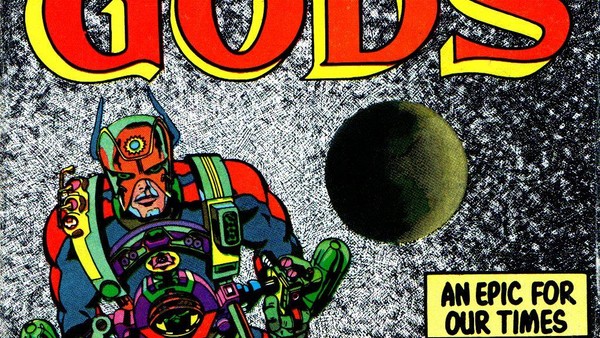
New Gods #1-#11 (February 1971-November 1972)
One of the key markers for the end of the Silver Age and the beginning of the Bronze was the move of Marvel's Jack Kirby (the artist who had collaborated with Stan Lee on the Fantastic Four, Hulk, Iron Man, Thor and many others) to DC in 1970. It was the end of an era at the House Of Ideas and the start of a new one for their Distinguished Competition.
At DC Kirby was given free rein to create whatever characters that he liked, while at Marvel he never had much control over his creations.
Ironically for something that changed the scope of the DC universe what he wanted to do was create a self-contained limited series which would not be tied into the confines of ongoing monthly comics.
With New Gods Kirby fully explored the cosmic epic themes he had began at Marvel. But this time he was able to invent his own mash-up of sci-fi and classical mythology. Kirby pushed aside the Old Gods of Asgard and similar for the New ones of the divided duelling worlds of utopian New Genesis and polluted nightmare Apokolips.
And, while New Gods and its Fourth World characters were never intended to run beyond the early 70s, Kirby tapped into a seam of big mythology that DC fans lapped up and wanted to keep. The New Gods, and Apokolips overlord Darkseid and his Anti-Life Equation in particular, would give DC their biggest of big bads whenever they needed a grand event story afterwards.
7. The New Teen Titans

The New Teen Titans #1-#40 (November 1980-March 1984)
The Teen Titans were a creation of the Silver Age, a place to dump the likes of Robin, Kid Flash, Aqualad and Wonder Girl for teen-friendly adventures. The version that we know today, however, the one seen in the 2000s cartoon (and its parodically silly spin-off Teen Titans Go!) and the current live action Titans, was a product of the Bronze Age.
Under the aegis of Marv Wolfman and George Pérez, the Teen Titans were reinvented in 1980. No longer were they simply the kid versions of mainstream heroes, but instead a diverse array of oddballs with their own individual angst.
Dick Grayson's Robin remained (although one of the series' great long term contributions to DC lore was in paving the path for him to develop his own adult identity as Nightwing), but he was joined by heroes not stuck playing second fiddle to the superhero A-list.
The new team capitalised on the trends we've already discussed with angsty demon's daughter Raven bringing the supernatural horror angle and Cyborg becoming one of DC's most popular black heroes.
This era also gave the Titans a proper nemesis in the form of Slade Wilson's Deathstroke.
The deadly assassin not only helped this particular team have more impactful stories now they had a significant recurring villain, but he also became a major player in the wider DC universe. (And, in bring parodied by Marvel's Wade Wilson, also prompted one of their rivals most popular icons).
6. Batman: Daughter Of The Demon
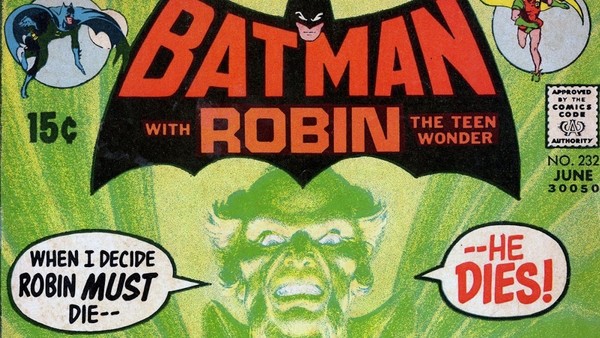
Batman #232 (June 1971)
In the Silver Age Batman was more popular than ever, thanks in no small part to the hit Adam West TV show. This meant, though, that the style of Batman in the comics tended to reflect the playful rainbow camp and knowing self-parody of that show.
In 1970 former Charlton Comics writer Denny O'Neil took up Batman writing duties and began to shift the tone once again. O'Neil's Batman was seen as a return to the character's roots as a vengeful, driven, obsessive, dark detective. His Batman stories had personal stakes and more darkly complex villains.
This was all exemplified in O'Neil's first major new contribution to the Batman mythos.
In Daughter Of The Demon Robin is kidnapped (no real change there), but this time shady mystic Ra's Al Ghul's daughter Talia has been kidnapped too, and so the villain gives Bats a lead on where to find them both. Everything from Ra's figuring out Batman's true identity and wanting Bruce to be his successor to Talia being in love with Bruce was already there in their first story.
The Batman-Ra's-Talia setup would yield some of the most interesting dynamics in future Batman stories, giving the Caped Crusader worthy adversaries, occasional uncomfortable allies and even his most impactful love interest.
O'Neil would build on successfully creating a new signature Batman villain by also revitalising some of the old ones. A few issues after Daughter Of The Demon he would reintroduce Two-Face, a character that the Silver Age had left virtually untouched, helping to make the multiple personality former-DA into one of Batman's greatest foes.
5. Green Lantern/Green Arrow

Green Lantern Vol. 2 #76-#89 (April 1970-May 1972)
Batman wasn't the only DC icon to get a Bronze Age facelift from O'Neil, whose recent death was a loss of one of comics' great pioneers, and artist Neal Adams.
Under their guidance the Green Lantern title had an abrupt turn from cosmic adventuring to grappling with very down to earth social issues. This was the beginning of comics engaging as much with social justice as the criminal kind.
Hal Jordan, the Silver Age Lantern, had seen sales of his title diminishing throughout the late 60s, meaning that a change in focus was inevitable. Jordan was seen as being out of touch with the concerns of ordinary readers.
For this new socially conscious age Hal was paired up, largely on the basis of a matching colour scheme, with Green Arrow. Oliver Queen had himself been recently revamped with a natty new beard and a plot that saw him losing his wealth and gaining a better understanding of life on the street.
The result was an odd couple pairing which defined the socio-political morality of these two major DC heroes going forward: the socially progressive, left-wing Arrow becoming a foil to Lantern's old fashioned conservatism.
The Green Lantern/Green Arrow run included the infamous story dealing with Arrow's sidekick Speedy and his heroin addiction, tackling a major new subject for comics.
In other issues they dealt with evil landlords, exploitative corporations, environmentalism and Native American land rights. Yes, some of these earnest stories have aged better than others, but they undoubtedly changed the sort of things comics were allowed to focus on.
4. Iron Man: Demon In A Bottle

Iron Man #120-#128 (March-November 1979)
Green Arrow's sidekick wasn't the only Bronze Age hero to struggle with addiction. Over at Marvel Tony Stark was about to discover that his greatest battle would not be with the nefarious Mandarin, but rather with alcohol.
Stark had been Stan Lee's attempt to turn everything young 60s liberals hated - a mega-rich arms-dealing capitalist - into a bona fide hero. It was a moderate success and gave Marvel a reliable B-list title, but never one where its hero faced any real challenges or needed to grow beyond his initial capture and construction of the Iron Man suit.
With the Vietnam War - an event deeply tied to Iron Man's origins and ongoing adventures as an anti-communist hero - now in the past, Bronze Age Stark was finally able to become a more complex and multi-faceted hero. Demon In A Bottle turned him into a man with personal struggles and made the character far more popular as a result.
The storytelling may not have aged perfectly, and Tony does seem to kick the habit remarkably promptly in the final issue. But without Demon In A Bottle, Iron Man would almost certainly never have been considered an interesting enough hero to land his own movie franchise.
Even though Iron Man 2 chickened out on doing more than nod toward the story, without this comic the Marvel Cinematic Universe would, then, have turned out very differently.
3. Giant-Size X-Men

Giant-Size X-Men #1 (May 1975)
The X-Men are widely considered one of the success stories of Marvel's hugely inventive run in the 60s, lumped together with Spidey, Hulk and the Fantastic Four. In truth, however, sales of the original X-Men always lagged far behind other Marvel titles and the series was dropped entirely in 1970.
It was only with the Bronze Age's All-New, All-Different X-Men that they became the mutant team that was popular enough to spawn hit TV cartoon and live action movie franchises in the 90s and 2000s.
The new X-Men began in 1975 with this bumper issue written by Len Wein in which the original all-white, all-American X-Men have to get rescued by their more diverse successors. Executives at Marvel had insisted the team be "more international" to broaden the appeal, resulting in the new lineup being far more distinct than one another both aesthetically and in outlook.
Kenyan weather manipulator Storm, bright blue German Catholic teleporter Nightcrawler and Soviet bruiser Colossus all brought something individual to the team. But it was Canadian maverick Wolverine that would become one of Marvel's greatest icons.
The story and the new cast laid the groundwork for all that was to come for X-Men. Chris Claremont was still a junior writer at the time, but Wein saw his enthusiasm for the new X-Men and handed him the reins as the series' creative driving force.
In the years that followed X-Men would become a dramatic soap opera with ambitious long arcs spread over years, like the legendary Dark Phoenix Saga. But all that began here.
2. Batman: Strange Apparitions

Detective Comics #469-#479 (May 1977-October 1978)
By the late 70s, Batman had already begun to swing from the bright and camp adventures of the Silver Age and toward the grim dark style embodied by the work of Alan Moore and Frank Miller in the age that followed. But it was Strange Apparitions - the name retroactively applied to the brief run of stories from writer Steve Englehart and artist Marshall Rogers - that really established the template for Bats's future.
This run brought forgotten figures like Hugo Strange and Deadshot back into the limelight and introduced new players like mob boss Rupert Thorne and socialite love interest Silver St Cloud.
Most significant, though, was what Englehart and Rogers did with the Joker. As Englehart described it, his run on Batman was designed to "get back to the idea of Batman fighting insane murderers at 3 AM under the full moon, as the clouds scuttled by", with a genuinely scary Joker as the most insane of the bunch.
Strange Apparitions' Joker stories - Laughing Fish and Sign Of The Joker - cemented the Clown Prince Of Crime as the manically unpredictable dangerous sociopath he remains in the popular imagination today. The success of these stories made the Joker a villain as popular with fans as any DC hero.
When the time came for Batman to step up to the big screen with the 1989 Tim Burton movie, these were the comics that the film looked to for inspiration.
1. Spider-Man: The Night Gwen Stacy Died

The Amazing Spider-Man #121-#122 (June-July 1973)
Often cited as the signature event of comics' Bronze Age, the death of Gwen Stacy is seen as the moment that comics grew up.
Major character deaths (outside origin stories like Peter Parker's own Uncle Ben) were then incredibly rare in comics. Ones that were intended to be permanent were basically non-existent.
In showing the Green Goblin throwing Gwen from a bridge and Spider-Man snapping her neck trying to catch her with his webbing, Gerry Conway, Gil Kane and John Romita showed for the first time that a superhero can do everything right, swing heroically to the rescue, and still fail.
Even more than Uncle Ben, this failure continued to haunt Peter and the guilt drive him for years afterwards. Not to mention how getting rid of the nice-but-bland Gwen opened the door for writers to focus on Spidey's greatest long-term love, Mary Jane Watson.
While there have been ample Gwen clones and alternate universe versions like fan favourite Spider-Gwen, the fact that she has always remained dead in the main 616 Marvel continuity is testament to this story's continued importance to Spidey's character.
And, yes, too many imitators attempting to recapture the impact of what was even then a controversial and far from universally popular moment has given us the "women in refrigerators" trope. But, again, that amount of copycats must surely also be a sign of what a gamechanger the original was.
After The Night Gwen Stacy Died things truly would never be the same again for comics or their readers.
Watch Next
Quiz: How Well Do You REALLY Know The Marvel Cinematic Universe?
