Working Stiff: Wrestling's History With Playboy Magazine
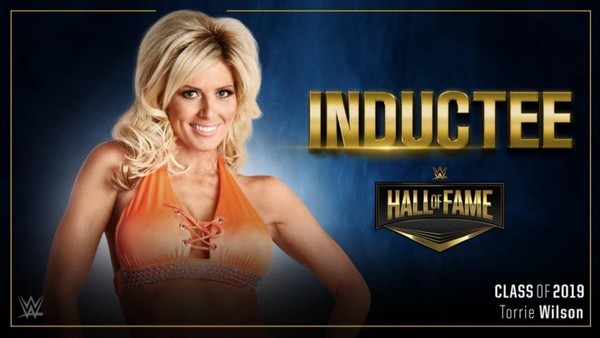
Torrie Wilson's Hall of Fame induction owes huge thanks to the magazine.

On
27 September 2017, a million floppy bunny ears fell limp following the death
of Playboy Magazine editor Hugh Hefner at the grand old age of 91. He was a man
for whom rigor mortis was most appropriate, but the stiffness had barely set in
before a broad range of eulogies were churned out of the opinion mill.
Hot cross bunny takes rose up from every side of the spectrum from the hagiographic to the high-handed, comment-baiting ideological thought-dumps rattled out to maximise the monetisation of the man's passing. Middle-market mouthpiece and lodestone of centre-right balderdash Piers Morgan was on hand to give glowing testimony to the softcore pornographer, fondly recalling the days of creepy 'Caligula-style orgies', whilst The Guardian's Suzanne Moore reiterated her prevailing - and once-over litigious - interpretation of Hefner as a "pimp".
The deceased was characterised as either one of two extremes: a misogynistic purveyor of the sex trade, or an opportunity-generating free-spirited libertarian.
Drowned out amidst the rhetoric-fuelled obituaries were the voices of the models themselves, many of whom were quick to praise Hefner for the careers he provided. That they didn't consider themselves exploited was quickly dismissed by those penning negative necrologies; after all, what would air-headed nudey ladies know about feminine equality?
Amongst those giving thanks to Hugh was former WWE 'Diva' Torrie Wilson, who posted an effusive social media display of gratitude for, ahem, exposure Playboy offered her. Torrie's ex-colleague and known aficionado of the female form, Jerry Lawler, was also quick to rhapsodise Hefner, noting his "true hero" as "the best."
There may not have been much to read into 'The King's tribute, given his well-earned status as wrestling's leading letch, but his public words, given his continued employ by WWE, were telling. His brief, laudatory comments served as a reflection of his paymasters, the company necessarily taciturn on the subject with concession to their family-friendly, PR-savvy image. The truth was, though they could never say it now, WWE owed as much to Hugh Hefner as any of his 'Playmates'.
[CON'T. P1/9]
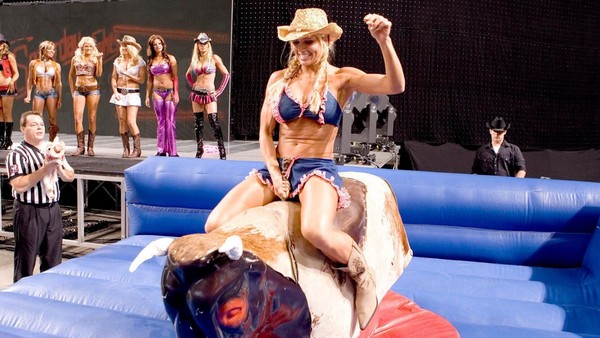
For the longest time, gratuitous displays of naked flesh within wrestling's circus were limited to the wobbly physiques of its bruisers. Though Rip Rogers and Buddy Rose bared the sobriquets 'Hustler' and 'Playboy' respectively, these coincidental allusions were as close as the television product ever got to the top-shelf.
That isn't to say women weren't frequently paraded as nothing more than eye-pleasing gewgaws, shoved into valet roles and discreetly sexualised through a hint of cleavage here or the occasional, accidental, lingering shot there. Emboldened by society's ongoing sexual revolution, the industry's women of the '70s used their implied sex status for lucrative sidelines. One of the most popular moonlighting gigs involved publishing private chat numbers in wrestling mags, allowing besotted fans to talk dirty to their idol of choice - at a premium rate.
For some, there were even greater earning opportunities afoot - provided they shirk their modesty. Better known as 'Miss Wrestling', Miki Garcia, a former Miss Sacramento, caught Hugh Hefner's eye whilst plying her trade on Roy Shire's Big-Time Wrestling. She was invited to pose for the January 1973 magazine in exchange for a huge wad of cash - such an offer had previously been turned down by Garcia's predecessor in the 'Miss Wrestling' role, Adrienne Barbour.
An indelible historical connection between wrestling and the Bunny House was established there and then; not only was Garcia the first lady of wrestling to spread across Playboy's spreads, but she was also the second person in the publication's history to appear fully naked.
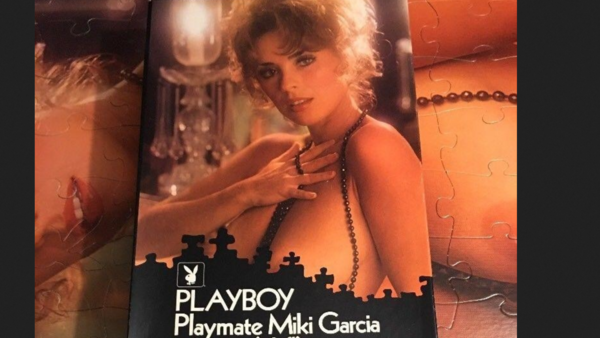
It proved a shrewd career move for Shire's buxom announcer, as she departed the wrestling business to become Playboy's Vice President for a decade, only for things to eventually turn sour when she testified before the U.S. Attorney General's Office on behalf of the woe-begotten fate of many of the company's Playmates. Her disgust at the common afflictions suffered by regular models, such as physiques honed with the help of rampant drug use, an alarmingly high attempted suicide rate, and the expected current of venereal disease, left wrestling's first show-all showgirl completely at odds with Hefner. It was a far cry from the sentiments echoed by her future wrestling compeers following his death.
Throughout wrestling's golden period, a handful of the industry's pre-eminent women followed Garcia's velvet-trodden footsteps in converting their grappling to the glossies. A ring full of stars from the satirical, subtly sexualised GLOW promotion joined AWA's Magnificent Mimi in a multipage feature for the December 1989 edition of the magazine, which highlighted their curves as much as their credentials. Mimi even appeared hoisting the AWA World Women's Championship belt, despite never actually earning the accolade. The particulars of the women, not the wrestling, were the primary area of soft focus.
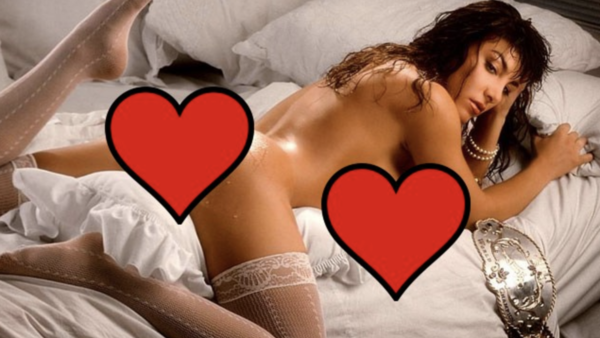
Unlike the former Miss Wrestling, none of the 'Gorgeous Ladies of Wrestling' stripped bare, instead posing in surprisingly conservative wrestling garb, albeit tight enough to accentuate their assets. Even more notable than the absence of unclad areolas was that of any representation from the nation's leading wrestling promotion.
In 1989, the WWF's Miss. Elizabeth was one of the most visible stars of the global federation's product, caught in the middle of an inevitable implosion between husband Randy Savage and Hulk Hogan. Such was the prominence of her role that she was even billed as the 'First Lady of Wrestling', yet she, nor any of her mainstream colleagues, had any part to play in Playboy's pro-wrestling puff piece.
Vince McMahon's pop-culture phenomenon wanted nothing to do with the seedy under-the-cover exhibitionism of Hefner's publication; the two simply didn't go hand in hand.
[CON'T. P2/9]
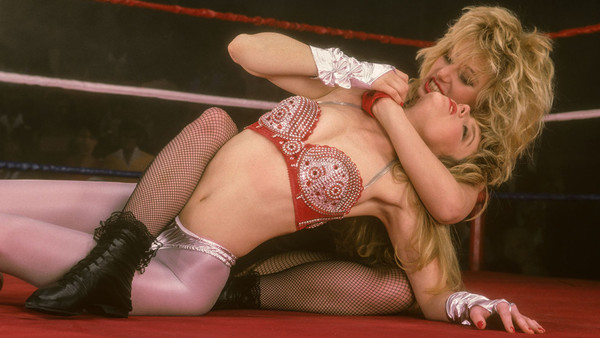
As the global WWF juggernaut rolled on, the term 'wrestling' became even more synonymous with Stamford. The exposed epidermis of bare breasts was about as far from the mind as possible when considering an increasingly cartoonish world occupied by superheroes and supervillains in the guise of undead morticians, bent police officers, and a flag-waving champion of all that was good and righteous.
On wrestling's outer fringes, adult-oriented content could be found - usually on the backpages of Apter mags, where clandestine tape traders advertised bone-bending video nasties. Likewise in its furthest frontiers: AJW star Mitsuko Nishiwaki stripped to her delicates for a tasteful spread in the Japanese Playboy in April 1991, just a year removed from her top-billed retirement. But clothes were never unfastened by the mainstream current of the industry.
By 1993, Vince's portrayal of female talent was far removed from the redolent flirtatiousness of Miss Wrestling and her GLOW successors. Eager to reintroduce competitive women's wrestling back into his fold after it had largely vanished following the infamous double-crossing of Rock 'n' Wrestling star Wendi Richter, McMahon drafted in joshi Debrah 'Madusa' Miceli. According to Miceli herself, Madusa - now known as 'Alundra Blayze' - was the first female wrestler the WWF chief considered 'legitimate', to the extent that he looked to build an entire division around his incoming star by gifting her the Women's Championship abandoned since 1990.

Despite being hand-picked to spearhead the new brand of credible women's wrestling, it was with some irony that Miceli was inadvertently the first WWF star to have stripped for Playboy, albeit outwith the company's auspices. Years prior to her move to Connecticut, the AWA starlet mimicked Magnificent Mimi in dropping drawers for the mag, only to place an interdiction on their release should the lewd images scupper an upcoming tour with Japanese promotion AJW. Had the saucy snaps not stayed hermetic in the Mansion's vault, it's possible McMahon would have looked elsewhere for his new icon. It was an employment policy that would change dramatically in the years to come.
It was a case of right place, wrong time for Blayze. In 1995, WWF's financial problems saw the women's section once again mothballed, with its champion unceremoniously slashed from the payroll. Just as no-one saw her strip for Playboy, so too did nobody see her officially stripped of the pink belt; she famously turned up on the rival WCW Nitro to drop the strap in a handily placed bin. When the title was next resurrected three years later at the behest of a new female focal point, it was to be a completely different story.
[CON'T. P3/9]

In a curious twist of fate, it was a wrestler playing a stereotypical homosexual character at the time of Madusa's betrayal who would indirectly lead WWE's charge into sexualising women. Unhappy with his WCW Johnny B. Badd persona - though because of a proposed angle involving a married woman, and not its outdated and insulting pink feather-boa waving schtick - Marc Mero signed on the dotted line with WWF in the spring of 1996.
Mero was a reliable performer in Atlanta, but WWF had no shortage of gifted sub-250 pounders. However, they were prepared to bring him aboard as a part of a package deal - with his wife. Rena Mero, a textbook supermodel blonde, had absolutely no prior experience between the ropes, but when Vince McMahon first laid eyes on her idealised figure, he saw a money-making asset.
More accurately: he saw two.
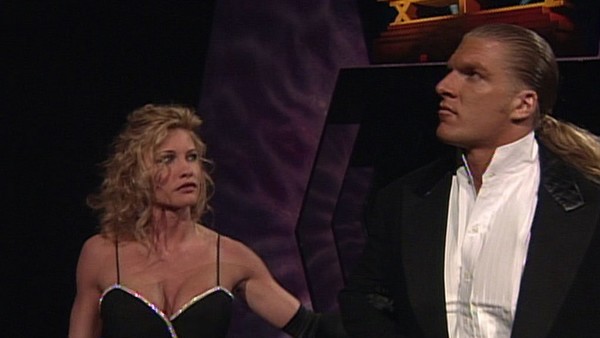
A nameless Rena made her understated debut at WrestleMania XII, linking arms with Greenwich snob Hunter Hearst Helmsley as his evening escort. Completely under the thrall of her hirer, there was little reason to suspect the mute companion would lead the company into its own sexual revolution. Following an embarrassing defeat to the returning Ultimate Warrior, Hunter went on the warpath, interrupting Rena's real-life spouse during his introductory interview, manhandling the defenceless valet in the process. The stage was set for Mero to 'save' the damsel-in-distress and take her into his own employ. Her identity was later revealed as 'Sable'.
Interestingly, WWE had already prophetically auditioned for the full Sable arc before Rena serendipitously fell into Vince McMahon's lap (metaphorically fulfilling his fantasies in the process). At the onset of January 1996, former Playmate Ashley Allen was signed to a speculative contract with the company, appearing on the New Year's Day edition as Miss Raw Bowl, ushering the entertainingly rubbish football/wrestling concept of the same name.
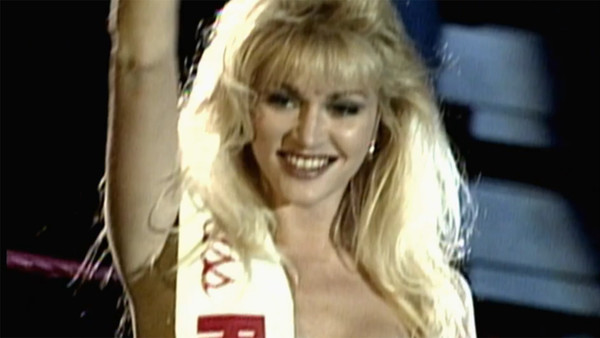
Jerry Lawler, in a preview of his Attitude Era role of 'dirty old man', slathered over the sashed showgirl, a manifestation of the feeling towards Allen in the boardroom. Big plans were drawn up to have the striking newcomer align with Bruce 'Brother Love' Prichard as his wife, reductively named 'Sister Love'. Eventually, the plan was to have the minister's wife involved in a sex scandal echoing that of Pentecostal televangelist Jim Bakker - presumably, with her Playboy background coming to the fore.
It never happened, but curiously, Allen did film a set of vignettes as Hunter Hearst Helmsley's valet - the very same turn Rena Mero would occupy.
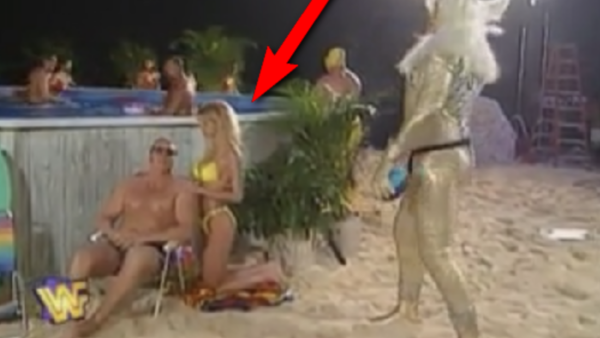
Her last appearance with the company fulfilled part of the original plan at least; she turned up alongside Hunter wearing nothing but a bikini as part of SummerSlam '96's beachside festivities.
[CON'T. P4/9]

The financial difficulties which had triggered Miceli's departure a year earlier were a sign that WWF's old model was no longer working. As the audience of the late-'80s boom were growing up, so too were their appetites, and fresh competition from Atlanta didn't help. Madusa's dramatic departure south was the latest move from WCW's upstart promoter Eric Bischoff, part of his drive to make Monday night wrestling shake it's stupor to become edgy, must-see television.
On the night of Sable's debut, it was clear WWF were already starting to wake up to the new season. Elsewhere on the show, the controversial, androgynous Goldust character had been stripped of his jumpsuit by a rampaging Roddy Piper, revealing women's lingerie beneath. The implications of kink added to the sexual undertones of his gilded persona were a stark departure from the wholesome entertainment proudly presented for many years prior - to the extent that television executives demanded changes. But the rabbit hole - or the bunny hole, as it would become - just became deeper.

Envelope-pushing programming gradually became the norm on WWF television, particularly following the damaging departures of Kevin Nash and Scott Hall to the southern rivals. Recognising the changing tastes of their audience - for many, part of a biological process of puberty - the company were prepared to shelve their prior prudish sensibilities. Contrary to the attitude surrounding Miceli's dismissal in 1995, women were suddenly about to become worth having. This time, wrestling had nothing to do with it.
An ill-timed injury to Marc Mero in 1997 couldn't have had worse implications for his career. During his convalescence, Sable maintained her on-screen presence, where her popularity mushroomed. Without being tied to a man, the audience began to appreciate Sable on her own merits - and for many, without the residual envy of her husband. The fans wanted to see more of Mrs. Mero - a lot more. They'd soon get their wish.

By 1998, Pandora's Box had well and truly been opened, and the fatuous purgatory of the 'New Generation' was consigned to the past. The ribald everyman 'Stone Cold' Steve Austin was WWF champion, but just as crucial to the company's shift in attitude was the new breed of objectified women, pretty pin-ups carrying the overt invitation to ogle. The top cat of this litter of sex kittens was Sable, whose enormous following brought the women's title back into existence once more.
Compared to Miceli, Mero couldn't have been less legitimate between the ropes - it was even written into her contract that she wouldn't take bumps - but that was irrelevant. Her matches didn't involve pinfalls or submissions, but panties and swimsuits. Sable might not have been able to sell in a wrestling ring, but her sexuality did.
[CON'T. P5/9]

The WWF's product became increasingly licentious, squarely (or roundly) centred around Sable and her co-stars' curves. Things peaked, in a manner of speaking, during a bikini contest between Sable and Jacqueline at the Fully Loaded '98 pay-per-view. The former, despite initially being awarded the victory, was disqualified on a technicality; her 'bikini' had been a pair of glittering handprints painted over her bare breasts. The tats were out the bag, as it were.
Almost a decade after Madusa had bared all for Playboy, Hugh Hefner again looked to marry the bounciness of the ring with that featured in his rag, only this time, there would be no pretence of modesty preventing its publication. It was a marriage made in heaven from the outset, allowing WWF to give their viewers exactly what they wanted without being taken off the air, whilst Hef could boost his own increasingly irrelevant magazine off the back of the WWF's momentum. There was only one candidate for centrefold conversion: Sable.
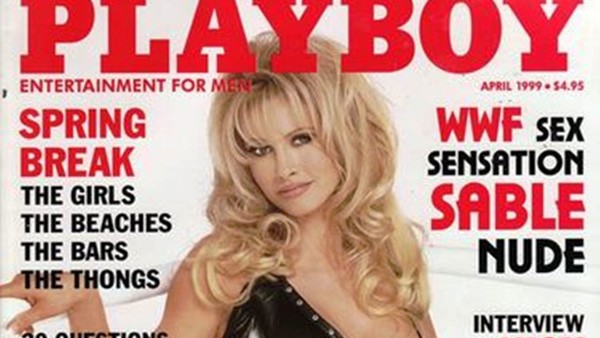
The April 1999 edition of Playboy was one of the highest-selling of its near half-century run, thanks to the imported popularity of the WWF sensation. Curiously, despite being at the apex of her prestige, the shoot caused an on-screen tweak to Sable's character, as she began to characterise herself as the 'Diva of the WWF'. The appellation would stick, becoming synonymous with wrestling's women for the better part of the next two decades. The pejorative connotations were casually ignored.
Life soon began to imitate erotic art, as Sable's ego ballooned in response to her successful shoot. Now considering her stock to be on an equal footing with the company's highest draws, the record-breaking Playmate began making demands of the WWF far outstripping her value - even as a stripper. The excursion to the Playboy mansion had made Sable too popular, and it became clear the sand was running out on her time in the company.
In a scenario strangely similar to that of future husband Brock Lesnar, Mero departed the company, expecting to earn more on her own. It was a well-measured gambit; later that year, she became the first woman in Playboy history to twice feature on its cover, the second time under her real name.
The next WWF 'Diva' to denude themselves within the glossy pages of Playboy couldn't have been less emblematic of the term.
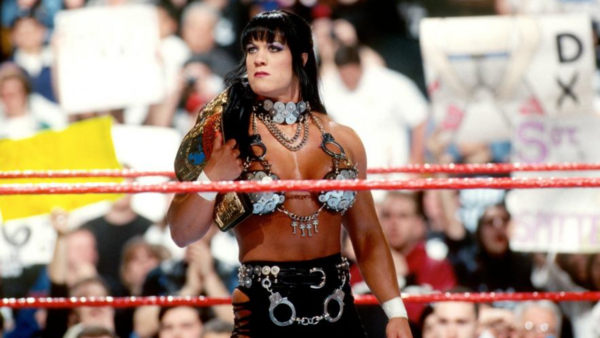
A muscle-bound Amazonian woman with actual wrestling training, Joanie 'Chyna' Laurer was the antithesis of the buxom bimbo the company had been keen to promote prior to her debut. Instead, she was - with no degree of incredulity - considered a possibility to be the group's first inter-gender wrestler.
Here was a woman who was as big as the men, and thanks to her unique appearance, as popular. For many on the roster, the prospect of losing to a woman was anathema; in one infamous incident, Jeff Jarrett held the company up to the tune of $200,000 for him to drop his Intercontinental strap to Laurer on his way out of the company.
[CON'T. P6/9]

Ironically, the more Chyna mixed it with the men, the more she converted into a typical WWF Diva. Extensive cosmetic surgery drastically altered Laurer's features, and despite holding titles and competing in matches designed for men, she gradually became a sex symbol like Sable before her.
The story followed an almost identical path: Chyna was approached for Playboy in November 2000, with the issue repeating the barnstorming success of the April '99 edition. And like her precursor, the attention soon got to Chyna's head.

Though she was more of an identikit 'Diva' now than ever, the 'Ninth Wonder of the World's heightened status placed her on a platform above wrestling other women - at least in her estimation. Her attitude was already proving a problem, but when ex-boyfriend Triple H - the same Hunter Hearst Helmsley who had introduced Sable to WWF viewers - began a relationship with the chief executive's daughter, Stephanie McMahon, the wallpaper couldn't be seen for the writing.
Like Sable before her, Chyna left the company, expecting opportunities to be just as prevalent beyond the difficult confines of the WWF. They were, for a time - Playboy came calling again in 2002 - before the unravelling of her personal life saw the release of a secret sex tape and her entry into the adult industry full time, as her demons began to mount up. Despite joining the business as a new symbol of powerful femininity, Chyna was ultimately shattered by its culture of exploitation.
Though their first two had left in acrimonious circumstances, so long as WWF had 'Divas', the company would enjoy a prosperous working relationship with Hugh Hefner. After the runaway success of Sable and Chyna, Vince's group began hiring women with the specific objective of putting them on the top shelf. This was wrestling merchandising brought to its most tawdry conclusion: bring them in, build them up, then pimp them out. Though the women were unquestionably objectified, the new circumstances brought unparalleled financial opportunities. There was no overt pressure to bare all - but those who would, prospered. The expectation was implicit.

Torrie Wilson became the next WWF star to appear in the pages of Playboy, rescued from the burning embers of the collapsed WCW. Her all-too familiar buxom blonde looks even coaxed Sable back into the fray, who later appeared quite literally cheek-to-cheek with Torrie in an issue of the blue paper.
From 2005 onwards, the company began to churn out unclothed centrefolds at an industrial rate. The invention of the 'Diva Search' contest finally dismantled the flimsy pretence of 'women's wrestling', giving the promotion a viable excuse for drafting in an array of beauty queens and lingerie models.
Dozens of women earned work in Stamford based on nothing but looks alone. The era of titillation over talent made lucrative careers for many an individual, but left the status of women's wrestling as a respectable contest at its lowest ebb. Equality wasn't even an illusion.
[CON'T. P7/9]

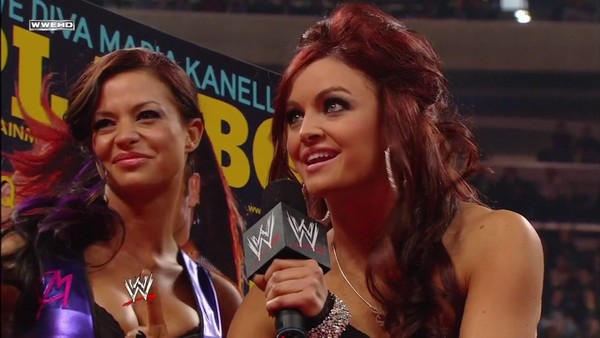
Between 2004 and 2008, no fewer than half a dozen meretricious, silicone-enhanced women defoliated their silken verdure for Playboy, having stumbled through the doors of the wrestling business thanks to the lamentable Diva Search. Carmella DeCesare, Christy Hemme, Candice Michelle, Maria Kanellis, Ashley Massaro, and Maryse Ouellet all bared the goods between the sticky pages of Hefner's cheesecake cookbook, the sum total of their collective wrestling ability just a little below that of a backyarder.
Hefner himself was happy to play along, frequently turning up during repeatedly rehashed jealousy angles whenever one of the Divas turned Playmate, with the magazine even endorsing an execrable WrestleMania XXIV Playboy BunnyMania Lumberjill match.
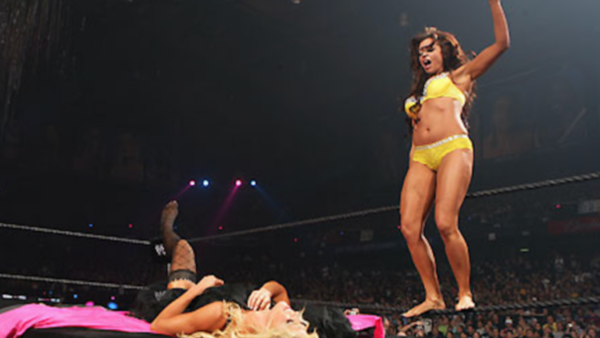
Thankfully, that was just about the last time WWE offered such prurient victuals. Instigated by the huge dent to public image caused by the Chris Benoit murder-suicide tragedy, a number of factors saw the company reset their moral compass - not least the same audience which had been fuelled by hormonal urges having proceeded into true adulthood. The promotion reverted to a sponsor-friendly PG rating, and the stream of salacious smut ran dry.
With the rating adjustment, the fruitful alliance with Playboy was at an end. It was the right time for it. Aside from the gross objectification of women being a smear on a company trying to style itself as a global brand in the 21st century, the cultural relevance of the magazine was in decline. The prevalence of the internet had made pornography easily accessible to the vast majority of those looking for it; they no longer needed to tune in on a Monday Night for the slightest hint of tame titillation. With the bases covered elsewhere, what they wanted was a wrestling show, not a peepshow - one they weren't embarrassed to watch.
[CON'T. P8/9]
As time created distance from those dirty days, the company itself was repeatedly haunted by its past. WWE was left red-faced during Linda McMahon's run for senate in 2012 when opponent Chris Shay likened the promotion's executive to the softcore impresario. It was a claim she could hardly deny; the group had enjoyed a very profitable working relationship with Hefner, effectively supplying him with models for the better part of a decade. It was also with some element of sheer hypocrisy that WWE repeatedly cited Chyna's adult movie experience as a reason she could not be considered eligible for their farcical Hall of Fame. It was good enough to profit from Chyna's sexuality when she worked for the company, but once money was to be lost from such exploitation, the behaviour was now demonised.
For the same reason, Sable has yet to be inducted into the elite club, despite many female performers far less instrumental to the business' growth being given the coveted ring - Madusa amongst them. It was only this year that the Ninth Wonder was finally deemed suitable for inclusion, albeit sneakily secreted amongst a broader 'D-Generation X' induction.
Playboy itself continued to court the wrestling industry after the WWE link dissipated, with the appropriately titled TNA the most frequent collaborator. It was a fitting marriage; the Tennessee company often felt like a second-rate, pale imitation of WWF in their pomp, and the association with the outdated facetiae emphasised the perception. Just as WWF and the magazine made fitting partners at their height, there was a comforting sense of shared irrelevance between two companies with little remaining pop-culture currency.
At the time of Hefner's death, women's wrestling had finally attained the ennobled position Vince McMahon hoped for in 1993. Sexist attitudes are no longer tolerated in a world where public outrage can be fomented in an instant and 'misogynist' is the kiss of death for a brand. Female 'talent' strictly refers to in-ring acuity, with jug-based judgement gladly consigned to the same bin as Madusa's pink women's title.
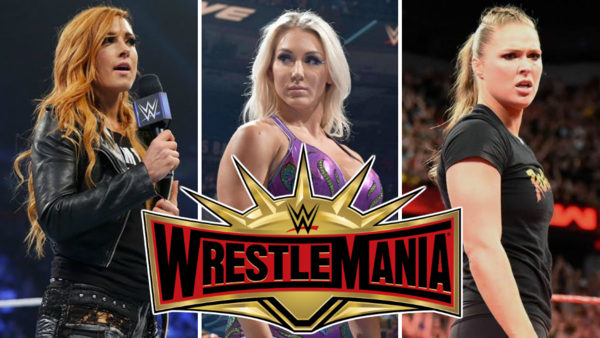
As we approach the first ever female WrestleMania main event, things look to be sticking, but it's a volatile business. With TV ratings in perpetual decline, we've already beared witness to a slight reversion to the dark old days. A full blown reversal seems unlikely so long as the acronym 'PG' adorns WWE product, but who knows - after all, the 'Attitude Era' seemed a million miles from the WWF product of the early-90s.
For now at least, wrestling's carnal chronicle has been folded up and discretely shoved under the bed.