What Really Happened To…Bruiser Brody
Exploring one of wrestling’s grisliest ever incidents, and the divisive performer at its centre.
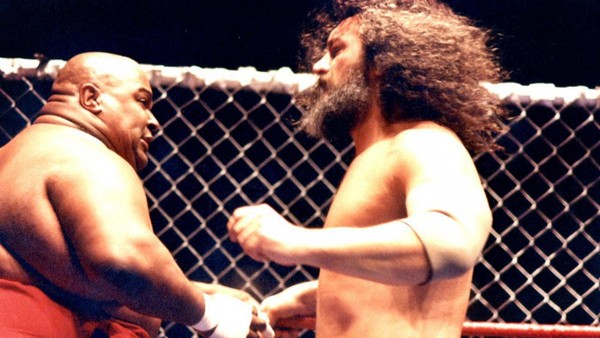
Bruiser Brody endures as a great mythical figure in the rich and profoundly twisted fabric of professional wrestling.
One need only have looked at him - something several spectators were almost reluctant to do, scurrying terrified at the palpable chaos orchestrated throughout his crazed, arena-wide brawls - to gain an insight into the wild man within. Brody wore a massive shock of curled black hair and a beard. He pierced your soul with a thousand mile stare revealing the full white of his bulging eyes. His forehead decorated with disgusting gig marks, he looked like pro wrestling’s Charles Manson, and projected himself with a similar insanity. It was a look as appropriate as it was chilling; Brody carved his legend as a cult unto himself.
To use a modern analogy, Brody was the proto-Brock Lesnar: a genuine Beast of a man capable of both commanding a gladiatorial atmosphere his public was at once repulsed by and drawn to, and forcing promoters to bend to his erratic, money-driven whims. He was also selectively brilliant, depending on the payoff and his enthusiasm for the job. Brody at times refused to comply with the finish and often the match itself, standing there frozen in stubbornness to an extent that exposed the business as a predetermined sham.
A major draw unto himself - hence why promoters would book him in spite of his selfish reputation - Brody was nonetheless the anti-fulcrum of the towns he deigned to make. The short-term box office injection that was Brody begat a long-term ailment. He was a sort of anti-vaccination that, suitably, needled many a promoter.
Much like everybody he performed in front of, Brody, even in death, triggers the polemicists of the wrestling community into a reaction. Those who deem him overrated cite the copy and paste nature of his default brawl as a limitation, when really, anything else risked a dilution of his unique aura.
CONT'D...
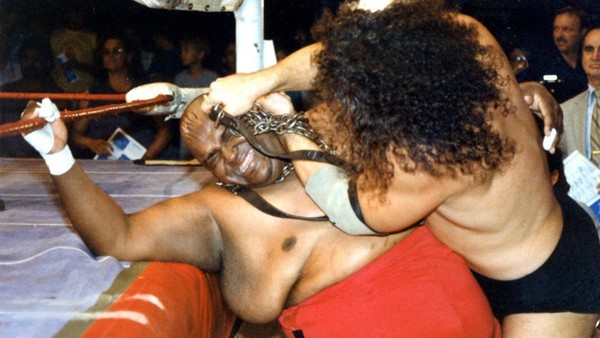
This perceived inability to do anything beyond being Brody just added to it. He often worked by not working, or not cooperating. He was singular in his identity: Brody was a true original, a man not to be f*cked with. That was his deeply credible appeal, one he carefully reinforced with his bullsh*t.
Those brawls remain captivating decades later. His tandem with Stan Hansen yielded matches richer than the Brody norm, but the Brody norm was best illustrated through his legacy rivalry with Abdullah The Butcher. Their matches together weren’t bound to the ring for long; both men rampaged through many an arena, frequently and literally collapsing in the stands as they strangled and smeared blood over one another’s faces, lying prone on the concrete.
Brody didn’t play to anybody, much less the crowd. They gravitated towards him; to his benefit and the detriment of so many others, he was at the centre of everything. In a business as despicable as pro wrestling, in which promoters literally paid potatoes and to this day refuse to classify their performers as anything beyond meat for the maw, this must be considered a victory.
Unlike Lesnar, Brody was legitimately unstable. Ornery is a euphemism. Or was that simply the calculated work, in turn casting him as one of the greatest? Several of his peers - Hansen, Jim Duggan, Bret Hart, Scott Hall, The Berzerker - have all stated on record their immense gratitude for Brody’s avuncular ways. An enemy of the promoters, he was naturally one of “the boys”. To some of them, anyway. Because he was a myth, there was never one accurate portrait of the man.
Again, like Lesnar does to this day with Vince McMahon and Dana White, Brody used his immense Japanese fame to extort North American promoters into booking him to the potential detriment of their regulars. He was an aberration: a myth.
A mythical man met a mythical end.
CONT'D...

On July 16, 1988, Brody, working for the World Wrestling Council (WWC) of Puerto Rico, was stabbed to death in the locker room shower area by José González.
Witness Dutch Mantell, speaking with Sean Oliver on Kayfabe Commenataries, sensed a tension beyond even the usual dangerous air dangling over Puerto Rico. He surmised that González held a long-dormant hatred of Brody for stiffing him badly in the old WWWF, and chose that date, and specifically that site - for reasons that will become clear - to exact his murderous revenge. Tony Atlas, another witness, recalled later that Brody said to him “Tony, I finally got in”. Perhaps González was apoplectic also that Brody had politicked his way into his booker’s cut.
“It seemed like an eternity,” Mantell wrote in a further article for Solie.org.
Per Wikipedia, it took paramedics close to an hour to reach Brody due to “heavy traffic outdoors and a large stadium crowd”.
Per Dave Meltzer on a recent edition of Wrestling Observer Radio, the inherent fabrication that was pro wrestling actually decelerated the response time. Nobody ever knew what to expect of Brody - whether he’d cooperate, or even appear - and the same was true of the local authorities; they took that eternity because they weren’t initially sure whether what was reported met wrestling’s winking eye.
This late response was hardly surprising. Just one year later, Atsushi Onita attempted to book an angle in which González would stab him, even going to the lengths of circulating pictures of himself clutching at his bloodied, gutted stomach. Mercifully, he never exacted the intended “revenge”; González was denied entry into Japan. This was beyond tasteless, even by wrestling’s standards, but it still spoke to the complete absence of its moral compass and the distrust it will always foster.
This was flagrantly disgusting business. Only in wrestling could one cry wolf after the wolf committed murder.
CONT'D...

Mantell was less diplomatic. He believed that the Puerto Rican workers were unwilling to translate the desperate cries of the American imports, and that when González’s Invaders tag team partner Roberto Soto eventually did, the policemen chose not to accept the Americans’ version of events. They “smiled” amongst themselves, refusing to buy into the work. Despite frantic protests to the contrary, they remained unmoved. To Mantell, “these cops grew up watching Carlos [Colón, the promoter] and Invader so, to them, they were big stars and they, just ordinary policemen”.
González was allowed to walk away from the scene, and Brody was left there to die.
Brody was one of wrestling’s most practised and celebrated bloodletters. The aspirin in his system facilitated the iconic images of his crimson-soaked face and, ultimately, his death. Brody bled out, hardly helped by the primitive medical facilities.
The subsequent trial exonerated González. Mantell, nor any other willing witnesses, received their summons to testify until after the trial’s conclusion. Mired in corruption and cover-up by a Puerto Rican justice system Mantell referred to as “weak”, González literally got away with murder, citing self-defence. In a grim but not altogether shocking turn of events, González continued to work Puerto Rico, as a babyface, in the ensuing years.
But, in a strange parallel between murderer and victim, this harrowing story diminished the popularity of pro wrestling in the unincorporated territory.
Brody’s death rippled throughout history. So, too, did his life’s work.
We know of his influence over Brock Lesnar, direct or otherwise. Similarly, The Road Warriors grew to immense wrestling fame by refusing to sell the offence of their opponents. That was a Brody trademark. In New Japan Pro Wrestling, Togi Makabe carries a heavy chain to the ring, much like Brody did in his native country. Luke Harper cosplays as Brody on SmackDown. Indie rock outfit the Mountain Goats immortalised the man in the song ‘Stabbed to Death Outside San Juan’.
“When the blade hits the bone, everybody hears it sing / Shower room full of people, no-one hears a godd*mned thing”.
Bruiser Brody was murdered in an infamously grisly chapter of wrestling’s infamously grisly story, but his legacy lives - and will always live - on.