The Evil History Of Pro Wrestling: TNA Victory Road 2011
You can’t learn to fall off a ladder, but you can mask the pain.
Pro wrestling is, historically, a diabolical business - so much so that the prominent media publication covering it, the Wrestling Observer Newsletter, presents an award to determine what is its most repellent incident. This award, the Most Disgusting Promotional Tactic, is voted on annually. Even in today’s cleaner world, in which the average pro wrestler is very professional and the mainstream promoters aren’t anywhere near as brazenly awful as their scummy predecessors, dishonourable mentions are rife.
Highlighting just how pervasively bleak pro wrestling is, the subject covered in this editorial did not win that year’s “prize”. Instead, it was awarded to WWE, for “promoting an anti-bullying campaign despite blatant mistreatment of Jim Ross”.
Beloved, legendary commentator Jim Ross was often bullied onscreen by then-company owner Vince McMahon. Ross, variously, was mocked for his Bell’s Palsy affliction and, in one infamous segment, undergoing colon surgery. The difference this time was that Vince had the gall to launch the Be A Star campaign in parallel. As detached as WWE is from reality at the best of times, this lack of self-awareness and hypocrisy was truly disgusting. It was a worthy winner of a hotly contested award, beating out the decision to proceed with the main event of TNA Victory Road 2011.
Various wrestlers, over the years, have wrestled while under the influence. ‘Man’s Man’ William Regal was a slurring, incoherent mess in the WWF of late 1998. In that same year, Davey Boy Smith was a 24/7 wreck in WCW, out of his mind on such a lethal cocktail that he once, recalling how long he had been wrestling, struggled to find the word “old” after saying “years”. The Sandman was blitzed more than once in ECW.
And, because pro wrestling is more diabolical than you ever remember it, real-life addiction has bled into the onscreen narrative all too often. Road Warrior Hawk’s potentially imminent real death was once an episodic hook of WWE Raw; ‘Last Call’ Scott Hall was also positioned as a car crash waiting to happen - and you might just see it, provided you choose Nitro over Raw.
TNA Victory Road 2011, held on March 13, was different.
Jeff Hardy had nearly been pulled from the Final Resolution pay-per-view on December 5, 2010 when concern arose over his condition. (Evidently, TNA wasn’t so concerned that Hardy, one of very few difference-making stars, was sent home). After some rest, Hardy was able to enter a respectable enough performance in the main event, during which he retained the TNA World Heavyweight title against Matt Morgan. Important context: TNA had a back-up plan in place in the event that Hardy could not perform - a match between Morgan and Mr. Anderson for the vacated belt.
Hardy was due in court on drug trafficking charges mere days after Victory Road, before which, to cover the company’s back, he had dropped the title to Sting on the February 24 edition of Impact.
It was widely known within TNA that Hardy was a liability, a danger to himself. His state on the night of Victory Road should not have come as a surprise to anybody in the company. The events of March 13 were destined to happen. If “destined” is a bit much, an incident was exceptionally likely to anybody with even an elementary understanding of the nature of addiction.
TNA should have had the prescience to devise a back-up plan for anything involving Hardy - but then, the promotion was so systemically incompetent that developing logical creative plans was a fiendishly difficult task for them to begin with.
At Victory Road, a heel Jeff Hardy was scheduled for his rematch against Sting. Hardy was apparently in a respectable enough state to turn up on time and run through the planning process of the main event with his opponent - shortly after which, as he was prone to do, he disappeared until bell time. Hardy himself has since revealed that he loaded himself up on somas, a highly potent pain-killing muscle relaxant.
With total naivety, just three months after Hardy had nearly destroyed a pay-per-view main event, nobody within TNA thought to check his whereabouts.
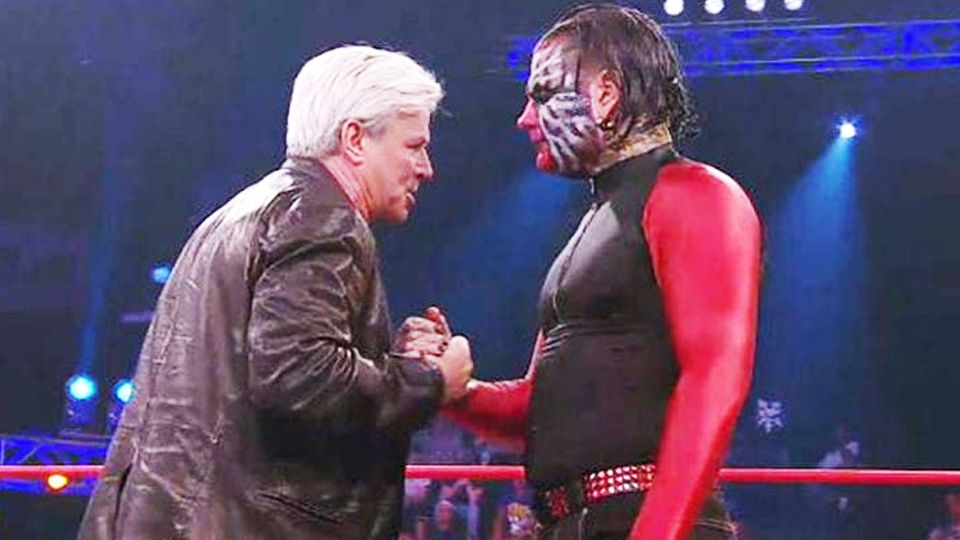
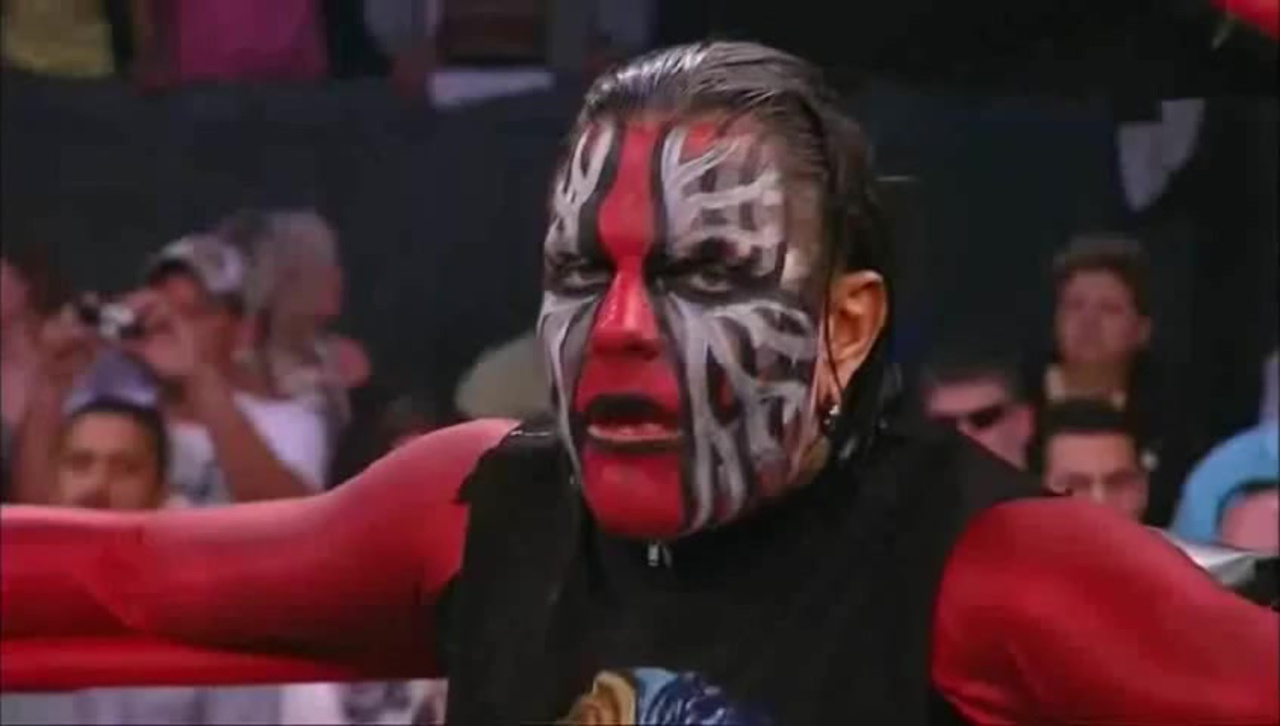
Jeff Hardy shambled his way to the ring. It took him a long time, so long that referee Brian Hebner was alerted to the situation immediately and held up the dreaded ‘X’ sign - a visual code that a real event must be addressed. Hardy tripped over the ring steps, just finding the ring post in time to balance himself before falling over. He located the camera, and after a slight delay, refocused his vacant eyes to stare at it dimly. He ventured outside as a concerned, pissed-looking Sting made his entrance and appealed to the crowd. Eric Bischoff, unexpectedly, made his entrance.
He said that, since Hardy had no time to prepare for the February match, the playing field should be levelled. The sequel was to be held under a No Disqualification stipulation - something Hardy knew about in advance. This was total improvisation, obscuring the real purpose behind his appearance: to deliver new instructions to the wrestlers. He told Jeff that he had to take the Scorpion Death Drop and get the hell out of there before relaying the message to Sting.
Sting did precisely that - but not before Hardy, in a dazed loop, kept trying to throw his shirt into the crowd. After the “win”, a devastated Sting skulked back up the entrance ramp. When fans chanted “Bullsh*t!”, Sting could only say “I agree. I agree.”
Writing in the Wrestling Observer Newsletter, Dave Meltzer was incredulous. His cynicism, finely-tuned through years of wading through the muck that is his area of expertise, led him to suspect it was a work - “a way to get attention”. Meltzer, as with everybody else, could scarcely believe that nobody with influence backstage was able to conceive of a better plan or an alternative main event. Dave Meltzer chronicled the rise and fall of WCW in real-time more comprehensively than anybody else. Meltzer, though, also wrote “there are no indications that it was [a work]”.
Eric Bischoff, whose catchphrase and autobiography title is ‘Controversy Creates Cash’, did not withdraw Jeff Hardy from the main event. He has since claimed that he lacked the power to do that; on his podcast 83 Weeks back in March 2021, Eric clarified that, while he was “technically the executive producer of the television show”, he “had no authority whatsoever and no official role in the pay-per-view”.
“I was concerned about the show,” Bischoff continued. He made the decision to make the decision, since nobody else would.
Bischoff spoke about what was best for the show, but betrayed this facade by revealing his first instinct: to be a carny and turn on Jeff. Eric said he wanted to stay within the parameters of his heel character and punch a struggling man in the face, triggering a disqualification, before remembering his own audible.
So who is to blame?
In May 2012, then President Dixie Carter opened up on the debacle in an interview with Busted Open Radio. Or rather, she didn’t; she completely, shamelessly ducked the question, offering zero accountability, choosing instead to put over Jeff’s latest plea to clean himself up. Carter even put herself over in the process, saying “I feel blessed to have been a small, small part of supporting him and helping put the structure in place”.
Perhaps Bischoff - a man with a toxic reputation in many circles, the man who booked the Kevin Nash Vs. Scott Hall storyline in WCW in 1998 - was correct when he said:
“I think [the Victory Road incident] reflected a tremendous amount of a lack of professionalism within the entire TNA organisation from top-to-bottom.”
(It should be noted that TNA in the aftermath acknowledged that Victory Road wasn’t good enough, and offered anybody who purchased it six free months of the on-demand online video library).
A lot of TNA’s dumb history is, more than anything else, very amusing - in a perverse way. A beneficiary of nepotism hired the world’s worst booker, sank the only vaguely well-financed alternative to WWE in 18 years, and had the temerity to blame the only one good thing the promotion ever had going for it, the talent, in an onscreen meeting.
While the wasted generations of great talent was a sad encyclopedia, the TV was nevertheless corking fun, if you’re prone to enjoy a bit of schadenfreude.
The ‘LOLTNA’ business becomes altogether less funny when you consider that these comically inept morons were tasked with safeguarding the agonised wrestlers who bumped for them.
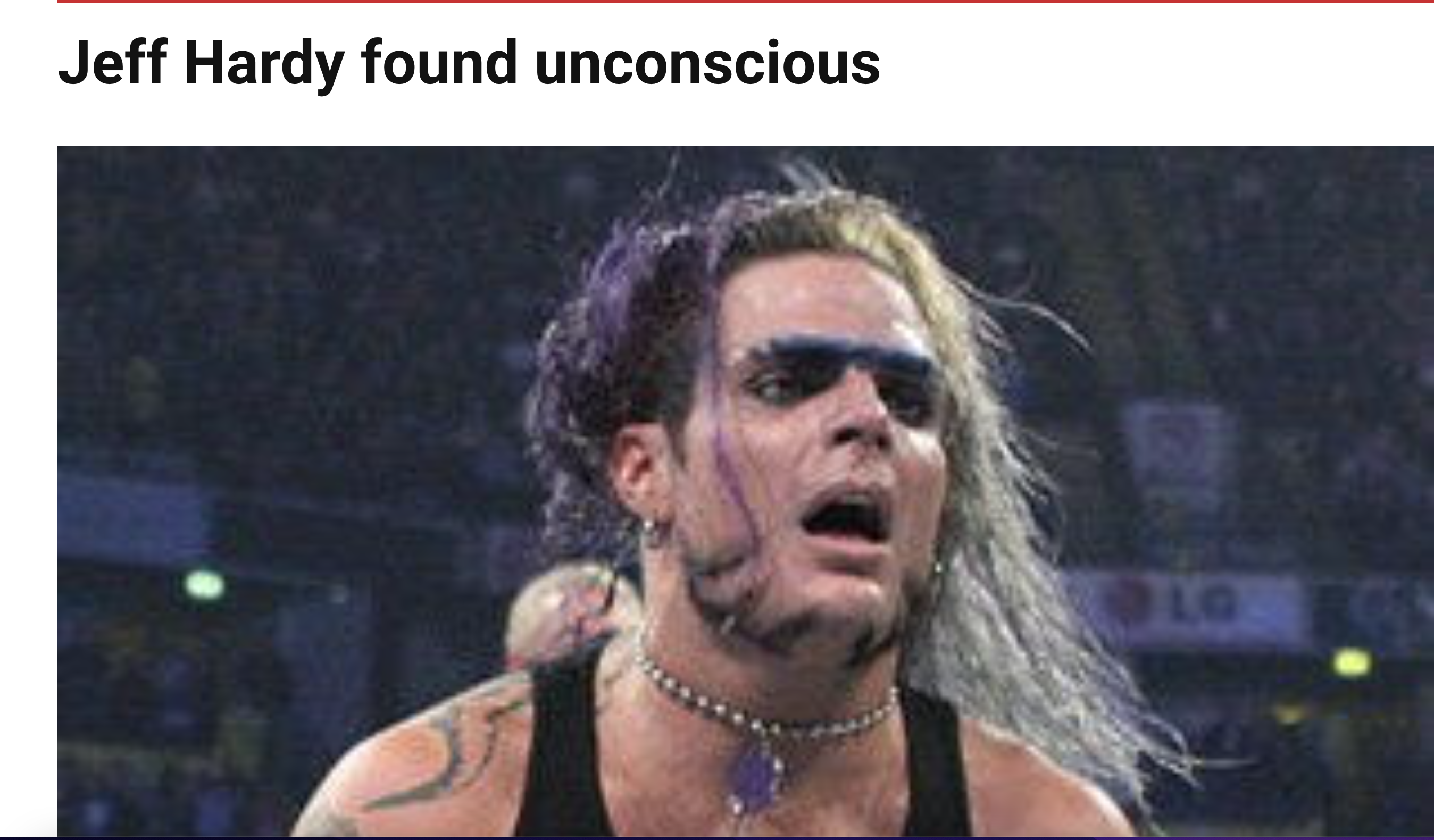
The disturbing truth is that Jeff Hardy has been enabled by professional wrestling ever since professional wrestling was able to monetise Jeff Hardy. TNA just happened to be the least competent. What a sad, brutal, eternal cycle it has been.
Hardy was released by WWE in April 2003 because he was clearly struggling, it was impacting his work, and he refused rehabilitation. Despite displaying similar behaviour in TNA, for which he last appeared in December 2005, he was re-signed by WWE in 2006. In 2006, WWE was not exactly enjoying a sparkling business period. He was twice suspended for violating the Wellness Policy during this second full-time run, during which his addiction was worked into the narrative: WWE teased, ahead of Survivor Series 2008, that he had died in a motel room - the place of premature death for too many performers. A year later, Jeff was gone again, of his own volition - weeks after which, he was arrested for drug trafficking. In 2018, 2019, and 2022, Jeff was arrested for either driving while impaired or being drunk in public. In 2019, he was done for both.
This is not even close to a comprehensive rundown of Hardy’s struggles. All the while, wrestling’s heartthrob daredevil was promoted in yet more debilitating ladder matches, the agony experienced in which was unbearable - unless he self-medicated.
Meltzer receives much in the way of flak, especially in recent years, but writing in the March 21, 2011 Wrestling Observer Newsletter, he was dead-on.
“When [Jeff] comes back, he’ll be over like crazy with the live audience, and then pushed to the top. And then the cycle will happen all over again.”
Now, Hardy was, and is, a grown man who is ultimately responsible for his own choices and actions. However, at a certain point, the power players within wrestling must be held to account. Did the owners of WWE, TNA and AEW really think, with Jeff, that “this time, it will be different”?
Or did they push the creeping doubt to the back of their minds - if they had the moral fibre to have that doubt in the first place - because Jeff is a money-drawing star?
One more drink can’t hurt.
It’s only one more ladder match.
One more drink can’t hurt.
It’s only one more ladder match.