Raven In WWE - What Went Wrong?
Quoth the Raven, "Never Pushed"

"Who the f*ck hired Johnny Polo?"
Not the ideal start to a second life with a resurgent World Wrestling Federation in 2000, but the one Raven apparently received. The above words were those of Vince McMahon, apparently so ensconced in his company's incredible growth and becoming a billionaire for the first time that he'd not done any of the work in bringing Scott Levy back to Stamford.
So goes the story - as told to Levy by Michael Hayes - Jim Ross had to 'admit' to the room that he'd gone to the trouble of signing a marketable upper midcard talent, but McMahon's chagrin at being out of the loop might have marked his cards.
There was tangible evidence of a certain separation between the two sides on the very night he debuted. To the utter thrill of ECW fans that still held out hope that all their Philadelphia favourites weren't just going to be squashed like bugs, Raven appeared at Unforgiven 2000 and helped (!) Tazz (!!) defeat Jerry Lawler (!!!).
Over top of a pretty sizeable pop, Ross screamed "where in the hell did he come from?" on commentary, before going on to note with bizarre clarity that he "didn't work" there. Any extra element of that was dropped in the (limited) follow through, but an otherwise-impactful debut feels retrospectively tainted knowing the conversations that had occurred beyond the scenes.
It was a strange tact to take on a performer that had only just been brought in. The goods weren't exactly box-fresh, but they weren't particularly damaged either. It would take decisions such as this and countless others like it to render a potentially profitable endeavour completely valueless, but Levy's arrival coincided with that philosophy becoming the troubling norm.
CONT'D...

The bulk of the Raven character's journey is one that remains genuinely delectable to those that lived through it, but one that might end up being lost to the increased speed at which pro wrestling moves in the 2020s.
There's lots of it to see. Old episodes of ECW Hardcore TV - the gimmick peaked before the company made it to pay-per-view in 1997 - are more accessible than ever before thanks to the WWE Network, but this is a blessing and a curse. Some of the edits, filming techniques and even matches themselves simply do not hold up now, even through the rose (or bloody) tint of nostalgia.
To try and cut an incredibly long story short, the former Scotty Flamingo and Johnny Polo came to ECW reborn as the Raven character in 1995. A stoic, disillusioned nihilist, Raven was the embodiment of a certain corner of youth culture Paul Heyman typically had a great feel for, as well as being the reinvention Levy required to make the most of his underrated promo ability and above average in-ring game. Bulkier and broodier in all the right ways from the Johnny Polo persona that had left WWE months prior, he was just the right amount of same and different in the land of Extreme, not least when word spread of his complex backstory.
Tommy Dreamer had taken some brutal sh*tkickings to finally gain the acceptance of the Philadelphia locals as a babyface, but his world was to be turned upside down by Levy's debut. It turned out that they'd been best friends at a summer camp as kids, but the jock Dreamer had abused Raven and "overweight, acne-ridden" girlfriend Beulah McGillicutty. Raven's violent streak was thus Dreamer's cross to bear, as was the news that Beulah had since become a model and was back alongside the misanthropic newcomer.
She wasn't alone in her adoration of Raven, fleshing out another part of the gimmick that literally every other company apart from WWE were willing to exploit...
CONT'D...
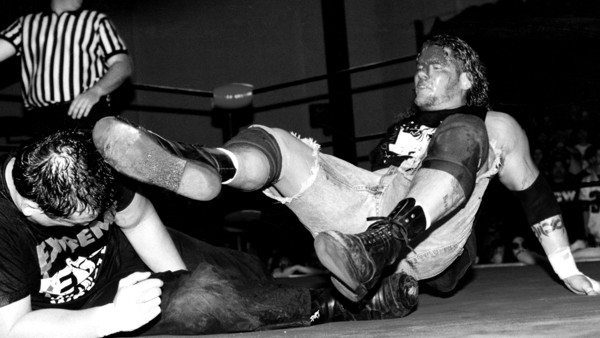
Raven had power over people with his words, to the point where he often didn't need actions. And just because he could work, it didn't mean that he had to in order to get over.
In ECW, his 'Nest' comprised of a rotating gang of goons to do his bidding in his unending battle with Tommy Dreamer. Stevie Richards was the goon that brought him into the company in the first place, before eventually getting a goon himself in the form of The Blue Meanie. Cactus Jack turned his back on the hardcore fanbase and felt love in the embrace of Raven's evil-doers. During a feud with The Sandman, the character took control of the cane-swinger's wife and young son. When Beulah eventually left his side for Dreamer in the story, (in obvious and cynical need of the ego boost) he replaced her with the of-her-time Kimona Wanalaya, before replacing her with hitherto unknown female talent Chastity ahead of his 1997 departure.
Because the departure eventually came. Raven was money, and Eric Bischoff had lots of that to spend.
CONT'D...

After two years of creative and relative commercial acclaim, WCW came calling for Levy and the Raven character. In that time, Raven achieved two long runs with the company's Heavyweight Championship, two stints with the Tag Team Championships, and - most notable of all - never lost to Tommy Dreamer until his very last night.
This was the f*cking really good f*cking sh*t, regardless of how marginalised or reduced ECW's output often was. His WCW offer proved as much, not least when he debuted with virtually the exact same gimmick and a 'Flock' of new followers sat ringside on Nitro.
The Atlanta outfit always had a different philosophical approach to Vince McMahon when it came to using characters that weren't created in-house, but they were certainly guilty of their own tinkering eventually. A year or so of Raven's abuse of power being a little more on the nose than the ECW iteration resulted in the Flock disbanding and the character disappearing for several months. When he returned, the company took a creative gamble that didn't pay off.
Presenting him as a spoilt rich upper class kid with a very white suburban family looking to get him help from inside their palatial mansion, "Scotty" spoke of avoiding treatment, not going into institutions and other cod-mental health bullsh*t as presented through the prism of grim wealth. There was a lot to not like about it, but not in the good way.
Within months of the vignettes airing, Eric Bischoff held a backstage meeting offering releases to anybody that wanted them. Reasoning that his carefully constructed persona was still just about in one piece, Scott Levy bet on himself and took the deal.
CONT'D...

Leaving Turner money on the table in 1999 came with a no-compete clause that parked any WWE aspirations for a year, resulting in Raven briefly returning to ECW to steal a living as the unlikely babyface partner of both Tommy Dreamer and The Sandman. The company was already a door mat for him before he wiped the last remaining WCW sh*t off his shoes, but they needed a star and he needed a spot.
This is the strange thing about Vince McMahon's aforementioned incredulity. Raven's impending arrival was a bit of a worst kept secret at the time, but McMahon was obviously so insulated in his money-sh*tting bubble that he had no idea.
Everybody else thinking the former manager/announcer could add value didn't matter if the boss disagreed, and he seemed to from the off. Teaming with Tazz to extract a few more ECW chants reduced his character to something Scott Levy had never had to tackle in the gimmick before - obvious mediocrity. He had no nest, nor flock, nor motivation to inflict violence beyond this horribly tacked-on relationship with the Human Suplex Machine. But Raven had always been about control, and Levy himself fairly quickly found a way to try and assert some over his career.
CONT'D...

Moving sideways from an ECW-adjacent team to an ECW-adjacent division, Raven used the skills he'd acquired to become something of a Hardcore Wrestling Ace. Though the title still had 24/7 rules akin to the R-Truth running joke that carries the label today, the matches were transformed under Raven's rule. Quality, worthy contests seasoned 2001 shows that were running short on flavour for the first time in three years.
He made the Royal Rumble 2001's early third a hoot, he was a crucial component in a WrestleMania triple threat being such a hit, and he conspired with Rhyno to turn a low-ranked title fight on a B-show and turn it into one of the best matches of the year.
Many that have worked with Levy have spoken of his intelligence, and it didn't end between the ropes. He switched his denim shorts and black shirt to white on top and leather below. This was more than just an away kit - it was a signpost as big and bold as the one he'd hit his opponents with that this version of Raven was an unexpected stamp of quality assurance. Like so much we all once loved, the wretched Invasion swallowed that up, spitting out the former ECW Champion as one of Steve Austin's Alliance losers. The leader had become the goon, and he'd struggle to break out of that pattern for the remainder of his run.
CONT'D...

His last ditch effort to stay over underscored how and why his run hadn't materialised in the way so many thought it would.
Pivoting to commentary after spending more of 2002 a*sing around in the soon-to-be-defunct Hardcore division, he took up permanent residence on Sunday Night Heat, again amassing a cult around his act. Only this time, it was the audience hanging on his every word. Attempting to work his own "Seven Deadly Sins" angle generated some low level buzz for those who saw it, but a final appearance on Monday Night Raw in early-2003 was most shocking for the sight of him working with short hair, black tights and boots for his loss to Jeff Hardy.
Much like with Vince McMahon years earlier, the actions of Raven had mostly been off the radar. Within weeks, he'd negotiated his own release, with his exit being as enigmatic as his arrival.
Days after leaving, he featured on a TNA weekly pay-per-view, becoming one of the few wrestlers to ever create an illusion of competition between the brands.
Precedent suggests McMahon probably had no idea about that either, but at least nobody could wonder out loud who the f*ck fired Johnny Polo. Levy left with his integrity, and a character beloved enough to buy him another decade and a half in the gimmick WWE never saw more than a few months of.