One MIND-BLOWING Secret From EVERY WWE WrestleMania
The secret stories behind the biggest wrestling show ever.
The biggest show of the year, WWE WrestleMania, is so synonymous with the pro wrestling big-time - the formal idea of “making it” - that WWE will reportedly make lower offers to prized free agents by using it as an incentive to join the promotion over AEW.
The show is indeed so fabled and massive that what used to be a humiliating defeat is reframed now. In the old world, Joe Hendry losing in three minutes to Randy Orton following a slapstick comedy spot would have scanned as a mean-spirited burial to the cynical audience. Now, the pull of WrestleMania is so profound - and the core WWE audience is so completely different - that Hendry was considered a star in waiting. WWE wants you to believe that WrestleMania is the single-most important and life-affirming pro wrestling experience imaginable. For a company often accused of blinkered, revisionist history, this is very much true. Mostly.
The first draft of WrestleMania is rarely what you see on the actual grandest stage. Over the years, Vince McMahon had far grander plans that never came to pass. McMahon wanted certain outrageous dream matches that he could not negotiate in time. Certain WrestleMania cards, as you’ll discover, might even be considered very weak consolation efforts.
WrestleMania is now under the direction of Triple H of course, and he put forward a show - 39 - that you could argue is the very best in WWE history, provided you analyse it in tandem with the closing scenes of WrestleMania 40. But here’s the thing: the guy who was actually meant to succeed Vince had one phenomenal idea of his own, too…
41. WrestleMania 1 | A Carny’s Claim

The most reductive synopsis of WrestleMania 1 is that Vince McMahon brought in a bunch of celebrities to steer attention towards Hulk Hogan, who was such a bonafide megastar that he himself became a celebrity. And thus, the boom.
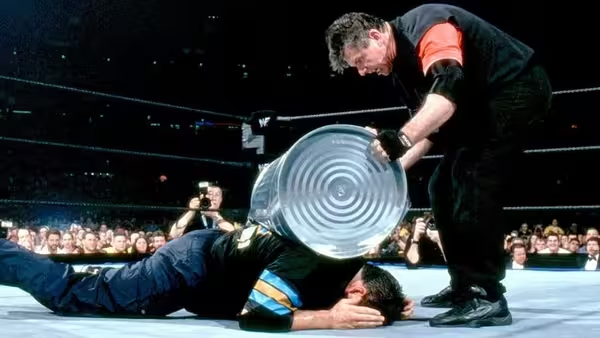
In a fantastic black comedy spectacle at WrestleMania 19, Vince and Hogan fought over this idea. Who, ultimately, was responsible for the success of WrestleMania - and by extension, WWE itself?
WWE should have booked a Triple Threat match, because Mr. T was pivotal in elevating the WWF in the public consciousness. (Cyndi Lauper’s contribution cannot ever be overstated, either.)
At its peak, ‘The A-Team’, in which Mr. T starred, was regularly watched by a quarter of the entire U.S. television audience. In the olden days of monoculture, Mr. T was a supergiant. WrestleMania 1 was ultimately a huge success, but trended towards disaster before an eleventh hour publicity drive. The show really did hang in the balance; without Mr. T, the modern history of pro wrestling looks unrecognisable.
While he was a far bigger star than time remembers, Sgt. Slaughter was no Mr. T - and yet, the former WWE Champion and alleged valor thief reckons that he nearly replaced him at the inaugural WrestleMania. Slaughter made this claim when touring with Inside The Ropes in 2024. This was shot down by Dave Meltzer, who pointed out that Slaughter was working for the American Wrestling Association at the time.
You’ve gotta love the old wrestler’s brain. They’re all different strains of Hulk Hogan in the end.
40. WrestleMania 2 | Mr. T Was In Fact The Fool
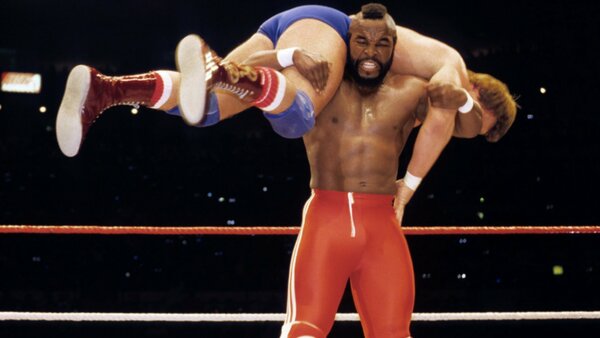
Again: Mr. T was a pop culture phenomenon. As much the architect of WWE’s success as anybody else, T was a perfect fit for the promotion in the 1980s.
Known for his “I pity the fool” catchphrase, he was visually striking, as toyetic as any box office action hero of the day - but despite a not unimpressive background, his hyper-masculine image was not entirely on the level. He served in the army and worked as a bouncer, and was brought to the attention of Rocky III screenwriter Sly Stallone for his bloody and emphatic victories in two tough-man contests that aired on NBC. Mr. T however would have been exposed in top-level boxing, but the American public weren’t to know that: T’s ability to mythologise himself, in tandem with his outrageous charisma, positioned him as one of the better workers of an era built on superficial toughness.
The WWF hired legendary heavyweight Joe Frazier to legitimately train Mr. T ahead of his worked boxing match against ‘Rowdy’ Roddy Piper at WrestleMania 2. Frazier was wholly unimpressed, because Mr. T refused to spar. According to the November 21, 2011 Wrestling Observer Newsletter, T confided to people within the WWF that he feared for his public image. Mr. T needed to be known as one of the hardest guys on the planet - a myth that would have been shattered, were he to get knocked out by somebody who actually knew what they were doing.
Frazier was annoyed, but he wasn’t stupid: he still accompanied T to the Nassau Coliseum main event to secure his payday. The attraction was a shambles, an interminably long mess, and a gassed Mr. T was the culprit.
39. WrestleMania 3 | Historians Have Actually Worked Out The REAL Attendance

78,000, or 93,000? What was the WrestleMania 3 attendance, actually?
Even though this should be an objective fact, the answer varies. If you love WWE, you’ll happily go along with the 93,000 number. You want your favourite thing to be as big as possible. If you once loved WWE, but your wrestling fandom veered in another direction after some instance of bad booking or other, you probably like the idea that they lied to you all along. It vindicates your cynicism.
It isn’t an objective fact, though, because WWE isn’t in the business of telling the whole truth. Embellishing the attendance of live events is a known company quirk that Vince McMahon has actually told shareholders about. This is itself a hint, isn’t it? It’s a bit convenient that WWE would have broken the pro wrestling attendance record, no?
Dave Meltzer believes so. He was the man to dispute the 93,000 number, arriving at 78,000 after promoter Zane Bresloff himself - backed up by the turnstile count - told Dave that the WWF faked it because they simply wanted to claim that they had outdraw the Pope.
Interestingly, journalist David Bixenspan - who doesn’t appear to be a big fan of WWE, so has no reason to lie - conducted his own investigation of sorts. The WWF, never known for its truthfulness in this regard, could barely keep its story straight, insisting that 88,000 people were set to attend in a press release issued days before the show. That is still more than 78,000, and as Bixenspan points out, is consistent with the venue set-up for football games.
Working on the hunch that 78,000 felt too low a number - the beautiful vista of the Silverdome really does seem endless - Bix probed further. He eventually determined, using research materials uncovered by wrestling historian Cory Gibson in the Amusement Business trade journal, that stadium director Mike Abington revealed the number. Abington disclosed that 88,100 tickets were sold to the public. A further 5,000 people worked in the building that night between concessions staff, WWF personnel, and the like. Interestingly, this has been double-sourced.
Upon being interviewed by Keith Elliot Greenberg for his WrestleMania 3 book, Basil DeVito - the WWF marketing guy responsible for the 93,000 number in the first place - conceded that the number did in fact incorporate those working in the building. 93,000? 78,000?
It really does seem like 88,000 is the actual number at long last.
38. WrestleMania 4 | The Revenge Plot Begins…

WrestleMania 3 was significant no matter how many people were in the building. The WWF had established Hulk Hogan as a living superhero capable of pulling off impossible feats, and made wrestling feel massive. The second Hogan Vs. Andre the Giant match, the first primetime network TV main event in 33 years, was another smash. Vince McMahon’s WWF was the hottest promotion in the history of the U.S. to that point. So why was WrestleMania 4 a relative commercial failure?
The tournament concept is not a huge draw for the U.S. public - King Of The Ring was abandoned by WWE for years for a reason, Survivor Series 1998 was a slight let-down, Vengeance 2001 was a disaster - but there’s more to it than that.
Survivor Series was launched in 1987 purely to thwart Jim Crockett Promotions’ Starrcade. Using the success of WrestleMania 3 as leverage, Vince told PPV providers that they could not air WrestleMania 4 if they failed to pull Starrcade. Only five pay-per-view companies opted to air Starrcade. On March 27, 1988, seeking retribution, Jim Crockett, Jr. and Ted Turner counter-programmed WrestleMania 4 with Clash of the Champions: a free major card that aired live on TBS. The classic 45 minute draw between Ric Flair and Sting headlined the show without commercial interruption. In a major over-performance measured against regular station viewership, the first Clash drew a 5.8 TV rating. The main event peaked at a TBS record 7.8.
Despite a huge spike in the availability of pay-per-view - 6.5 million people had the ability to order in March ‘87, where 10 million people did so in ‘88 - WrestleMania 4 didn’t perform that much better (if at all) than 3.
Vince could look past certain things if it was best for business, but Sting kicked his ass in 1988 and 1997 alike, called the WWF morally reprehensible for years after the Attitude Era, and later signed when Vince had run out of stars and leverage.
Is that why WrestleMania 31 was such a hatchet job?
37. WrestleMania 5 | The Greatest Wrestling Story Of All-Time Almost Didn’t Happen

Since this is a long-form article covering 42 years of WrestleMania, and not 42 years of Starrcade, you can infer that the first Clash of the Champions was an aberration. The WWF rebounded from the short-lived disappointment that was WrestleMania 4 to set a PPV record in 1989 that would stand until 1998. All it took was the greatest story Vince McMahon ever told. He almost never wrote it.
According to the May 30, 2011 edition of the Wrestling Observer Newsletter (a typically outstanding obituary covering the life and career of ‘Macho Man’ Randy Savage), Dave Meltzer revealed that Ted DiBiase was in fact originally slated to win the WWF title in 1988. Vince only resorted to the greatest back-up plan ever devised when - and this is incredible to read in 2026, given their respective legacies - the Honky Tonk Man refused to do a job for Savage. This isn’t as inexplicable as its modern equivalent - Dominik Mysterio refusing to lose to CM Punk, perhaps - because the Honky Tonk Man was a real attraction. Still, Randy Savage was the bigger star - as he’d soon prove.
Savage was meant to win the Intercontinental title and wrestle DiBiase on the summer house show loop. Hogan was scheduled to dethrone DiBiase at WrestleMania 5. Plans indeed changed, and the Mega Powers storyline was initiated at ‘Mania 4. While the storyline was brilliant, and the payoff a commercial smash, Savage actually bettered Hogan’s box office throughout the summer on a year-on-year basis. The WWF didn’t need to tell it.
In an additional trivia note, Demolition was not the only blatant Crockett Promotions ripoff; the ‘Mega Powers’ name was clearly indebted to the Superpowers tandem of Dusty Rhodes and Nikita Koloff.
36. WrestleMania 6 | The Main Event Almost Didn’t Happen

When WWE released the Self-Destruction of the Ultimate Warrior DVD in 2005, it was something of a self-own. Yes, Warrior was notorious for his recklessness, lack of passion, and generally entitled and abrasive attitude - but the idea of making a documentary out of all that nine years after his last appearance was clearly agenda-driven. The DVD didn’t go down well; Warrior was always far more over than the character assassination wanted you to believe. Turns out WWE weren’t wrong, they were just an asshole.
The Warrior was never happy in the WWF even before he sensed that he wasn’t on Hulk Hogan’s level and payscale, leading to the infamous SummerSlam 1991 dispute. In Warrior’s defence, even though he didn’t do much in the ring, he had to do it a lot. The late ‘80s ‘Killer Kalendar’ spared no man’s sanity. Warrior, who was often too…alert to sleep, was a frazzled, exhausted mess all of the time. He was really close with Owen Hart, of all people, and when Owen quit after WrestleMania 5, feeling that he was being treated like a joke, the Warrior wanted to join him in Japan. If that actually happened, there would have been no WrestleMania 6 main event. No Ultimate Challenge. No Hulk Hogan selling the loss like God had decided to punish him.
Owen was a notorious ribber. Some of his jokes were very mean-spirited. He must have really liked Warrior, because he didn’t encourage him to go there and fail spectacularly. And Warrior would have failed in Japan: they would have laughed at him.
Owen gently told Warrior that Japan isn’t for everyone - which, translated, means “You’re lucky enough that they take you seriously here”.
35. WrestleMania 7 | A Crazy Match Was ACTUALLY Discussed

This might not necessarily be a secret concerning WrestleMania 7 - but it’s mind-blowing all the same.
Hulk Hogan was a notorious fantasist. He made stuff up constantly. He was such a renowned liar that it’s impossible to believe anything reported about him. He cried wizzolf for so long that, when you read about the time he actually accepted Randy Savage’s challenge to be a man and fight, your inclination is to not believe it. This, after all, was a time-travelling baseball pro with a real super-power: the ability to smell dying children.
As such, you’d think that a mooted Hulk Hogan Vs. Mike Tyson pay-per-view match was another hysterical Hogan invention, followed closely by “I actually gave him that lisp when we sparred in the ‘80s - he never recovered from the swelling on his tongue”.
According to the February 11, 2002 Observer in its ‘12 Years Ago This Week’ section, Vince McMahon and Don King actually held talks in an attempt to negotiate a Hogan Vs. Tyson PPV match. While Meltzer wrote that the discussions “never got very far”, it’s still crazy to imagine.
Looking at the timeline, this could not have been the plan for WrestleMania 6; the ‘Ultimate Challenge’ was issued on February 3. It’s possible that Vince may have had SummerSlam 1990 in mind - the report never specified when the match would happen - but it was only ever going to be one of the two. What on earth would it have looked like?
Equally compelling and rubbish, you’d imagine, but it’s more fascinating to picture the discussions surrounding the finish - Vince telling Hulk that the celebrity needs to go over, and Hogan sagely nodding, glad that they’re on the same page.
34. WrestleMania 8 | A Rumoured Special Guest Referee

In 1985, the WWF was a riot of a fad that many celebrities enjoyed, if only for the schlock of it all. Some of them obviously enjoyed being paid to be a part of it.
By 1992, the WWF was a very different place. The increasingly unpopular brand was becoming toxic; by February, the St. Louis police department had raided the locker room on suspicion of illegal drug possession. WrestleMania 8 was a virtual celeb-free affair, outside of Reba McEntire singing the Star-Spangled Banner, and it’s little wonder. It was hardly a great public relations opportunity, was it?
This almost wasn’t the case. Vince wanted more celebrity involvement originally.
In the February 24, 1992 Observer, Dave Meltzer reported that sources at Top Rank boxing, operated by Bob Arum, claimed that boxing legend George Foreman had received an offer to be the special guest referee for the main event. Arum was apparently happy for Foreman to get the payday, but Foreman wasn’t interested. He was in the midst of a late-career renaissance. That, or he was worried Hulk Hogan was going to batter him for stealing his endorsement deal two years before it was struck.
Discussions then turned to Lou Ferrigno, star of the Incredible Hulk, which was probably more realistic. Ferrigno was on the downswing - his TV movies weren’t drawing - but there was an obvious narrative “in”.
Sid spent much of the WrestleMania 8 build accusing President Jack Tunney of corrupt, “bogus” acts. Installing a guy also sort of named ‘Hulk’ as ref might have further incensed Sid. The television would have been gold. Obviously, that never ended up happening, either.
33. WrestleMania 9 | Bret Hart Was At It MUCH Earlier Than You’d Think

Bret Hart is one of the funniest guys to ever be involved in wrestling, even if you can never be entirely sure how much he means to be. You could talk to the man on the subject of anything at all, and he’d still find a way to change the subject to Goldberg.
The fateful thrust kick is something that Bret brings up an awful lot, but he has other favourite topics. He likes to tell you that Triple H was an idealess bore, a “four out of ten” wrestler. Bret has made a hobby of finding different synonyms and phrasing with which to call Eric Bischoff stupid. Bret also likes to downplay the in-ring skills possessed by Ric Flair. Did you know that every match Flair had followed the same pattern? And that Flair never really “got” the art of wrestling, because all he did was spam chops that actually hurt?
People put this down to bitterness, which seems cruel. What happened to Bret Hart was awful. Humiliated by the company he broke his body for and mismanaged by the company he was pressured into joining, Hart’s career ended prematurely, and he was plagued by serious health issues when he was trying to rebuild his personal life.
Also: Bret’s gleeful shooting is not an embittered reaction to his experience in the wrestling business. He is a hater for the love of the game.
Case in point: at the pre-WrestleMania 9 press conference, Bret opined that Flair was overrated as a worker. Bear in mind this was years before the shoot interview was invented as a medium. This was years before wrestling itself became self-referential as a medium. Also, there was no company-wide campaign to smear Flair like there later was against Hulk Hogan and Randy Savage: Flair left on amicable terms having done a stellar, selfless job.
Hart did it just to do it. In 1993!
32. WrestleMania 10 | Randy Savage Was PISSED

WrestleMania 10 can’t be considered a classic, or up there with the best WrestleMania shows of all-time, because it was only a two-match show. Now, those two matches were as good as it gets.
Bret Hart Vs. Owen was perfect. There is no other word. It was two incredible fusions at the same time: a display of soapy WWF storytelling and scintillating in-ring action, with the action itself a fusion of pristine technical wrestling and, when Owen started acting like a brat, a pissy fight. Razor Ramon Vs. Shawn Michaels, meanwhile, was the most spectacular and futuristic match in the history of U.S. wrestling to that point. The Bret Vs. Yokozuna main event was an inferior sequel to the prior year’s title match. Randy Savage Vs. Crush was fun and unusual for the time. But really, WrestleMania 10 needed a far stronger undercard attraction to be remembered as one of the very best. The card almost had something in that vein to make it more exciting.
An unusual-for-the-time 10-man tag team match was set to take place. The WWF excelled at this sort of thing - memories of the traditional Survivor Series matches remain very fond - and the one fall to a finish rules would have added a further sense of briskness and chaos. The heel team of IRS, the Headshrinkers, Rick Martel and Jeff Jarrett were going to take on the 123 Kid, the Smoking Gunns, Tatanka, and Sparky Plugg. While this wasn’t likely to be as crazed as a 2000s Dragon Gate six-man, and was an excuse to hand some midcard dudes a payday, it could well have ruled, if Sean Waltman was going to bump, sell his ass off, and play Ricky Morton.
It was cut for time. Shawn and Razor went over theirs, they allegedly knew about it and didn’t care, and Randy Savage purportedly handed out a scary verbal assault to Shawn in the aftermath. Doing a “Taking food off my table” promo, and it actually making sense?
That’s why Savage was a genius.