If WWE Were Being Honest About ALL IN
Chicago Fire

Vince McMahon was probably asleep.
Well, he probably wasn't snoozing - the man abhors sneezing, let alone giving his body up to occasional bouts of tiredness - but he was dozing on the job when he allowed Cody Rhodes to walk away from his organisation loaded with long-dormant creativity and bigger dreams that ones gathering star-dust on B-show storage crates, so it wouldn't be completely out of the realms of possibility that he was having a power nap whilst ALL IN announced itself as WWE's first noisy neighbour in nearly a decade.
McMahon has neither the time nor inclination to worry about other businesses as he flits between an Alpha Entertainment XFL wet dream and a beta entertainment WWE dry spell. But his son-in-law and heir to the throne will have certainly kept one eye on events from inside the Sears Centre.
Triple H's important reinvention as the future's gatekeeper was a crucial turning point in the early 2010s, but he spent his own wrestling career trampling on his peers just to remain relevant. ALL IN (and particularly t's intrepid leader Cody) worked not just promote tomorrow's talent today but also shine the brightest ever light on the men and women of independent wrestling - the scene Hunter cribbed liberally from when he bathed Full Sail University in yellow.
So no, The Chairman probably won't have given a single sh*t, but has a game-changing night changed things for 'The Game'?
CONT'D...
Analysing the near-future of WWE as an economic machine rather than a creative one is the only way to assess if actions outside it's near-impenetrable bubble even have an impact.
TNA's limp attempt at a revived 'Monday Night Wars' in 2010 was as dated as the product they delivered. Night One on January 4th was a headf*ck of comebacks, surprises and swerve turns, but performed admirably against old guard WWE bringing back Bret Hart back in front of a live audience for the first time in 13 years. It was an embarrassing slaughter from that point onwards though, with Raw rarely needing to excel in order to crush Impact on a weekly basis until they tottled back to their old Thursday slot in May. It tried - but failed - to retrieve the relatively stable number of viewers they'd garnered unchallenged for years.
It failed for a multitude of reasons, but a key error TNA made was in assuming the wrestling audience still wanted much of what they'd lost when WCW went out of business in 2001. There was a mournful emotion around the Atlanta outfit's demise, but even some of its most ardent supporters were quietly relieved to not have to donate their Mondays to the chronically awful Nitro.
The January 4th 2010 edition of Impact was in actuality the closest the industry came to an ECW reunion show for World Championship Wrestling. It was not the first strike back at an empire, or an attempt to stake a new claim in professional wrestling's future. On that very same night though, one man across the Pacific Ocean eating his own humbling loss was unaware of his own major role in transforming perceptions about the very artform itself.
CONT'D...

Seven years after Kazuchika Okada's opening match loss at 2010's Wrestle Kingdom IV, he was in the main event at the Tokyo Dome supershow against Kenny Omega.
Their IWGP Heavyweight Title clash was a flag-planting moment for wrestling outside of WWE. A year prior, Shinsuke Nakamura and AJ Styles had earned unexpected plaudits across the pond for their own effort, but it was widely speculated that both were about to sign on with Vince McMahon immediately afterwards. WWE was - in spite of a product long-homogonised in line with the advent of the WWE Networks and television rights fees replacing pay-per-view revenues - still the place to become known as a wrestling megastar and the 'dream' destination of many.
Okada's victory over Kenny Omega was a line in the sand, though. WWE had taken advantage of habitual viewers' loyalty (and always will, to an extent), but the dynamic Wrestle Kingdom 11 topliner demanded attention and further emotional and financial investment. Something was happening, and whilst The Young Bucks were ringside for their Bullet Club leader that night, it was a relatively recent WWE evacuee that would be the vital component in their plan to "Change The World".
CONT'D...

Cody Rhodes surprised many with how well he adapted to the independent scene, making a splash before he'd even dropped a cheap pop bionic elbow.
His tweet noting a list of goals he had as an emancipated sports entertainer was a shrewd attempt to curry favour with fans he knew weren't anticipating his arrival. Cody was one of countless underutilised WWE performers, but that alone wasn't going to guarantee him the loyalty of an audience pre-disposed to genuine cases of those fighting the man or raging against the machine. Rhodes had made good money from said man and machine and was born into the business as it was.
This day one acknowledgement was the first of hundreds of smart steps that paved the way to ALL IN. His appreciation for the scene was reflected by quantity and quality - he wasn't just working odd great matches, but many excellent ones. He was experiencing a rebirth, collecting the affection of brand new fans and weathered cynics in equal measure. Joining Bullet Club - a faction synonymous with both those key demographics - was the next crucial turning point.
CONT'D...

Cody's storyline infestation of Kenny Omega's Bullet Club stood side-by-side with worked shoot weekly regular YouTube show Being The Elite. Initially just an enjoyable guide to the lives of travelling salesmen Omega and The Young Bucks, 'BTE' evolved into a mix of that spliced with the wider kayfabe antics of the Club. It continued to expand to the extent that an appearance on the show bought performers pedigree amongst loyal money-spending supporters.
The particular audience Being The Elite attracted was crucially important to the foundation and success of ALL IN. The Young Bucks, in particular, were shameless capitalists when it came to selling merchandise through the channel, but positioned themselves as hustlers and chancers instead of company men. They reframed the entire narrative as being something charming rather than cheap, and the perception of their brand grew in stature as a result.
With each babystep the crew made into the modern mainstream so too did a whispered theory that they could scare WWE from the outside rather than attempting to remodel it from within. Enough stars had failed at that anyway, and even in-house NXT projects were being hung out to dry by the main roster. ALL IN was a thing waiting to happen long before it was actually A Thing, but Vince McMahon and WWE never once set out to genuinely counter the movement.
CONT'D...
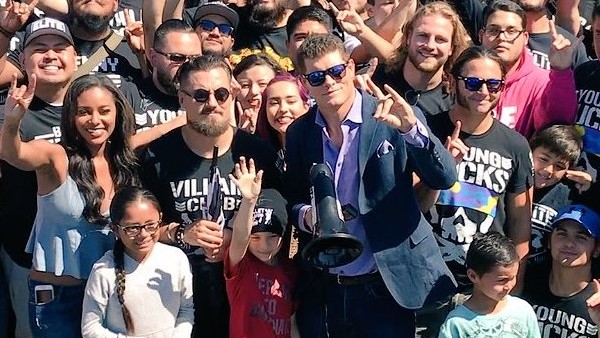
John Cena and Roman Reigns t-shirts continued to sell at arenas, but the days of seeing folk in their favourite wrestling shirts had died out before WCW event did. In contrast, Bullet Club shirts went on sale at zeitgeist high street vendor Hot Topic, with some fans admitting to having never even engaged in NJPW - the original home of the stable - before buying in. When a movement's on the rise, it matters little to those at the front why exactly people are signing on beyond knowing that they are.
And anyway, the obvious narrative was the best one to set. Cody Rhodes never needed to use a branded megaphone to shout that wrestling fans had grown tired of WWE - he let the fans say that themselves en route to a Monday Night Raw 'invasion' or local show featuring one of the Being The Elite cast members. BTE becoming a storyline vehicle was actively beneficial to Ring Of Honor and New Japan Pro Wrestling. Both have been largely successful thus far in expanding their operations, and in 2018 alone NJPW and ROH's biggest ever US shows have been headlined by clashes established in the Bullet Club/Elite universe.
The match quality being high was a bonus, but an important one. Understanding something WWE have forgotten since the demise of the Attitude Era, Cody and The Bucks had to continue paying off before they could sell out.
CONT'D...

During a podcast chat with Cody and The Young Bucks, Chris Jericho spoke of a conversation he'd had with Vince McMahon about ALL IN's potential success. McMahon's only notable quotable was apparently that they were barmy for booking a show at a traditionally dead time of year. Flogging every ticket in the Sears Centre wasn't the first or last tradition they'd defy, but was a sign the fanbase they'd established were willing to take a gamble on their gamble.
The Being The Elite crew have played percentages throughout. They have assessed this entire project from a business perspective and dressed it up as a creative endeavour. WWE immunised itself from actual head-to-head competition through a wise Disneyfication during a down period for the industry, so Cody & Co instead assessed supply and demand. Rhodes himself often noted in rallying cries that wrestling was for everybody - including themselves - not that they were taking a run at Vince McMahon's vision of it.
That many of their fans held that disdain was irrelevant to the bigger picture, but incredibly useful in the short-term. Not a single match was announced before every ticket was sold. This was not the old way of doing things with top draws, nor the new method of super-serving to the point of bloat. In a world divided and a 'Universe' disinterested, this was - finally - wrestling's third way.
CONT'D...

Investment is everything in pro wrestling. WWE hasn't inspired creative investment beyond short bursts that amount to titillation, but they've secured $120 a year from two million Network subscribers and an unimaginable loot from panicked television stations trying to save their own industry from collapsing off a cliff edge.
The growth of Bullet Club, the subsequent sustained success of Being The Elite and the creative and commercial success that was ALL IN benefited from entirely different investments. Cash injections from smaller audiences that wanted to pay more, until they became bigger audiences that still wanted to shell out. Emotional investment assured, financial investment earned, ALL IN had 'only' to deliver a wrestling show worthy of the faith. That it did so (with associated wrap-around events cultivated by podcast impresario Conrad Thompson) gave an increasing section of the fanbase a thirst for more.
If WWE were being honest about ALL IN, they'd reduce its grandiose presence as a jumped-up house show, whilst reminding the wider populous that they'd just ran shows in China. But of course they did - the brands are in different worlds and act as such. If WWE were being really honest though, they'd perhaps express concern about where it all goes next. They can afford fans to invest in other shows as well, but not - as the case seemed to be with the Chicago show's success - abandon the Sports Entertainment ship completely.