7 Reasons WWE's Cruiserweight Division Is Failing
Give the people a reason to care and they will.

It's undeniable. The cruiserweight division has been a flop since it was resurrected with so much promise last year.
Given the wealth of talent involved and exposure stars like T.J. Perkins, Rich Swann, Cedric Alexander and Noam Dar enjoy on a weekly basis, it's quite amazing how WWE have concocted a product that is a completely and utterly lacking in excitement for the matches and stories unfolding each and every Monday and Tuesday night.
Factor in a series of other booking missteps and promotional misfires and you have the recipe for an underwhelming product that is less revolutionary and more mediocre.
7. Lack Of Characters

Often forgotten in the rush to judge a wrestler based on his abilities between the ropes or a match on its flow and high spots is the importance of characters to the sports-entertainment industry. After all, "Stone Cold" Steve Austin did not get over with millions of fans every Monday night because he was a superb worker.
He got over because he had a character the audience could relate to and a story they could invest in emotionally. They had love for him, something they do not for the cruiserweights.
Rich Swann and Cedric Alexander are popular indie stars who have found success on WWE TV but neither is where they should be because WWE Creative has failed them miserably in terms of crafting characters to go along with their undeniable skill set.
The lack of character definition and complete absence of compelling stories has left the cruiserweight division to become a glorified piss break for fans rather than can't-miss entertainment.
6. No Defining Match
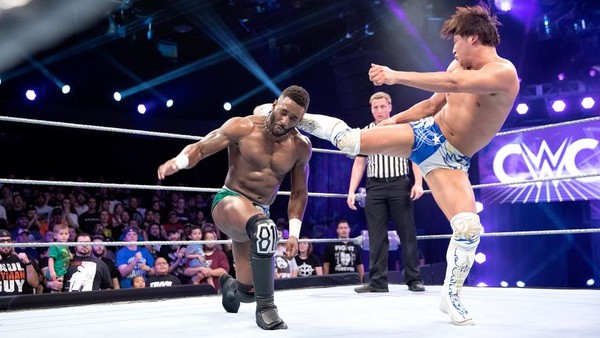
When WCW implemented the cruiserweight division back in 1996, the likes of Rey Mysterio and Dean Malenko instantly captured the attention of fans with a series of outstanding matches that made it known to management and the audience alike that they were to be taken seriously.
Outside of a Cedric Alexander vs. Kota Ibushi match from last summer's Cruiserweight Classic, which was seen only by those fans with WWE Network and those who bothered to tune in, the cruiserweight division has lacked that one defining match that forces fans to sit up and take notice.
At best, the current division has been responsible for a handful of really good matches. The problem with that? They come on a show that has lots of really good matches, featuring stars fans actually care about.
No one bats an eye at Neville and Rich Swann having a strong pay-per-view match because Roman Reigns and Kevin Owens just blew them out of the water moments earlier. A psychologically sound battle between Brian Kendrick and T.J. Perkins is meaningless because Charlotte and Sasha Banks are destined to eclipse it with an equally sound match later on the card.
Until the cruiserweights step up and deliver a match that forces audiences to recognize their contributions and how important they can be to the product, they will continue to be disregarded, the strong or even superb work elsewhere whetting the audience's appetite for great wrestling.
5. Its Treatment As A Sideshow

The purple ropes.
The different ring apron.
The lighting.
The announce team switch.
All of these things come together to slap the audience in the face and announce to the world that, yes, the cruiserweights are in fact a sideshow.
At this point, Neville and company are no different than the women were during the 2000s or the minis were during the 1980s. They are but a break in the normal action, something different for fans to "ooooo" and "ahhh" over while waiting for Roman Reigns or Seth Rollins to hit the ring in the next segment.
Rather than seamlessly inserting the division onto Raw, master visionary Vince McMahon had to go over-the-top to show the world that his cruiserweights were different. While it may have been well-intentioned, what it did was equate the Superstars in that division to clowns or sword swallowers in the circus. They are the freaks, the smaller competitors who do not work a different style than the main event stars but who are just tiny and bland enough not to deserve recognition as Raw Superstars like Rusev, Big Cass, Braun Strowman or Kevin Owens.
It is a major disadvantage for the competitors to overcome and a stigma that will follow them until they are more effectively integrated on Raw.
4. Lack Of Distinction

What constitutes a cruiserweight in 2017 World Wrestling Entertainment?
What sets them apart from someone like Dean Ambrose, Sami Zayn, AJ Styles or Seth Rollins, all of whom are smaller than the prototypical WWE Superstars and soar the air with grace. They throw caution to the wind and leave fans in awe of their athleticism.
So do Cedric Alexander, Rich Swann, Neville and T.J. Perkins.
Then there are bruisers like Kevin Owens and technicians like Dolph Ziggler. What sets Drew Gulak, Tony Nese and Ariya Daivari apart from them?
Why should fans be any more impressed by Lince Dorado leaping of the top rope when Apollo Crews, a much larger man who looks like he was chiseled out of stone, can do the same thing?
The lack of distinction has hurt the cruiserweight division immensely. The is no definition, nothing that sets them apart from the other Superstars they share the roster with. Until that is repaired, it will be difficult to sell the audience on what should be this new, exciting element of WWE.
3. Fan Apathy

There are many reasons for fans not to care about the cruiserweight product, many of which we have already covered. Yet, it is their apathy for the wrestlers, the matches and the stories that has done more to adversely affect the cruiserweight division than anything.
No matter how strong a match between Drew Gulak and Lince Dorado may be, a complete and utter lack of excitement limits its ability to reach its full potential. Working the match in front of a half-empty arena because fans have decided that beating traffic is more important than showing respect to the workers is another unfair condition the competitors have found themselves forced to work under.
With 205 Live failing to capture the attention of the audience and drive in more eyes to the cruiserweight product, it is fair to say that the audience's unwavering apathy for the division is both a telling sign of the deficiencies within WWE Creative and the unwillingness by audiences to accept a division with the "cruiserweight" label when the action unfolding every week is nowhere near that of the revolutionary work put in by Rey Mysterio, Juventud Guerrera, Dean Malenko, Chris Jericho and Eddie Guerrero during the 1990s.
2. Misuse Of Talent

The misuse of the talent at its disposal is another issue plaguing WWE's attempt at reintroducing the cruiserweight division.
T.J. Perkins is a dynamic, flashy young star so pairing him with a more psychology-based worker like Brian Kendrick, whose work is confined to the ground at this point in his career, was a major misstep that hurt Perkins' ability to be the face of the division.
Tony Nese is a super athlete, a wrestler who looks like a star and whose agility is world class. Portraying him as a glorified jobber, losing on a weekly basis to competitors like The Bollywood Boyz and Mustafa Ali is not, in any way, beneficial or effective use of him.
Then there is Drew Gulak, a wrestler so skilled at what he does that WWE officials wanted him to work in the Performance Center, preparing the next generation of stars. instead of positioning him as the badass technician of the division, he joins Nese a bumbling, stumbling jobber whose biggest win to date is a tainted victory over Cedric Alexander.
Failing to recognize the strengths of the talent and utilize them in a way that best suits them has been highly detrimental to the division and may actually keep it from ever succeeding.
1. Lack Of Familiarity

From the moment 205 Live hit the WWE Network airwaves for the first time, it was apparent that WWE had learned nothing from previous mistakes regarding the cruiserweight division.
Rather than airing video packages in the weeks leading up to the show, utilizing more of the mind-numbing three hours of Raw to hype the cruiserweights up and help them connect with audiences through character profiles, the Superstars were trotted onto the stage and introduced, one-by-one, to the audience.
It was embarrassing to watch T.J. Perkins, Rich Swann, Brian Kendrick and Company step forward and be summarily dismissed by fans. The lack of reaction was telling, a sign of unfamiliarity with the men for whom they were supposed to boo or cheer.
The fans were not to blame, no. The company had done such a poor job of introducing the competitors to audiences in a meaningful way that families who had packed the arena for that night's SmackDown Live taping really had no familiarity with the majority of the competitors.
Thus, they did not care about them. They could not have cared about them any less, actually, and that is a major indictment on WWE Creative and its inability to market and present the Superstars in a way that allowed audiences to know them, understand the characters and want to see them win or lose by the time that first episode of 205 Live arrived.