5 Real Reasons Why CAN'T MISS Wrestling Prospects Bombed
NOTHING could stop these WWE and AEW stars, except for...

Wrestling is way more of collaborative effort than many of its success stories would have us all believe. The business promoted by those that make it to the top as a dog-eat-dog/shark-like/pick your favourite animal analogy is in fact one that requires a numbers advantage just like everything else.
The best wrestler in the world could be hated by a booker. The best booker could have the worst wrestlers. The bookers and wrestlers could have their vision screwed up by a bad agent. Extend the parameters to television and it gets even harder. Every single thing could play out exactly as planned but the commentators could mess up the sell. The cameras could miss the moment. On and on and on it goes to the point where the more you think about it, the more you put just about every good thing you've ever seen on a wrestling show down to luck more than all of those individual's judgment.
The upper echelon of pro wrestling is virtually impenetrable, making it all the more impressive when stars break out, talent break through, and performers genuinely connect. It's why, contrary to increasingly over-simplified conversation in a social media age, there's typically more than one good reason why an act failed too. There are just too many traps one can likely stumble into on the road to the top - it's little wonder so many hot prospects fall in to one...
5. Tyler Bate

Tyler Bate was just 19 years old when, in front of a packed Empress Ballroom in Blackpool, England, World Wrestling Entertainment decided to strap him up as their first WWE UK Champion in January 2017.
That sentence alone feels like something generated by the sort of ineffective AI that appears at the top of the average Google search almost a decade later, but somehow all of it is true. A total prodigy having worked less than three years by the time he was carrying a belt the market leader now pretended to are about, Bate had worked roughly 300 matches between his 2014 in-ring debut and WWE bow. For context, current-era breakout star Je'Von Evans has only just clocked up the same amount despite wrestling twice as long and getting an extended NXT run to tune him up for weekly shifts on Raw and SmackDown.
Bate had miles on the clock, and was constantly gaining value thanks to experience and connections - his on and off-screen relationship with fellow scene standout Pete Dunne and BritWres boom veteran Trent Seven further bolstered the sense that he was an unstoppable force. British Strong Style in name and concept was over. Moustache Mountain for all of its of-the-time meme popularity was over. Peaky Blinders theft, full stop, was over. Then the bell rang, and Bate monstered bigger men with deceptive strength, gifted the crowd sing-songs and let-ups with his wry throwback comedy, and clawed through the ropes for support with all the guile of Ricky Morton at his lowest ebb. He quickly became the performer most associated with the perfect wrestler hypothetical; what can't he do?
The answer, somehow, was occupy wrestling's brightest spotlight despite impressively holding down full-time employment with the market leader ever since.
Why?
The end, as is all-too-often the case, starts at the beginning. Bate really was an ideal inaugural UK Champion, but idealism was rapidly at the core of just about everything to do with that entire project. Observers old enough to have lived through similar versions of the same thing could see what was going on with WWE's sudden interest in a scene that had served itself just fine before the big boys took over. They wanted only the best bits of it for a diluted version that could chew up just enough of the UK market, all while stirring up division between those that (somewhat justifiably) wanted permanent deals with the market leader and those that (even more justifiably) knew that the pots of gold weren't going to be in high supply nor even full of that much gold.
Bate had a belt and a slice of history, but was now front-and-centre of a capitalist culture war that played out precisely as most assumed. Within a year, the belt was only valuable as a prize in actual NXT, the eventually-launched NXT UK was a middle-of-the-road compromise of a promotion that served nobody, and as the first winner, Bate was - in more ways than one - the first loser. He dropped it to Dunne in booking that reflected a fairly rapid rejection of even minor changes he was making to the aesthetics of the first character that got over on the big stage. Youth became young manhood, fans craved Bate making time stand still more than reflecting its cruel movement, and what little prestige remained of WWE UK was transferred to Dunne and new signing WALTER.
Bate, Dunne and select others chugged along until really they were the only ones left from the barren wasteland WWE left behind, but TV reps had the opposite effect to road ones- 5 years after his debut, the 24-year-old already felt out of date. Triple H getting the creative reins initially seemed to be a ray of light for the pair, but perception was too close to reality and the damage was done. New Catch Republic may as well have been subtitled with "that wrestling style you've been bored of for a while", and it spoke volumes when becoming masked goons for El Grande Americano in 2025 was unreservedly a step in the right direction.
Age has been the blessing and curse of Bate's run thus far. He's "done it all", but his birth certificate still places him a decade away from what now classifies as wrestler's prime. There's still time to see the top of the mountain, but has a full adult life in base camp convinced him that the comfortable life is the best one?
4. Emma

Unfortunately, it became much easier to count the reasons Tenille Dashwood failed to hit big in WWE than it did recount what it was specifically that should have made her a massive star to begin with.
A product of the true golden era of NXT before the entire brand pivoted to chasing critical acclaim and/or trying to keep pace with the wider wrestling landscape beyond WWE, Emma was a good wrestler with a great, potentially transcendent connection with the crowd. This was the formula for the black-and-gold brand in 2014, thanks to Triple H being bound by the valuable restrictions of talent and time.
It was catnip for Paul Levesque as he entered the next stage of his global domination plan. Politicking his way into a new role (that he was admittedly lightyears better at than his predecessor), 'The Game' had to at long last do what he was so allergic to when he was a Champion and actually get some other wrestlers over. Alongside an invaluable Dusty Rhodes before his 2015 passing, Levesque set about extracting gold from what remained of some dud FCW developmental years in the (first) John Laurinaitis era.
The strategy had multiple strands; 1) Reconnect a disparate WWE back with its fanbase, or at least wrestling's current take on it. Vince McMahon's 2000s monopoly era stubbornness had pulled the market leader as far away from what so much of the market wanted as it had ever been. Numbers reflected it until Stephanie McMahon spotted the need to move PG in line with a monster Mattel deal and sponsors in general at long last not side-eying Sports Entertainment. The booking wasn't getting any better though, and Mr McMahon-Helmsley was as good a choice as anybody to do it on the smaller scale in NXT. 2) Improve the supply line between developmental and the main roster, expanding beyond the Florida loop that talent had become comfortable with, and providing actual preparation for life on Raw and SmackDown rather than sending ill-prepared talent to the proverbial slaughterhouse. 3) Get Triple H over as the honourable and respected saviour of the company/industry/world should he hypothetically ever be in the position to take it over.
Emma - and the women's division in general - was at the centre of all of it. NXT was attempting to rebuild audience interest in women's wrestling in the shadow of the doomed Divas Division on the main roster, and Emma was an unexpected shining light. WWE had long been the place where "nice" had gone to die, but that's precisely what Emma was, and her character was cast-iron proof that things could be different in WWE. Her lack of coordination was her superpower rather than a minor failing to be mocked, which tacitly said as much about the braintrust behind the show as those in front of the camera.
To smart mark fans absolutely desperate for a show that even slightly appealed to them, Emma was a bonding agent. Rises in wrestling are often less organic than they might appear, but NXT was expert at stage-managing ascents. Her off-kilter music was an ear-worm in keeping with her apparent lack of coordination and her out-of-time hand dance was easy to imitate in the stands, especially when she started using the move to pop bubbles that greeted her entrance. The act clicked massively, and the in-ring work backed it up as more than just an entrance. Never was this more apparent than in her defeat against Paige at NXT Arrival, the WWE Network's first live broadcast and precursor for the TakeOvers to follow. Then justifiably held aloft as the best women's match the company had ever promoted under any banner, it could and should have been her ticket to the top but that had sadly already been stamped out by a main roster debut that force-fed every positive trait the character had to the point of glum disinterest.
Emma was earnestly funny, see, so Vince McMahon paired her with Santino Marella for forced comedy that zeroed in on her dance and just about nothing else. The relationship wasn't built, the respect wasn't earned, the matches barely even happened, and the character died on the vine. She was so well respected in NXT that a salvage job nearly worked when she wore her main roster scars as a heel in 2015, but the pattern repeated when that got over too; Emma and Dana Brooke were excellent midcard heels that were hung out to dry with their 2016 call-ups, but for the Aussie, the worst was somehow yet to come.
The bewildering Emmalina repackaging (weeks and weeks of vignettes to the point where it was more gag than gimmick, to build to a debut in which she immediately binned it and went back to her old persona) should have been a point of no return before her actual one arrived. In a late-2017 rematch of a quality outing the pair had in NXT, she was used to help launch Asuka on the main roster before an untimely and unfair release. As a cruel coda to the story, a 2022 return only lasted around a year and ended in brutal fashion when she was once again cut literally hours after tweeting her excitement over WWE returning to Australia for Elimination Chamber in 2024.
As unceremonious an end as one could realistically have, her post on it appeared to laugh through the obvious disappointment. Once again it was too much to expect WWE to get the joke.
3. Parker Boudreaux

It's perhaps worth starting this entry with a note that we're not necessarily at the end of Parker Boudreaux's story.
The former WWE and AEW wrestler is currently working semi-regularly in Japan, is only in his mid-20s, and might yet turn a corner professionally that results in him hitting hitherto unseen heights in the industry. But all those caveats and qualifiers fly in the face of all the pre-emptive praise and positive reinforcement he was given by some of the sharpest eyes in industry history before he'd even taken a bump on television.
Boudreaux looks a bit like a young Brock Lesnar if you squint a bit, but the comparison ends before the bell rings. Across small handful of matches he had for NXT and AEW he had between 2021 and 2023 (19 in total), very few instincts revealed themselves that would lead any rational viewer to consider him a next big thing, let alone anything close to the skill Lesnar had when he was given the nickname by WWE's marketing machine.
Paul Heyman vehemently disagreed. Back in 2021 and before he'd appeared in any capacity for either of the North American majors, Boudreaux posted on Twitter about his aspirations to make it to the top of the industry, and the man behind 'The Beast' jumped in to back it up. Using one of his famous on-screen catchphrases, Heyman said "His tweet is not a prediction. It’s a spoiler", and even dared users to save the tweet. Jim Ross agreed, attempting to tease him towards the other side of the divide, noting "Big money is earned, not awarded. Parker Boudreaux is great and has been in my radar for 2-3 years. You do know that there’s “big money” in AEW too."
Boudreaux wasn't shy in acknowledging it either, noting how integral Heyman was to him even entering the industry. As he put it in an interview with Sportskeeda WrestleBinge around the same time, "Paul Heyman was recruiting me at a young age – that to me was always such a huge blessing because not many people get the rub from Paul Heyman, especially at a young age like I did. For him to be not only a mentor, somebody that brought me into the business, showed me how to really work and to become one of those elite Paul Heyman guys, it’s an honor and it’s a privilege to be having a great relationship to this day with him."
All the right words from all the right people - Boudreaux included - but the actions never really reflected them. As Joe Gacy's heavy duty bodyguard Harland, he failed to elevate bad material and, removed from the bad gimmick, just continued to fail. Lacking the instincts to be trusted in singles matches and not quite scary enough to be a heater, he was let go just six months after he appeared on television, but took Jim Ross' words to heart and rocked up in All Elite Wrestling that summer. The company capitalised on his look more effectively by aligning him with Trench as part of Swerve Strickland's unnerving Mogul Affiliates group, but yet again a dispiriting lack of ability physicality was the grand undoing. Injury in 2023 kept him out for the better of a year before he parted ways with AEW in 2024.
To Japan via Mexico, he continued to not really make waves, but power players still have Boudreaux's back. GLEAT President Hiroyuki Suzuki called him the "greatest fighter in the world", and International legend CIMA has taken him under his wing. Can the GLEAT Dojo do what no other wrestling school has yet managed and truly maximise his potential? Heyman, Ross, Suzuki and others will presumably be hoping so.
2. Sean O'Haire
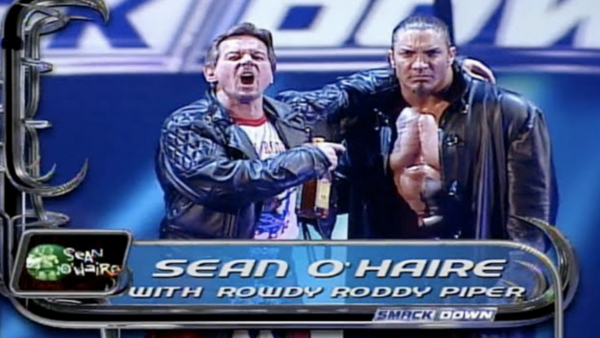
The failed push of Sean O'Haire in 2003 was a steep learning curve for fans of a certain age that genuinely felt like they had seen everything from North American pro wrestling during the mid-90s boom.
The Monday Night Wars brought a pace and zip to weekly television that hadn't existed before, and realistically needed to be scaled back in the aftermath. For a while, Raw and Nitro moved at the speed of light and it was the primary function of the star wrestler to hold on for dear life 'lest they be left behind. Sean Waltman was cursed so cruelly by this that "X-Pac Heat" became shorthand for describing that very specific feeling of boredom one felt when a wrestler was a little-too-familiar. This hit him hard in 1999, all of 12-18 months following the introduction of the new DX member, and all while he was the grand old age of 27. Compare that to 2026, where main events are the preserves of a 40+ crew who've been in the same or similar spots for decades (!) and suffer none of the derision. Different times and not ones built to last, and never was that more evident than at the start of 2003. A barren wasteland for star power, the show was being carried by The Rock in career-best heel form either side of his permanent Hollywood exit, as evidenced by a WrestleMania XIX show that featured all the biggest names of a generation but drew the lowest buyrate for the show in six years. Change was viewed as an absolute necessity, with the pushing of new talent viewed externally as the sure-fire route back to the promised land.
Sean O'Haire's new gimmick was capital-T capital-A The Answer.
A Natural Born Thriller for World Championship Wrestling during the aforementioned era for pro wrestling, O'Haire was one of several from the stable that carried the burden of the company's failure rather than their own. Viewed as prodigies, the youngest and coolest from the dying days of WCW had left a mark on the fanbase writ large, and WWE's burial of the entire Alliance in 2001 galvanised protest groups within the audience to back these wronged performers to the hilt when they finally got their opportunity. With his inch-perfect wrestler physique, great overall look and uncharacteristically impressive aerial game (nobody forgot their first look at the Seanton Bomb), O'Haire never left fans' lips despite WWE's attempt to give him an out-of-sight out-of-mind run in developmental territory Ohio Valley Wrestling after the Invasion bombed.
The vignettes that aired for O'Haire in early-2003 were the wrestling dictionary definition of "opportunity". Having not appeared on screen once in 2002, the skits felt like atomic bombs smashing up lousy shows that were in dire need of the scorched earth restart. A suited-and-booted O'Haire appeared against a purgatorial white backdrop preaching on societal matters of Sex, Taxes, Religion Dieting and Vices before rounding each speech off with a killer "I'm not telling you anything you don't already know" catchphrase as some foreboding and dramatic music reached a thrilling crescendo. Given the "devil's advocate" label by an enormously enthused online audience who immediately spotted the references and cinematic overtones, the next step was the most important - tweaking the character slightly into something that could work in the live setting.
It failed horribly, and that's probably not telling you anything you don't already know.
For messaging that felt so big in the build, O'Haire slotted into SmackDown as a small-scale disruptor only. The Undertaker and Brock Lesnar were around on SmackDown at the time but a guy associated with end-of-days damage didn't get anywhere near any of them. Outgoing WWE Champion Kurt Angle would have been a statement target for this dangerous new presence, but the two didn't once share the screen. Then, either by accident or design, much of his rabble-rousing was just around wrestlers getting naked. He convinced Brian Kendrick to reenact a popular Nike advert of the day and dart nude through the building, while talking Dawn Marie to expose her breasts on television to make up for losing a Playboy spot to Torrie Wilson. It was WWE's typically tropey take on "mind games" featuring characters seemingly born without brains, and when neither resonated meaningfully with the crowd, the good idea went from botched to outright abandoned.
He was inexplicably paired with an out-of-form Roddy Piper for his ongoing nostalgia war with Hulk Hogan/Mr America, but none of the legend-dust sprinkled onto the doomed O'Haire's broad shoulders. He was the constant number two for Piper, eating pins and beatdowns from the babyfaces in programmes that didn't really appear designed with him in mind. His look - pleather trench coat and trunks - couldn't have been more divorced from the original aesthetic, reducing him in stature further as he tumbled down the card into a passing Velocity spot that didn't even come with a guaranteed win. Injuries from a motorcycle accident in November kept him out until February, where he ended his WWE career entirely via one last short stint back in OVW.
His wrestled just seven more times, spending the next decade dealing with a host of personal problems before he sadly died by suicide in 2014.
1. Gable Steveson

When it comes to Gable Steveson, the ratio of push-to-end product failure might be the biggest in company history, and think of the ground that covers. WWE has a reputation as a bad idea factory, but Steveson's story is one of familiar failure despite unfamiliar circumstances.
WWE is the company that once spent hundreds of thousands of dollars they didn't really have going spare putting Lex Luger on a bus for a month in the hope that he'd get over to the same degree Hulk Hogan had been after nearly a decade on top. Steveson couldn't lace Luger's boots of course. Neither man started out as pro wrestlers but when has that ever had to be a hurdle? Luger's NFL career was once promising enough that he was almost a Packer rather than a grappler, noting that "had it worked out in Green Bay, I seriously doubt I would have become a pro wrestler". Even with that mindset, the manner in which he adapted to the fundamentals was proof positive that the game was always mentality first, everything else second. Professional sports will always be the playground of the mentality monster, particularly when it comes to solo pursuits and especially when it reaches Olympic level. On these terms, it was reasonable to expect the best from a Gable Steveson push.
WWE is the company that promoted Million Dollar Mania, one of the most obnoxious wastes of television time in an era full of strong contenders. The concept literally promised the giving away of cold hard cash in a desperate (and failed) quest for ratings. Its execution was disjointed at best and risible at worst, though it did at least keep performers and their trajectories out of the line of fire once in a while, and even delivered an ending that was supposed to be a cliffhanger. This was more McMahon family melodrama that swallowed up television time at the expense of promising wrestlers who desperately needed it, but by 2022, lessons had been learned. Having been included as a prospect in the 2021 Draft, Stephanie McMahon was tasked with introducing Steveson to the world on the grandest possible stage at WrestleMania 38 a few months later, and the company were careful and considered in the aftermath - a polar opposite to throwing money at a problem. He dropped fellow amateur standout Chad Gable with a suplex, then went back into the background so not to have his aura diminished by peaking too soon. On these terms, it was reasonable to expect the best from a Gable Steveson push.
WWE is the company that persevered with the Triple H "reign of terror", a push so destructive that it chased off a generation of fans that took a gamble on wrestling during the mainstream boom just a few short years earlier. 'The Game' had convinced his Father-In-Law that more of him was the only solution when it fact it was the biggest problem. A diminished company was oversaturated with a wrestler that only spoke of his greatness as opposed to being able to deliver it with any consistency. Over-exposure begat over-confidence, resulting not just in quantity being a problem but quality too. Contrast that to the extraordinarily patient roll-out for Steveson, who appeared fleetingly with the likes of Kurt Angle in a cute 2022 throwback to his "milk-o-mania" soaking of The Alliance, and in NXT where he advised wrestlers on how to beat his brother Robert (working at the time on the show as Damon Kemp). Was anything from the Gable Steveson WWE soft-launch as offensive as the time World Heavyweight Champion Triple H hopped aboard a mannequin and threw bolognaise at the camera while attempting to "screw its brains out"? Of course not, and on these terms, it was once again reasonable to expect the best from a Gable Steveson push.
Expectations rose, and rose and rose, and coincidentally, so did WWE's stock. The company was experiencing the most unlikely of creative rebirths during the exact point Steveson finally stepped into the spotlight...only for the former Olympian's obvious flaws to expedite his collapse, one familiar mistake at a time.
Steveson didn't get a bus, but within the confines of NXT, he was held up as a Kurt Angle-in waiting, which was even worse. Steveson and Angle are the only two gold medal wrestlers to ever make serious goes of it in WWE, yet they are defined more by what separates them than the obvious bond. Angle dog-walked the majority of people to ever give wrestling a try; comparison to him was a curse rather than a blessing, particularly if the background was similar. Angle fought Brock Lesnar in front of a braying crowd of wrestlers backstage just to prove this point. Steveson might have been able to do the same, but credit on camera was far more important and he'd yet to establish any.
Next, WWE threw money at the problem, upping his visibility on the show in an attempt to play catch-up on what was starting to feel out-of-nowhere like a loss. Having attempted patience, they jumped forward to panic. Steveson was a weekly television character, was being bounced in and out of programmes, being given sink-or-swim segments that flew in the face of the project up to that point. It was the summer of 2023, he'd not yet been in the system two years, and he hadn't even had his first match. The worst case scenario constantly felt like it was lurking around the corner and when it finally revealed itself, it bottom line'd the project as Steveson bottomed out.
In a match as rotten as any of Triple H's biggest turkeys, Steveson's debut was an epic-scale Premium Live Event disaster against solid hand Baron Corbin at 2023's Great American Bash. Fans had seen through the turbo-push on television, but the contest with Corbin was abysmal enough to make liars and fools of everybody that had ever said anything nice about Steveson's potential. The pair raced through a Day One training school tackle/dropdown sequence and immediately into an ankle lock spot to try and generate a cheap pop. It drew boos. The audience were on to the con, and a con it was - the booking itself showed no belief in the hot new prospect, racing to a non-committal double count-out lacking the physical fire the story required.
In the end, the run was one big WWE doomscroll after all, all the way to a barely-talked-about release in early 2024, with a sum total of zero more televised matches after the Bash debacle.