11 Misconceptions About WWE You Probably Believe
A lie can travel half way around the WWE Universe while the truth is putting on its shoes

By it's very nature, professional wrestling is one of the easiest industries for misconceptions, half-truths and outright lies to grow into something resembling a fact. As a generation if fans were reminded multiple times a week on WWE broadcasts, "the hazards are real", but beyond the terrifying risks the wrestlers take with their bodies, very little else is.
Kevin Nash astutely/infamously offered the take that the "money and the miles" were the only realities in wrestling, and it's not a bad way to see things. Cash - proper cash, a wage, something to allow you to thrive rather than merely survive - goes some way to to easing the very real pain of the profession. The miles are, per most performers, comfortably the hardest part of the game. Constant travel might look glamorous to the desk jockeys and service workers amongst us, but the endless commute and majority of a life lived moving from one destination to the next takes just as much a toll as the bumps by the end.
Those, for better and worse, are the hard truths. Everything else in an industry where even the hardest punches are worked? Constantly up for grabs, and up for debate...
(Get 73% off and three free months when you sign up to NordVPN here: http://go.nordvpn.net/aff_c?offer_id=564&aff_id=3013&url_id=31010&aff_sub1=WhatCulture.)
11. The Failure Of A WWE-Owned WCW Was The Fault Of WCW

WWE heels Stone Cold Steve Austin and Kurt Angle effortlessly deck Booker T and Buff Bagwell during the first ever "WCW" match on the maiden voyage for the rebranded Number Two on Raw.
SummerSlam 2001 when The Undertaker and Kane massacre and humiliate the duo of Diamond Dallas Page and Chris Kanyon.
Vince McMahon kicking off the build to the Survivor Series showdown between WWE and The Alliance by saying he was "tired of this crap".
The evidence goes beyond those three examples and isn't hard to find, but in terms of a beginning, middle and end to the life of World Championship Wrestling under the WWE umbrella, the case studies are as good as any. WCW - with or without the bloom being off the market leader's rose that summer - was little more than an unwelcome and unwanted interruption to the regularly Feduled broadcast to those in Stamford.
The WWE wrestlers had bought into the "war" narrative too literally and didn't trust their new colleagues nor want to give up their spots. The new arrivals from WCW were too job-scared to fight back politically, while the bigger stars on Turner contracts weren't going to pass up free money knowing that their opportunity would come later anyway. And those with power to affect change at an office level didn't want to do it - the newcomers weren't booked with credibility, and locker room egos were deemed more important than a satisfying creative output.
The call was coming from inside the house - not the old one thad had long burned down by the time Vince McMahon purchased it.
10. Things Are Different Now They're Owned By TKO
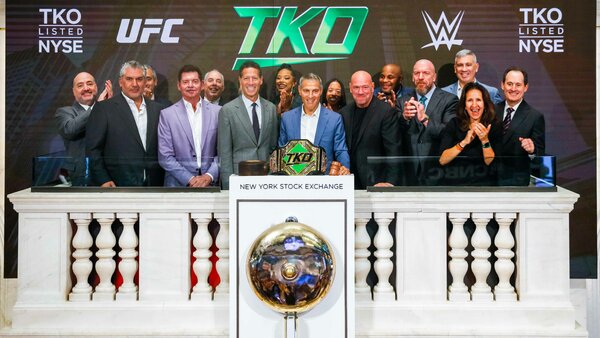
Depending on who exactly is peddling this narrative will determine why you're hearing it.
If it's Paul Levesque, it's because he's using the language to differentiate between the creative regime overseen by his Father-In-Law before he resigned in disgrace and his own, but doing so in a way he thinks is less braggy.
If it's Dwayne Johnson, it's because he's one of the men at the top of the pile and wants to take credit for any business successes. He'll be nowhere near the conversation if there's no successes to be discussed.
If it's from a chronically online WWE fan on social media, it's because they want to desperately cling on to the idea that WWE wouldn't have callously released their favourite wrestler when it was the little Mom-and-Pop-shop-that-could until the 2023 merger with UFC.
All that's to say that the only think we as fans/audience members/consumers need to consider is exactly how much it's impacting our ability to enjoy the shows. Notable examples? WWE ticket prices have risen towards what UFC have long charged, and the wrestling market leader's had less of an issue embracing prominent right-wing entertainment acts despite - as of writing - not yet welcoming President Donald Trump into a building with a fleet of escorts and his own Kid Rock entrance theme.
That said, Trump already had two WrestleMania hosting credits, a key role in one of the biggest-drawing matches in company history and a Hall Of Fame ring from WWE. To suggest one horse is higher than the other would be just as naive as thinking the transfer to TKO was going to do away with the supposed evils (or niceties!) of the past.
9. Bret Hart Vs Shawn Michaels Was A Classic WWE Rivalry
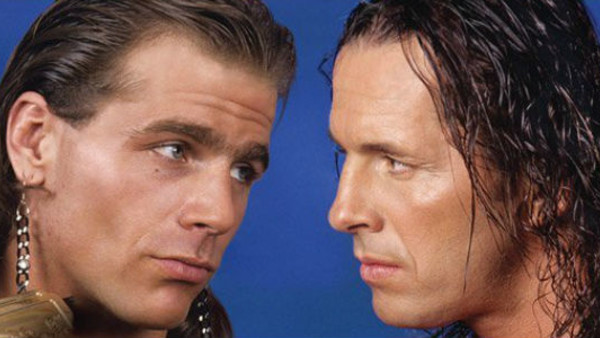
WWE like to keep their narratives neat whenever possible, and the idea that two professional and personal enemies were able to translate the turmoil into an on-screen series is a good one, not last considering how head-and-shoulders Bret Hart and Shawn Michaels were above their peers at their peaks.
What's not to love about the traversing trajectories? Both started under-sized for the era, surviving as super-workers in tag teams but with aspirations of breaking glass ceilings as the years passed. Then they did just that, scoring Intercontinental and World Heavyweight gold when the straps were anything but trinkets or participation trophies. Then, as well you know, they clashed repeatedly, a breaking point was reached, a screwjob changed everything, and wounds took a decade and change to heal.
The one thing - glaring as it is - missing from all of this? A truly great match between the true greats.
"Divisive" would be a kind way to describe the WrestleMania XII Iron Man disappointment, though the company's collected take on it remains that it was an all-timer. The 1997 Survivor Series brawl has all the right energy before it's swallowed up by the abrupt and controversial ending, and every other singles battle on record feels as though one or both man is holding just a little bit back for another day, or worse, reaching so hard to make a match a classic that they inadvertently stop it becoming one.
8. The Attitude Era Was One Grand Plan
The Attitude Era was a result of so many happy accidents that it's a wonder all of Mr McMahon's trousers weren't piss-stained as opposed to merely the ones he wore when Stone Cold Steve Austin held a toy gun to his head.
Famously, Austin wasn't slated to win the King Of The Ring, and even when he was, the victory speech that changed everything popped into his head that very night. Even then, he wasn't truly recognised as The Guy until Bret Hart returned in October, labelled him the best wrestler in the company, and set about making him the next top star. The babyface turn driven by the fans was made his heel position untenable, but his actions forced a tonal change for so many other superstars, redefining what it meant to be a good or bad guy right as WCW started to over-stuff and overthink the New World Order on the other side.
The bright future was back in sight, but very little of it was plotted to go the way it did until the company knew they were on to an absolute banker with 'The Rattlesnake'. In much the same way the organisation pretended that Daniel Bryan's 2013/14 run to the top was one long cohesive story, it still took as much luck as judgment when it came to forcing Vince McMahon and others out of their stubborn comfort zones.
After all, even with Austin on the crest of immortality, McMahon still rolled out the red carpet for a former luminary to take his spot...
7. Vince McMahon "Couldn't Wait To Fire" Ultimate Warrior

The infamous "Self-Destruction Of The Ultimate Warrior" DVD was just another example of WWE at their most arrogant during the monopoly years - a shameless attempt at character assassination towards a figure who was doing a good enough job of that himself in real life anyway.
Warrior's legacy had rapidly moved between legendary to strange to unpleasant following his politically strained WWE exit in 1996, bust of a WCW stint in 1998, and homophobic and racist public speaking tour of college campuses in the mid-2000s. The market leader had their own hatchet job lined up too, and kicked it into high gear when discussion moved to his first exit from the company in 1991. The documentary told the tale of a cruel and vindictive Warrior holding owner Vince McMahon up for cash ahead of the heavily promoted SummerSlam main event alongside Hulk Hogan against The Triangle Of Terror, and McMahon as the hero of the locker room booting Warrior out of it as soon as he left the ring.
Whilst this wasn't even close to the truth, the fact that Warrior was welcomed back in 1992, 96 and was offered a monster deal in 1997 of all periods highlights the bluster peddled in the interest of supporting the brutal and insecure narrative.
6. Hogan, Andre & The WrestleMania III "Firsts"

There's nothing inherently wrong about telling a few white lies in the spirit of promotion as long as they're not there to cynically deceive the consumer, and when it came to promoting WrestleMania III back in 1987, it made all the sense in the world to proclaim the main event a first of its kind in every respect.
Back then, the vast majority of people newly invested in the market leader had neither the knowledge nor interest in what Hulk Hogan and Andre the Giant might have done in past wrestling lives, nor the means of finding out for themselves. The magic and majesty of the historic main event was powered by a near-universal belief that this was once-in-a-lifetime stuff. Buy a ticket if you live nearby, buy it on pay-per-view or closed circuit if you don't, but whatever you do don't miss out. Good business, and great lore for wrestlers that were inspired to get into the industry by the spectacle in front of them.
But not, as would later be explored by many a documentary and Network/Vault collection, the truth.
Hogan and Andre had wrestled many times before, for one. The heel/babyface dynamic had even been switched, for another. Then, and perhaps most crucially, there was the matter of 'Hulkster' doing what "had never been done before" and slamming Andre as part of the epic climax. This wasn't just not the first time The Giant had hit the deck in this manner, but wasn't even the maiden voyage for these two - Hogan had lifted the big man above his head several times during their prior battles.
5. Tag Team Wrestling Suffered Because Of A Lack Of Talent

The only way this is true is if the discussion is on quantity of wrestlers required. As in, four people are needed for a standard tag team match over two, which is basically the real reason why - whenever it did - doubles wrestling struggled under Vince McMahon.
Some of the great eras of tag team action for the market leader have taken place in spite of the former boss' tightness. Bruce Prichard confirmed as much years ago, noting that the simple dollars and cents didn't add up to the Chairman, even though range on a card and consumers enjoying the genre could have been just as strong a money-driven argument against being so stingy.
The 1980s tag division was stacked enough to present two critically acclaimed 20-man Survivor Series matches in 1987 and 1988. The TLC era brought about by Edge & Christian, The Hardy Boyz and The Dudley Boyz between 1999-2001 saw those three ascend literally and figuratively, and a quiet purple patch during the early stages of the 2016 brand split gave The New Day the likes of the heel-turned Usos and enemies-turned-friends unit The Bar as credible challengers.
Tag Team wrestling in WWE was bad when Vince McMahon couldn't be bothered to pay for it. No more, no less.
4. Stephanie McMahon Invented Women's Wrestling
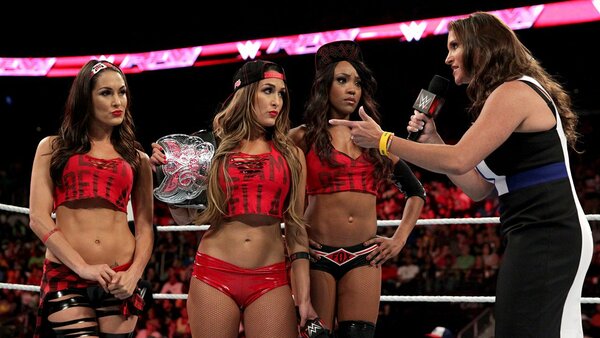
In defence of WWE here, the company has never been shy of crediting four specific people with the enormous shift in attitudes towards women's wrestling over the past decade, even if the work was really done by many many more. It's also a pity that those four people are Stephanie McMahon, Stephanie McMahon, Stephanie McMahon and Stephanie McMahon.
What's more galling about the July 2015 segment that saw McMahon introduce Becky Lynch, Charlotte and Sasha Banks to the main roster and thus plaster herself all over a carefully marketed "revolution" forever was in how long she and the company took to get there. Pridefully boasting that the company was at long last going to appeal to over 50% of its potential audience decades late was a weird flex from the 'Billion Dollar Princess', and simultaneously buried the hard work of many that had grafted to make something worthwhile in worthless times.
The Bella Twins, Paige and Emma were the four (barely) in the ring when a #GiveDivasAChance hashtag trended worldwide for days after yet another three hour Raw passed by with mere minutes of airtime. The likes of Michelle McCool, Beth Pheonix, Natalya, AJ Lee, The Bella Twins and many others had worked under impossible pressures chasing fair representation, all while Lynch, Flair, Banks and Bayley became Horsewomen in NXT riding a wave of momentum that saw every show-stealing TakeOver match improve upon the prior one.
McMahon was there again for the announcement of the first Women's Royal Rumble, three years after that and when the company had got enough ducks in a row to promote such a thing. Only in 2010s WWE could a fall come before the pride.
3. WWF To WWE Was A Philosophical Shift

In 2020, WWE decided to finally stop re-monetising the Attitude Era and package together a long-form Network profile series on some wilderness years. The only problem was, they weren't comfortable considering the time period as a down spell.
From these shaky foundations, the "Ruthless Aggression" (more on that presently) series aired, with so many half-truths that it became little more than excuse to see a few new clips while ignoring the asinine commentary offered by the usual gang of brothered-in talking heads. Never was this more apparent than when the market leader marched forth with a brand new strain of nonsense about the 2002 decision to "get the F out" and rename the company WWE.
Per the new company line, the change was nothing to do with the breaking of a legal agreement and the punishment henceforth, but a creative drive from Vince McMahon to move the Federation even closer towards Entertainment.
Eh?
To recap, the World Wrestling Federation had shared initials with British nature charity the World Wildlife Fund for many years, and though the relationship wasn't exactly harmonious, it existed thanks to a deal McMahon made not to hammer the "WWF" branding. Then he did, over and over again, voiding any legal agreements and pushing his luck beyond the patience of the group. 2002 was merely the culmination of a battle the company were destined to lose, not a carefully plotted course change by a false idol pretending not to have lost his Midas touch.
2. "Ruthless Agression" Was An Era

What's the more astonishing bit of marketing/brainwashing by WWE about the period of time between 2002 and 2008, when a deal with Mattel resulted in a sharp shift to PG and away from the excesses that had defined the company for decade at that pont?
Is it that the company successfully rebuilt itself back to the heady mainstream days of the Attitude Era on the strength of Triple H steering the ship through choppy waters until John Cena and Batista were made men? Or is it that this spell was known by everybody back then as the Ruthless Aggression Era? Both are parroted as truisms despite being provably false, and the latter also says something specific about how audiences were emotionally disconnecting in droves.
In a fairly desperate and grabby manner, Vince McMahon lined his rosters up like peons in 2002 to scream in their faces that they sucked despite his genius booking, and that only by having "Ruthless Aggression" could they get out of the funk. In contrast to the branding of the Attitude Era coming long after the vibe within the company had already shifted towards it, this was a naked attempt to replicate the reverse, and only really worked for a corny Cena promo during his debut against Kurt Angle.
Within weeks, the concept (?) was dropped and it was back to sagging business as usual for the default market leader.
1. Vince McMahon Made Professional Wrestling Huge

He didn't.
He made WWE huge. He then made WWE the shorthand for professional wrestling, and the two became understandably intertwined in the minds of the vast majority right as a digital revolution beckoned, but gatekeepers and record-keepers alike have the facts on the relatively healthy state of wrestling before Vince Jr was even born.
The name Jim Londos invites scorn amongst those that only choose to subscribe to WWE/McMahon's version of events, not least because other respected journalists and historians in the field go to him first as the easiest example of wrestling being anything but the preserve of the "smoky bingo halls" before the recognised symbol of excellence in Sports Entertainment came along. Londos passed away at 81, shortly before McMahon's 30th birthday, having spent decades in the early 1900s as a worldwide wrestling draw beyond anything seen until Hulk Hogan's 1980s domination.
In the 1930s, he became Madison Square Garden's first ever major drawing card, routinely pulling 20,000 to the 'World's Most Famous Arena' for his headline matches, following a relatively barren time for the business in the building. In 1933, Londos visited his home nation of Greece to see his Father, and drew 70,000 to the Panathenaic Stadium for a match against Kola Kwariani. Approximately 20,000 more were on hand outside the venue just to be part of the magic. A year later, he broke the US attendance and box office records in one show when he defeated longstanding rival Ed 'Strangler' Lewis in front of 35,625 fans for a gate of $96,000, both North American records at the time. Adjusted for inflation, that'd comfortably clear $2million today.
WWE was "what the world [was] watching" when the brand exploded - but, much to the egotistical McMahon's chagrin, wrestling had always been a global game.