10 WWE Experiments That Completely Failed
Unforeseen consequences.

Anyone who runs a successful business enterprise will tell you that they've had to take one or two risks to get where they are today. It's a fact of life that you have to spend money to make money, and whenever you spend it, there's always a chance you won't get it back.
Risk is arguably even more prevalent in the world of professional wrestling, an industry where a company's fortune is determined by fans who are often drawn to the bizarre and the unfamiliar, where things that look ridiculous on paper can bring in buckets of cash.
It's in this context that WWE, led by mad scientist Vince McMahon, have over the years carried out a series of hare-brained experiments, hoping that if they throw enough random ideas at the wall, one or two of them - by the law of averages - are bound to stick.
And, to give them their due, a lot of them have. The Royal Rumble, WrestleMania, D-Generation X, Elimination Chamber; all of these were once ideas floating around the brains of WWE's decision-makers, and it's only by trying them out for real that they could realise their potential.
And then there are the experiments that weren't so successful...
10. Raw Goes Three Hours

Subsequent to the collapse of WCW in 2001, many industry insiders went on to suggest that the decision to expand Nitro to an unprecedented three-hour broadcast was part of the reason for its demise.
The logic here is that, while some movies can get away with going 180 minutes (including The Lord of the Rings, which clocked in at a combined one month and 11 days), it's kind of difficult for a wrestling show to hold the viewer's gaze that long.
So it has also proved in WWE, who in 2012 added an extra 60 on the end of Monday Night Raw, a move many fans have since come to lament on account how badly it dilutes the quality of what was already a patience-testing show.
In their defence, the driving force behind this decision was said to have been the network, rather than Vince McMahon himself. And they have undoubtedly profited from the additional commercial revenue that a longer show (and more ad revenue) entails. But in terms of show quality? It's been a big miss. No two ways about it.
9. Trump Buys Raw
1296011It sounds like a pretty good publicity stunt on paper. Step one: you pretend that you've sold your flagship television show to one of the world's most famous businessmen. Step two: ???. Step three: profit.
Only problem was WWE executives neglected to tell shareholders that it was all a work. In consequence, stocks fell by 7%, forcing the company to issue a statement confirming wrestling isn't real and then drop the storyline altogether a week later.
Apart from having to see Trump's face all over the product, it wasn't really all that bad for the fans. Those watching TV got a rare commercial-free episode of Raw, and the lucky few in attendance were even refunded the cost of their tickets.
For WWE, though? If you combine the loss of ad revenue from ditching commercials, the cost of buying everyone a free seat (let's assume that the future POTUS didn't dip into his own pockets here) and the sheer embarrassment of it all, this has to go down as a total, unmitigated disaster.
8. Celebrity Guest Hosts

Another unwelcome side effect of Donald Trump buying WWE's flagship show was that Raw temporarily did away with a permanent general manager in favour of the incredibly unpopular celebrity guest host model.
Did this at least give us one or two nice moments? Well no, not really. If you manage to convince a cool celebrity - let's say Arnold Schwarzenegger - to get involved in the ring, just have him appear under the auspices of promoting an upcoming movie. There's no need to dress it up.
Besides, most of the hosts they managed to book weren't really all that "cool", and many of them appeared to have precisely zero knowledge of professional wrestling, often mispronouncing or just outright forgetting the names of performers and even upcoming pay-per-views ("SummerFest!").
Whatever small difference all of this made to viewership figures, it can't have been worth the price of enraging the wrestling die-hards and having to spend time in the company of Ozzy and Sharon Osbourne.
7. 205 Live

It seems a little harsh to write off 205 Live as a failed experiment while it's still ongoing, especially with such a talented (and mostly likeable) array of stars busting their collective butt every week to try and make it a success.
But the numbers don't lie. Almost from the beginning, it was reported that WWE were struggling to convince fans to stick around after SmackDown to watch the cruiserweights (hence all those empty seats).
That's a pretty shocking indictment. If you can't get people to watch something that they've technically already paid for, then you know you're in trouble.
At one point, it was said that they even tried saving AJ Styles' match until after 205 Live tapings were wrapped up, hoping that spectators would consider suffering through Enzo Amore a fair price to pay for the opportunity to watch the Phenomenal One. But all that did was annoy SmackDown viewers.
6. Jinder As WWE Champ

It's difficult to put your finger on exactly what last year's Jinder Mahal experiment was supposed to prove. Did WWE really expect to conquer the elusive Asian market by putting their biggest prize on the arm of a wrestler of Indian heritage?
If so, it seems a touch naive. Sure, Chicago fans love CM Punk. And the Brits got a kick out of Bulldog's victory at SummerSlam '92. But few are drawn to professional wrestling in the first place simply because "one of their own" is headlining the show.
Shoehorning a relative jobber into the main event after virtually no build-up is also an obvious recipe for disaster. Jinder was unfairly burdened with the unenviable task of having to win round sceptical die-hards - a situation that could have been easily avoided had they held fire just a couple of months.
And that's a massive shame, because the guy could have become a really interesting heel if they first allowed him the room to grow. Instead, he faces going through the rest of his career with an albatross around his neck.
5. UK Championship
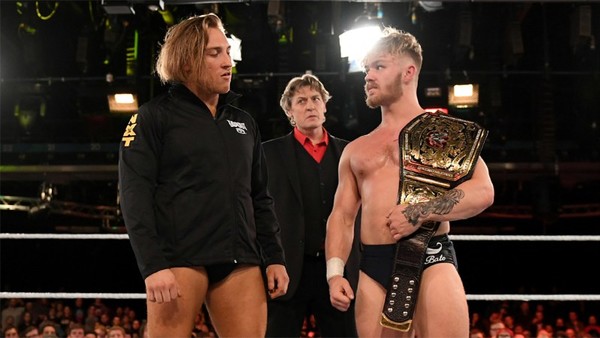
If the aim of the UK Championship was to shine a light on some of the brilliant grassroots work currently being done by independent wrestling promotions in Britain, then fair enough. Mission accomplished.
Nobody really believes WWE's intentions are that pure, though. The truth is that putting roots down in Blighty had less to do with showcasing talent than it did gearing up for a potential ratings war with ITV's World of Sport reboot.
Of course, it still needed to be profitable. That's why news reports late last year claiming that running shows across the pond had left a big hole in the company accounts were so disheartening. It basically confirmed this would only be a short-term thing.
Admittedly, Vince McMahon is bringing his crew back to the UK next month for round two, but like tying Pete Dunne and Tyler Bate down to exclusive contracts, this all feels like a defensive move. It's basically damage limitation.
4. Big Dog Roman Reigns

The so-called "Roman Reigns experiment" has been going on nearly four years now, making it one of the longest running in the history of science.
Its hypothesis is two-fold. First, that annoying internet fans are mistaken in their belief that The Big Dog isn't the greatest thing since sliced bread. And second, that Albert Einstein was wrong to assert that doing the same thing over and over again and expecting different results was the definition of insanity.
So far, things aren't looking great. Even after a prolonged absence from the world title scene, the sight of Roman's name at the top of the card is still being met with dejected sighs, as though this relatively new 32-year-old has been around since before the Attitude Era.
There are signs that Vince McMahon and co are at last thinking about turning off their Bunsen burners, namely the fact that he's twice come up short against Universal Champion Brock Lesnar. But this is WWE we're talking about: they're nothing if not stubborn.
3. ECW Reboot

Over the years, nostalgia has been a fairly useful money-making tool for WWE. They're still pulling in top dollar on nWo shirts, for instance, and Hulk Hogan and Kevin Nash haven't been "too sweet" since the late 1990s.
Attempts to reboot ECW 12 years ago, however, bore much less fruit. The company succeeded neither in replicating the magic of the original product (how on earth could they?), nor providing a platform for the stars of tomorrow.
In fact, it's far easier to come up with a list of ECW rookies who fell by the wayside than it is for those who actually went on to enjoy long-lasting runs on either of the two major brands (and the latter group includes CM Punk, who was probably destined for the top whatever his pathway).
Perhaps that could be overlooked if the experiment - which ran nearly four years - at least produced a handful of memorable shows or matches, but there was really very little to write home about. RVD's title victory, a couple of decent Kurt Angle bouts - that was pretty much it.
2. Stone Cold's Heel Turn

Remember when they did the Large Hadron Collider experiment a few years ago, and the press tried to convince us that it was going to result in the end of the world as we knew it?
Of course, all the science nerds who actually knew what they were talking about played down the level of risk. This is because those involved had taken the necessary precautions to ensure it didn't go too badly wrong - unlike, say, WWE in 2001, who decided to turn Stone Cold Steve Austin, their biggest star, into a bad guy on a complete whim.
Admittedly, the world didn't quite end, but it can hardly be classified as a success either. The fans had no interest in booing the Texas Rattlesnake, regardless of the company he started keeping or the horrible, cowardly things he did to try and turn us against him.
Moreover, many historians have cited this decision, and the subsequent loss of a focal marketing emblem, as one of the factors behind the death of the Attitude Era, WWE's last real boom period. Short of blowing up the planet, experiments don't get much more disastrous than that.
1. XFL

The XFL was, to be fair, a good lesson in what can happen when your eyes are bigger than your belly. Not content with just running the wrestling world, Vince McMahon wanted to take over American football too - regardless of how hopeless an ambition that may have been.
As many predicted, the project faced obstacles from the outset, not least of all the fact that a legitimate sports league operated by the world's leading fake sports organisation was inherently difficult for viewers to take seriously.
After ratings fell of a cliff, WWE and its partners were forced to pull the plug after just one season, having incurred reported losses of more than $30m. Even the perennially stubborn chairman of the board would later admit that it was a disaster.
And yet, he has seen fit to give the experiment another go in 2020, apparently convinced that the myriad issues they experienced two decades ago were merely teething problems. To his credit, at least he's not putting any company money into it this time.