10 Wrestlers Lumbered With Dead On Arrival Gimmicks
The Rib of Creation.

The jury is still out on Mike and Maria Kanellis.
The double act debuted at Money In The Bank and announced themselves as a couple head over heels in love to, it must be said, a fantastically OTT power ballad entrance theme. It could go one of two ways, really: WWE could position Maria as a conniving valet, engineering unjust wins on her lover's behalf in a welcome continuation of Maryse's great work in a much-missed role.
Or, Mike could be presented as a lovestruck geek, failing to win matches as a result of his obsession. Given WWE's current creative malaise, it is impossible to get one's hopes up.
The Shield worked so well because their M.O. of upholding justice could be contrived to suit any given storyline. Their quest for justice and, thereafter, total domination allowed WWE to script their programmes in their sleep. Those absolutely blinding six-man tags were the best thing about WWE in 2013 by a mile. The Hounds of Justice had the luck of cats in the creative stakes.
Even the utter failure that was Phantasio in '95 might have worked beyond a few weeks because he had a totally bloody stupid but logical tactic with which to advance up the card.
These acts had no chance of actually initiating a rivalry or succeeding in the eyes of the audience because they were buried well before fans could even get the shovels out...
10. The Shining Stars

Primo and Epico are a curious case. Not once, in seven years under WWE employ, have they come remotely close to getting over. They're talented enough, if colourless. The abysmal gimmicks handed to them probably have more to do with it.
The very worst of which - worse than a direct sequel to Tito Santana's dire El Matador bit, which didn't get over in 1991 so what chance the Colóns stood in 2013 is anybody's guess - saw the two second generation talents repackaged as The Shining Stars. Travel salesmen.
How to parse this?
Even the very worst occupational New Generation gimmicks made some kind of transpositional sense, if you squinted or were of a generous disposition. The Goon was a hockey player too violent even for that bloodsport, so he had to turn his hand at the wrestling racket. Sparky Plugg was fast and furious in the driver's seat and in the ring! Or something.
How were the Shining Stars meant to translate to a pro wrestling rivalry? They didn't. They appeared in grimly unfunny backstage skits with the likes of R-Truth in which they attempted to sell him a time share in their holiday resort.
This wasn't funny. These skits didn't even contain gags, let alone lame ones. They just went nowhere because they had no chance of going anywhere. This is what happens when a TV executive decides RAW must be three hours in length.
9. Jinder Mahal

Jinder Mahal returned to WWE screens in 2016, ostensibly, to artificially cast the diluted, split RAW roster as bigger stars in contrast to him. He was there to stare at the lights in filler segments. That was about it.
But it wasn't enough. Before suddenly deciding they wanted to steal a march on Impact Wrestling and monetise their immense presence in India, WWE had Mahal announce backstage that he came to WWE "in peace". He came to an organisation in which its performers must do combat to advance, and he did so "in peace". Which, for those who cannot hack the density of Leo Tolstoy's work, is the opposite of the war WWE stars must wage as the primary responsibility of their role as professional wrestlers.
Mahal had apparently "trekked in the Himalayas" and "spent time in the monasteries" in order to find inner peace. This was such an eye-rolling amalgam of Indian cliche that it's a wonder some birdbrained writer stopped short of saying he'd worked in a convenience store.
This didn't get over, of course. It had no chance. Some buddhist subsets do practise martial arts, but it's not as if Mahal claimed this zen approach helped his in-ring balance or anything. He simply droned on about tranquility because he's foreign.
That was about the size of it.
8. Pirate Paul Burchill

The British scene is a wrestling hotbed in 2017. That decidedly wasn't the case a decade prior; there was simply no viable platform on which to showcase the talented men who comprised it. One such talent - Paul Burchill, a beast with the most spectacular cult move in wrestling, the C4 - escaped the drudgery and made it to the WWE promised land...
...only to be lumbered with two rotten gimmicks and sapped of any enthusiasm and star quality.
By the mid 2000s, Vince McMahon reverted to type and presented something akin to a New New Generation - another raft of silly, antiquated characters rendered even dumber than their occupational progenitors because they were unlucky enough to fade in the still-looming shadow of the Attitude Era. Burchill, after a middling start, was recast as a wrestling Jack Sparrow because of his ancestry or some such sh*t. This involved him making his entrance by winking to the camera in a tacit acknowledgement that, hey, at least he was getting paid, before swinging from stage to ramp via rope.
You can sort of make a similar leap and suggest that a quest for Championship gold might represent his own treasure hunt, but really, the only pirate connotation you can accurately use is buried.
7. Flatulent Natalya

WWE is one gigantic paradox, best exemplified by the fact that it is the most popular wrestling organisation on the planet but still, all too often, has an audience of one: Vince McMahon.
How else do you explain Natalya's inability to control her gas? Christ, even writing that sentence is an embarrassment. Natalya must have felt sick going into work, knowing she had to perform a crass comedy routine for the amusement and entertainment of absolutely nobody. Here in the WhatCulture office, I am surrounded by fellow wrestling fans, #GamerLads and comic book enthusiasts, essentially running the gamut of a geek culture in a plush and elevated safe space. And I'm still dreading perusing the lowlights of this run on YouTube lest I get questioned for my choice of hobby.
Natalya, as I've just been reminded, once ate the pin in a tag team match because something she ate beforehand disagreed with her and the referee, who was repulsed at the stench she let out when applying the Sharpshooter. Tamina took advantage of the distraction. "That's funny," you can imagine Vince saying in Gorilla. "But it wasn't as good as that time she killed the midget, d*mmit!" Natalya in an earlier backstage segment, of course, also broke such heinous wind that it killed Hornswoggle.
This bullsh*t wouldn't make the grade at CBeebies.
6. Renegade

In 1995 era WCW, a familiar-looking face-painted hero with long hair marched to the ring.
He pumped his fists in the air and banged his head as he ran the aisle to the sound shredding, lightning quick power chords. He shook the ropes and flattened his opponents with the splash. He made short work of them in dominant squashes.
None of this got over in the slightest because this wasn't the Ultimate Warrior but a comparative geek by the name of Rick Wilson in the role of "Renegade" - the Aldi to Warrior's Asda. It didn't help the tragic Wilson that he was built like a cruiserweight. The poor b*stard looked like a cosplaying teenager. His grasp of Warrior's mannerisms was stilted. This, combined with the amateurish production values of his promotion, echoed Tim and Eric public access nightmare fuel more so than a wrestling act.
This, unbelievably, was the most money rich wrestling organisation on the face of the planet. When Renegade ran to the ring, it resembled a grim leisure centre WWF knockoff. To be fair, you could say that about most of what WCW produced that year.
This is a sadder tale than most. Wilson was so despondent over his failure to make it in wrestling that he committed suicide via gunshot to the head in 1999.
5. The Gobbledy Gooker

What's astonishing about watching the WWF product of the early to mid 1990s back now is that fans actually received some of the absolute dross with mild amusement.
The legendarily naff Bushwhackers and Men On A Mission Vs. Bam Bam Bigelow, Bastion Booger and the Headshrinkers match from Survivor Series 1993 - in which the WWF actually deployed the banana skin slip for comic effect - went over reasonably well with the Boston Garden crowd. It was a simpler time.
Even the WWF diehards - the fans who bought every last Hasbro figure, every last collector cup, who put up with all manner of naff characters - took a gigantic dislike to the inexplicable turkey man that hatched from a gigantic egg at Survivor Series 1990. As per Bruce Prichard's impression of the fans via Vince McMahon, "they f*ckin' hate him! They're booing the sh*t out of him!"
The Gobbledy Gooker, portrayed by poor Héctor Guerrero, was inscrutable. He gibbered. He couldn't talk people into the building. He danced about like a moron. His outfit actually precluded him from wrestling.
It was possibly the most harebrained idea Vince McMahon ever had, so deeply ironic - the turkey was never not going to be a turkey - that it lives on as wrestling shorthand for sh*te.
4. The Funkasaurus

Brodus Clay devised the Hall of Pain gimmick that was eventually handed to Mark Henry.
The long term arc would have given Clay a storyline reason to lock horns with virtually anybody on the roster - local enhancement talents, undercarders, midcarders and, eventually, headline acts. It was a barnstormer of an idea as marketable as it was ripe with narrative opportunity, a sort of proto-Braun Strowman-needs-competition trajectory. There was also vast Hall of Fame crossover potential heading into WrestleMania season. If Clay had denounced the original Hall and ran through that given year's inductees, WWE could have also spun a Legend Killer retread, leading to a marquee 'Mania bout pitting Clay opposite an able-bodied vet to cement him in the eyes of the casual audience.
Instead, WWE pulled an initially amusing bait and switch and debuted Clay as the Funkasaurus - a dancing big man who could barely dance. His reappearance on the January 9, 2012 RAW was something of a left field hit. Clay showed bags of personality when he shut down an audience heckle with a camp "My bad!".
His momentum was halted when, after weeks upon weeks of teases and presumed backstage planning, it became apparent that Clay couldn't dance. He was removed from television for a couple of months before returning to the grandest stage of them all.
At WrestleMania XXVIII, Clay danced with his "momma" - a young woman with a bean bag shoved up her backside in a dubious spot of racial profiling, popping nobody but Vince McMahon and his legendarily puerile sense of humour.
3. "That 70s Guy" Mike Awesome
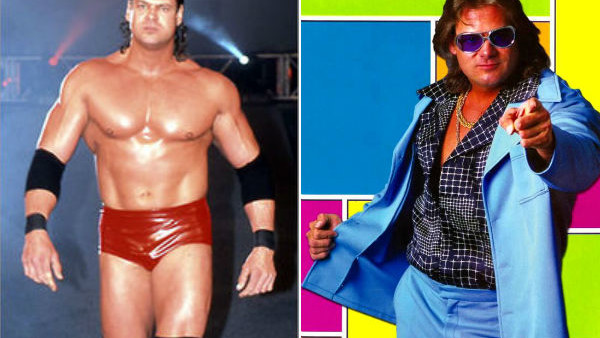
This was peak Vince Russo.
Mike Awesome's April 2000 jump from ECW to WCW was controversial. Awesome no-showed several ECW shows - when he was the company's World Champion - having been seduced by a very lucrative, high six-figure contract. On top of that, WCW paid an additional six figure sum to procure Awesome's release from his typically murky ECW contract. This legal kerfuffle dissuaded WCW from running with the original plan of booking Awesome, like Madusa before him, to literally trash a belt belonging to the competition.
You'd think, then, that after going to all that trouble, Russo would position Awesome in a favourable light. It would have been a complete waste of money to portray Awesome - an electric and dangerous performer, framed in the right context - in a fringe comedy role.
This was peak Vince Russo.
Awesome, just a couple of months later, was the recipient of Russo's ADD and repackaged as the Fat Chick Thrilla. Perhaps worse than that - at least his fat fetish might have warranted a rivalry with Buff Bagwell - was his September re-repackage as That 70s Guy.
What happened was thus: Russo was aware that That 70s Show was a popular network sitcom and attempted to capitalise on its popularity. They spun a feud with Vampiro out of it because the demonic creature of the night took a disliking to Awesome's shaggin' wagon.
WCW folded within a year, funnily enough.
2. Oz
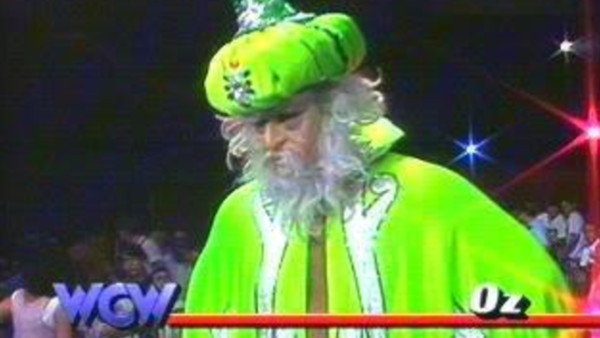
Oz was Kevin Nash portraying the less-than-wonderful wizard in the Godawful Jim Herd era of WCW.
Tony Schiavone, to his credit, tried to grasp the character with his own head canon and explain it to the audience during his second appearance on WCW television. At first, he and Jim Ross were at a total loss for words beyond "He's huge!"
"You know, in this sport Jim, there's a lot of psyching out of your opponents - and if that doesn't psych out your opponents, I can't think of anything that does!"
The thing about the Oz costume is that it looked incredibly naff and cheap. Nash wore a luminous green gown decorated with stars. There was no pyro blast announcing his entrance. What amounted to glorified sparklers erupted with all the force of a urinary tract infection. This young stud of an athlete was also plastered in old man make up.
How could those apparently psychologically afflicted opponents take him seriously under the guise of the guise of a diminutive conman?
Jim Herd couldn't even plagiarise correctly.
1. Fake Razor Ramon & Diesel

In September of 1996, the apparently disgruntled Jim Ross turned heel and threatened to bring back Razor Ramon and Diesel just months after they had jumped ship to WCW on the promise of considerably more, guaranteed money for fewer dates. They had become the hottest act of the decade in the meantime.
Any notion that the men who portrayed the characters, Scott Hall and Kevin Nash, were actually returning was fanciful on a purely common sense basis, irrespective of their very real contractual status.
So, the WWF pushed journeyman Rick Bognar and green hoss Glenn Jacobs into those roles. This was the WWF as its ultra-defensive worst. That's generous. The whole farce was completely pathetic.
Nothing about this was good, insofar as the onscreen presentation. Jim Ross hadn't reached beloved uncle status just yet, but nobody could believe him in the heel role. And, of course, nobody could believe Jacobs and Bognor were the originals.
Hilariously, though, the fabulously inept WCW was so frightened by the WWF's insistence that Hall and Nash were returning that Turner worked themselves into awarding them fatter deals - even though the contracts they were already held to meant they could have sued them if they did.