10 Things We Learned From VICE's Chyna Documentary
Chyna's story is one of childhood trauma, WWE success, heartbreak and exploitation.

VICE's filmmakers might've taken a break from their 'Dark Side Of The Ring' duties, but that doesn't mean they've left wrestling's most controversial topics alone. The production house just released a two-hour look at Joanie 'Chyna' Laurer's rise to WWE fame and sad slump into a world of drugs, porn and depression.
It was a documentary about another documentary.
Chyna's bid to rescue her reputation was going to be framed as 'The Reconstruction Of Chyna'. Together, Joanie, her manager Anthony Anzaldo, director Erik Angra and producer Ron Potylo (who was also a massive fan of her WWE career) planned to produce that story back in 2015. Production was halted when Laurer died in April 2016.
VICE went in-depth with talking heads like Anzaldo, Potylo, Vince Russo, Mick Foley, Sean Waltman and other pro wrestling stars about Chyna's life and career. As you'd expect, there were chinks of light in amongst all the misery - VICE do such a great job of peppering docs with hopeful messages before bringing everything back down with a crash.
Here's everything learned from Chyna's tale of WWE success, personal excess and more...
10. Chyna’s Traumatic Childhood

Joanie's traumatic childhood isn't properly examined until VICE reaches the second hour of her story, but it's nonetheless shocking. As the doc speeds towards her untimely demise, it takes a break to flesh out Chyna's backstory and reveal some of the horrors she experienced in her youth.
Clips of Chyna describing how dysfunctional her family life was are interspersed with revelations that she once saw her father stab her mother with a butcher's knife. That harrowing visual lived with her forever (no wonder), and eventually destroyed her relationship with mum.
Laurer went to live with her dad aged 16, and didn't see her mother for approx 30 years.
Jan, the lady in question, was totally taken aback when she spotted her daughter on WWF TV in the late-1990s. That didn't seem like something Joanie would do; it's upsetting to think that Chyna couldn't even excitedly boast about pro wrestling to her own family.
9. Early Indy Footage Is Amazing

This was one of the brighter points in the doc.
There's some really cool footage of Chyna working intergender matches, women's matches and cutting promos on small spot shows pre-WWE. Most of this comes from 1995-1996, and it's clear straight away that Joanie had star power. She was different, and definitely a cut above everybody else shown.
Perhaps the best thing about these clips is that they present a totally untapped period of Chyna's journey through wrestling. WWE, to date, hasn't produced an in-depth documentary on her life that includes this sort of thing, and that's a shame. Laurer was truly inspiring in her youth, and refused to let a "manly" appearance hold her back.
Talk of changing perceptions about women in wrestling was ahead of its time too. Honestly, anybody who enjoyed Chyna's run in the WWF will get a lot out of this footage. You need to see it for yourself.
8. Chyna Approached Triple H

It was Joanie herself who first approached Triple H about working for the WWF. She'd seen him around once or twice after attending shows, and told her then-boyfriend Gerry Blais that she had a plan. Laurer was going to approach Trips and ask if he'd be interested in having her as his bodyguard.
That was totally fresh.
Blais didn't want to stand in Chyna's way or stop her from living her dreams. He could see that she was taken with wrestling, and admired the fact that she was willing to be so bold and approach an already-established name in the biz. Gerry was even more impressed when it actually worked.
Common WWE storytelling claims that Triple H headhunted Chyna from Killer Kowalski's training school. There may be some truth in that if she was a top prospect, but VICE's doc says it was Joanie who first made contact with Hunter about coming in as his muscle.
7. Vince McMahon Didn’t Like The Idea

The most important man in wrestling didn't like it.
Various interview clips with Chyna reveal that Triple H told her he was having a tough time selling Vince on the thought of a female bodyguard. Both he and Shawn Michaels (who would've had way more influence than Trips in 1997) had to push hard to even get her in the door at all, let alone as Hunter's second.
McMahon had a very specific vision for women in his company. They were largely helpless figures who needed men to fight their battles for them, so it must've been agonising for an alpha male like Vince to look at Chyna, see how powerful she was and admit defeat.
Kevin Nash described Vince as "a man's man", which is one way to put it. The wrestling industry (and, indeed, society as a whole) wasn't quite ready to present women as equals. That's damning now, but it's the truth. Chyna planned to change that.
6. Who Came Up With Her Name

Many theories have been thrown out there since the 90s about why Chyna was called well...Chyna. Did someone on the WWF's writing staff struggle to spell? Was this supposed to drum up images of the vast size of the country? Was it totally random and plucked from creative services? Not quite.
Triple H and HBK were responsible.
They loved the oxymoronic feel of the moniker. To them, it'd throw fans off - the name conjured up images of a porcelain 'China Doll'. Then, when people clapped eyes on Joanie, they'd see she was anything but fragile. This clever name apparently went some way to selling Vince on Laurer's new act.
He gave Hunter and Shawn the go-ahead to bring Chyna in and present her as the former's bodyguard. That, almost inevitably given their closeness as pals behind the curtain, snowballed into a three-person dynamic (four at first with Rick Rude) as D-Generation X.
Joanie had a lot to thank Trips and Michaels for there.
5. She Didn’t Want To Split From DX
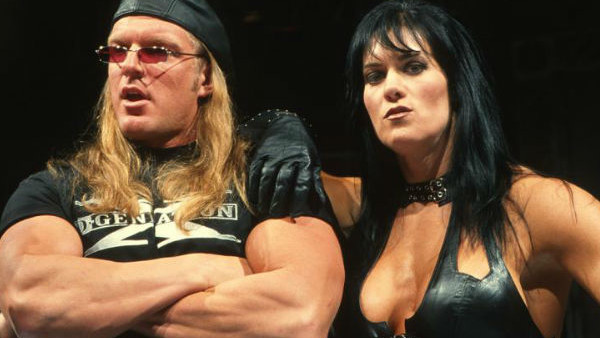
Years later, she was cursing the same creative process.
Old interview footage with Chyna tells its own story. VICE included that in their doc, and it's quite eye-opening. Apparently, Joanie never wanted to split from DX and strike out on her own. Her anxiety came to the fore, and the "pressure to be perfect" (her words) was too much of a burden.
This totally clashes with other talking head comments from guys like Jim Ross. He's always said that Chyna had a bit of an ego and wanted similar money to the likes of Steve Austin when her contract came up for renewal in 2001. Maybe, by then, Joanie was in a stronger place and believed she'd done everything asked of her.
Still, between 1999-2001, Chyna struggled to find her own way without Triple H or the D-Generation X gimmick there to back her up. She didn't want to become a solo act, at least not in '99 when the WWF made that call.
4. The Other Side Of The Coin

WWE get to set a clear narrative anytime they talk about Chyna. Despite giving Joanie more praise over the past few years than at any point since her release in 2001, the company may never tell her side of the story properly. That's why docs like this one from VICE are so essential.
Chyna found love letters from Stephanie McMahon to Triple H around a year before they officially split up, which is incredible. Things moved quicker from there, and she ended up leaving the promotion in '01. Discussions started after that between both parties - Joanie wanted to use the Chyna name, but Vince wasn't so sure he should let her.
He owned it, after all.
The breakdown of her personal relationship with Hunter, and a perceived drop down to the women's division after years of wrestling men combined to set Chyna on a rocky path. After leaving and battling for her ring name, Joanie spiralled into further anxiety and depression when she didn't get it.
It's sad to watch.
3. Her Manager Doesn’t Come Across Great

Let it be known that Anthony Anzaldo seems like a shady character.
One can only go by what they see in front of them, and Anzaldo certainly doesn't come across very positively in VICE's doc. He wanted to be the main driving force behind the abandoned 'Reconstruction' flick, and he's presented as manipulative, arrogant, dismissive and as a typically-exploitative promoter throughout.
Chyna told friends that Anthony was trying to talk her into doing things she didn't really want to do. Early on, Anzaldo is also shown telling the cameras that they'll see Joanie naked "figuratively and literally" in his new documentary. Wow. Almost nothing he says comes out looking honest or helpful to Chyna's fragile mental state.
Once she'd passed, Anzaldo then set up a picture op for fans with her ashes. It's almost too much to sit and watch this man flit from moments like that to calling himself Joanie's "soulmate". He even showed a complete disregard for dangerous medications that were threatening her life.
It's not a great look.
2. Some Footage Is Seriously Hard To Watch

Be warned, you will not have fun watching some parts of the documentary later on. As genuinely heartwarming as that early independent footage of Joanie making her way in the wrestling industry is, it's hammered flat by clips of her crying as she begs for help from those were incapable of doing so.
Chyna's cries of, "I'm Chyna - I'm a champion" come across as desperate, and there's a heartbreaking moment in her teary speech during which Laurer questions why all this is happening to her. The woman was having a bloody mental breakdown, and the producers of that 'Reconstruction' film shoved cameras in front of her face to capture it.
Man, it's so rough.
Erik Angra, the director, at least admits he wasn't proactive enough in helping Joanie at the time. Meanwhile, Anthony is content to sit there and spew nonsense about being Chyna's "soulmate". This portion of VICE's doc is seriously, seriously grim and might not sit well with most.
1. The Abandoned Doc Was A Bad Idea

Being honest, 'The Reconstruction Of Chyna' was just a terrible idea from the start.
Joanie's decision to move back to the United States from Japan and seek some closure on her pro wrestling heartbreak might've worked had she been supported by better people. Unfortunately, it clearly didn't need to be such a public affair, and the poor woman just wasn't ready for everything all at once.
Watching her shaking as she attends autograph signings is awful, for example. Some friendly faces, like Mick Foley, were able to calm Laurer down at these events, but there's this overwhelming sense throughout all of her dealings with the doc team that she'd rather not be there.
Somebody needed to step in and save her from it, because it wasn't helping.
Having so many toxic, exploitative people around who couldn't hope to aid her recovery wasn't positive either. Even if the original idea (helping somebody heal) was largely fine, Anzaldo and Angra's project was doomed to fail from the get-go.
What did you think of VICE's documentary on Chyna? For more like this, check out 10 Things We Learned From Dark Side Of The Ring: Dynamite Kid and 10 Wrestlers Who Were Wrongly Judged On ONE Match!