10 Reasons Why Scott Steiner Is The Most Unappreciated Pro Wrestler Ever
He is, mathematically, the man.

The perception of Scott Steiner, among some quarters of the wrestling fandom, is one of a bumbling, over-muscled hothead with drop foot syndrome - a depressing footnote in Triple H's dubious history with the shovel.
That infamous match, at Royal Rumble 2003, was the lasting impression much of the wider fanbase have of the man. A proto blueprint of Brock Lesnar's Night Mayor act - in that Steiner did little more than drill Trips with a succession of overhead belly-to-belly suplexes - it was a dubious and unintentional innovation. But, not for the first time, Steiner was ahead of them.
Steiner is equally renowned for his often baffling promo work - a supposedly laughable stream of consciousness born from the mind of an absolute lunatic - but there was, if you can excuse the cliche, method to his madness. Steiner grasped the finer points of specificity in his comedic ramblings. His famous boast - "I've got freaks nine days out of the week" - was so much funnier that it would have been, had he swapped nine for seven.
Steiner knows how many days there are in a week - even if he isn't all that great with percentages...
10. He's Incredibly Innovative

Scott Steiner invented the Frankensteiner, the difference between that and the hurricanrana is so negligible as to not exist. The "rana" in hurricanrana refers to the double leg cradle pin which follows the move Steiner patented, and should get more credit for patenting.
Its influence on wrestling was seismic; in an era heavy on workrate and populated by men of unprecedented athleticism, it is as ubiquitous now as the lariat or the power slam was back then.
The story behind the move is as important as the move itself. Steiner first devised it when he was working out of Memphis, but to preserve its importance, he waited until he was on a national stage to debut it. He knew that it would mean nothing, if nobody really saw it. And people think the man is stupid.
There's a lesson in there somewhere. As savvy as Daniel Bryan was, and as much as he cherished his time in Ring Of Honor et al. as he did his stint in WWE, he was on borrowed time when he finally starting earning real money. He misses wrestling. He could've done more of it, had he adopted Steiner's less is more approach.
Bryan is a humble man, one who detests materialism. He probably isn't the best example to cite, but there's arguably none better for the stars of tomorrow to follow.
9. ...More So Than You'd Think
Steiner, incredibly, also invented the 450 splash which 2 Cold Scorpio later adopted to carve himself out as one of the most dynamic and cutting edge performers of the 1990s.
Seen in the above video, wrestling under his real name of Scott Rechsteiner, it's not hard to fathom why he never added it to his repertoire permanently. He undershoots his trajectory, and would have missed the intended target even if he had not scrambled out of harm's way. But, as inauspicious as the move was, he owns the patent to it.
His name was curiously missing when WWE acknowledged the history of cruiserweight wrestling when reinstalling the division last year - but he copyrighted Tony Nese's hits like a heavyweight, moves like a cruiserweight act when the Premier Athlete was still in Pampers.
Beyond the moves he innovated, Steiner used his considerable NCAA pedigree to inform the believable amateur leanings of his professional style. Even before he unleashed the terrifying lunatic within on national television in the late nineties, his work was immersive. He made suspension of disbelief easy because he was as powerful and intense as he was technically-minded.
8. He Had The Best Gear

Praising an act for their choice of attire might seem like a literally superficial pursuit, but branding, when fashioned by a genius, is emblematic of it.
The Steiner Brothers, at curious odds with their brutal and no-sense disposition, wrestled in technicolour dream singlets - impossibly colourful and patterned garb which reflected their unmissable, standout ring work.
Too few wrestlers today stick to one colour scheme or patented iconography. Steve Austin was a no-frills bad-a**. His all-black clobber told you as much. Bret Hart fused cool strategy with an athletic flair. His trademark black and pink clobber told you as much. When you scroll through the wrestling DVD and Blu-Ray pages of Amazon, Hulk Hogan's trademark red and yellow jumps out from the tiniest of thumbnails. Is it a coincidence that so many of his modern day successors are so indistinct, when they jump from one outfit to the next with little in the way of logic?
There is psychology in wardrobe. Steiner grasped that as well as he did the need to deploy it in the ring. Steiner's garish gear was as unforgettable as it was inexplicable, but it just added to the bizarre paradox with which he has lingered so long in the memory. Steiner invented the 450 splash and is arguably the most muscled performer ever. He shouldn't exist.
7. ...And The Best Tag Matches Of The 90s

Has wrestling ever bettered the 1990s for match quality and innovation?
Modern day cards are typically better, on the whole. The pursuit of workrate, demanded by the modern day fan, has mercifully rendered the likes of Mideon a relic. But wrestling was richer back then - and Scott Steiner's peerless work in the tag ranks was at the forefront of wrestling's greatest ever period.
The inherent structure and suspense of the tag team match lends itself to rote formula - beat up Ricky Morton, generate the heat, have Robert Gibson provide the all-important release - but the Steiner Brothers' body of work was wonderfully eclectic. Their matches in those famed joint WCW/NJPW supershows, against the likes of Hiroshi Hase and Kensuke Sasaki, were gripping, athletic, anything-you-can-do-we-can-do-better p*ssing contests. One of - if not the - best match in WCW pay-per-view history was their bout opposite Sting and Lex Luger at the inaugural SuperBrawl.
Initially fought as a friendly exhibition, albeit one with a blistering, hard-hitting pace, a series of misunderstandings unravelled the tone of sportsmanship, giving way to a vicious melee of a finishing sequence. Steiner was a sublime storyteller.
6. He Refused To Accept His Lot

The Steiner Brothers tag team was the greatest tandem of the 1990s. Scott could be forgiven for resting on those peerless laurels - that he didn't speaks to his immense ambition and creativity.
Before the act truly outstayed its welcome, Scott transitioned to the singles ranks in 1998. He sensed that the wrestling landscape was changing, and so remodelled himself as a jive-talking sh*t-kicker divorced entirely from his Day-Glo persona. Knowing that fans would struggle to accept him as a singles star, he underwent a physical transformation to symbolise the transition. He ditched the anachronistic mullet and picked up a despicable attitude. It was crude and misogynistic, like the era in which he did it - but, like that era, it was utterly absorbing, transgressive, and unforgettable. He was one of few WCW acts to capture the zeitgeist, rising above a sea of dated dross.
Scott was synonymous with tag team wrestling, literally bound to it by blood. Not many have removed that stigma. Bret Hart and Shawn Michaels are the most famous examples, but further south, Scott's equally successful breakaway is never received with as much acclaim.
He wasn't the star they were, admittedly - but politics had much to do with that...
5. ...And Refused To Kowtow To His Masters
The above destruction of Ric Flair was one of the most shocking shoots in an era which popularised them. P*ssed off beyond belief at the state of the company which employed him, and the toxic politics which were eroding it from the inside, Steiner directed his ire towards Ric Flair in an astonishing February 2000 rant.
"Last week, I was watching TV, and I watched a 53-year-old man - who has more loose skin than a Shar Pei puppy - come out here and say he's still the man. In this wrestling business, there's never been a bigger ass-kisser - and you belong where you're at in WCW, because WCW sucks!"
Flair questioned the logic behind Steiner's burial of WCW in his autobiography, To Be The Man. "Yeah, WCW sucked, but it wasn't smart to advertise that on your own show. He's a guy who meant nothing as an attraction, drew no money, and has no legacy. People will forget him the minute he retires." That, patently, is untrue. Steiner might be unappreciated, but the man is unforgettable. That promo alone was far more memorable than anything Flair did at the time. His own, famed drawing power didn't save WCW. Nothing could - even an act as sharp as Steiner's.
In his own way, Steiner cared about WCW. So many of his main event peers could not have given less of a sh*t. He helped build it, and he wanted to save it. He thought he could by killing its darlings, who had driven into the unrecoverable ground.
He was on the same wavelength as the WWF. If only he'd joined the company before his body betrayed him.
4. He Almost Single-Handedly Made WCW Worth Watching In Its Death Throes

WCW, by early 2000, was dying a death by a thousand cuts. Hulk Hogan's tyrannical grasp of creative control, Eric Bischoff's short-term, one-note creative philosophies, spectacularly incompetent middle management - these factors and a book's worth of more converged to inject it with a lethal dose of poison.
Steiner was far and away the best thing about it. One of the last of the truly great heels - the only laughs he sought back then were of the blackest shade - he revelled in his ability to generate heat. He did not concern himself with being cool. He spat on his opponents. He threatened to kill them, which was probably a bit much. But you could believe everything he said, and he said everything in such an inimitably entertaining way. He created catchphrases on a near-weekly basis. Imagine if WCW had a merchandise department that was capable of designing more than one t-shirt.
His in-ring work was as awesome as his persona. He gave Mike Awesome the best matches of a legendarily embarrassing run. Outside of his fabled 1997 series with Randy Savage, Steiner got the best out of Diamond Dallas Page.
He was so good that even Vince Russo couldn't ruin a fifteen minute match wrestled with a man who often struggled beyond five...
3. He Got The Very Best Out Of Goldberg

Goldberg's greatest ever singles match - and one of his longest - took place at WCW Fall Brawl 2000. The man in the opposite corner was Scott Steiner.
Goldberg, a graduate of the infamously diabolical (in both senses of the word) Power Plant training school, was not built to go the distance; his best and most memorable matches were the sub-five minute squash matches with which he forged his undefeated streak. His Halloween Havoc 1998 bout opposite Diamond Dallas Page ran this a close second, but Steiner's ultra-credible hard man aura lent this blood-soaked war a more believable heft - incredible, really, given that Vince Russo played a major role in it.
This was something so special that even he could not ruin it. Steiner's feats of athleticism - reversing himself from an offensive tombstone piledriver position to take Goldberg's over-the-shoulder military press slam - made his opponent look absolutely monstrous, but Steiner's own stretch of offence was so credible that it was almost easy to believe that he might win without interference. When he planted Goldberg on his head with a top rope overhead belly to belly suplex, you can pause and see mouths agape. To underscore his mastery of storytelling, those jaws remained dropped until the closing bell.
Watching Goldberg bump with such abandon and realism would have been incongruous - had he wrestled anybody else on the might.
2. His TNA Stick Work Is Actually Is As Good As It Is So-Bad-It's-Good

Scott Steiner knew what he was doing. The greatest trick he ever pulled was convincing you that he didn't.
He knew that TNA was a hyper-exaggerated playground constructed by a man with a crippling form of Attention Deficit Disorder - and he played his role within it to perfection. He knew that he was there to blood in the next generation in a midcard comedy role. He did that by positioning himself as a bully, substituting pure sociopathy for more broadly comedic strokes. Yes, much of the time he was indecipherable. But that was part of his charm.
He once criticised Sting for selecting Christian Cage as his tag team partner. "Picking a partner from Canada? He would have been better off picking a partner from Ethiopia. Matter of fact, they got more muscle tone than you, Christian Cage."
His delivery in TNA was never smooth, and it was even harder to transcribe than his promos from WCW. But Steiner's promos were so electric that even his his flubs are more memorable than much of what gets uttered, smoothly and with obvious rehearsal, on any given episode of RAW.
A victory over Steiner wasn't a scalp in TNA, but then even a talent as in form as Kurt Angle in 2009 couldn't move the needle.
1. He Refuses To Conform To WWE Revisionist History
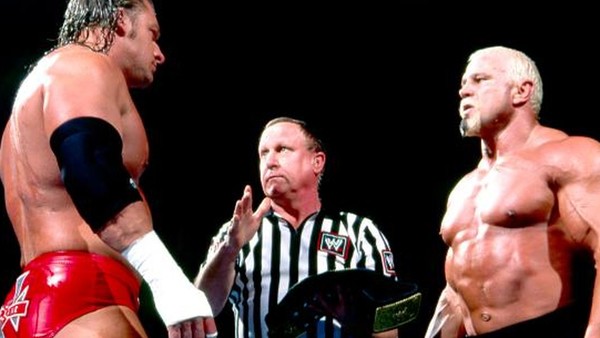
The obvious danger of the Hall Of Fame, as a pervasive institution, is that it is massively politicised and shaped entirely by WWE bias.
In recent years, acts which forged their reputations outside of WWE have been inducted into it, like Tatsumi Fujinami and Stan Hansen - but in reality, those men, even if their inductions were thoroughly deserved, were welcomed because the company are fast running out of names. That they have never referred to Triple H as a "c*nt" probably did them a favour, as well.
It has also enabled the likes of Bruno Sammartino and Wendi Richter to soften their poisonous stance towards the company - inductions which were considered inconceivable even one year before they happened. All of which might lead you to believe that WWE, in an attempt to apportion credit for its success and the success of the wider industry, is no longer constrained by frosty relations or its own product.
That isn't the case. Steiner hates WWE's modern day vision of sports entertainment. Joining an endless line of veterans bemoaning the scripted era, he also hates the two heirs to the helm in Triple H and Stephanie. He is the embodiment of the Hall's bias.
He absolutely should be in it, but it's likely he never will be. They don't want him, and he doesn't want them. It cannot therefore be considered a true reflection of wrestling's glorious history.