10 Most Shocking NJPW Upsets
Making it Rain.

New Japan Pro Wrestling is known - and beloved - for its sensible long-term booking.
The man with the pen, Gedo, has etched himself into the genius realm of Giant Baba, Bill Watts, and Dusty Rhodes by booking the Golden Age of New Japan Pro Wrestling with an impeccable balance. Caution is fused with risk. Intricate, long-term narrative is fused with the necessary reset of the short-term, shocking headline. The clean win directive is fused with the protective, epic singles match model in which the losers resonate as anything but; the winners, sucking air and sweating profusely, put over their spirited wins in post-match press conferences that put over also the company as the consummate emulation of a true athletic event.
'King of Sports' isn't just marketing. There are no losers in NJPW; only though those that must train harder to reach the pinnacle.
At least two of those aforementioned names are known for their devolution as much as their revolution of the art. In the inherently volatile industry of pro wrestling, a staunch, philosophical refusal to move with the times invites the meteorite. The word "sensible", meanwhile, is loaded with that drastic connotation of "predictable" - even "boring".
Gedo has avoided both by fusing logic with audacity, echoing the Lion's roar throughout 47 years of history.
10. Naoya Ogawa Vs. Shinya Hashimoto - Battle Formation 1997

The genesis of Inokism, it should be pointed out here that, irrespective of the results, there was a certain foundational logic to company founder Antonio Inoki's latter-day, controversial philosophy: with MMA flourishing under Inoki's vision of technical legitimacy, his focus narrowed.
Shinya Hashimoto was as legitimate as it got in an arm of the industry that leaned on that tenet to capture the imagination of its paying audience; equipped with both a martial arts-inspired arsenal and a hulking, burly physique, he was the über-credible super-worker of the Three Musketeers era. And it was for this precise reason that Antonio Inoki sacrificed that aura to put over the debuting Naoya Ogawa, Inoki's ideal performer incarnate, in the first and most traditionally compelling of a notorious trilogy of matches impossible to parse in their mendacity.
A decorated Olympian in judo, Ogawa's profile at first accentuated Hashimoto's, especially as the sequel restored parity. It was, at first, the perfect, mutually beneficial dynamic: Ogawa's legit credentials enhanced Hashimoto's aura, and Hashimoto's ring generalship deftly sidestepped any prospective styles clash.
This famous shocker begat something far more infamous in the years that followed; where Inoki initially used Hashimoto's strong drawing power to slowly introduce his new ethos, he later sabotaged it to the detriment of the company.
9. Kazuchika Okada Vs. Tetsuya Naito - Wrestle Kingdom 12

New Japan fans will debate the wisdom of this result forever - particularly as Tetsuya Naito fades, ever so slightly, from his zenith of white-hot popularity.
This is just how new Champions are crowned, isn't it?
The hottest, coolest star, having won the most arduous battlefield of contention in the form of the G1 Climax tournament, arrived on the biggest stage the company performed on. There, as his adoring public roared him on in their tens of thousands, decked out in the Los Ingobernables de Japan t-shirts NJPW couldn't print enough of, he was set to formalise his status as the 'Shuyaku' of New Japan.
Gedo didn't elect to crown a new Champion on January 4, 2018 - but rather a Godlike entity in his grand narrative tapestry.
Okada, wearing flared trousers in a fit of impossible arrogance, his Icarus moment, surely, withstood Naito's sadistic offence. He suffered blow upon blow to the face in the bout's unforgettable visual, one of sheer persistence eroding the myth before our eyes. Incredibly, shockingly, he overcame, stunning the Dome into silence.
This didn't elevate Naito - but it did elevate the already unsurpassed prestige of Okada and his record reign with the IWGP Title. When he eventually relinquished it, to Kenny Omega at Dominion, it resonated as nothing less than the biggest triumph in company history.
8. Shinsuke Nakamura Vs. Hiroyoshi Tenzan - Battle Final 2003 Day 12

In Shinsuke Nakamura, Antonio Inoki knew that he had found the man with the talent, aura and marketability to reverse his company's dwindling fortunes.
Prescient, but impetuous: Nakamura hadn't yet tapped into his alien brand of mega-charisma, and while fans had gravitated towards his unmistakeable raw talent, the multi-disciplinary prodigy, in 2003, was some distance removed from the complete package he would become.
In 2003, Inoki nonetheless awarded the 'Super Rookie' with the distinction of becoming the youngest-ever IWGP Heavyweight Champion. But, unlike the shocks that would come to instantly alter the complexion of the New Japan main event, Nakamura was not yet on the cusp of true greatness, and his rapid ascent, at the expense of the established, trusted Hiroyoshi Tenzan, was cut short by injury before it could stigmatise him. Foreshadowing the near-demise of the company, Inoki was somewhat myopic in his self-indulgent focus.
With a reasoned motive, in this case.
Nakamura embodied the core principles of New Japan. He was a preternaturally gifted shooter with a killer aura and an understated showmanship. But he required an excursion to find his true self - as something beyond a mere Inoki disciple.
This was a lesson Gedo learned, and applied impeccably.
7. Hulk Hogan Vs. Antonio Inoki - IWGP Championship League 1983 - Day 28
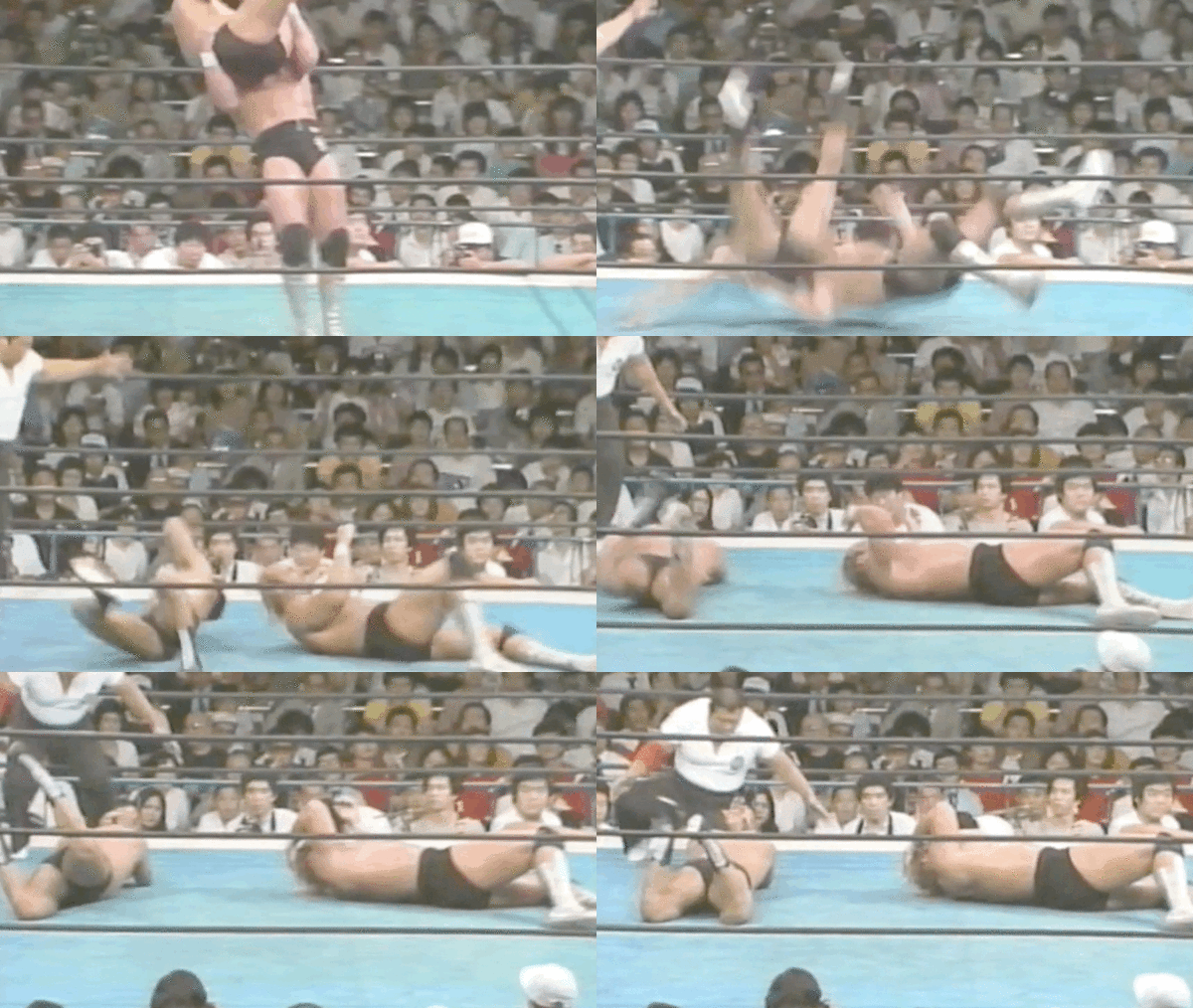
As much a fascinating historical curio as in-the-moment shock, accounts vary, between trusted historians, as to what precisely occurred here.
Some are of the opinion that Hogan, a far more dynamic and crunching worker than he was, or needed to be, in the U.S., legitimately knocked out Antonio Inoki in the finals of the inaugural IWGP Heavyweight tournament. In the April 13, 1998 Wrestling Observer Newsletter, Dave Meltzer specifically used the word "job" to describe the finish, indicating a predetermined outcome. Either a very well-conceived and executed work or a deeply fortuitous shoot, in how it suspiciously protected each megastar, if Hogan was involved, the cynical route is the safest.
In any event, this stunned the fans in attendance, for Inoki did not lose, and he did not lose for good reason. He wasn't merely the founder of New Japan Pro Wrestling, the politicking egomaniac with the means and the need to cover himself in glory; he stood astride the sports and entertainment components of pro wrestling as the ultra-charismatic household star of wrestling and, for a time, a genuine, top-tier worker whose work is more influential than it is timeless.
Work, shoot, whatever; Inoki retained his aura, with which he eventually bled in the next generation, and Hogan went on to join the Mount Rushmore of wrestling's immortal draws.
6. Kengo Kimura & Tatsumi Fujinami Vs. Antonio Inoki & Seiji Sakaguchi - IWGP Tag Team League - Day 25

Antonio Inoki's legacy is complicated; he is both the creator and very nearly the destroyer of the very company.
The company found itself embroiled in scandal by the mid-1980s; Inoki and Vice President Seiji Sakaguchi stepped down (only to mysteriously return) after it emerged that the former had embezzled NJPW live event profits and funnelled them into his failing bio-tech supplement company. This, in addition to the stranglehold Inoki seized over the top of the card, compelled several name acts to depart the company, creating offshoot renegade and shoot-style promotions in the form of Japan Pro-Wrestling and the Universal Wrestling Federation.
With the problems traceable to Inoki, Inoki removed the focus from himself as the IWGP governing body added a fictional coherence to a company in chaos. Fans had clamoured to see the vastly influential technical wizard Tatsumi Fujinami reign over the jungle, and on this night, he emerged, using his fighting spirit and advanced scientific nous to reverse Inoki's old school abdominal stretch with his state-of-the-art, innovated Dragon suplex.
A finish and indeed a match based on succession, that Inoki very rarely lost, much less to a fellow native, much less cleanly, put Fujinami over as an established main event talent.
(Should you wish to learn more about New Japan's fascinating history, Chris Charlton's Lion's Pride comes highly recommended.)
5. AJ Styles Vs. Kazuchika Okada - Wrestling Dontaku 2014

Yet more evidence of Gedo's unparalleled genius, here, he created another megastar over the course of a single match - his second impossible achievement in the span of two years.
AJ Styles was not a household name in the East, but this did not deter New Japan from promoting him as such. He had last wrestled for the company in 2008, as part of the old arrangement with TNA - but hadn't, on this impression, made much of an impression with the Japanese public. Styles and Kazuchika Okada assembled a very worthy contest, lacking somewhat in the inimitable fiery drama of the true modern NJPW classics; this was AJ's first night back, and thus his lack of profile undermined the occasion.
Gedo corrected this, before the match even unfolded, by making sure fans paid attention to him after the fact: he crowned AJ Styles as IWGP Heavyweight Champion on his re-debut.
Assisted by the Bullet Club, in sacrilegious contravention of his clean finish policy, this masterstroke convinced the fans to emotionally invest in a stranger - and it worked because there was no cynicism to detect. New Japan was growing, flourishing. It didn't need to resort to the shock tactic to drum up intrigue.
It worked in and of itself, and in shaping the complexion of the top of the card, because AJ was rapidly approaching career-best form - something Gedo clearly knew.
4. Hiromu Takahashi Vs. KUSHIDA - Sakura Genesis 2017

A masterclass of subversive booking, Gedo here reworked the old quandary, of working oneself into a shoot, by slightly modifying Hiromu Takahashi's reputation as a danger unto himself.
At Sakura Genesis 2017, he booked and weaponised Takahashi as a danger to all others. The New Japan top-tier title match follows a standard formula diversified by the players involved. Typically stretching to 18 minutes at a minimum, the lineage and the occasion is put over in a very physical war that culminates in a head-spinning sequence of reversals and near-falls. Essentially, if a performer stands a chance of retaining or capturing gold, they must enter the fight of their lives. Here, Gedo subverted that, too, by booking a lightning squash in which Takahashi steamrolled over the longstanding division Ace KUSHIDA in under two minutes of breathless, pulsating action.
A shock tactic designed to build interest in a sequel, it rang true as resoundingly as the Time Bomb rang KUSHIDA's bell with his frightening, blitzkrieg offence. We already knew Takahashi to be dangerous; on this night, Gedo simply redirected our moral compass.
To subvert an old wrestling catchphrase, this was the night on which Takahashi evolved from Suicidal to Homicidal.
3. Jay White Vs. Kazuchika Okada - Wrestle Kingdom 13

We'd been here before.
Gedo had aligned with the man in whom he saw something nobody else did, and that man, Jay White, found himself in the opposite corner of the ring from the man he had replaced: Kazuchika Okada. Narrative symmetry; the integrity of the rising star; the potential turmoil faced by the rumoured departure of the Elite: almost everything converged to raise White's arm in victory, and yet, Okada's entrance changed everything.
Having lost the IWGP Heavyweight Championship with which he had apotheosised, Okada in the previous months had descended into a sort of charming, balloon-throwing madness. This wasn't Okada but rather an unsettled, visually unrecognisable version of himself. On January 4, 2019, White was confronted with the Rainmaker proper, once more dressed in the iconic trunks that symbolised the apparent restoration of his dominance. But White, following an incredible performance of cunning and escapism, still overcame, defeating the company's new Ace in a powerhouse showing that contrasted perfectly with his tentative Tokyo Dome bow the year prior.
This was pure disruption; Gedo had protected Okada's Dome Ace aura by sacrificing NJPW's hottest star, Tetsuya Naito, on his Dome battleground in 2018.
White promised to change everything in the days that followed; one year later, through audacious booking and a prescient eye for talent, Gedo did precisely that.
2. Vader Vs. Antonio Inoki - Year End In Kokugikan 1987

Almost too effective in its aim, the Sumo Hall crowd were not merely shocked by this result; absolutely seething, a set of fans known for their mild manners set fire to and threw cushions around a venue New Japan was subsequently banned from running for years.
Already incensed at being deprived of the huge Riki Choshu Vs. Antonio Inoki main event, the equally mild-mannered Vader used his preternatural, menacing instincts - and association with reviled comedian Takeshi Kitano - to exacerbate the situation following his impromptu, stunning win over Inoki.
In spite of its disastrous outcome, New Japan did something right by doing something wrong; orchestrated as an assault of fan relations, the debuting Vader didn't merely beat Inoki; he destroyed a weakened shadow of him in a clubbing, one-sided exhibition. New Japan demolished its monuments of brand trust and top act to put Vader over as a star.
A victory of both intention and happenstance, eventually, fans redirected their anger towards the intended target, and shaped the folklore of Vader as the last of the old-fashioned foreign invaders - to an extent that his stint in the East was as mythical as the legend that inspired the act.
1. Kazuchika Okada Vs. Hiroshi Tanahashi - The New Beginning 2012

The most successfully audacious booking decision of all time, NJPW will reap its rewards for years to come.
Just look at the match graphic. Kazuchika Okada wears an expression noticeable for its try-hard grimace. He is obviously just playing the role of an IWGP Heavyweight Title challenger, a sentiment shared by every single observer with, of course, the exception of Gedo. Look at the physical make-up of his face, even. Aged 24, he still looked something like a gawky teenager ahead of a title challenge that bemused everybody; Hiroshi Tanahashi's otherwise excellent, epic reign had drawn minor complaints for its predictability, and in TNA reject/Tokyo Dome failure Okada, he faced the most predictable challenge yet.
Okada's reinvention was near-absurd in its optimism, too; overnight, he looked like the most ostentatious pro wrestler on the planet. This all teetered so closely to Super Liger territory, but, through an incredible performance, the Rainmaker literally matured from ungainly adolescent to international megastar over the course of 24 spellbinding, shocking minutes. Vicious, devious, and equipped with an awesome finish that rattled the Ace's brain and our sense of everything, Okada lived up to the most aspirational gimmick ever conceived.
A cataclysmic result, every last IWGP Heavyweight Title match, seven years on, is loaded with a certain dramatic layer eternal in its heft: if Okada could beat Tanahashi in 2012, then...