10 Biggest Moments In WWE Women’s Wrestling History
The Long And Winding Road

It would have been nice - albeit unexpected - for Stephanie McMahon to announce the first ever Women's Royal Rumble as a storyline solution to civil unrest on Monday Night Raw and SmackDown Live! caused by the recent arrival of Absolution and The Riott Squad on the respective brands.
Obsessed as they are these days with telling you they're making history before they've just gone and actually done it, WWE are now so self-aware that they value the plaudits of their equitable decision-making as much as the end result. It's an extension of McMahon's infamous 'Philanthropy is the future of marketing' endorsement tweet in 2015. Stretching the Royal Rumble out to the women's division is far from charitable, but in clawing desperately as they always have done for blanket mainstream approval, WWE's see-through seizing of positive headlines outweighs any motivation to tell captivating stories.
More's the pity too. Whilst not in the rudest health creatively just now, both brands boast a wealth of diverse and youthful talents that will only improve through putting in the time on the live broadcasts. Quantity currently out-strips quality, but Rumble season is the time where numbers are of paramount priority.
Occasionally of their own doing but as much down to the persistence of the performers, WWE have actually played host to a number of historical checkpoints in the slow stroll to equal rights between men and women on the main roster. Like the Rumble proclamation itself, these shouldn't be lost to WWE's latest transparent attention grab.
10. Girls Just Wanna Have Fun

With almost as much mainstream attention as Hulk Hogan and Mr T garnered in the showbiz build-up to the inaugural WrestleMania, Wendi Richter was the female icon for the show as she prepared to tackle Women's Champion Leilani Kai in a rematch from their controversial clash at 1984's Brawl To End It All.
Embroiled in the MTV/Rock 'N' Wrestling movement, Richter was the muscle behind singing sensation Cyndi Lauper's fearless moxie as she raged on Rowdy Roddy Piper and the other overblown villains of the day.
The semi-main event of the first ever 'Show Of Shows' and one of the only other matches with a hot storyline leading in to the iconic Madison Square Garden supercard, Richter and Champion Kai's match was bouyed by the incredible heat generated by the entranced New York crowd.
The match was decidedly below average, but a contest's quality had barely mattered ever mattered less. Soundtracked by Lauper's blockbuster 'Girls Just Wanna Have Fun' hit, the sight of the pair's wild celebratory dance remains one of the original 'WrestleMania Moments'.
9. Web Of Deceit

12 years before the most famous real-life screwjob in wrestling history, Fabulous Moolah would swing the axe on Wendi Richter's WWE career just eight months removed from the aforementioned spectacle of the 'Grandest Stage'.
Wrestling under a mask as 'The Spider', Moolah rolled up Richter just minutes into their November Madison Square Garden clash for a three count despite the Champion comfortably kicking out at one.
In the minutes that followed, Wendi unmasked her foe as The Fabulous Moolah as the bell rang to signify that the title had indeed changed hands. Richter, unaware that the fix was in between her opponent and the referee (and under orders of Vince McMahon) continued a worked attack on Moolah until the referee parted both women and the penny dropped.
Richter and McMahon allegedly had a tempestuous relationship over financial compensation at the time, with the 'Original Screwjob' successfully implemented to drive her out of the company altogether.
Though initially undue, the story did at least put some prominence back on the title, resulting in Moolah working WrestleMania 2 and beyond with the title until Sensational Sherri confidently marched into the promotion in 1987 to take the throne.
8. Bombshells

Vince McMahon's favourite toy for a hot second in the mid-1980s, The Jumping Bomb Angels were a futuristic fascination for the WWE Chairman during a rare spell of interest in the 'Ladies' division.
A 906-day novelty for existing Champions 'The Glamour Girls' between 1985 and 1988, the Women's Tag Team titles had been mothballed when Leilani Kai and Judy Martin elected to ply their trade in Japan rather than make up the numbers in Vince McMahon's travelling circus.
Brought back as hollywood heels alongside Jimmy Hart, the pair played buffoon tackling dummies for the electric Angels in a series of energetic efforts between 1987 and 1988.
Though McMahon literally couldn't tell the Japanese pair apart, he knew a pop when he heard it, and their starring role in the 1987 Survivor Series Women's elimination match justified the existence of the contest even occurring. A dynamite clash at the first Royal Rumble between the pairs was the in-ring highlight of the card, and the duos were often tasked with closing the first halves of house shows across the country as the killer 1980s live event churn took hold.
With a legacy trimmed by company disinterest in the mere act of women's wrestling rather than their act specifically, The Jumping Bomb Angels were a brief window to another world for the WWE audience, casting aside traditional ethic and racial stereotypes to dazzle and delight a fanbase starving for stellar in-ring activity.
7. Poached Egg

Todd Pettengill's borderline racist interview with the brand new Champion at the 1994 Survivor Series may have significantly undermined the moment to western audiences, but Bull Nakano's victory over Alundra Blayze as the semi main event of All Japan Women's Pro-Wrestling's legendary Big Egg Wrestling Universe was a landmark moment for the under-utilised WWE Women's Title.
Blayze and Nakano were routinely having the best matches on cards across the country in 1994, most notably when they threatened stealing the show from underneath the Harts, Razor Ramon and Diesel on a red hot SummerSlam undercard.
Left off the Survivor Series in favour of Jerry Lawler abusing little people, Bull and Alundra instead contributed ten glorious minutes of hard hitting action to a ten hour supershow in front of a whopping 32,000+ in the cavernous Tokyo Dome.
Their post-WrestleMania Monday Night Raw rematch was almost as good, but brought a permanent end to the programme following the firing of Nakano immediately following it. During a particularly barren period for in-ring excitement as 1995 limped out of the blocks, Vince McMahon taking a pass on the spellbinding efforts of his own talents regrettably foreshadowed an incoming malaise.
6. The Worker/The Superstar
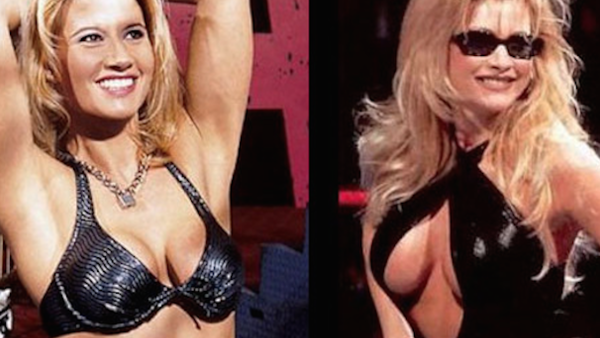
Transcending how women would be used on WWE television for better and worse, the stereo ascensions of both Sunny and Sable between 1995 and 1998 saw a door kicked down when it looked permanently locked.
In binning the Women's Title on a December '95 edition of WCW Nitro, Alundra Blayze seemed also to trash Vince McMahon's interest in women's wrestling altogether. Not only did the boss not immediately fire back with a selection of matches designed to highlight how his company would be just fine without her, he doubled down by not even reintroducing a new title.
The role of a woman in his product would have been obsolete had it not been for Sunny's striking emergence alongside real-life partner Skip in 1995. Prodded by Vince Russo and others, Sunny's sex appeal was pushed as her U.S.P by early 1996, in line with the arrival of Sable as a Miss Elizabeth for the modern age alongside 'Wildman' Mark Mero. By late-1997, Sunny was the golden goose of a burgeoning online presence for the company, whilst Sable's transition to voluptuous vixen was completed by surgeons and scriptwriters alike.
Amidst a raft of personal problems, 'The Golden Haired Fox' would permanently depart WWE in 1998 as Sable became second only to Stone Cold Steve Austin as the marquee performer of the Attitude Era. Neither ever claimed to have mastered any technical proficiency, but their pioneering performance skills salvaged the wreckage of potential destitution.
5. The Main Event

2004 was arguably the most destructive ever year for WWE Women's wrestling, more so than periods in the 1980s and 1990s where the very concept didn't exist.
Bored of trying to have his cake and eat it - open-mouthed and all - too, Vince McMahon tired of trying to make his wrestlers be bikini models and instead flipped the script entirely with his 'innovative' Diva Search.
Money and fleeting fame welcomed winner Christy Hemme, though the contest's rough edges cutting through weeks of valuable television time infamously set a hope for future female dominance back to square minus one. Sex, sleaze and an anti-feminist agenda flooded WWE programming for an entire summer (as it would do for several years following the alleged success of the original), replacing and reducing the hard work from the likes of Trish Stratus, Molly Holly, Jazz, Victoria and others to give the Women's Title a semblance of prestige.
Its last gasp for a generation came in a choice December 2004 Raw main event between Stratus and longtime foe Lita. The two closed the show (a first for a women's singles match) in a heated brawl notable for Stratus' fabulous heel persona bursting through her obtrusive nose-guard and Lita's frightening botched dive that literally folded her in half at the neck.
It betrayed a damning near future for WWE Divas, but for a split second, they mattered more than most once again.
4. Hard Reset

WWE were deeply flawed in their belief that having groups of three fighting and endless rotation of heatless battles would somehow fix the deep-rooted issued in their Women's division, but the July 13th debut of Charlotte, Becky Lynch and Sasha Banks on Monday Night Raw was a legitimately surreal paradigm shift.
Stephanie McMahon had to take credit for their introduction because of course she did, but the instant things became physical, the NXT alumni were immediately earmarked as the ones to watch.
In the segment alone, their shining moments dwarfed the spots of those currently in the spotlight. Nikki Bella threw lame punches whilst sister Brie unleashed a Thesz Press Steve Austin could probably have topped six seconds after neck surgery. Banks responded with fierce running knees on every woman seeking solace in corners, not once looking back to survey her damage. Lynch fired back with wicked springboard strikes, whilst Charlotte caught Alicia Fox's flailing axe kick and locked her in a Figure Eight.
The hold triggered a memorable visual in which the three starlets trapped the 'Team Bella' bullies in their trademark submission holds. Barely a minute into their main roster careers, they'd literally and figuratively had the division in their clutches.
3. Taking Over

Weeks after Sasha Banks had lit up the main roster, she threw herself into what she believed would be her NXT swan-song as the semi-main event of TakeOver: Brooklyn against ultimate underdog Title challenger Bayley.
It was, without hyperbole, the most important women's match in WWE history.
An evocative and exhausting battle, Banks and Bayley engaged in something resembling a the perfect blend of a Flair/Steamboat struggle and Austin/Hart tussle for the modern age. Forced to follow a seemingly never-ending stream of improving TakeOver women's matches, the pressure was huge on the pair as they took the stage for NXT's first flirtation with full-size arenas. 'Overachieving' would be the understatement of the century.
Like any truly beautiful pro wrestling match, consistent character work gracefully intertwined with the wider narrative arc. Bayley entered with a broken hand, wrapped in the polka dots of dearly departed mentor Dusty Rhodes. 'The Boss' spat at the sentiment and her opponents fragility, ripping away the protective material to zero in on the weakness. Forced to dig deep within herself, 'The Hugger' survived the ungodly onslaught, made worse when a 'Banks Statement' escape attempt resulted in the brutal stamping of her injured appendage.
The two shed tears alongside colleagues and friends Becky Lynch and Charlotte following Bayley's historic win. Within a year and a day of the match, all four would be the cornerstones of the main roster. Tellingly, none of the quartet have yet produced something quite as powerful. Though three of them came close...
2. Diva Death

A crucial part of the 2015/16 reimagining of main roster women's wrestling, the WrestleMania 32 reintroduction of a 'Women's title to replace the existing Divas belt marked an unsubtle but important milestone.
Representative of the sharp upswing in bell-to-bell action if not creative direction, the Triple Threat match between champion Charlotte, Becky Lynch and Sasha Banks just about lived up to the lofty billing it received as WWE overreached in their efforts to be thought of as progressive.
Lita's reveal of the new title belt on the Kickoff show was particularly poignant in highlighting how few bonafide stars had escaped through the division's darkest days to prosper in the bright lights of its future. A minority figure alongside Trish Stratus when the focus shifted back from wrestlers to models in the mid-2000s, her own on-screen exit was one of the company's more ugly and misogynistic black-spots in stark comparison to the respectful send-off they'd afforded Stratus just months earlier.
Historic whitewashing rightfully positioned her as an important figure in a clunky evolution, passing the torch to three new trailblazers. For once, WWE's bombast and bluster wasn't total bullsh*t.
1. Gimmick Infringement
The Royal Rumble won't be the first pay-per-view in recent times to have its signature showdown shared with the women's division for the very first time.
The Survivor Series admirably afforded significant airtime to the aforementioned mid-1980s 'Ladies' league midway through the inaugural edition of the show, and would continue promoting multi-women matches on the Thanksgiving Classic with mixed fortunes.
Its perhaps due to certain November nonentities that the women weren't extended the opportunity to work a Royal Rumble up to this point, nor receive the chance to test their mettle and metal in Hell In A Cell or Money In The Bank until 2016 and 2017 respectively.
As she did on the main roster with Charlotte in December 2016, Sasha Banks went 30 minutes with Bayley in 2015's NXT TakeOver: Respect headliner. The spectacular Full Sail University battle closed the show, and whilst its unlikely that January's pay-per-view will end with a woman pointing at the WrestleMania sign, 'The Boss' will likely feature prominently in another huge checkpoint.
There's no current quality precedent, unfortunately. Expectations doomed the Cell show-closer to failure, but the Money In The Bank debut (and televised rematch) were enjoyable affairs despite the divisive first result. Their continued presence in the annual calendar remains the ultimate commitment from WWE that this time, they're playing for keeps.