10 Things You Didn't Know About How Star Trek Got Started
 The original Star Trek series made its TV debut on Sept. 8, 1966, and was cancelled three years later due to mediocre ratings. Yet instead of disappearing into a black hole, the show found new life in syndication, and its iconic characters became ingrained in our popular culture. But Star Trek as we know it almost didn't happen. Here's a look at 10 oddities in the show's rocky history.
10. Star Trek Was Social Commentary Disguised As Sci-fi
 Gene Roddenberry, a former L.A. cop, wrote numerous TV scripts during the late Fifties and early Sixties, especially for police dramas. But the networks wouldn't let him touch on controversial topics such as war, sexuality, and racial prejudice. Roddenberry decided that in order to address social and political issues, he would have to create his own series and set it in the future. That way, he could use allegory to comment on current events, and the network "suits" would never figure it out. Nichelle Nichols has recalled that about halfway through the first season, she approached Roddenberry and said, "I know what you're really doing, Gene. You're writing morality plays, aren't you?" And he whispered, "Shh don't tell anyone."
9. If At First You Don't Succeed, Try Again Star Trek is one of the few TV series to have two completely different pilot episodes. The first pilot, "The Cage," starred Jeffrey Hunter as Capt. Christopher Pike and was filmed in late 1964. NBC rejected it in February 1965, calling the story "too cerebral." Yet some NBC executives were intrigued enough by Star Trek's premise to ask for and pay for a second pilot. This time, Roddenberry hired Canadian actor William Shatner to play Capt. James T. Kirk. "Where No Man Has Gone Before" made up for the first pilot's alleged deficiencies, offering more action and humor. Second time's a charm; the network went for it. And "The Cage" didn't go to waste. Later in the first season, much of its footage was incorporated into "The Menagerie," Star Trek's only two-part episode.
8. Captain January, Anyone? How About Captain Flagg? Roddenberry didn't want Shatner to simply replace Hunter in the role of Capt. Pike. Instead, he chose to create a new commander for the Enterprise and that meant coming up with a new name. Roddenberry compiled a list of possible last names, including the aforementioned January and Flagg. Also under consideration were Drake, Christopher, Thorpe, Richard, Patrick, Raintree, Boone, Hudson, Timber, Hamilton, Hannibal, Neville, and North. Fortunately, the producers settled on the shortest name on the list: Kirk. In hindsight, it's hard to imagine the crew answering to a guy named Hannibal or Timber. And the prevalence of macho, outdoorsy names like Boone and Hudson seems to reflect the popularity of TV Westerns during the 1960s.
7. Spock Was Almost A Martian In Roddenberry's original proposal for Star Trek, Spock was accurately identified as "the Captain's right-hand man." But the character's description hardly resembles the Spock we came to know. "The first view of him can be almost frightening," wrote Roddenberry, "a face so heavy-lidded and satanic you might almost expect him to have a forked tail. Probably half Martian, he has a slightly reddish complexion and semi-pointed ears." The red makeup looked awful on camera, so they switched Spock's skin color to light green. The pointed ears remained, despite vehement objections from the network. In fact, somebody at NBC infamously airbrushed a publicity photo to make Spock's ears look human.
6. So Now He's Vulcan? What's That?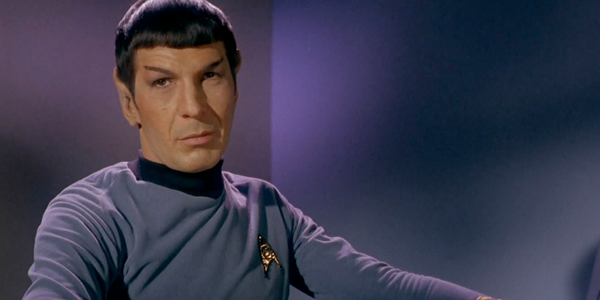 It took most of the first season to establish ground rules about the Vulcan species, culture and home planet. Early on, Spock was called a "Vulcanian." In his first scene with Kirk, he admits that one of his ancestors married a human female, but doesn't mention that the two people in question were his parents. Gradually, we learned the most intriguing fact about Vulcans: They have strong emotions, but they attempt to suppress their feelings and achieve a state of pure logic. This dichotomy created endless dramatic possibilities, but with Spock, it was even better: He's half-human, so he's always at war with himself. Brilliant! The first season introduced us to a couple of unique Vulcan abilities: the mind meld, through which a Vulcan may share consciousness with another being, and the neck pinch, which can instantly incapacitate a person. It wasn't until the second season that a bizarre quirk of Vulcan biology was revealed: The males have to mate every seven years, or they'll die.
5. The First Star Trek Episode To Air Was Not The Pilot Five episodes were "in the can" when the producers had to decide which to broadcast first. For various reasons, four of them were deemed not to be a suitable introduction to the world of Star Trek. By default, "The Man Trap" was selected as the debut episode. Viewers were generally not impressed. "The Man Trap" is a standard space-monster story about a "salt vampire" attacking crewmembers, and the plot unfolds at a snail's pace. The pilot, "Where No Man Has Gone Before," was the third episode to air, creating some confusion because its retro costumes looked different from those worn in the rest of the series. It also featured a somewhat different cast. McCoy and Uhura weren't there yet. Sulu made an appearance, but his job title was physicist, not helmsman.
4. DeForest Kelley Was The Third Actor To Play The Ship's Doctor In "The Cage," the chief medical officer of the Enterprise was Dr. Philip Boyce, played by John Hoyt. The actor was unavailable for the second pilot, so Paul Fix was hired to play Dr. Mark Piper. Both guys looked as though they were ready for a retirement home, in contrast to the rest of the Enterprise crew, who appeared young and fit. So Roddenberry hired DeForest Kelley to portray Dr. Leonard McCoy. "Bones" was intended to be about 45 years old closer in age to the 34-year-old Jim Kirk, so they could realistically be friends. All three of the doctors had the same basic character profile. They were curmudgeonly humanitarians who distrusted modern technology and believed computers could never replace genuine, face-to-face contact. What set De Kelley apart from the other two actors was the sense of humor and playfulness he brought to the role.
3. The Star Trek Theme Music Had Lyrics http://www.youtube.com/watch?feature=player_embedded&v=hdjL8WXjlGI Alexander Courage's "Theme from Star Trek" became one of the most recognizable tunes in television history. But most viewers don't know that the song had lyrics, penned by Gene Roddenberry. In fact, even Courage didn't know at first. Turns out Roddenberry wrote words for the song, not intending to ever use them on the air, because it allowed him to earn 50 percent of the royalties. Courage was reportedly enraged, calling Roddenberry "unethical," but he never filed a lawsuit. We, the viewers, are the winners, because we weren't subjected to Roddenberry's wretchedly bad poetry. How bad? Here are the opening lines of the song: Beyond the rim of the star-light My love is wandering in star-flight I know he'll find in star-clustered reaches Love, strange love a star woman teaches... You get the idea.
2. The Transporter Was A Money-Saving Device It seems like one of the coolest sci-fi ideas ever: What if you could travel from one place to another by dematerializing your atoms and rematerializing them somewhere else? Think how much time you could save if you didn't have to rely on vehicles to get around. But Roddenberry didn't decide to have crew members "beam down" because it was a futuristic thing to do. The truth is, he simply didn't have enough money in the special-effects budget to send shuttlecraft to and from a planet surface every week. Plus, traveling by transporter beam is almost instantaneous, which allowed Roddenberry to skip the logistics and get straight to the storytelling.
1. At The Time, Star Trek Was The Most Expensive TV Show In Production Before Star Trek, all science-fiction TV series had been anthologies such as "The Twilight Zone." They had a different setting and characters each week, and could be filmed anywhere. Star Trek was the first sci-fi show to have a regular cast and permanent sets. But when Roddenberry set out to create an entire universe 300 years in the future, he didn't foresee the implications. He soon realized that because the show had to look futuristic, nothing from the 20th century could be used. Costumes, props and furnishings all had to be designed from scratch. This, of course, was prohibitively expensive. And NBC didn't want to spend more on Star Trek than it did on any other TV show. So the production crew had to find creative ways to cut corners. That's why Dr. McCoy's surgical instruments were actually salt shakers, and why the tribbles had no eyes or feet. As always with Star Trek, necessity was the mother of invention.