10 Fragile Star Trek Villains YOU Could Beat
Yes, even you could beat them.

When Star Trek first aired in 1966, it helped shape the sci-fi genre and over the last 54 years countless fascinating heroes and villains have been born of the franchise. Great stories have great conflicts, and striking villains like the Borg are held up as examples of the strong writing of the show. There are countless examples of ground breaking strong antagonists... but equally there are examples of villains that languish in failure.
While, Star Trek is known for its daring conflicts and fierce antagonist, the franchise is also known for being campy and comedic - featuring villains who aren't much of a fight. Sometimes the antagonist are too dumb to be a real threat, have no defense against attack, or have a "kryptonite" that is readily available to the protagonists. Other times an episode clearly tried to portray a strong, compelling villain, but didn't think through some basic foil that should have made the antagonist easily handled by starfleet.
Let's look at some of those villains who were weak, incompetent, and easily bested in their plans - fragile villains that even you could confidently take on.
10. Space Hippies - TOS

The Way to Eden (TOS) introduces us to some memorable antagonists fans call "space hippies" - for obvious reasons. These groovy, hate the man (or Herbert as they call anyone who's too authoritarian), youths are always ready jam out with their sci-fi chordophones. They are also trying to find their way to the mythic planet Eden, regardless of what they have to do to get there.
Recently beamed on to the Enterprise, the space hippies hardly seem worthy foes for Starfleet. Yet, they manage to exploit some massive security issues on the ship. Using a musical performance as a distraction, the space hippies strategically knock out some crewmen and use the intercom to blast an ultrasonic frequency until everyone's unconscious.
Any mortal means could easily take down the space hippies, and their leader, Dr. Sevrin, is the weakest of them all. He's trying to find Eden because artificial environments have caused him to carry a contagious bacterium and he's convinced nature can cure him. Spoiler: it can't. As Spock says, "Dr. Sevrin is... insane."
The planet of Eden kills Dr. Sevrin just as easily as you could: with poisoned food. Turns out all the lush nature of Eden is full of deadly acid.
9. Vendorians - TAS

The villain of The Survivor (TAS) is a Vendorian who has taken the form of a now-dead human named Carter and is allied to the Romulans. Being able to shapeshift into any animate or inanimate of a similar mass (including a deflector field) should make him a dangerous antagonist. Turns out Carter isn't very savvy about how to strategically use his shapeshifting.
When Carter tries to hide as an inanimate object he makes the bizarre choice of becoming an examining table in a room that normally has only two tables. This is obviously noticeable. When threatened with acid, the Vendorian doesn't think to turn himself into something immune to acid.
Sentient forms cause different problems for Vendorians. When they first take on a new shape they have only a vague idea of the personality of who they mimic. Spock and Captain Kirk are able to recognize a fake Dr. McCoy quickly. If a Vendorian stays in a sentient form for too long they begin to permanently take on the memories and emotions of the being they mimic.
This is the undoing of Carter. He recalls the romantic feelings, the human whose form he wears had for one of the woman aboard the Enterprise. Carter gives viewers an easy roadmap to defeating a Vendorian: just wait for them to inevitably make a stupid mistake that gives themselves away and then capitalizing on it.
8. The Pakleds - TNG

The Pakleds appear to be a slow-witted alien species, because they are. They make up for their lack of raw intelligence with an ambitious conniving and willingness to lie to get what they need. The Pakleds are scavengers, the technology they have is developed by others. They don't need to understand how things work because they steal or convince others to do the work for them.
In Samaritan Snare (TNG) the Pakleds send out a distress signal, pretending that their ship is in need of repairs. Riker is taken in by the childlike mannerisms of the Pakleds and La Forge is sent to help the seemingly harmless aliens. Once on the ship, La Forge is kept captive. The Pakleds plan to use him to help them "make their ship go" and to make weapons.
While the Pakleds have some cunning their lack of any sort of smarts makes them easy to defeat. A bit like being captured by a bunch of six-year-olds, their ability to reason only goes so far. In this case The Next Generation crew is able to discuss their rescue plan openly in front of the Pakleds, who remain oblivious.
7. The Kazon - VOY

The Kazon are an alien race created to be a primary antagonist of Voyager. They were unpopular characters in and out of the show. Meant to be based on the conflict between the Bloods and the Crips, the Kazon had some troubling implications if taken as a direct allegory - but like modern gangs they had multiple sects with much infighting.
The Kazon had once been technologically advanced for their space region, but they ended up being subjugated by the Trabe. The Kazon were treated like animals and the Trabe encouraged them to fight amongst each other, so that they wouldn't organize an uprising.
Eventually, the Kazon escaped, living as nomadic people, free from the Trabe but not free from their own self-inflicted violence. Their poverty only heightened their fighting and instability. Their resources were scarce enough that one sect tried to barter for water.
Warfaring and territorial, most of their energy is spent on their own splintered communities. To put it mildly: the Kazon are their own worst enemies. The Borg themselves decided to Nope out of that one, and not assimilate with the Kazon. They are an antagonist whose best defeat is just to leave them to their own devices. Which, eventually, the show itself did, and the Kazon plot line was dropped after the second season.
6. Shinzon - Star Trek Nemesis

In an interview with Variety, Patrick Stewart compared the experience of Logan with his experience on the film Star Trek: Nemesis "It was the best ‘X-Men’ experience we both had, because we were the same characters but their world had been blown apart...Next Generation’ didn’t end like that. In fact, our last movie, ‘Nemesis,’ was pretty weak." Weak also, was film's antagonist Shinzon.
Shinzon was a clone of Picard created by the Romulans for nefarious purposes. Realizing this was a stupid plan, the Romulans abandoned Shinzon to a life as a slave working in the mines. Shinzon has smarts, an awesome sci-fi weapon and grand plans of vengeance, but he is human and can be killed as easily as any other human. In the film he finally dies by being stabbed by Picard with some ship debris.
Even if any normal injury couldn't kill him, he has another major disadvantage: his clone DNA is deteriorating. Unless he has a compete blood transfusion with Picard he will die. Simply keep Shinzon isolated from Picard and his own body will do himself in.
5. Salt Vampire - TOS

Dubbed by fans as the Salt Vampire, this villain was introduced in The Man Trap (TOS). Not a traditional shapeshifter, the Salt Vampire uses some sort of hypnotic visions to create an illusion of someone their target knows. So, multiple people in the same room can each see the Salt Vampire embodying the form of a different person.
The creature is sentient, but to what extend their victim fills in the blanks of the conversations and illusions they see and hear, and how much is strategical intended by the alien is unknown. What is known is that the alien needs salt and lots of it.
While it can survive on salt tablets (and has been prior to the start of the episode) it prefers to suck the salt out of living creatures - leaving a trail of bodies on the Enterprise. At the end of the episode, Dr. McCoy shoots the Salt Vampire with a phaser gun: demonstrating that killing the creature through normal means isn't the problem. The problem is finding a creature who can convincingly appear as someone else.
Eating an extra salty meal might help lure the salt sucker to you, but the best bet of identifying the alien is with the use of a carnivorous beauregard plant, like the one Sulu tends to named Gertrude. For some reason this type of plant reacts to the Salt Vampire when it comes within a radius of some ten to twenty feet of it.
4. Xindi Eggs - Enterprise

Xindi refers to six different alien species who all used to live on the planet of Xindus. Five of the species survived the destruction of their home, despite a tenuous relationship they have remained allied. The Xindi can be fierce fighters and on one occasion killed million of human in an attack on Earth.
In Star Trek: Enterprise Hatchery the threat of the episode is perhaps the least threatening version of the aliens one could imagine: some eggs. If you think that some fragile insectiod eggs in an unprotected hatchery, with only enough power for a few more days of egg-bio-support would be easy to defeat... You'd be right.
Burn them with fire. Leave them to die on their own. The possibilities are really endless. The only actual defense the eggs have is a pheromone spray which causes the recipient to reverse-imprint on the eggs: so they feel a need to protect the defenseless Xindi young. Which is exactly what happens. Lucky for the eggs, they end up spraying Captain Archer and not some random ensign.
The other thing that inadvertently works in the favor of the hatchlings, is that the MACO (military) personnel stationed on the Enterprise are trained to follow orders. So, despite the increasingly ill-advised decisions Captain Archer is making, follow orders they do.
Considering that the insectoids just want to survive being born, maybe it wasn't such a bad thing Archer goes temporarily baby crazy.
3. Flying Parasite - TOS
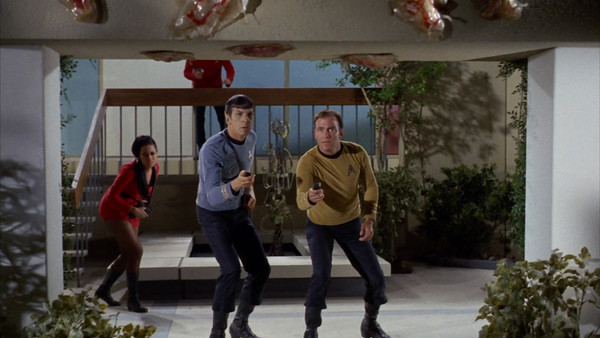
Introduced in Operation - Annihilate (TOS), these parasites could fly and when attached to a host, they would force the victim to bend to their will. The pain caused by the parasite eventually causes insanity in its host and death follows soon after. Not a fun way to go. On top of that, the neural parasites are barely affected by phaser fire and appears nearly indestructible.
Things seem dire for the Enterprise crew when they are attacked, and Captain Kirk has a personal beef with these villains: they caused the death of his brother and sister-in-law. Despite the high emotional stakes, turns out the way to kill the little crazy-makers is so easy it's hard to believe how many planets and people were driven mad by the parasite.
To do this deadly creature in -all you need is some UV light. Not even dangerous amounts of it that might cause damage to people, just regular old UV light. So, get yourself some UV lamps, or maybe an arc welder if you're feeling extra snazzy, and go to town killing these deadly critters.
2. Tribbles - TOS

Trouble with Tribbles (TOS) first introduced Tribbles into the Star Trek canon, and trouble they are. Tribbles are non-sentient slow-moving peaceful creatures that make a pleasant purring noise that all different kinds of aliens find soothing (not Klingons, though, they hate the buggers).
Despite their seemingly harmless nature, there is a reason Tribbles are illegal to transport. The main trouble with Tribbles is that they are born pregnant and reproduce at a startling rate. According to Spock they average one birth every 12 hours, and normally have about 10 in a litter. Meaning within three days the Enterprise is quickly overrun with some 1,771,561 of the fluff balls.
While, the Tribbles give the crew of the enterprise a whole lot of headache (filling up the ship, and demolishing the supply of grain the crew was meant to be protecting), this episode also demonstrate how fragile they are.
Tribbles have no natural defense besides their cuteness. Poisoned food easily kills them, as would beaming them out into space. Or you could go Scotty's route and introduce the Tribbles to one of their natural enemies by transporting them onto a Klingon vessel and letting nature run its course.
1. Ba'ul - DSC

In Star Trek: Discovery, Sound of Thunder, our protagonists find themselves on Kaminar. This is the home world of Saru, the first (and maybe only) Kelpien to join Starfleet. The docile Kelpiens share their planet with the predatory Ba'ul and see their role as prey animals as the natural order of things.
While the menacing Ba'ul have technology on their side - arguably they aren't as strong or difficult to defeat as they appear (despite having an entire population under their dominion). It turns out that Kelpiens aren't innately prey creatures, and this was all a nice bit of propaganda started by the Ba'ul.
The Kelpiens believe that when they go through vahar'ai, they will die. In order to keep the "Great Balance" their faith tells them to submit themselves to the Watchful Eye and give up their lives peacefully in order to sustain the Ba'ul and the balance of their world. In actuality, vahar'ai is simply the next stage of Kelpien growth: in which their fear melts away and they move from being prey to predators themselves.
The Ba'ul were so fearful of what a low-tech species that had the capacity to fight would do to them -they spent over 2,000 years promoting generations of religious dogma to convince the Kelpiens to essentially commit suicide for the Ba'ul's benefit. A bit of grit, fight, and some basic technology seems to be enough to cut down the Ba'ul.