14 Dumbest Things In Star Trek Generations
Is anything in this movie dumber than dropping a bridge on Captain Kirk? You bet your Nexus!

Let's face it, Star Trek: Generations is a jumble of disconnected elements that aren't particularly interesting on their own and fail to come together as a coherent or compelling story. The writers, Ronald D. Moore and Brandon Braga, have acknowledged that they were handed a checklist of must-haves for the film, which hindered the resulting screenplay. The pair wrote the feature simultaneously with the series finale “All Good Things...”, which made it difficult to give the film the attention it required. Compounding this, neither of them had prior experience writing a feature film, which is a different beast compared to a TV episode, so they were out of their element.
For all that, the fundamental issue with the movie lies in the contrived mechanism they devised to bring Kirk and Picard together: the Nexus. It’s an Anything Muppet that does whatever the story requires at a given moment, no matter how unbelievable, nonsensical, or just plain dumb. It’s so dumb I could write 14 items about it alone.
But hey, there's plenty of other dumb aspects to this film, so let's make sure we have some space to discuss those too!
14. The H.M.S. Holodeck

Between 1979's Star Trek—The Motion Picture and the 2009 reboot, the various and sundry Star Trek movies were always middlingly budgeted affairs, as Paramount knew they typically pulled in a bit north of $80 million US, and a movie’s box office has to at least double the film’s budget just to break even.
But movies aren’t TV episodes, so it was necessary to spend some of the film’s budget to open things up beyond TV scope. So we got the introductory sequence featuring The Next Generation crew on an actual sailing ship merely on the weak pretext of dropping Worf and Crusher in the drink and to establish Picard’s romanticism of the past. As such, it ends up a pointless, gratuitous sequence that isn’t half as charming as it thinks it is.
Worse, it exemplifies a problem that permeates every TNG cast movie: that it caters to fans at the expense of a broader audience. Does Worf’s promotion matter to the story? No. Does the holodeck? Nein. Do the Duras sisters? Nyet. All appear only for dedicated fans and mean nothing to the casual viewer. And the more they did this, movie after movie, the fewer causal viewers they were going to get.
Dumb.
13. TOS-sed Word Salad

Mssrs. Moore and Braga were clearly out of their element trying to write dialog for the TOS period and characters in the film. Sure, the dialog Scotty and Chekov played was originally written for Spock and McCoy (more on that later), and not rewritten to fit the characters who ultimately mouthed it. So what comes out of their mouths is woefully out of character. I mean, Chekov literally assigns journalists to be “nurses” and drags them down to sickbay fer chrissakes.
Worse still is the Enterprise-B scenes are awash in the grand tradition of "[tech] the [tech]" gibberish; Next Gen's worst impulse. It’s all “gravimetric distortions,” “quantum interference” and “venting plasma from the warp nacelles.” They even give Scotty the most un-Scotty like line imaginable. “It may be possible to simulate a torpedo blast using a resonance burst from the main deflector dish.” That line would have been out of character even for Spock!
In his 1996 memoir, Beam Me Up Scotty, Doohan commented on the subject:
Let’s say the engines are in trouble. Geordi will say, “If I can reroute the isometric ion pulse through the engine core, then maybe I can temporarily backload the matter-antimatter resonance.” Scotty would say, “Ah’m holdin’ ’em together with spit and bailing wire, Captain, but it won’t last for long.”
You tell ‘em, Doohan.
12. Sugar Glass

Upon the Enterprise saucer crashing on Veridian III we see a number of interior shots depicting overhead windows shattering. Even assuming the windows are made of less durable stuff than the hull, why do those on the upper surfaces of the ship break when we can clearly see many windows on the leading edge of the saucer—which smashed through hills and took out countless large trees in the process—are all intact?
And how is it that the bridge skylight, some 200 meters back from the leading edge and pointed straight up, breaks? What are they made of? The easily smashed sugar glass used for scenes where stunt performers get thrown through windows?
Dramatic? Maybe.
Dumb? Definitely.
11. The Nexus Moves At The Speed Of The Plot

The Nexus ribbon’s velocity varies for plot convenience. Data says it passes through our galaxy once every 39.1 years…so where is it the rest of the time? Circling around the Local Group of galaxies? Making side-trips to Andromeda?
For it to pop through our galaxy so frequently suggests the damned thing is traveling at Ludicrous Speed, and should flash by stars in the blink of an eye. So how come it apparently slows down to subsonic speed in order to scoop up Picard and Soran? Yeah, sure, someone can make an argument that its velocity varies depending on its proximity to a gravity well or a host of other rationalizations, but none of that’s in the movie.
Maybe we’re lucky the script doesn’t attempt to address this. The last thing this movie needed was more dumb technobabble.
10. Kirk Plays As Shatner

Even in his Nexus fantasy, Kirk cautions Picard not to accept promotion out of the captain’s chair, to stay where he is and can make a difference. That’s exactly in line with what we saw Kirk doing in the opening sequence on the Enterprise-B, right? So given that, why in the name of Hell would Kirk’s fantasy be set anywhere but on a starship? He ought to have been back on some version of his Enterprise, Spock, and Bones at his side, having a TOS-style adventure.
In fact, the opening scenes of the film were originally conceived and scripted to bring the Big Three of TOS back, but both DeForest Kelley and Leonard Nimoy turned down the opportunity to reprise McCoy and Spock for pointless cameos. Having them appear as illusory versions of themselves counseling him as they always did might have made the roles compelling enough to merit them signing on.
But, no, instead of Shatner playing Kirk, we’re given Kirk playing Shatner, pandering to the actor's equestrian interests...almost none of which has anything to do with the character of Captain Kirk.
9. Modesty Forbids
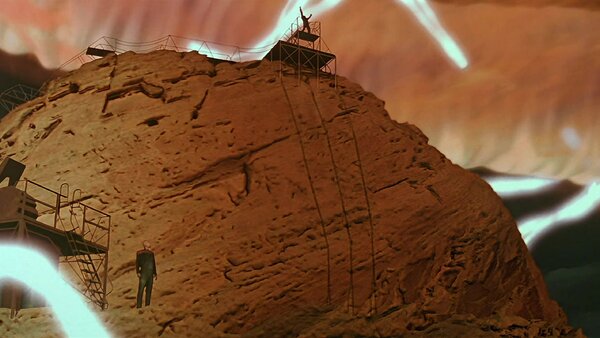
Like Bruce Banner’s trousers, which survive his Hulking-out without being torn asunder in a wardrobe malfunction for the ages, the Nexus preserves modesty by being incredibly selective about what it scoops up and what it doesn’t.
On Veridian III it scoops up both Soran and Picard but leaves the rocks and Soran’s scaffolding completely intact. Just how does that work? This ribbon of spaceship-crushing joy selectively picks up not just the men and their clothing while managing not to collect bits of what they're standing on? It’s hard enough to buy that the transporter can do it to this degree, but at least that’s plugged into a supercomputer. So how does the Nexus know to collect Picard’s boots, rather than stopping at his socks? Is it intelligent?
Modesty is fine, but when a galaxy-surfing phenomenon knows to do it, it’s plain stupid.
8. That’s Some Mighty Stellar Cartography, Mr. Data

There’s zero indication that the Federation has much understanding at all of the Nexus, so how is it that Data can get the computer to project how the destruction of the Veridian star will alter its trajectory?
Of course, the simple, logical solution is staring us right in the face, but the movie misses it. While in stellar cartography, Data and Picard are trying connect the implosion of the Amargosa star to the Nexus, and had Data noticed that the Nexus was not quite where it was projected to be based on previous data, then we could buy that he could deduce that the alteration of gravity resulting destruction of the Amargosa star was the key the Nexus’ deviation. And from that he could logically project how the potential destruction of the Veridian star would alter its course to skim Veridian III. Simple.
But, no. Who needs to show the characters figuring things out when Picard can just make a mental leap and Data can inexplicably project a course with no real, er, data?
7. Data's Over-Emotional Chip

From his first appearance in the series Data professed a desire to be more human, and his emotion chip seems just the ticket to that dream. The film had the opportunity to not only explore the reality that these newfound emotions aren't what he expected but to have an arc wherein how he deals with their reality could have effectively reinforced or counterpointed the Nexus, which likewise concerns people fulfilling their fantasies and—at least for our heroes—finding such illusions unsatisfactory.
Sadly, the film doesn’t do anything interesting with the idea, just playing Data’s being overwhelmed and going for comedy by having him say or do things that would otherwise have been out of character.
And, honestly, would new emotions alone trigger someone who’s never employed profanity to suddenly curse? Well, it would if all you’re after is a cheap, dumb laugh.
6. That The Space Battle Lasts More Than 10 Seconds

That the mighty USS Enterprise gets taken down by a lowly, ratty Klingon Bird of Prey was ironic the first time it happened back in 1984 but doing it again a decade later wasn’t just lazy, it was dumb. In The Search for Spock, it was believable because the starship was in a bad way with less than a skeleton crew, and Kirk literally blows the ship to bits to take out as many bumpy-headed space Vikings as he can. In Generations, the Enterprise-D is in perfect working order, and the only reason it’s mortally wounded is the utter incompetence of the writing and how that trickles down to the crew.
When the Dumbass, er, Duras sisters are able to get torpedoes through the Enterprise’s shields by learning their frequency, what does William T. Riker, in command of the mightiest ship class of the time do in response? He orders evasive action and to fire the phasers…which the ship does only twice. The ship then turns around while presenting a big, fat, stable target. He doesn’t think to, oh, call me crazy, change the shield frequency, or do logical things like go directly to warp and zip past the Klingons and out of the line of fire, or—to quote Nero in Star Trek 2009—”fire everything!” With so many options before him the script forces Riker to fight it out at putt putt speed just so the Enterprise can lose. Had Riker not been tossed the idiot ball he’d have ordered Worf to open up an economy-sized can of Whoop-Ass on the Duras sisters and pounded them to Klingon Come.
But nope, the movie falls back on the show’s lazy “[tech] the [tech]” trope and has them invent some convoluted way to lower the Duras’ defenses and lob one—one!!!—slow-motion torpedo at them. It’d have been far more satisfying, and less dumb, to watch the mortally wounded ship wipe the deck with the Klingons before it succumbed to its wounds.
5. Would You Trilithium?

In a movie full of nonsense science (ahem, Nexus, ahem), Soran’s trilithium missile and its effects take the cake. When launched it shoots off into the sky for about 9 movie seconds, and from there apparently gets to the star Veridian in five seconds. The star immediately flares and then is seen fading out for about 12 seconds.
But here’s the problem: stars are incredibly huge and dense. It apparently takes the average photon something more than one hundred thousand years to get from the core of our Sun to its surface. Yet, a few kilograms of this movie’s equivalent of much-ridiculed Red Matter (from Star Trek 2009) manages to kill an entire star virtually instantaneously, which means the effects of this stuff chain-reacts through its entire vast mass at light speed or greater. That’s not science, that’s thick-sliced baloney.
Even buying the preposterous notion that the star is magically insta-killed, the dying light from it still travels at light-speed. Mind you, the light from our Sun takes over 8 minutes to get from its surface to the Earth. For Veridian’s light to get to Veridian III in seconds that planet would have to be over 100 times closer to its parent star than we are from ours. How does a habitable Class-M planet exist that close to a star?
Mmm mmm mmm, toasty.
4. What The Dickens?

During the run of Star Trek: The Next Generation, Patrick Stewart began performing his one-man version of Charles Dickens’ A Christmas Carol, with the latter really smacking of the inspiration for Picard’s family Christmas fantasy in the Nexus.
And who’s this random woman we see as his wife? Is it someone who got away, like Kirk’s Antonia? Was it just some idealized fantasy character? For his initial Nexus fantasy to be Christmas in the middle years of family life, that’d have to be his most prominent fantasy. And if that's the case, why is he dressed in the same uniform he was wearing on Veridian III? Wouldn't his fantasy of a different life take him out of it?
And that fantasy as depicted makes no sense. The script calls for it to be held in a 24th century French house, but what we see in the film is a weird amalgamation of Victorian, Edwardian, and mid-20th century. The girls' gifts are antique-style dolls and stuffed animals, and the younger son gets the 1992 Aliens "Space Marine EVAC Fighter" from Kenner's toy line (so Picard's fantasy life reinforces outmoded gender stereotypes?).
And notice all the incandescent bulbs which you’d expect to see on A Charlie Brown Christmas’s tree. Why on Earth would Picard imagine such an odd conglomeration of Christmases Past unless we he was a closet Dickens fan? Or has he merely binged one too many Holomark Christmas specials?
Or maybe it was all just dumb pandering to Stewart’s interest in A Christmas Carol.
3. I Spy With My Little VISOR
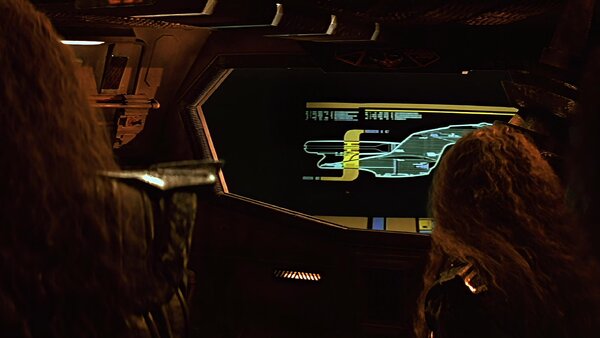
It’s really unbelievable that after being imprisoned, abused by Soran, and stripped of his VISOR, Geordi just goes back on duty without anyone bothering to scour every nanometer of his sight gizmo. Hell, Geordi himself ought to have been concerned that the VISOR might have been tampered with. It’s not just a pair of fashionable shades, after all, it’s an intel nightmare.
And speaking of the VISOR, even choking down the horse pill of an idea that this sabotage would work at all, the writers missed a great opportunity to milk this action for all its potential tension. The moment they realized the Klingons were able to fire through their shields Geordi should have rotated the shield frequency, and when the Klingons instantly matched that frequency change one or twice, put together what they did to his VISOR, rip it off and order someone else to change the frequencies, but too late to save the ship.
2. Anytime, Anywhere, All At Once

Time has no meaning here. So if you leave you can go anywhere, any time.
So said Echo Guinan in the Nexus. But just how does that work? How can anyone exit the Nexus in places it hasn’t been? The only way into it is via the ribbon rupture, but if you just will yourself out it knows just how, when, and where in time and space to put you, and how to do it safely? This isn't science fiction, heck, it’s not even science fantasy. It’s pure, unadulterated fantasy complete with magic.
And if Picard was really so distraught over the death of his brother and nephew, why not step out before the fire and warn them, then call up Starfleet and say “Hey this dude on the Amargosa station’s got a trilithium star killer and he’s working with the Klingons. You might wanna deal with that."
Instead, Picard jumps back to where he failed before, this time just bringing Kirk with him. Not to mention the wibbly wobbly, timey wimey-ness of him appearing where and when he was before entering the Nexus...except where did Picard from the previous go-around go?
God, temporal mechanics are dumb…
1. Mis-Stakes Were Made
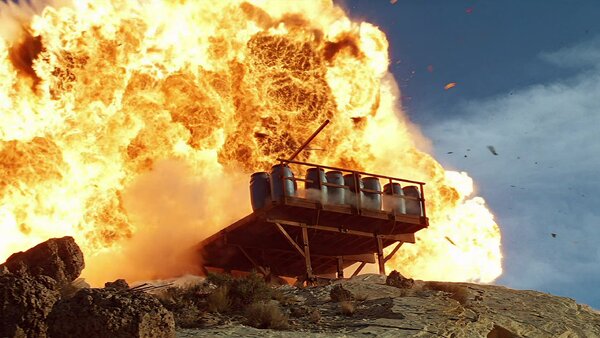
For all the Nexus stupidity, the biggest one is that, if you think about it for half a second, it creates a lack of true stakes at the end of the movie. Specifically, since Picard and Kirk can exit anytime, anywhere, there’s really no way they can fail unless both of them get killed. I mean, if it looks like they can’t stop Soran from launching the missile all they have to do is let themselves be scooped up by the Nexus, jump back out, and try again.
Hell, the first time they arrive they could just go into hiding, spy on Soran’s movements, figure out when he’s the most vulnerable, go through the Nexus revolving door, and then do the deed.
And if that didn't work? Wash, rinse, repeat as needed til Soran fails or goes boom.
Did I mention that temporal mechanics are dumb?
Temporal mechanics are dumb.