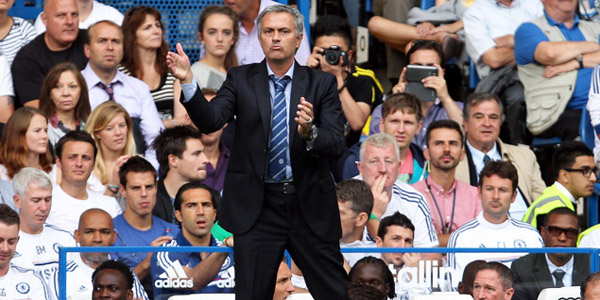
Chelsea's 1-0 victory over Everton on Saturday was the deserved result of a dominant team's battling performance, fighting to victory against an opponent determined to sit the game out for a point. Or at least, that's the narrative Jose Mourinho would like you to believe. The truth is that Chelsea were lacklustre for large stretches of the game, creating little against Everton's outstandingly organised defence and needing Petr Cech to be at his best against several dangerous counter-attacks. Mourinho certainly deserves enormous credit for instilling his team with a never-say-die work ethic and greater defensive discipline than the schizophrenic Chelsea sides from virtually every season since the departure of Carlo Ancelotti, but while the Blues remain difficult to beat, there is an increasingly strong sense that they are altogether less confident in their attacking play and opponents are wising up to them. It's a difficult case to make while Chelsea are sitting top of the table, albeit assuming that Manchester City do not win their game in hand. Mourinho's teams have always achieved success through graft rather than grace, a model which appears on the surface to be working wonders again this season. The problem is when you look at the problems Chelsea have endured this season, how many of them have come as a result of Mourinho's decision making, and how likely they are to grow in prominence next year, or the year after. In order to better examine the problems facing Mourinho now and in the future, this article is divided into four sections: this introduction, a Tactical Analysis on Page 2, his self-imposed Lack Of Options on Page 3, and a look at how Teams Change on Page 4.
3. Tactical Analysis
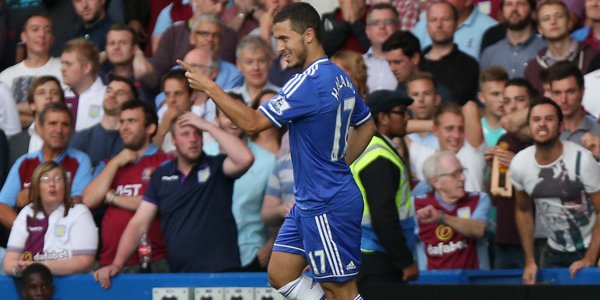
At the beginning of the season, Mourinho promised his side would play vibrant attacking football. This never quite materialised, half an hour against Hull City excluded, and the manager looked distinctly unsure how to meld his ingrained need for discipline and organisation with the free-flowing offensive play craved by the fans and, more importantly, club owner Roman Abramovich. When results started going against him, he returned to the tactical model which had succeeded so many times before to restore defensive stability and get results back on track. This began around mid-December, following a 2-1 loss to Sunderland in the Capital One Cup and other unconvincing results against Basel, Stoke and Sunderland again, this time in the league. Mourinho set out his side to control possession and gradually draw teams towards them, opening them up to allow the pace of Willian and Hazard to charge forward on the break, playing one-twos with Eto'o or Torres up front to create space for runs into the box or shots from outside. With Willian moving from box-to-box on the right, Ivanovic moves forward for additional attacking support, while Azpilicueta hangs a little further back on the left to mitigate Hazard's more attack-focus play in cutting inside and linking up with his striker. Oscar hangs a short distance outside the area, ostensibly in the No.10 role, directing the play while ready to cover any counter-attacks. The midfielders behind him are the standard pair of a ball-winner (Matic/Mikel) and box-to-box man (Ramires/Lampard), with slight variations depending on the personnel. In defence, Terry always stays back while Cahill or Luiz offer a slightly more direct method of getting the ball at speed on the counter, with the ball-winning midfielder dropping deeper to cover, similar to how he retreats to form a back three when Ivanovic or Azpilicueta are supporting Willian and Hazard. The turnaround was quick and effective, leading to an unbeaten run lasting all the way to this month's 2-0 loss to Manchester City in the FA Cup. Yet while results have been positive, performances have become increasingly less so, with growing evidence that opponents have worked out Mourinho's gameplan and are starting to plot against it. The league victory away to a seemingly unstoppable Manchester City side is undoubtedly the club's finest result of the year, and Mourinho's defining tactical coup. It could also be surmised as the point at which the team's tactics started to become increasingly transparent, to the extent that City nullified the Blues completely in a 2-0 victory less than two weeks later while fielding a number of second string players.
2. Lack Of Options
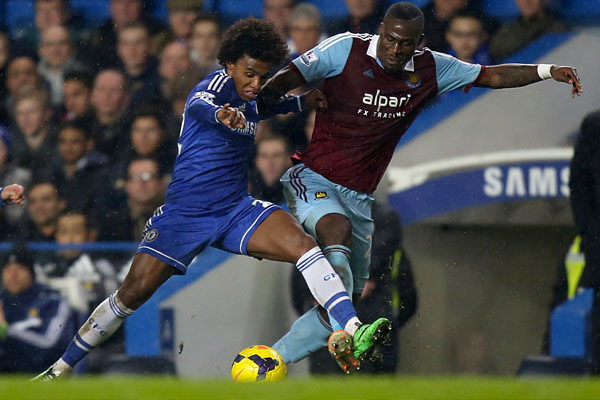
The problem is that Willian and Hazard both attack in very similar ways and have shown little ability in adapting their play to more conservative opponents. Mourinho's strategy is based around stretching teams so Hazard in particular has room to run into, yet recent matches against West Ham and West Brom (important games both unexpectedly drawn) and last Saturday's fortunate victory against Everton have shown defences staying increasingly tight as a unit, dropping their midfielders deeper to further close ranks and congest the penalty box and surrounding area. Since Hazard and Willian both cut inside as a key part of their game, using Eto'o as a conduit for finding space, the lack of space means they are either reduced to impotent passing outside the box, or moving the play out for Ivanovic or Azpilicueta to cross from deep, easy pickings for central defenders faced with a relatively diminutive Chelsea forward line. The extraordinary number of blocked shots in the West Ham and West Brom games were no coincidence. When faced with teams who refuse to be drawn out, Mourinho's lack of options becomes abundantly clear. Not to sound too unkind, but Schurrle and Salah are lesser versions of Hazard and Willian, so straight replacements means defenders only have to deal with a slightly fresher version of the same threat. Oscar is the closest thing Chelsea have to a playmaker, yet is too often on the periphery of games where the focus is on getting the ball to the quicker, wide(r) men. Defensive responsibilities limit his ability to move away from his central role, and congested defences mean any attempted through balls or shots rebound off the crowd. If his recent form has been little better than dreadful, it's as much down to opponents' changing strategies as his own inability to do anything about it. Mourinho's supporters would be quick to argue that the manager simply needs the chance to bring in new personnel in the close season, yet this crucially ignores how much of the existing team is already of Mourinho's choosing. He chose not to sign a big name striker in either of the past two windows, and approved the signings of Willian and Schurrle just as much as he happily waved goodbye to Kevin De Bruyne and Juan Mata. It's noteworthy that those two players were, Oscar aside, the ones offering something genuinely different from those now at his disposal. Mata has none of Oscar's defensive discipline (or intent), but his positional intelligence and passing range are endlessly more subtle, best left perusing between enemy lines and slowly but surely picking them apart with the kinds of killer balls and unpredictable movement Chelsea are now so visibly lacking. De Bruyne, regardless of any attitude problems which may or may not have contributed to his departure, is a pass-and-move player with exceptional vision and crossing ability, the latter a skill no-one in the current team can boast.
1. Teams Change
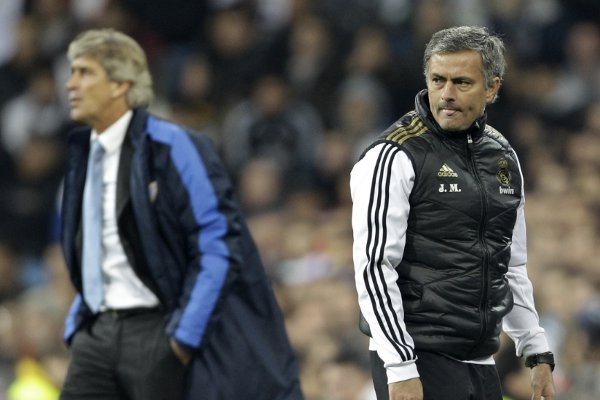
If Mourinho let them go, it's because they didn't fit into the pattern of play he wanted at the club. The way Chelsea are playing now is the way he will have them playing in future, and that should be a cause for concern. One only need look at Manchester United, who are experiencing similar problems but with less effective personnel and Mata stranded wide left. Both sides consistently enjoy good levels of possession, yet score relatively few goals. The enormous number of wasted cross United threw into the box in their 2-2 draw with Fulham was indicative of a side lacking ideas and flexibility, a similar narrative to Chelsea's increasing struggles to break through team happy to frustrate and only occasionally break with a small number of versatile players. Man City and Chelsea may be on more or less equal footing in the league right now, but it's hard to see City's fluid, dynamic football being as troubled in future by immovable opponents as the regimented, uncreative Chelsea, overreliant on moments of magic from Hazard or turns of fortune in the dying minutes. A Lukaku-esque strongman would certainly be a help in giving opponents a greater physical challenge to contend with (for that reason, Mario Mandzukic would probably be a wiser transfer target than Diego Costa), and be an easier target for Ivanovic's inconsistent crossing, but new personnel will only get the club so far when playing a system rapidly threatening to become outdated. Right now, Chelsea are only really effective when opponents commit men forward, which is where Man City naively fell apart, expecting Mourinho to park the proverbial bus as every other team before them had done at the Etihad Stadium, only to give Hazard and Willian a suicidal amount of room to break into. Similarly, Newcastle came to Stamford Bridge with the intent of attacking, and ended up on the receiving end of a Hazard hat-trick. Mourinho tried to play the same way on his return visit to the Etihad, but his side were easily undone by a home side having learnt from their mistakes and adapting to maintain defensive stability even while dominating in attack. Similarly, Everton and Roberto Martinez showed on Saturday how even a side with ambitions beyond playing for the draw need only use a little patience and organisation to establish a good balance between defensive and offensive potency. Looking further afield, let's also not forget how Barcelona were once the unquestioned top dogs of Europe, until being thrashed home and away in last year's Champions League semi-finals by a Bayern side using their opponents' overconfidence and tactical familiarity against them. Times change in football, and with an increasing number of teams challenging for the top spot in the Premier League and the top prize in Europe, Mourinho can no longer afford to his familiar methodology on the basis that it was effective ten years ago. The warning signs were there during his troubled days at Real Madrid, and while he may be sitting on top of the table with Chelsea right now, it would seem a grave mistake to rest on those laurels with a resurgent Arsenal, Liverpool and Tottenham on his tail, a United side in the rebuilding process and a City team which will only grow stronger. Mourinho may take pride in his teams being hard to beat, but that won't win him many titles if everyone else is too. Do you think Mourinho's tactics are out of date or are the Blues on course to dominate the Premier League for years to come? Let us know in the comments below!
28-year old English writer with a borderline obsessive passion for films, videogames, Chelsea FC, incomprehensible words and indefensible puns. Follow me on Twitter if you like infrequent outbursts of absolute drivel.