Celtic: 5 Reasons Why They Deserve To Be In The Premier League
5. Domestic And European Significance and Success
 Celtics historical significance is well-known Celtic was the first British team, and the only Scottish team, to win the European Cup (now Champions League). Even before Manchester United, Liverpool, and Nottingham Forrest had their successes on the European stage, Celtic managed to win the European Cup in 1967 and lost in extra time in 1970. Celtics present significance is that it is the most successful current Scottish side, overtaking fierce rival Rangers Football Club after it descended into administration and liquidation in 2012. Celtic has also managed some success on the European stage again in recent years, reaching the final of the UEFA Cup (now Europa League) in 2003, and famously defeating Barcelona 2-1 last year en route to a place in the 1st Knockout Round of the Champions League. Celtic would be able to add a level of competition to the EPL right away, and there is very little doubt that the team would be able to stay in the league after the first year of play.
4. Global Brand
 Celtics green-and-white hooped strip is recognized around the world, and can be seen almost anywhere one may travel. Despite playing in a country of only 6 million people, I can talk to people at my college in Florida in the United States (a state of over 12 million people, to put it in perspective) and they have heard of Celtic. I believe that the distinct strip helps, as does the FIFA video game franchise, but I believe there is more to the story than just that. Perhaps it is because of the diversity of players that Celtic has signed in recent years. Shunsuke Nakamura joined the club in 2005, at the peak of his playing career, and boosted estimations of Celtic supporters in Japan to almost 7 million fans. Similarly, signings of Ki Sung-Yueng, Emilio Izaguirre, and Victor Wanyama, have increased Celtics profile in South Korea, Honduras, and Kenya, respectively. Finally, it might be because of the massive amount of ex-pats living in North America that contributes to Celtics global recognition. There are more than 60 Celtic supporters clubs in North America that are well-attended (I know from experience). Therefore, while Manchester United and Chelsea enjoy many casual fans in the U.S., Celtic has a very loyal group of supporters who watch week-in-and-week-out, which would only boost the already great profile of the EPL in the U.S.That leads very nicely into the next point
3. The Supporters
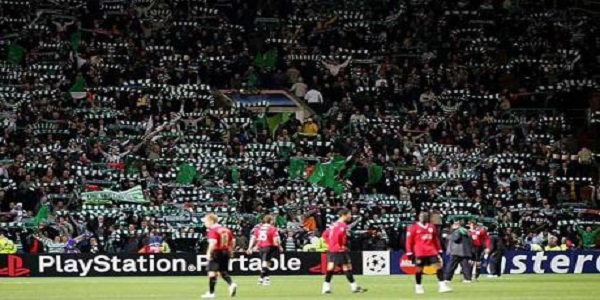
 Celtic has at its disposal a uniquely passionate and loyal group of supporters. It is estimated that there are more than 1 million fans in North America alone perhaps due to Celtics Irish identity and connection to the likes of Boston, Massachusetts. Even taking the attendance figures from the 2012-2013 season, which was a down-season for Celtic in terms of match attendance due to the loss of Rangers as a rival, Celtic would have had the 5th highest average attendance in the EPL, just 50 fans less than Manchester City (4th place). For a club playing in the relatively uncompetitive SPL, thats incredibly impressive. Furthermore, Celtic fans have been recognized for their travels around the world in support of their club. In 2003, FIFA awarded their Fair Play award to the fans of Celtic in the wake of the UEFA Cup Final in Seville, Spain. This was the first time that supporters of a club won this award since fans of the Republic of Ireland won it in 1997. Some 80,000 fans of the club traveled to the capital of Andalusia, and they handled themselves magnificently. Imagine having even 10% of that number traveling to away grounds around England for EPL matches.
2. Competition
https://www.youtube.com/watch?v=ILzN-ZEctaU While the SPL is certainly no match for the EPL, and while Celtic would not be able to crack the top-four with the present side, there is no argument that Celtic would provide a good level of competition in the first year in the EPL. In competitive games in the past 10 years, Celtic has enjoyed relative success against English clubs. In 2003, Celtic defeated Blackburn and Liverpool en route to the UEFA Cup Final. In 2006, Celtic would have beat Manchester United on aggregate had it not been during the group stage of the Champions League (lost 3-2 in Manchester, won 1-0 in Glasgow). If you add to that pedigree the fact that Celtic would have the SKY money that is available to even the lowliest of EPL teams, its not that farfetched to say that Celtic would qualify for Europe within their first few years in the EPL.1. Mutually Beneficial
 All of the aforementioned reasons have been leading up to this point it would be mutually beneficial for both Celtic and the English Premier League to join forces. I understand the main argument against the union it would be unfair on the Championship club that would lose a spot. However, I would counter that with some unfairness that Ive noticed English clubs not abiding by the financial fair play rules that are supposed to make the game a level playing field. Since it is clearly not level, Im willing to overlook that particular team having to repeat their year in the Championship. The travel to Glasgow would not be all that taxing on EPL teams, especially those close to the border; similarly, the travel from Glasgow for Celtic would not be that much more than trips to Inverness or Aberdeen. Celtic would have to sacrifice at least one year of European football in order to join the EPL; similarly, England would have to sacrifice on Championship promotion, perhaps decided by the play-off. Overall, though, both sides would benefit greatly from joining forces in the very near future.