4 Reasons UFC Champion TJ Dillashaw's Title Reign Won't Go Down As A Fluke

It wasn't predicted to happen but that doesn't mean it was a fluke.
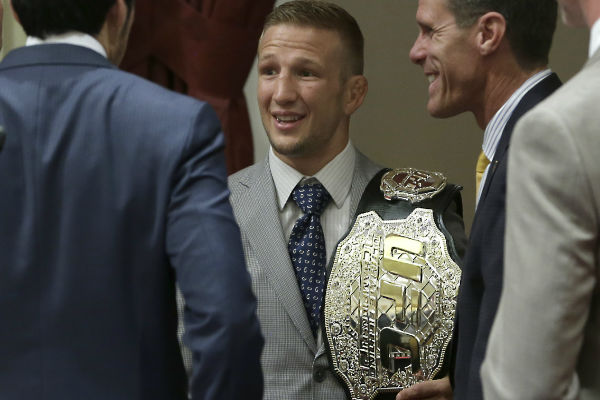
The rise of T.J Dillashaw had not been expected by many pundits in 2014. He was considered as one of the better bantamweights in a lackadaisical division. In a popular Team Alpha Male camp, he was one of the lesser publicized fighters. Now six months later, he€™s the only champion in the camp and headlining another pay-per-view. It was his performance against Renan Barao at UFC 173 that will certainly be the most impressive performance of the year. He outclassed Barao in dominant fashion in every facet of the fight. Now that he€™s gotten the top, here comes the greater challenge. The ability to stay on top as champion is far more difficult. Jon Jones, Chuck Liddell, Frank Mir, and Forrest Griffin discussed above how much pressure goes into behind holding the belt. Despite the pressure, Dillashaw is one of the most well-rounded fighters on the current roster. You couldn€™t have asked for a more perfect performance against Mike Easton and Barao. His upside is endless through his work ethic. With a mastermind guiding him in Duane Ludwig, he will continue to evolve in all aspects of MMA. Here are the main reasons on why Dillashaw's title reign won€™t go down as a fluke.

4. Footwork

http://youtu.be/bftu29knJ4k When it comes to lighter weight classes, footwork is one of the most essential elements to have towards being successful. Most fighters in the lighter weight classes don€™t have the luxury of having a size advantage. The only other major advantage would be from relentless wrestling like Khabib Nurmagomedov possess. The lighter weight class champions all possess tremendous footwork and speed. T.J Dillashaw showcased that at UFC 173 by consistently moving laterally to avoid taking significant damage. As Dan Hardy shows brilliantly here, Dillashaw kept circling to his right to avoid Barao€™s patented spinning back kick. His utilization of angles left Barao in distraught, as he struggled to connect with any significant strikes in the latter rounds. Another issue with Barao is how he relies on straight line movement and his hand to parry away strikes. He€™s not moving laterally like Dillashaw, which is an issue against a much quicker fighter. Barao is one of the bigger bantamweights in the division and isn€™t blessed with great agility. He paid a price for continuously moving backwards and using his hand to parry punches in a lazy attempt to avoid taking damage. Footwork is essential, especially against someone that trains under someone as technical as Duane Ludwig. His guidance has given him excellent footwork that will always be a vital advantage for Dillashaw, along with the next category.

3. Speed

Dillasource// Dwayne Wolfe/Fight Booth The term €œspeed kills€ can always play a factor in an outcome of a fight. It applies to every division, including the heavyweights. Stipe Miocic€™s fifteen minute assault of Roy Nelson comes to mind. A major speed advantage allows you to get in and out safely on many occasions. If you combine that with excellent cardio, that makes you become the ultimate enigma. Dillashaw€™s relentless pace and outstanding speed makes him that enigma, which Barao will struggle to figure out once again. He believes in being more of a volume striker rather than being calculating. Barao€™s tendency to stalk had left past opponents in distraught. Urijah Faber couldn€™t get his timing down and was forced to be more defensive. That led to him getting caught and eventually finished. Faber was fighting with a torn hamstring, which is why we didn€™t see his usual explosive self. Still it must have opened Ludwig€™s eyes on how you have to fight Barao at a higher pace. That€™s what Dillashaw did through every round, before finishing him in the final round. While there certainly other quick bantamweights that can match Dillashaw€™s pace. Not many bantamweight fighters have come close to out-striking him. Other than Dominick Cruz, no other bantamweight comes to mind as a sound technical striker. Speed will always be indispensable for a lower weight class fighter. It€™s how you utilize it through your game plan is the difference maker between being a champion or contender or a journeyman. Dillashaw gets it.

2. Striking

http://youtu.be/-NgXLyE4e5c The speed advantage goes into his striking, which has developed substantially under Duane Ludwig. His breakout performance against Mike Easton last January showcased that. He was landing his left high kick at will, which is nearly impossible to do. A left high kick is a low percentage attack for most fighters that throw it to keep their opponents off balance. Dillashaw has made the kick an important move into his arsenal. It was the same left high kick that rocked Renan Barao again that signified the end for him. He uses great faints to keep his opponents guessing. As important as it usually is to be unpredictable, you need to have something behind being unpredictable. You see so many fighters now throw a spinning back kick or shoot for a double leg out of desperation. That desperation comes from either wanting to keep their opponents honest or look to land something spectacular. Dillashaw is different in keeping his opponent honest through a relentless pace and crisp striking. That€™s the main reason behind him averaging the most significant strikes in bantamweight history. On the rare occasion, he uses a long windup to land an immense punch or kick. He used a lethal over hand right that dropped Barao. He did so by sensing Barao€™s tendency to keep moving straight back. It€™ll be interesting to see the changes that Barao makes, along with how Dillashaw continues to evolve. His striking will be one of the main things to evolve, considering he€™s already proficient in so many areas.

1. Wrestling

http://youtu.be/nZQvRW3B_Ug Wrestling has become the most important attribute to have in MMA today. From Greg Jackson to Ray Longo, the best coaches in the world stress that inspiring MMA fighters need to wrestle in high school or as a walk-on in college. Dillashaw is well-equipped by wrestling in both high school and college. At one point, he eas ranked tenth in the nation at 133 pounds. His reputation coming into the UFC was actually as a wrestler. That may seem like a distant memory, but it will always remain essential for his title reign. In the fourth round, Barao was desperate in looking to get the fight to the ground. Dillashaw moves his hips and sprawls effectively in not allowing a dangerous Barao on top. We€™ve seen Barao submit submission artists like Michael McDonald in an instant. With his efficient takedown defense, it allows him to fight more freely and take more chances. He€™s yet to be taken down in the UFC and there aren€™t many bantamweights that can pose a threat in putting him on his back. Takedown defense is a vital attribute to have, especially when trying to dictate your certain game plan. That attribute makes Dillashaw an even bigger nightmare towards gis furter opponents.

Contributor
Contributor

I cover the sport of MMA, along with being a fan of the sport since 2008. I've been covering the sport for two years now, along with interviewing several fighters. I also write on MMASucka.com. You can follow me on twitter @Allen_Strk or email at AStrk19@gmail.com