6 Reasons Donald Trump Of The Past Would Hate Donald Trump Today

His disregard for ideological integrity is nearly as impressive as the endangered species that sits atop his head.
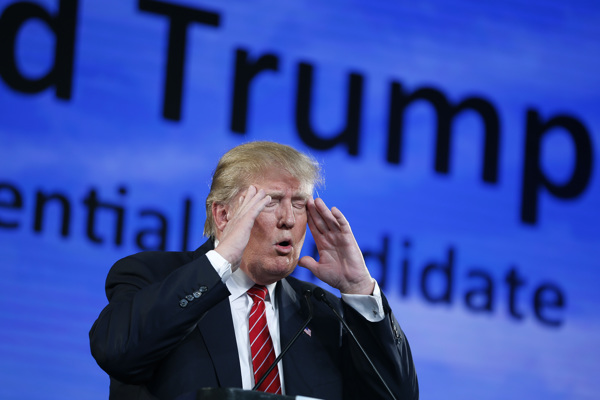
Donald Trump has stolen the headlines in the 2016 race for the White House. He€™s been outspoken against immigration, naïve on his measures to combat ISIS, and even taken a (tiny) shot at sacred Republican institutions like Fox News. Despite all his blustering, it seems that his tactless offensive is working. Trump recently moved to the top of a nationwide Republican primary poll. But, unbeknownst to the real estate billionaire, the majority of analysts still see him as a farce and he is the least-liked candidate out there. In many ways, Donald Trump has become the Vuvuzela of Republican candidates: Frustratingly hard to ignore, impossible to comprehend, and, hopefully, an annoyance for only a couple of months. Despite his eccentric opinions and delusional rhetoric, no one can deny Trump has this je ne sais coif about him. You simply cannot turn away. His opening campaign speech read like a 3-year old€™s Mad Libs submission and subsequent interviews have been as strange as they have been loud. This means little to Trump, as he will continue to stay relevant thanks to the media€™s obsession with him and his overzealous ways. Trump is what you€™d call a bumblebee candidate: A new contender that enters the Presidential Race, €˜stings€™ the party with his ideas and then dies off (hopefully). This is not the first time we€™ve seen a bumblebee candidate; there were plenty of examples in 2012. Newt Gingirch and his moon colony failed to propel support into the stratosphere; Herman Cain€™s idea for a flat tax of 9-9-9 never added up; and Rick Perry couldn€™t remember which 3 government agencies were the bane of America€™s existence. (Maybe you keep the Department of Education, Rick?) For better or worse, bumblebee candidates have to be acknowledged, challenged and dealt with. The real candidates€”Jeb Bush, Rand Paul€”will have to wait until the others run out of money or common sense to voice their opinions. Financial support and palatable ideas often go hand-in-hand, but with the Citizens United ruling, it€™s not a guarantee. Enter Trump and the multitude of questions surrounding his campaign. Is he a legitimate contender or a candidate placating a small, angry part of the GOP? Are his beliefs conservative enough to win the Republican nomination but lose the general election? And most importantly, where does he really stand on the issues? As hard as it is to imagine, Trump was not always the right-wing reactionary he is so-often caricaturized in the media as. His consistency on hot-button issues has changed (evolved?) over his lifetime. Remarkably, the 69-year old actually held a number of progressive political and social positions in the past. Which shows that Trump appears to be one of the worst types of attention-starved politicians: the morally malleable kind. Trump is fuelled not by principles or convictions, but by people and their cacophony of noise, regardless of whether that noise is constructive or simply inaudible anger sprayed from a common horn.

6. Immigration

The issue that has sent the most shockwaves through Donald€™s campaign so far has centered on immigration. It all started with his kick-off speech two weeks ago where he noted Mexican immigrants in the U.S. were criminals and rapists. Trump would soon double-down, claiming the Mexican government forced its undesirable citizens into the U.S, resulting in an infectious disease spilling across the border. His inflammatory remarks led to business deals being rescinded and an alienation of one of the most important voting blocs in America. Here comes the cognitive dissonance however, because while Donald may publically lambast immigrants, privately, Trump Organization has taken a different approach. For starters, Trump€™s clothing line has, in the past, been produced in Mexico. Most likely for the same reasons many U.S. companies move production south: cheap labour, close proximity, and ease of access. Furthermore, an article in the Washington Post last week noted a number of illegal Mexicans and Hispanics workers are currently contracted to help build Trump€™s new hotel in Washington, D.C. Granted, Trump cannot oversee all aspects of his business, and the hiring was most likely sub-contracted out, but it brings up an interesting point. The people Trump rails against for political points and applause lines are the one€™s adding to his empire. While Donald has never claimed to be a nuanced man, the broader he gets with his claims against immigrants, the greater the chance his business needs will prove him wrong.

5. Healthcare

Healthcare in the United States is one of the most contentious and polarizing issues of the last half-decade. For outsiders looking in, it€™s baffling. How the wealthiest and most advanced nation to ever grace the Earth can€™t look after its most vulnerable citizens is perplexing. Yes, there is a lot of backroom opposition from powerful lobbyists who try to kill medical reform bills via donation threats. But it€™s their fear mongering, with terms like €˜death panels€™ and €˜socialism taking over America€™, which really strangle true progress. President Obama discovered this hostility when he attempted to implement his version of healthcare reform€”Obamacare€”and was met with stiff opposition. Countless political favours, a nationwide tour, an election seen as a referendum on the issue, and 2 Supreme Court decisions later, Obamacare appears a permanent fixture of the U.S. social safety net. Perhaps one of the reasons for the strong opposition against Obamacare is that it€™s seen as a step towards socializing America€™s healthcare system. Socialism, a quarter-century after the fall of the Soviet Union, is still a dreaded word in the U.S., like €˜portion control€™ or €˜subtitled documentary€™. During the lead-up to the Obamacare vote, citizens and public officials in opposition littered the airwaves and town halls with speeches and signs claiming the new law was part of a communist takeover. It was far from it, as it kept insurance companies largely intact, though there were new regulations€”patients couldn€™t be denied on pre-existing conditions, children could stay on parents€™ plan until 26€”that stymied unfair industry practices. And who was in favour of socialized healthcare? Donald Trump in 2000, who advocated for universal health coverage in his book The America We Deserve. In the book, and succeeding interviews, the former TV host noted that America should have full government care, even if that meant doctors were paid less. The number of uninsured Americans, at the time 42 million by his estimate, was another point of discontent for Trump, as he deemed it unacceptable. He even went on to praise neighbouring Canada for their approach to looking after ailing citizens. Fast-forward 15 years, and Trump€™s moral imperative has changed a little. Trump has called Obamacare, which covers millions of formerly uninsured Americans and lowers everyday insurance costs through state and federal exchanges, a filthy lie, unconstitutional, and bound to destroy America. Trump further noted that he wished to repeal the President€™s signature legislation. He went on to claim that he could replace it with a plan that was better and cheaper, but skimmed on the details. Maybe that better plan he mentions is a single-payer plan, or maybe it€™s a case of the tail wagging the dog.

4. Birthers

Birthers€”a term spellcheck doesn€™t recognize and many more have given up on. But in 2011 and 2012 there was no bigger Birther€”a moniker for people who believe Barack Obama was born outside the U.S.€”than Donald Trump. (A person is ineligible to be President of the United States if they are not a €œnatural born citizen€, an ambiguous term at best.) Trump€™s continued scepticism of the President€™s birthplace thrust him into the political spotlight and had him flirting with the idea of running in 2012. He went so far as to suggest his team of investigators in Hawaii, Obama€™s home state, was on the cusp of uncovering a major breakthrough, a claim that never came to fruition. Trump went on to call the 44th President the least transparent leader in American history for skirting the issue. Eventually Obama would release his long-form birth certificate, allowing the issue to die a necessary death. At least he thought he had. In an interview last week, Trump claimed he was still wasn€™t sure if the President was born in America. At this point, unless Trump cut Obama€™s umbilical cord back on August 4, 1961, it doesn€™t appear he€™ll ever believe the Hawaiian Birth Registry. According to Donald Trump, clarity and openness of political candidates is of the upmost importance. But now that it€™s his turn to run for President, the popular Manhattan resident has decided to be less forthright about his own personal records. The Guardian recently reached out to Trump to ask if they could view his birth certificate, but were quickly rebuffed. While there is little doubt that the newspaper questions his birthplace, what The Guardian did discover was that Trump doesn€™t like his own medicine. Eventually, one can assume, he will release his birth certificate, if for nothing else than to silence the story. The concern isn€™t the actual certificate, but the hypocritical nature in which Donald Trump conducts himself. He is the demander-in-chief, he makes the requests. Trump€™s bull-headed manner may work in a boardroom, but running a country as diverse and divided as America requires cooperation, a lesson he may never learn. Besides, it looks as if his Birther Bullseye may be set on a new candidate: Ted Cruz, who was born in Alberta, Canada.

3. Gun Rights

Gun rights are innate within the social and political fabric of the United States. Owning a gun is a birthright to some, a civic duty to many more. Supporters thank their Founding Fathers for installing a safeguard, the Second Amendment, which protects their right to bear arms. Well, actually it notes a well-regulated militia has the right to protect a free state through firearms, but let€™s not take our eye off the target. Weapon entitlements are safe for now, and many applaud this notion. As a result, firearms have saturated nearly every facet of American life; reports show there is nearly one gun for every American citizen (over 300 million firearms in total). As a result of the proliferation of guns, mass shootings have become an all too common and predictable part of everyday life in the U.S. With these slayings often comes a public debate about background checks, waiting periods, accessibility, etc. As such, politicians and public figures are forced to take a side on gun rights. Donald Trump is no exception. Younger Trump supported the ban on assault weapons and called for a longer waiting period for firearm purchases. He noted that Democrats were wrong on the issue because they wanted to take away all the guns, and that Republicans were similarly incorrect because they kowtow to the National Rifle Association (NRA). A decade later, and competing against other gun-ho candidates, Trump now applauds firearm enthusiasts. Last week, Donald claimed he was a lifetime member of the NRA and that the organization€™s effort to stop limitations on all weapons was invaluable. He continued, saying he opposes gun control and staunchly backs the Second Amendment. When asked about his earlier support on the assault weapons ban, he responded by claiming that the popular AR15, a semi-automatic rifle, is not an assault weapon. Trump is correct, as the rifle fires one shot for every squeeze of the trigger. Although, the AR15 can unload between 50-60 rounds a minute and was the firearm of choice for both Adam Lanza in Newtown, Connecticut and James Holmes in Colorado, killing 39 in total. It is sold as the closet thing to an assault rifle a civilian can get, and is eerily similar to the M16 assault rifle. Not by coincidence, the military-issued M16 is an adaptation of the AR 15. Technicalities aside, the AR 15 can do a substantial amount of damage in a smaller amount of time€”and Trump knows this. He attempts to pettifog the issue and pass blame to Democrats who, he suggests, take away things American love. The Left is wrong because they are against the majority, infers Trump. Though, that€™s what real leaders do: Make hard decisions that are unpopular for some but benefit society as a whole. And they don€™t change their beliefs to gin up support.

2. Iraq

Iraq has been a regional quagmire and political tightrope for 12 years now. Republicans running for office have been pulled in two directions over the failed conquest, as they struggle to distance themselves from the unpopular invasion while simultaneously assuring soldiers their sacrifices weren€™t made in vain. To be fair, this is not just a Republican concern, as Hillary Clinton, who supported the incursion in Iraq, found out during the 2008 Democratic primaries. Consequently, politicians on both sides of the aisle have been tremendously prudent and calculating when discussing their support, tacit or active, of the 2003 invasion. In 2004, Donald, freshly minted from the success of The Apprentice€™s first season, offered his opinion on the war. Trump declared Iraq was a total disaster and that he would fire the Bush Administration if possible over its decision to enter the Middle Eastern nation. He would comment in later interviews that he would have never invaded the oil-rich country in the first place. The most striking factor, however, is the reason for his reluctance. Trump lamented the fact democracy would likely never take hold in Iraq, and showed a sliver of compassion when he noted American soldiers and Iraqis were paying the ultimate sacrifice for nothing. A pretty sound and sensible opinion that many still hold to this day. But not Donald. Jump forward 11 years and much has changed. While still against the 8-year offensive, at least in some interviews, he now believes American soldiers should re-enter Iraq to secure its oil deposits. Donald would note in an interview with Fox€™s Bill O€™Reilly that if America didn€™t secure the enemy€™s natural deposits, all 4,400 soldiers killed during the initial invasion perished for a hopeless cause. Trump would also apparently change his rationale and (inferred) support for the invasion, claiming in an interview with The Wall Street Journal that entrance into Iraq for oil seemed smart. A far cry from the concerned Trump, who years earlier wanted no lives lost for unobtainable democratic values.

1. Pro-Choice vs Pro-Life

There isn€™t an issue too controversial for Donald Trump to comment on€then retract his statement and say the exact opposite about. In 1999, during an interview on Meet The Press, Trump weighed in on abortion. He told host Tim Russert that he was very pro-choice. Trump commented that he hated the idea of abortion (as compared to those who revel in it?) but that he simply believes in choice. The father of five eventually pushed the subject even further, hoping that abortion would be removed from the political realm and left to women and their doctors. It would be hard to find, at the turn of the last century, a more devout pro-choice individual than Donald Trump. Now in 2015, Donald€™s ideological 180 is already in full swing. Trump recently told media outlets he was pro-life and that abortion should only be legal in rare circumstances. So much for removing the issue from the political arena. To his credit, Trump acknowledges this about-face and cites a personal story as the reason why he switched positions. The cause for the turnaround revolved around a friend who thought about an abortion, didn€™t have one, and now adores their newborn. A touching and personal story, no doubt, but it would be hard to believe that it was the first time Trump heard of such an account. Perhaps it was no accident that it was in 2011, before contemplating a Presidential run, that Trump made these comments. It€™s hard to conceive the Evangelical base of the Republican Party, who are unwavering pro-lifers, filling out a ballot for anyone against or ambivalent towards fetal rights. Trumps variation is nothing new; he has to hit certain criteria to win the nomination. Whether or not people believe he has made a sincere or strategic reversal is up for voters to decide, and to justify.

In this post: 
Donald Trump
 
First Posted On: 
Contributor

Tristan Small hasn't written a bio just yet, but if they had... it would appear here.