10 Iconic Photos Of Richard Nixon On His 100th Birthday

Futurama Today, Richard Milhouse Nixon, the 37th President of the United States, will have been 100 years old. Depending on who you talk to, he was either a great president or one of our worst; but either way you slice it, the man was iconic. He worked hard to get where he was and ultimately some of that hard work turned against him, leaving him no choice but to resign from the highest office in American political history. Today we come here not to bury this man's reputation, nor praise his deeds in excess. Today we celebrate the birthday of a great man. He may have had his share of flaws, but he also had his share of fortitude as well. Ultimately, he was a man, and as such we would expect at least equal measure of the two. So here now are ten iconic photographs chronicling the life and times of Richard Nixon.

1. Nixon's Youth

College Football

January 9, 1913 - Richard Nixon is born in Yorba Linda, California to Francis and Hannah Nixon, a pair of Quakers, in a house that his father had built. The second of five children, all boys, Nixon was born into a faith that prohibited "alcohol, dancing, and swearing". Reflecting back on his childhood, Nixon once said, "We were poor, but the glory of it was, we didn't know it." One could say that from the beginning of his life he learned to live with both compromise and hardship, which made him all the better of a person, and at the same time set him up for his own undoing. The photo above is from his days of Junior Varsity Football at Fullerton Union High School. Football and Debating were his two passions growing up, but ultimately he'd have to give up the former in order to help care for his family's business. His father's declining health due to Tuberculosis made the second eldest Nixon son step up and help out, even turning down a spot at Harvard University in order to stay local.

2. Congressman Richard Nixon

Hiss Microfilm

After graduating from law school at Duke University, Nixon was almost an FBI agent: if it wasn't for budget cuts to the department, he would have been appointed as he had hoped. However, turning adversity into triumph, Nixon would practice law, meet his wife Pat while doing Community Theater, and ultimately wind up living in Washington DC during his Naval Service towards the end of World War II. After leaving the Navy, he and wife Pat would move back to Whittier, California only to be pulled back to D.C. for his next call of duty: Congress. California Republicans ultimately settled on Richard Nixon for their 1946 Congressional Race in the 12th District, where he bested his incumbent opponent 65,586 to 49,994. Most prominent in his Congressional career was his investigation (and subsequent prosecution) of Alger Hiss on charges of Soviet Espionage during his time at the State Department. This investigation, in the time of the "Red Scare", helped secure not only a Congressional Re-election, but also launched and won Nixon a successful Senate campaign in 1950.

3. Nixon and Checkers

Checkers Speech

With his star on the rise in Washington, Richard Nixon became the Vice Presidential Nominee on General Dwight D. Eisenhower's presidential ticket in 1952. Not all approved of this appointment however, as the News Media of the day began to investigate a personal fund Nixon had set up in which his political campaigning expenses would be reimbursed by his donors. Nixon looked like he was being bought, and as the cries for his resignation began to raise in volume, Senator Nixon addressed the nation on Television. A medium in its infancy and a candidate on the cusp of another game changing promotion came together on September 23rd of that year, and the young Senator told the story about how one of his Texas donors sent him and his family a present. That present is the infamous Cocker Spaniel by the name of Checkers, the dog that his daughter fell in love with and whom he would never separate from his family. Scandal dispatched, Eisenhower and Nixon would be on their way to their two term career together, despite an attempt to demote Nixon to a Cabinet Member during the 1956 election.

4. The Kennedy/Nixon Debate

Kennedy Debate

After two terms as Vice President, Richard Nixon did what most Vice Presidents go on to do...he ran for President. An easy Primary win secured Nixon, and his Vice Presidential candidate, Henry Cabot Lodge Jr., the Republican ticket. Opposing their White House run was a young upstart by the name of John F. Kennedy Jr.: a war hero, a Senator, and a handsome/well connected political player all rolled into one. Nixon would eventually lose to Kennedy, and one of the major reasons cited for this loss was that of Nixon's disastrous appearance during the first ever televised Presidential Debate. Battling illness (which caused him to sweat), clothed in a grey suit (which blended with the background), and appearing unshaven; Nixon was no match for the well groomed, and undeniably camera ready youth of future President Kennedy. Defeated, Nixon would take one more political stab with his Gubernatorial bid in California's 1962 election, only to be met with further rejection which prompted most to write him off as a political force. Even he believed it was the end of his career in politics, as he stated in his concession, "You won't have Nixon to kick around anymore because, gentlemen, this is my last press conference".

5. "Sock it to Me?"

Laugh In

In 1968, Richard Nixon broke a promise he made to himself and his family back in 1962: he ran for President a second time. After remaining a Republican heavy hitter, returning to his law practice, and writing his memoir "Six Crises", Nixon decided to get back on the horse and ride as Lyndon B. Johnson was finishing out his derided term as President. With Spiro Agnew at his side, Richard Nixon became President Nixon in a 301 electoral vote victory against challengers Hubert Humphrey and George Wallace. Now to understand Nixon as a figure is to understand the fact that he played better with the older crowd. The Greatest Generation and those who came before it may have been just fine with him, but the rising tide of Counter Culture thinking (and, by proxy, voting) was rising against "The Establishment" as it stood. So a man like Richard Nixon, who had a hard enough time running for the presidency in an earlier/more politically friendly era, really needed an ace in the hole. That ace would be his impromptu appearance on Rowan and Martin's Laugh-In, during the 1968 election. His rendition of their catch phrase mocked his out of touch image, and showed that he was at least willing to reach out to the other side of the cultural aisle.

6. Nixon and the Image Race

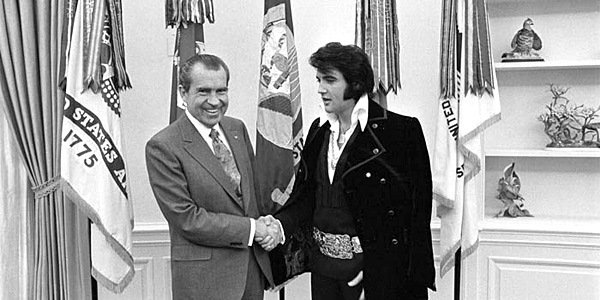
Nixon and Elvis

Winning the Presidential race, as well as the image race, was the easy part for Nixon; because the hard part would be keeping up with the times on a more concurrent basis. Luckily enough for him, a golden opportunity presented itself through the boredom of Elvis Presley. A small spat with his family during the Christmas season lead The King to go travelling, first to California and then to Washington D.C. His reason for traveling to the capital of the nation was a random one at that: he wanted to add a DEA badge to his collection of law enforcement badges. Through a letter to the President, Mr. Presley stated, "Sir, I can and will be of any service that I can to help the country out...I would love to meet you". (His wife, Priscilla, would later go on to mention in her biography that "With the federal narcotics badge, he could legally enter any country both wearing guns and carrying any drugs he wished.") It wasn't long (about a day or so) before The King was granted audience with The President, and he came bearing a gift. Elvis had brought President Nixon a Colt .45, in exchange for the badge he would received that day from the President, which lead to the particularly interesting photo op you see here before you.

7. Nixon and World Relations

Vietnam

A good public image is worth nothing if you don't have the credibility to back it up, just ask anyone. What President Nixon may have lacked in public image, he most certainly made up for with experience in Foreign Relations. With the help of his National Security Advisor/Secretary of State, Henry Kissinger, Nixon embarked on what was coined at the time as "Shuttle Diplomacy". This new style of negotiation entailed Kissinger being a go-between for Nixon and other nations of the world to settle their differences without meeting in person. This style of diplomacy was used in negotiations with China, the Soviet Union, and the Middle East during the Nixon presidency, and it yielded results that laid the foundation for building better relations between America and the nations of the world. Chiefly among his achievements in international diplomacy, as well as upholding domestic tranquility, was his eventual withdrawal of American forces in the Vietnam War. While he kept up with the methodology and the positions of administrations before him, by time 1970 rolled around the "Credibility Gap" between his promises and his actions was getting wider by the day. By 1973, America was withdrawing from Vietnam and the nation could begin to heal thanks to the Paris Peace Accords. These peace accords would allow for a temporary suspension of North and South Vietnam's fighting, so that America could withdraw its troops safely within 60 days time.

8. The Nixon Resignation

Farewell

After all of his achievements, after a long and dramatic rise to the top, Richard Nixon would be uncovered and undone in one career defining act: the Watergate Break In. Five men, all aides to The White House, were caught breaking into the Democratic National Committee's headquarters at Washington's Watergate Hotel on June 17, 1972. What followed was an investigation that was until then unheard of, and lead by Carl Bernstein and Bob Woodward of The Washington Post. Aided by their source Mark Felt, under the pseudonym "Deep Throat', Bernstein and Woodward would eventually smoke out the link between those five men (known as "The Plumbers") and the White House. What Nixon had hoped to keep under wraps as political rumors and whispers turned into legal action, the revelation of the White House's secret recording system, and several scandals that made it almost impossible for Nixon to remain in office with dignity. On August 9, 1974; Richard Nixon resigned from the presidency in as best of a way as he could. A month and a day later, President Gerald Ford officially pardoned President Nixon of all wrong-doing involving Watergate. Little did he know that his ordeal over Watergate was far from over.

9. The Frost/Nixon Interviews

Frost Nixon Interview

In 1977, attempting to rehabilitate his image, former President Nixon took the advice of famed agent "Swifty" Lazar and agreed to a series of Television interviews with chat show host David Frost. Frost, a British journalist, solidified his reputation as a journalist with these interviews that depicted Nixon as a penitent man. Perhaps the best indicator of such an attitude was in the Watergate section of the interviews, where he stated, "let down the country...I brought myself down. I gave them a sword and they stuck it in. And they twisted it with relish. And, I guess, if I'd been in their position, I'd have done the same thing." Nixon was paid $600,000 for his interview, as well as made a deal for 20% of any profit made. It was the most watched program of its time, and after the interviews, Gallop polls had the following numbers: 69% thought he was still trying to cover up, 72% found him guilty of Obstruction of Justice, and 75% thought he should have no further role in public life.

10. A Lasting Legacy

Five Presidents

After his resignation and retirement to public life, Richard Nixon went on to write ten books, as well as maintain unofficial diplomatic duties between the U.S. and the nations of the world. Through his efforts, he continued to rehabilitate his image with the public, and ultimately came to be somewhat accepted back into the Washington fold. Newsweek proclaimed, "He's Back!", and to a certain extent he was as he advised and supported political figures like Ronald Regan, butt heads with the State Department during the Carter Administration, and met with world leaders who still held him in good standing. On April 18th, 1994; Richard Nixon suffered a stroke, which hospitalized him for four days before his passing. He was buried on the grounds of the Richard Nixon Presidential Library in his birthplace of Yorba Linda, California. No matter what was thought of him during his career, or after for that matter, Richard Nixon is history's charge now. It will remember him as either the man who let his paranoia get to him and made a huge mistake that sent his career into its death spiral, or it shall remember him as the man who fought to have everything he earned, and ultimately made good with the world again. To paraphrase Band of Brothers, we salute the office of the Presidency, even if we don't always salute the man. Happy birthday, Mr. President. Resources used in preparation of this article are as follow: The Richard Nixon, John F. Kennedy, Shuttle Diplomacy, Paris Peace Accords, and Nixon Interviews Wikipedia Entries "Richard Nixon Goes on Laugh-In", by Dan Fastenberg at Time Magazine"When Elvis Met Nixon", by Peter Carlson at Smithsonian Magazine

Contributor
Contributor

Mike Reyes may or may not be a Time Lord, but he's definitely the Doctor Who editor here at What Culture. In addition to his work at What Culture, Mr. Reyes writes for Cocktails and Movies, as well as his own personal blogs Mr. Controversy and The Bookish Kind. On top of that, he's also got a couple Short Stories and Novels in various states of completion, like any good writer worth their salt. He resides in New Jersey, and compiles his work from all publications on his Facebook page.