10 Facts About The Universe That Make Your Brain Hurt
Astonishing facts about the universe are absolutely everywhere, and you do not have to go far from home to find some.

10. There Could Be Billions Of Alien Civilisations In Our Galaxy

9. Up To 4800 Stars Are Born Every Second
It's an educated guess of course, but how realistic is that? More to the point, how would you go about working something like that out? It's a lot of stars and does it account for the universe getting bigger, or expanding all the time? The expansion of the universe is due to other factors; however, if we keep focus on those stars being reformed out of existing material then we can see a way to work it out. The question then becomes how much dust and gas becomes stardust each year. Yes, it's true to say that it takes a long time to make a star, eons in fact, but what we sometimes lose sight of is that the process is continuous. In the Milky Way the star formation rate is about 3 solar masses per year and one solar mass is equal to the mass of our Sun = 2x1027kg. It's another way of saying that enough basic material to construct three suns is used every year. That's only on average remember, since every star varies in size and mass from the next. Our sun is a pretty common size, so it's fair to say we get three per year. Now we know other facts such as the number of observable galaxies there are and the density of the universe immediately following the Big Bang, (back to that Planck density we mentioned at the introduction). From this astronomers extrapolate the number of probable galaxies in existence to around 50 billion. Already the numbers are getting pretty awesome and it's easy to see where all this star raw material comes from. Just as there are many different types of star there are three different types of galaxy with a few subdivisions in the classification: spiral, irregular, elliptical. Similarly, the same logic as for suns also applies to galaxies. If ours is average then through extrapolation we can also reasonably suggest that 3 per galaxy x 50 billion = 150 billion is accurate enough. That's 400 million stars born per day, or 4800 per second!8. Sunlight Is 30,000 Years Old

7. Black Holes Are Often The Brightest Objects In The Universe
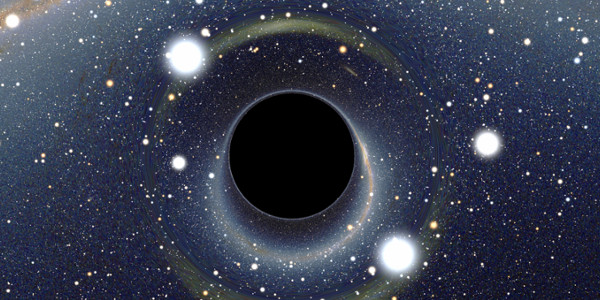
OK, so now I've lost it and you reckon I'm just making up stories in the hope you'll carry on reading. The clue is in the name, isn't it? Black hole! Well yes, I have been careful to use the word 'often' for this fact. Black holes are indeed super-compact concentrations of stellar material of such enormous mass that they tend to deform space-time. And yes, they are so dense that they even eat up passing light so that all you can see of them is an empty space. Were you able to carry a black hole to Earth on a teaspoon it would probably weigh in excess of 100,000 tonnes, (100,000,000 kg). But there is one variety of black hole known as a quasar, (quasi-stellar radio source). Around many black holes is an accretion disk of material emitting energy as it falls into the black hole. A quasar is a compact region in the centre of a massive galaxy that surrounds its central super massive black hole. Around quasars, if you can imagine it, you get radiation acting outwardly and a huge gravitational force acting inwardly upon it. That's where the light begins to get emitted due to something called the Eddington limit, or Eddington luminosity. When there is an imbalance between those two forces, gravity and radiation, the Eddington limit is exceeded and the quasar starts pumping out an intense solar wind resulting in highly luminous light. Quasars are the extraordinarily bright nuclei of galaxies and the brightest quasars have a luminosity of L = 100,000 LMW = 1042 watts, which is something like a trillion times brighter than our sun. This is not too surprising when you get their size into perspective. Often as large as 1 kiloparsec across that puts them on average bigger than our entire solar system.6. If You Could Put Saturn In Water Then It Would Float
 I have heard this fact many times recently, but that does not stop it being spectacular when you put it that way. If you were to put the planet Saturn into a big enough tank of water it would float. This is because its density is 0.687 grams per cm3 while water's is 0.998 grams per cm3. Notwithstanding that the tank would have to be over 120,000 km in diameter to achieve this, it's a pretty cool fact that tells us more about the nature of the universe. Nothing is absolute, you see. It is all to do with a thing called 'relative density', or a comparison of the density of one material to the density of a particular standard, such as water, at a given temperature or pressure. You might also have heard it called specific gravity. Saturn is simply less dense than water. It all depends upon how much matter there is in a substance. We call the amount of matter in a substance combined with its inertia, mass. It is different from weight because weight can change with variations in gravity on the object. It is for this reason that the same object is heavier on Earth than on the moon. There is less gravity on the moon and mass remains the same in both cases. So, why bring this up? Well, one reason is that once we dig further into issues surrounding mass, density, atoms and the basic building blocks of the universe things begin to get decidedly weird - brain hurtingly weird.
5. All 6 Billion People On Earth Can Fit Inside An Orange

4. Most Of The Universe Appears To Be Missing
3. Light Doesn't Always Travel Very Fast
"Nothing travels faster than light." That's something we hear bandied about quite a lot. Another is, "Light is a constant. We can measure everything alongside it." Sometimes we hear that light can have its direction of travel altered, e.g. when it passes close to a star. The truth is that light can end up going quite slowly and it is not quite the constant many believe it is. What people mean to say, or should rather express, is that light travels at a constant speed in a vacuum. Without this essential qualification we soon see that light is anything but a constant. In a vacuum light travels at 186,000 miles per second, (300,000 km per second). Am I just a pedant merely quibbling with tiny amounts of speed? It seems not, because when travelling through water photons will slow down to about three-quarters of their maximum pace. That's a full 100,000 km per second. You can go a long way in one second if you're a photon of light, so I don't call that a quibble. It gets weirder when we start observing light in specific spaces. Particles in some places acting alongside light photons actually go faster than light itself. Does this mean they're travelling into the future, I wonder? I wouldn't like to get into that question, but in a nuclear reactor that is precisely what happens. In a reactor some particles are forced up to extremely high speeds indeed. If they happen to be passed through an insulating medium that slows light down at the same time they end up going quicker than the light around them. When that happens you get an effect called Cherenkov radiation, which manifests itself as a blue glow. Reactors glow in the dark, not because they are getting overheated, but because light is being overtaken. Scientists have even slowed light down to a standstill and the slowest it has been recorded travelling was 38 miles per hour, (17 m per second).2. Electrons Colliding At The Edge Of The Universe Affect Us On Earth Instantaneously

1. You Can Never Use The Past To Predict The Future