God Of War Secretly Teases FOUR Potential Sequels We Want Right Now
This journey is just beginning.
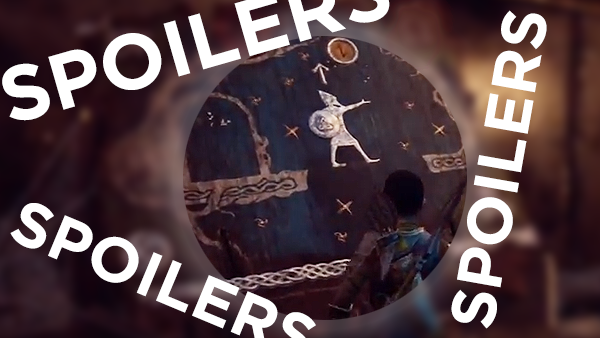
Continuing our extensive God of War coverage (you can find Ups & Downs, a full video review, Tips & Tricks AND an "Ending Explained" so far), there's a lot to talk about in terms of where the franchise goes from here.
Once again, we're dealing with SPOILERS in regards to the game's secret teaser ending, and where future games are likely to be set. Nothing more.
So, towards the end of the game you'll journey down into Odin's vault, uncovering a wooden plaque that shows the Norse God Tyr in possession of the Unity Stone, as he seems to have uncovered a way to travel between various mythologies and religions (as we now know them).
God of War's very premise is built on Kratos wandering "out" of Greek mythology and into Norse, yet this particular plaque shows not only the Greek symbol for "great" or "power" (the iconic Omega logo God of War has used for years), but also an Egyptian Eye of Horus, and another two that are incredibly exciting.
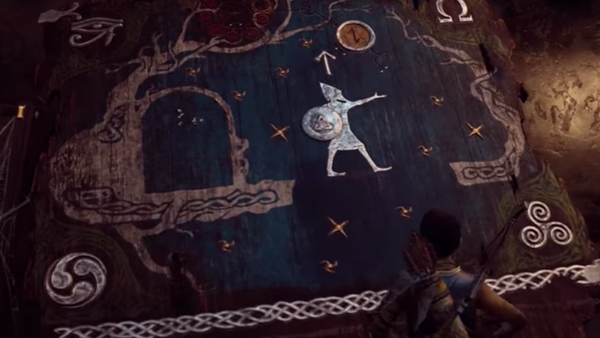
That's three potential sequels set in markedly different time periods and belief systems, alongside the game's actual secret ending that cuts to black after revealing Thor, God of Thunder.
Let's break these down.
4. Thor's Arrival & The Norse Continuation

The most likely of the sequels unless anything changes in response to the idea of using different mythologies, Sony have already confirmed the next God of War will continue the reboot's Norse setting.
God of War's secret ending - triggered by returning to the family home after the first set of credits - sees Kratos and Atreus finally get some sleep, only for "Some years later" to pop up, and a ferocious thunderstorm to wake them in a panic.
Kratos sprints outside where a hooded, Mjolnir-equipped Thor is standing, and yells, "WHO ARE YOU?!"
This is where we cut to black, as upon returning to gameplay, Atreus notes it was a dream, but that it "felt so real."
It leaves Sony Santa Monica open to experiment. They can treat this as an eventual future, giving us another interstitial game featuring Kratos and Atreus, do any number of additional titles set wherever they fancy, or leap straight in and let Thor be the main villain for the duration.
Either way, and backed by the Marvel movies making Thor a modern household name, it's great to see him here.
3. Egyptian Mythology (Eye Of Horus)
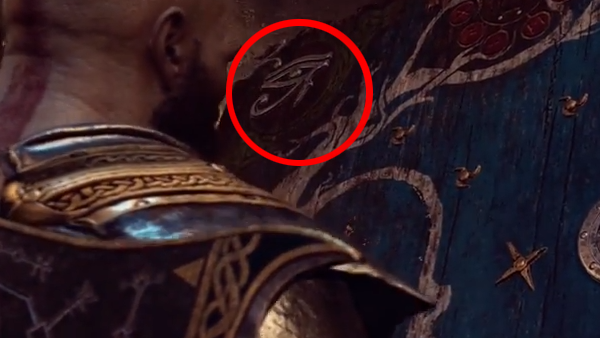
As Assassin's Creed: Origins is proving in ABUNDANCE, there is a ton of potential to mine gameplay-wise from letting us go up against Egypt's wealth of gods and deities.
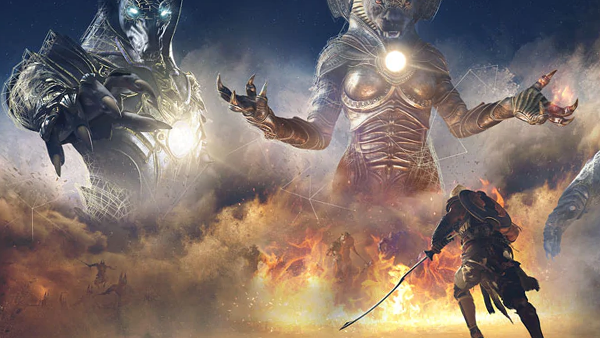
Anubis, Horus, Ra, Osiris - they're almost next in line if we're talking about sets of mythologised fables/religious figures that a wider populace is aware of.
Kratos remarks when looking at this plaque that all the symbols mean "war", but interestingly - as you'll see with the following symbols on the next pages - the Eye of Horus is supposed to represent royalty, good health and overall, protection.
In the God of War canon, Kratos and Sony Santa Monica have explored that notion of godhood and absolute power only creating oppression and suppression, under the guise of doing "what's right for the people".
Yes it was an excuse to lamp everybody in the face, but depending on how politicised the franchise wants to become in light of various real world leaders straddling that same line, it could be a fascinating way to go.
2. Celtic Christian Mythology (Triskele)
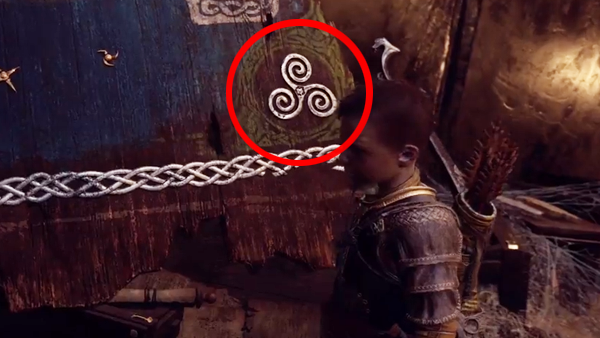
Like Far Cry 5 bringing its overblown, usually foreign shore-affiliated ways home to America, it looks like at some point, God of War might see Kratos going toe to toe with Celtic Christian history, its figureheads and that belief system in general. There are all sorts of Celtic gods, giants, faeries and everything in between - you can see a beautiful depiction of them in Tomm Moore's Song of the Sea - though they're seldom given the same coverage in popular media as the likes of Greek, Norse or Egyptian mythologies.
The above symbol itself is a Triskele, though it has appeared in MANY forms over human history. One of the earliest in Irish history was at Newgrange in Ireland, circa 3200 BC. More commonly thought of as a "Celtic spiral", a common tattoo, it represents in this case Sony Santa Monica teasing the idea of exploring Celtic mythology, fables and religion.
By far the riskiest move the franchise could take, being that the western world still takes any form of Christianity rather seriously, it does bring about the rather insane idea of, well, Kratos battering Jesus.
Bring that... on?
1. Japanese Mythology (Mitsudomoe)
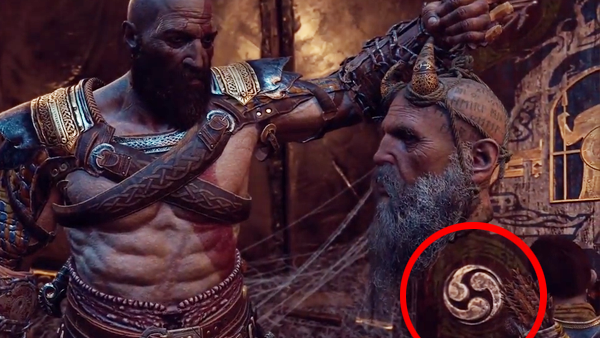
Hey Sony, if you're listening - do this one.
The above symbol is representative of Japanese mythology/religious history, and though its origins are to this day impossible to identify correctly, it is a regular fixture of Shinto shrines, the common religion in Japan. It stands as an icon of belief, peace and the cyclical nature of harmony, though enforcing such things when the Gods are literally bickering amongst themselves, is likely where a game would take place.
Interestingly, the Ryukyu Kingdom of the 15th to 19th century used this as their royal crest, and though it's highly unlikely God of War would start introducing real world elements like kingdoms and certain reigns, like the Eye of Horus, the Ryukyuans used the Mitsudomoe to represent royal blood and leadership itself.
A neat thematic tie between cultures, if nothing more.
In terms of visuals and what a God of War game set in Japanese history might look like, you need look no further than 2017's exceedingly good Nioh. Its various demons, folklore-inspired creatures and even basic enemy types were loaded with detail, symbolism and a level of care befitting of such a rich heritage and culture.
If we're staying with Shinto worship too, that's everyone from wind god Fujin, to Ryujin, the dragon god of sea and storms.
Yes, that was THE DRAGON GOD. OF SEA. AND STORMS.
Stick a Leviathan Axe in me. I'm done.