Cuphead Review: 6 Ups & 4 Downs
The hardest game of all time?

Very few games whip up the gaming populace quite like Cuphead. Created by a tiny team over at Studio MDHR, it was originally shown way back in 2013 during an indie dev showcase. Naturally, with an art style as original and vibrant as 1930s comic ephemera, all those who saw it only needed mere seconds to stand up and shout "Wait, WHAT WAS THAT?!"
Cut to 2017 and the public are having... a bit of a divisive time with the final product. At time of writing only a fraction of the player base on Xbox One have even made it out the first world. Personally speaking I'm part of the 4% who've fought the devil himself, but those are some crazy low percentages for a heavily marketed game - and something that's going to be fronting the Xbox One X's launch, no less.
Make no mistake: Cuphead is brutally unforgiving in a way that the likes of Dark Souls never came close to. At least in FromSoftware's titles you knew what was killing you and what you could've done to survive - in Cuphead there's every chance you've boxed yourself into a corner of the screen, left only to watch projectiles close in and finish you off.
With such a brick wall of challenge comes a great sense of reward, but what genuinely works and what doesn't in the full game?
Ups
6. Some Of The Best Platforming Controls In Gaming

A platformer is only as good as its control. Where games like Super Meat Boy have a little bit of 'slide' and momentum to take into account, Yacht Club's immaculate Shovel Knight lets you let off the stick and drop straight down - which is perfect when you need to make an about-face and dodge some enemy attacks.
For Cuphead it's the latter, and alongside responsive jumping and shooting is an infinitely usable dash - which can be upgraded to grant invincibility for a few frames - a duck to get some low shots in, a parry and two types of special moves.
Brilliantly, the parry is an in-air animation you trigger by bouncing off anything coloured pink (pellets, parts of enemies, environmental obstacles etc.) letting you gain an instant notch on a five point meter. This meter also builds up from dealing damage, but factor in the parry and you can burn a point to pull off a quick high-damage blast (with the starting weapon, anyway - more on them later) or save up all five for a more screen-filling spectacle.
Combined you've got a solid set of abilities to call your own, alongside such proficient weight and momentum to Cuphead's general movement that his animations are never the cause of death. That... comes from everything else.
5. Possibly The Best-Looking 2D Game Of All Time

The jury's out on whether one particular art style can ever be 'better' than another (art history dictates it cannot) but still - just look at Cuphead.
Aiming to bring the "Rubber Hose" style of animation that American cartoons popularised back in the 30s, Cuphead is the first game to ever take such an aesthetic and execute on it masterfully. The nearest comparisons to outstanding 2D visuals in gaming come from Ori & the Blind Forest, South Park: The Stick of Truth, Child of Light and Rayman Legends, but there's a genuine heartfelt depth to artist Maja Moldenhauer's work that genuinely feels unprecedented.
Simply because the entirety of Cuphead was once hand-drawn, scanned in and painstakingly animated, everything from the expressions on Cuphead/Mugman's faces to the very projectiles that come at you are bursting with personality and memorability.
It comes to something when during the fight against a whopping great dragon who spews a screen's worth of fireballs, each one is animated like a small knight gallantly marching across the battlefield with the utmost purpose, making the countless restarts almost laughable as the whole project is so damn lovable.
4. Useful Upgrades DO Help With The Excruciating Difficulty
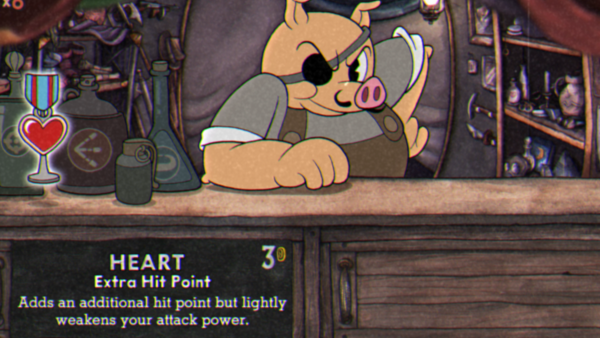
The difficulty of Cuphead is obviously its most talked about feature, but know that despite the opening slog-combo of first Run n' Gun level and boss battle being insurmountable unless you put in the time to memorise attack patterns through trial and error, there ARE some upgrades that make things a tad more palatable.
Coming from the fantastic "Porkrind's Emporium'' you can unlock additional health points (after starting with three) allowing you to take more hits before restarting - and then there are the weapon upgrades:
Cuphead starts with basic repeat-firing pea shooters (they're called as much), but quickly you'll get a short-range burst fire option, a bouncing orb, a boomerang shot that can be fired backwards to arc across the screen and - best of all - a high-damage charge shot.
Brilliantly, as the boss strategies and various run n' gun levels have such different requirements in terms of their movements, animations and hit box placement, you'll be swapping between these quite frequently. Perhaps if a boss has a noticeable 'rest period', nab the charge shot and do more meaningful damage - if their attacks arc wide, equip the burst fire, run in and really whittle down their health.
Rarely does a game actively encourage its entire repertoire through trial and error, but Cuphead's series of scenarios really do benefit from unlocking his entire moveset.
3. There Is A Simple Mode If You Need It

"A cop out!" the hardcore would've shouted, had the Simple mode still meant you could complete Cuphead.
Instead, rather than have the game's reputation be somewhat hampered by an 'easy option', the 'Simple' designation can 1. Only be chosen on boss battles, and 2. In a deliciously dark way, won't let you pick up a boss's contract to progress into the next world.
Basically, you can use the Simple mode to unlock the world you're in and practice on a boss's ability set, but you'll have to beat them on Regular if you actually want to get anywhere.
Such a great dynamic gives - debatably - enough leeway to allow those struggling with the standard setting to practice, though as I'll get to in the Downs, it doesn't get around the fact that players who are genuinely incapable of reaching such a high skill level won't see the full game.
2. Phenomenal Boss Design

Before the game was delayed and its production was rejigged to include a number of more standard platforming levels, Cuphead was designed to be a boss rush - literally a game where you go boss to boss with little in between, rather like The Game Bakers' immaculate actioner, Furi.
Thankfully, with boss battles being Cuphead's bread n' butter, they're all simply phenomenal. Ginormous perfectly-animated concoctions of devilish smiles and energy blasts, you'll battle everything from a sentient confectionery-conjuring witch to a stressed out bird who coughs eggs at you.
Each one is immediately memorable thanks to such emotive facial expressions and attack patterns - ones that will take you a good half hour or so of memorisation before you can duck, weave and strike to victory. Across my time with the game I can only recall one that was just a little bit weak (a bullet hell robot that covered the screen in energy orbs), yet the majority - from a mind bolt-throwing carrot to a fang-toothed pirate ship - are simply brilliant.
1. Painful Difficulty Means That Winning Feels INCREDIBLE

Right then, the game's difficulty will appear as an Up and a Down simply because it's so divisive, and there really are pros and cons to both sides.
First up, the positives to being constantly kicked in the teeth: It means that when you finally do surmount any given obstacle, there'll be this unique little 'David vs. Goliath' narrative you're then surmounting for the win. Like beating a Dark Souls boss after hours of agonising defeat, if you have the stomach for a game that's entirely reliant on trial and error, Cuphead has an immaculate set of animations to study and figure out.
Manage your screen space, take note of when you should've zigged last time you zagged, swap out some abilities and try again. The bosses are all meant to be intimidating, but not without weaknesses - not without specific 'paths' through phases that you'll lock-step with over time.
Each boss and level is only a couple of minutes once you actually get these paths figured out, and going from downtrodden, "*Sigh*... this is gonna take some time..." to projectile-dodging, "Yeah?! WHAT NOW?!?" is a sensation of pure, game mettle-testing elation.
Downs
4. Many People Won't Get Their Money's Worth
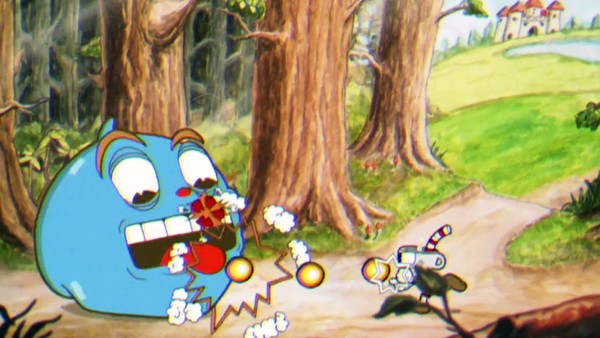
Of course, the flip-side to such a level of challenge is that some - potentially the majority - of consumers simply won't get their money's worth. As mentioned earlier, we're talking minuscule percents of people who've even made it out the first world, let alone witnessing the majesty of World 3's more OTT battles.
And that's a real, immediately felt shame.
Cuphead's visuals are one of the driving forces to see it through. You actively want to see what else Studio MDHR have conjured up. The music is just as outstanding and unique per battle as the animations and abominations you're up against - though when you're 10, 20, 50 tries in, that appeal can start to waver.
With such a realisation that the game is saying, "No, you come to me", it's a stark contrast to the hand-holding we're used to, but almost to a fault being there is nothing less than the skill level required: No cheat codes, no easy modes that carry through for the majority - nothing other than bending to the game designer's whim.
Simply put: Cuphead is such a hard and unforgiving game reliant entirely on pattern memorisation and pure motor skill, it can be unbelievably off-putting - a realisation you won't get until you've played for yourself.
3. Run N' Gun Levels Can Feel Like An Afterthought
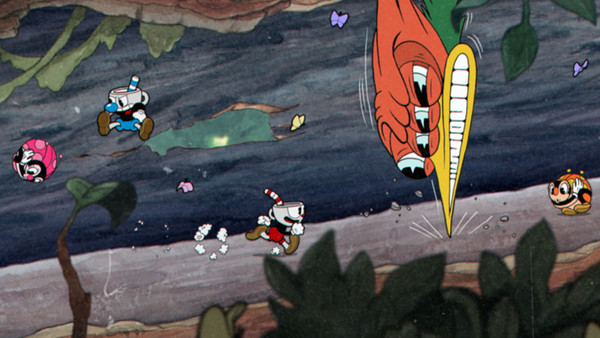
The main reason behind why we didn't get Cuphead a good couple of years ago, the devs elected to add some more standard side-scrolling platform levels to please the masses that requested them. That said, they've not done it in a way that ticks the 'mass appeal' box - rather, these Run n' Gun segments are certainly visually appealing, but outside of where you'll get coins to unlock upgrades, mechanically they feel like what they were in reality - an afterthought.
Like the boss battles, you can rattle through them in around two minutes or less, but unlike the more recognisable set-piece aspects of Cuphead, each platforming run doesn't have the requisite care and attention put into learning a 'perfect path' from beginning to end.
Instead, they fall back on peppering the screen with awkward enemy placement or showerings of projectiles to ensure you die in a particular spot. There's a more damning sense of frustration when off-screen enemies can still tag you with ranged shots, and of the handful available, many Run n' Gun levels have sections designed to force deaths until you get lucky and squeeze through.
Also telling is that completing these levels isn't required to open the next World - the final indication that even on a pure progression level, you can opt out and focus on the good stuff.
2. You Can Completely Lose Your Character In The Chaos
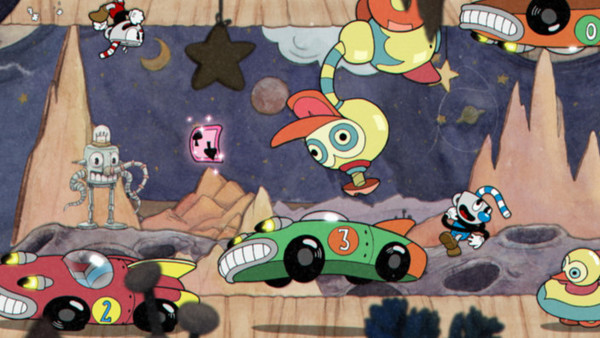
Something of a rarity, with so many projectiles, undulating enemy animations and hyper-colour design aesthetics, it is possible to completely lose track of your position on the screen.
This is especially annoying when it happens during a boss's final stage, ensuring Cuphead commits that carnal sin of all challenging video games: Making you feel like you were unfairly screwed out of success.
It really is a shame, because there's no easy solution.
Boss Grim Matchstick (the dragon) spews fireballs with obscuring smoke trails and Beppi the Clown's final phase sees the top of the screen turn into a carousel with many similar colours to Cuphead and Mugman. Factor in the reality of trying to learn attack patterns, dodge a new set of projectiles, do damage yourself and jump between platforms to stay alive, and Cuphead CAN walk a specific line of challenge, only to occasionally stumble in a truly annoying way.
1. There's An Argument To Be Made For Mis-Marketing
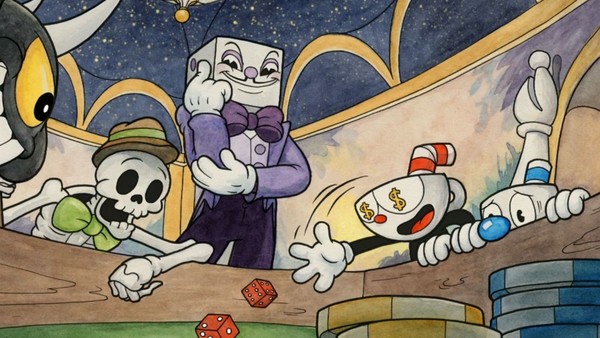
As the industry continues to pick apart the ramifications of a game so controller-shatteringly hard it belongs in the 1980s, there are a number of think-pieces emerging as to what's 'right' and 'wrong' when it comes to evoking stress in the player.
Outside of the fact that difficulty was born in arcades or through the primitive restrictions of early game design (challenge = longevity), nowhere in Cuphead's marketing is it communicated that underneath the cuddly, gorgeous and loveable exterior is something that challenges the Mega Mans and Super Meat Boys of the world as one of the hardest titles in history.
Personally I'd love it if we had a difficulty warning alongside age ratings on storefronts, rather like how many films will have an "Includes explicit scenes" disclaimer. Because both the PS4 and Xbox One are yet to offer refunds if you're unhappy with your purchase, there is a harsh reality to realising the game you've just dropped money on isn't anything close to what you think.
Honestly, what do you do if you literally don't have the mental capacity to surmount the notably hard challenge ahead?
With Cuphead and difficulty in general, yes reviewers and articles online can comment on how bad or cheap it feels, but it's a sensation you won't fully grasp until you've explored your own limits for this style of game design.