Assassin's Creed: Ranking Every Game's Story From Worst To Best
One guess which Kenway places higher.

Back when the original Assassin's Creed dropped in 2007, few could have predicted that it would become the behemoth of today. Spanning nine main titles, numerous spin-offs and over 100 million copies sold (and counting), AC has, for better or worse, made quite an impact on the video game industry.
However, just as the quality of the games have been up and down over the years, so too have the plots within. For every gripping revenge story, there's a glorified treasure hunt that fails to fully take advantage of its setting.
With Assassin's Creed: Origins hoping to give the franchise the breath of life it sorely needs, time will tell where its story will fall in terms of quality.
Will we be gifted a riveting tale, steeped in Egyptian culture? Or will it fall apart faster than Unity's online servers?
Here I'll focus on the plots of the main games, not the quality of the games overall, and there won't be any handheld exclusives or DLC included. Also, because the present-day storyline never truly rose above "merely alright," the majority of the focus will be on the tales told from within the Animus.
Note: Beware of spoilers for all Assassin's Creed games so far.
9. Assassin's Creed

The original Assassin's Creed set the groundwork for the incredibly successful franchise, featuring unique gameplay and a breathtaking setting.
It was also incredibly boring.
AC's plot never rose any higher than the absolutely threadbare, consisting almost entirely of "go here, kill him, receive lecture from Al Mualim, repeat." While setting up the assassinations were fairly interesting, the plot did little to justify them.
By the time Al Mualim was revealed as the big bad of the game, players were interested in murdering the annoying fetch-quest giver than they were in killing the main antagonist.
Say what you want about the increasingly convoluted storylines or the shoehorned historical figures in the sequels, but at least Ubisoft was making an effort with those. The fact that there is barely a plot in the original means that the first is most certainly the worst.
Altair may have had some healthy character progression, but the flat (American for some reason) monotone voice he gave everything made him less of a stoic mercenary, and more of an angsty teenager desperately trying to be edgy and cool.
It was a smart move to revamp the performance for Revelations, giving more emotional weight and depth in the character in Altair's limited scenes. Speaking of which...
8. Assassin's Creed: Revelations

Ezio Auditore da Firenze, assassin extraordinaire and legendary badass, spent the final game in his trilogy looking for some books.
Ezio was trying to unlock Altair's library in order to learn the true purpose of the assassins. This sounds like it could have been a great side quest, reminiscent of the Romulus missions in Brotherhood.
Unfortunately, this was the entire game.
From a narrative standpoint, there is some sense to this. After all, Ezio is nearing the end of his life, hanging up his hood at the end of the game. However, playing through someone's twilight years doesn't exactly equal a riveting experience.
Both Ezio and Altair are wonderfully realized, with Altair becoming a wise leader and family man, while Ezio is as great as he's always been. The supporting cast is a bit more iffy, however.
Yusuf was a fun, if expositional character. Sofia was initially interesting, but grew more grating over time. Meanwhile, Prince Ahmet was one of the most boring and forgettable villains of all time. His "big reveal" as the main bad guy was met with a resounding "Wait, who are you again?" from players.
Overall, while having more story than the original, Revelations was just an assortment of scenes surrounding a bunch of fetch quests. This is the game that was pinpointed as when the series starting going downhill for a reason.
7. Assassin's Creed: Unity

The French Revolution is considered to be one of the bloodiest and most brutal parts of European history. So, naturally, Ubisoft used the time period as a backdrop for a love story.
Unity was pretty much the quintessential example of wasted potential. Before Unity's release, many assumed that lead character Arno Dorian would play a major role in shaping how the Revolution would play out.
What gamers did not expect was a video game version of Romeo and Juliet, featuring Templars and Assassins instead of Capulets and Montagues.
Arno and his Templar compatriot Elise were both well-written characters. They have fairly decent chemistry, even if not enough of it was actually shown. All the chemistry in the world couldn't have done much to salvage the disappointment felt by players.
Assassin's Creed games are at its best when the location plays a significant role in the plot. Otherwise, what's the point of having games in historical time settings? Arno and Elise's story could have been placed anywhere in history, and it would still have worked. And that's the issue.
If the French Revolution setting wasn't absolutely vital to the story, then why use it at all? Put the star-crossed lovers in a more boring setting, and give this time period to a worthier character.
6. Assassin's Creed III

Every fan of the franchise remembers how they felt upon watching the trailer for Assassin's Creed III for the first time. The Native American hero darting through cannon fire and taking down British soldiers ignited a hype machine that could not be stopped.
The Revolutionary War was one of the most exciting ideas for a game. Participating in historical events that would help shape America was a mouth-watering prospect for many gamers. And on many fronts, AC3 succeeded at this. The player witnessed the Boston Massacre, the signing of the Declaration of Independence, and Paul Revere's Midnight Ride.
Unfortunately, all of this was done with a cast of deeply unlikable characters.
Connor Kenway, our supposed hero, is an absolute wet blanket and charismatic black hole. His mentor, Achilles, is tiresome and annoying. Historical characters such as George Washington and Paul Revere were utterly boring, with the latter providing one of the worst missions in Assassin's Creed history:
Only one of the main villains, Connor's father Haytham, comes out of the game even remotely likeable, but even he was hampered by being the playable character through AC3's absolute slog of a tutorial, ruining any goodwill he had established.
The presence of more interesting events notches this game slightly above Unity, but the characters prevent it from placing too high on this list.
5. Assassin's Creed: Syndicate

Assassin's Creed: Syndicate was the final game in the series before it went on hiatus. After the disappointment of Unity, many were unwilling to even give Syndicate a chance. Which is a shame, because it is definitely a step up.
Unlike AC3, most of Syndicate's cast is well-liked, especially the main protagonists Jacob and Evie Frye. While not on the level of Ezio or Edward Kenway, the duo were well-written and had a fascinating sibling dynamic. The main antagonist, Crawford Starrick, delightfully chewed the scenery in his every scene, making him one of the better entries in AC's rogues gallery.
The plot, on the other hand, was average.
Jacob murders his way across London and builds up his gang, while Evie searches for an artifact. While both of these storylines were done pretty well, they are as basic as a plot can get. Neither was particularly intriguing or new to the franchise, which was quickly running out of ideas.
While London was a gorgeous setting, the industrial revolution didn't quite have the same amount of interest as, say, the Italian Renaissance or the French Revolution.
Assassin's Creed has had its ups and downs in the past 10 years. Syndicate represents its exact middle of the road.
4. Assassin's Creed: Brotherhood

Ezio's Revenge: Part 2 may not have been as enthralling as the original, but Brotherhood provided one of the better stories in series.
No longer learning the ropes to become an assassin, Ezio starts his journey on an unbelievable high, successfully preventing Rodrigo Borgia from gaining control of several pieces of Eden. It doesn't take long for all hell to break loose, resulting in an awe-inspiring destruction of Ezio's village and the murder of his Uncle Mario.
It's easy to feel Ezio's desperation as he attempts to start a new life, his old one shattered by his own mistake to not kill Rodrigo. With a crumbling Rome providing an interesting parallel to Ezio's own struggles, he gradually tries to rescue the once great city from the oppressive rule of the Templar Order.
The supporting characters are also quite good here, ranging from the tough Claudia, to the mysterious Machiavelli, to the always excellent Leonardo da Vinci. Cesare Borgia is a fascinating, power-hungry villain, providing a much better foil and final fight for Ezio than his father did.
The big gripe with Brotherhood is that it feels fairly familiar. Ezio taking revenge on the people that killed his family was also the plot of his previous adventure. Then again, anything taking place after the excellent Assassin's Creed II was always going to be a disappointment anyway.
3. Assassin's Creed IV: Black Flag
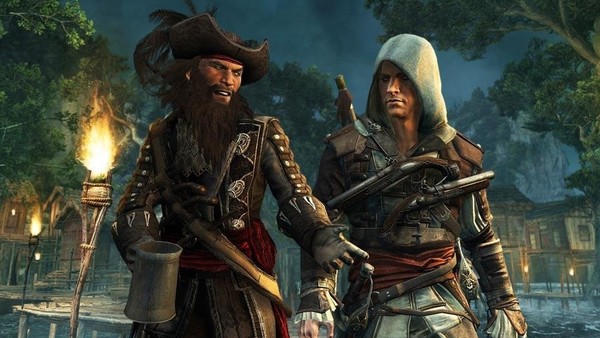
Pirates!
That may as well have been the entire marketing strategy behind Black Flag. Gone were the morally upright protagonists (as morally upright as one can be while being an assassin anyway), and replaced with Edward Kenway, easily the best member of the Kenway family.
Edward's journey from rapscallion to genuine hero is incredible, full of twists and turns and shocking betrayals. Black Flag manages to consistently surprise players in its story and its characterization of Edward. His newfound assassin position frequently clashes from his greedy pirate ways, providing one of the most layered characters in the entire franchise.
Characters are where this entry shines the most. Although the villains may not be terribly interesting, the likes of Blackbeard, Mary Read, and Adéwalé in particular all contribute to Black Flag's rich supporting cast.
Additionally, the game has the best ending in the entire series, with a genuinely touching tribute to fallen characters set to The Parting Glass, and Edward sailing off into the sunset with his daughter Jennifer. That's without mentioning the easter egg ending, introducing Haytham Kenway in the very theater that he would later overthrow the Assassin's Brotherhood in.
Who would have thought that one of the greatest pirate games of all time would be in the Assassin's Creed franchise?
2. Assassin's Creed II

Considered by many to be the single greatest entry in the Assassin's Creed series, Ezio Auditore's revenge story is one worthy of a show on HBO.
Starting the game with Ezio as a baby may have seemed like a weird decision at the time, but allowing players to watch Ezio grow from child to angry teenager into sage assassin instantly made him one of the greatest characters in all of video games. It is not often that a game allows a player to fully immerse themselves in the life of their protagonist.
Ezio's emotional journey in unraveling the conspiracy that destroyed his family only grows more and more intriguing with each passing sequence. The final reveal that the main villain became The Pope and defeating him required infiltrating the Vatican sent chills down the spine of every player.
Ezio is a compelling lead surrounded by an equally compelling cast. Each assassination target comes with a different personality and a unique motivation. While it is a little silly that every person that helps Ezio throughout the story turns out to be an Assassin, each ally comes into their own as a fantastic character, particularly Leonardo da Vinci.
It was thought for years that Assassin's Creed could never top the story in its second entry. That was until...
1. Assassin's Creed: Rogue
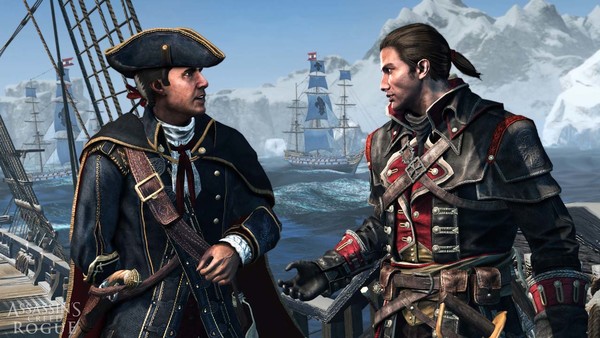
The one where the franchise went in a completely new direction.
After years of the black and white scenario of Assassins = Good, Templars = Bad, Rogue turned this entire idea on its head by revealing the fact that it's not so simple. This was no longer a battle between good and evil, but rather a clashing of two distinct ideologies.
Is it better to have freedom, or safety?
In a series that has grown increasingly stale, Rogue manages to be the best by doing something completely different. The main foe of the entire franchise was suddenly humanized beyond "we are evil just because."
Shay turning on his Assassin brethren is given a reason in the single greatest set piece in the franchise's history. With it was the realization that each of the friends and allies Shay had in the beginning of the game were now his sworn enemies and future assassination targets.
Fan favorites such as Haytham and Adéwalé both return here, the former as a fleshed out mentor, the latter as a reluctant foe. Despite going up against the "heroic" assassins that had defined every other game in the franchise, Shay easily comes across as the most sympathetic. It's really a shame that the franchise hasn't done more with the Templars.
Despite flying under the radar due to Ubisoft's bizarre decision to release this game concurrently with Unity, Rogue deserves a second look as the greatest story in the Assassin's Creed franchise.